
Project Parameters
| Parameter | Value |
|---|---|
| Process route | Pretreatment + plate-type MVR forced-circulation evaporation crystallization (BOO model, two-phase build) |
| Industry | Natural gas field produced water desalination (China) |
| Feed type & key components | Gasfield produced water: high TDS brine with hardness and hydrocarbon carryover |
| Evaporation capacity | 1,600 t/d total (phase I 600 t/d + phase II 1,000 t/d); 40 t/h single-train plate MVR blocks |
| Construction materials | Plate heat exchanger bodies; forced-circulation crystallizer circuit (alloy per service, indicative) |
Representative process configuration compiled from published industry project data. Indicative values, not a process guarantee.
Project Description
China’s onshore gas provinces have turned produced water from an afterthought into the binding constraint on wellpad economics. Discharge limits on oilfield water have been tightening year over year — COD ceilings on oilfield effluent dropped toward 50 mg/L in the 2025 regulatory round — and injection capacity in several basins is either unavailable or already committed. The result is a procurement shift: operators now buy produced water capacity as a service, and BOO plants are financed against long-term tonnage.
The representative configuration is exactly that: a two-phase BOO facility treating 1,600 t/d of gasfield produced water, phase I at 600 t/d and phase II adding 1,000 t/d with startup of the second phase in January 2024. The plant processes the field’s produced brine to two sellable outputs — water and salt — and its economics depend on both.
Process Technology
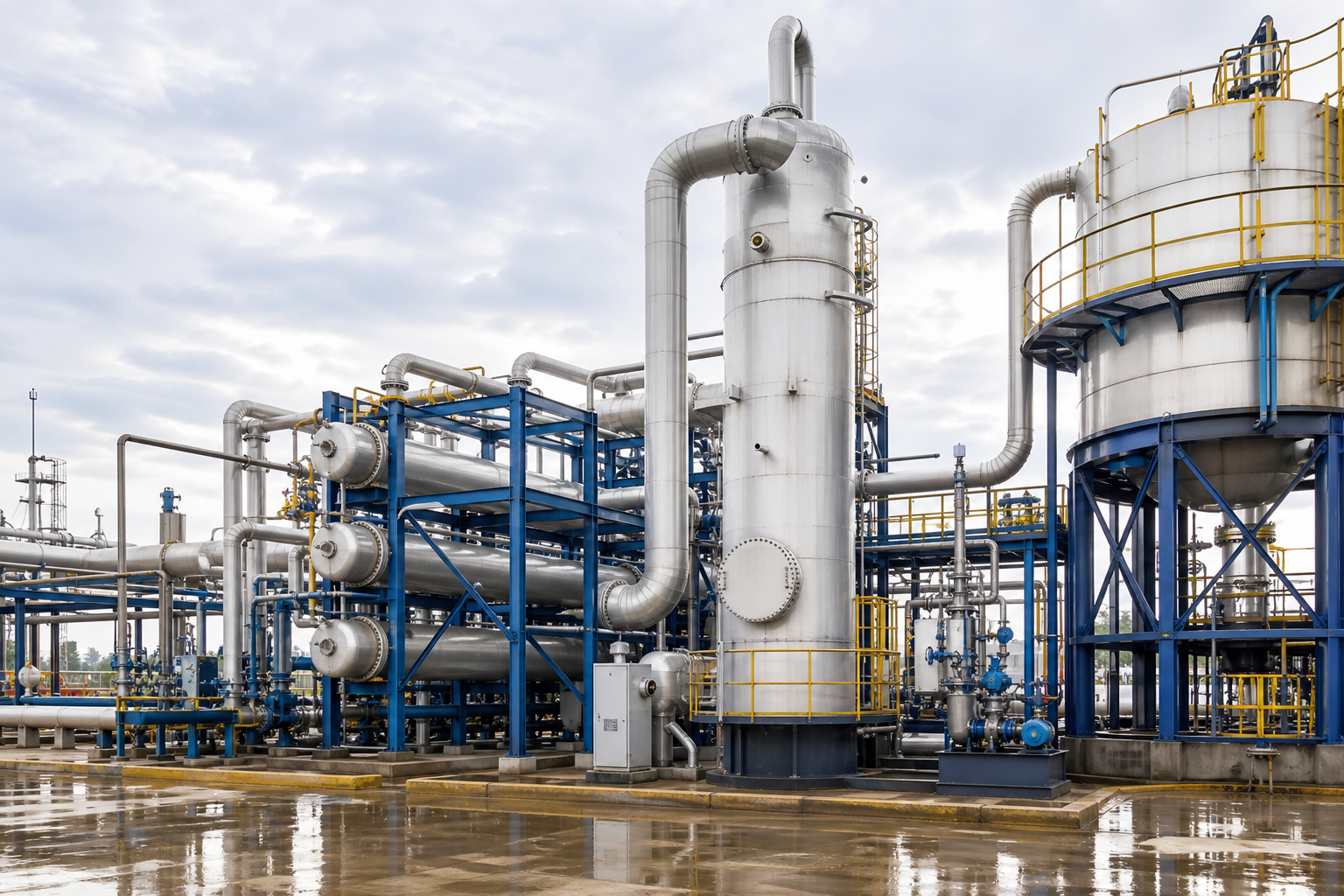
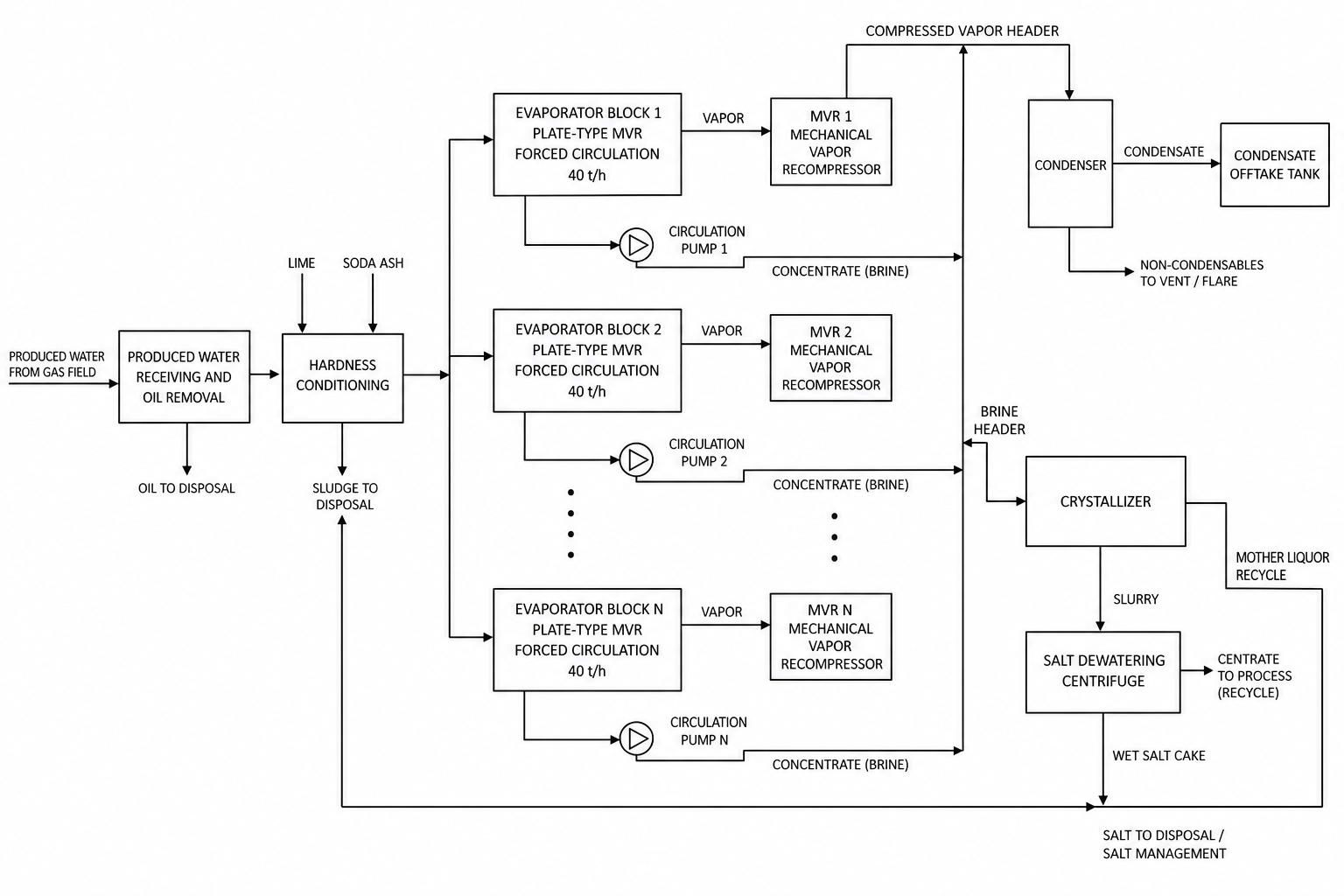
The train is organized around 40 t/h single-train plate-type MVR evaporator blocks. Each block concentrates produced brine in a forced-circulation loop through plate heat exchanger bodies: liquor is pumped through the plates at high velocity, boiled under vacuum, and the vapor is recompressed electrically by the MVR compressor to drive the next pass. Building the plant from repeated 40 t/h blocks is what made the two-phase BOO structure simple — phase II duplicates proven trains rather than redesigning the flowsheet.
Plate versus shell-and-tube is the load-bearing selection here. Plate bodies carry a substantially higher heat transfer coefficient than tubular equivalents at the same duty, which shrinks the heat transfer area and the building for a given capacity; on a remote gasfield site, footprint and erectable-modularity are money. The published basis for this plant class reports plate-type MVR at noticeably higher transfer efficiency and lower plot size than the tubular alternative, with the forced-circulation loop raising tolerance to scaling and fouling by a multiple in continuous service — the property that matters most in a brine that carries hardness and hydrocarbons.
Pretreatment ahead of the evaporators conditions the produced water: oil and solids removal and hardness management keep the plate surfaces clean for their full service interval. In the crystallization endgame, salt grows in the forced-circulation circuit and is dewatered to GB/T 5462-2015 grade-1-or-better wet industrial salt under the reference configuration — a product with a buyer, not a landfill liability.
Condensate leaves the train as the plant’s second product: the reference configuration reports treated water clean enough for external reuse offtake rather than disposal. For a field whose alternative was deep-well injection, the water balance itself is revenue.
Equipment Configuration
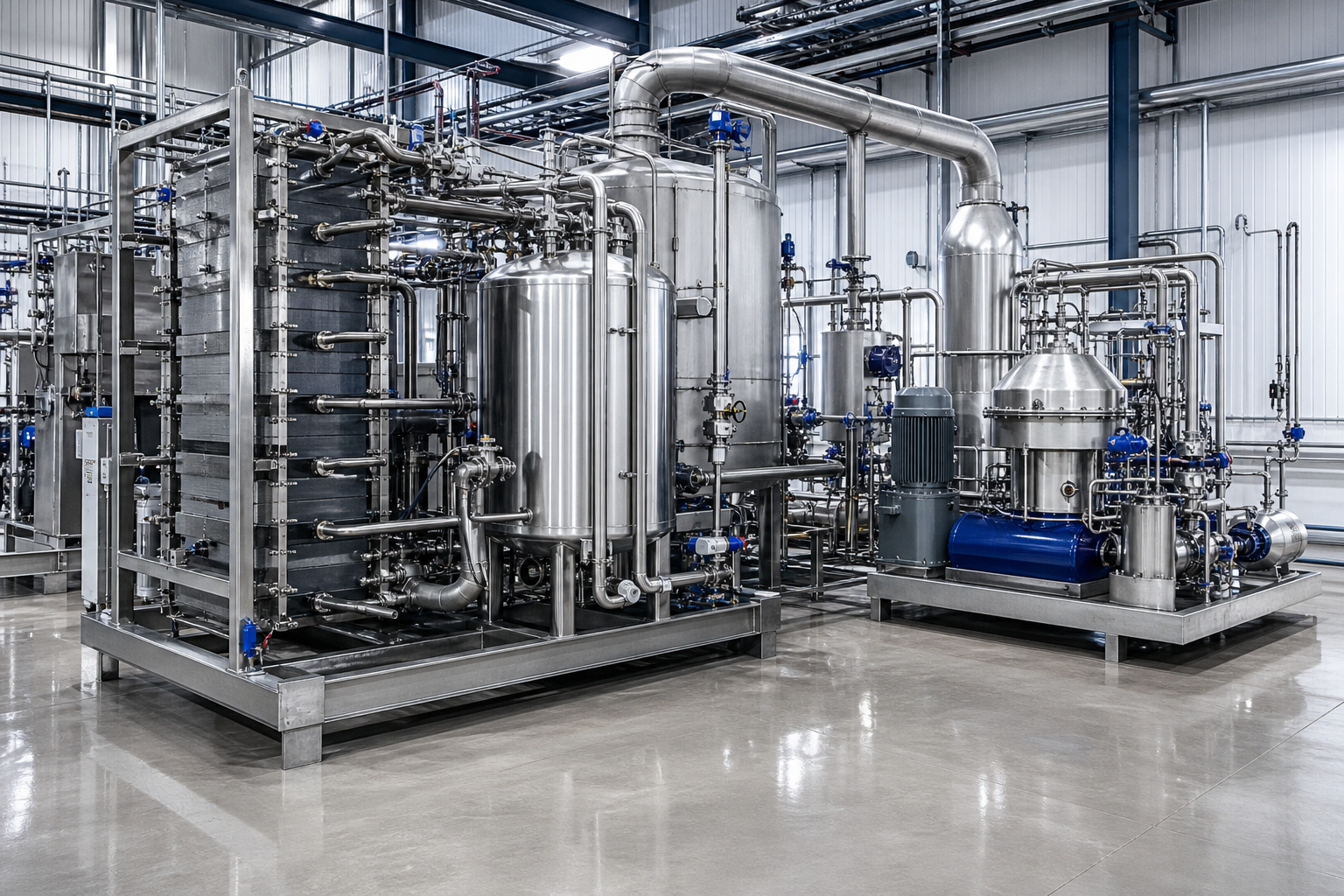
One set of the following equipment is typical for this duty:
- Produced water receiving, oil removal and hardness conditioning
- 40 t/h plate-type MVR forced-circulation evaporator blocks (repeat trains)
- Mechanical vapor recompressors with clean-in-place provision
- Forced-circulation crystallizer circuits with salt dewatering to GB/T 5462 product
- Condensate polishing and offtake for external reuse
- DCS supervision of train blocks, densities and salt quality
Performance & Outcome
Compiled from published industry project data, indicative: two-phase BOO plants of this class reach 1,600 t/d on repeatable 40 t/h plate MVR trains, recovering grade-1 wet industrial salt and reuse-grade condensate while holding scaling tolerance through forced circulation. Specific energy, salt grade and water offtake terms are quoted per project contract.
Simplified PFD
The simplified process flow diagram above shows produced water conditioning, the repeatable 40 t/h plate MVR forced-circulation blocks, salt dewatering and condensate offtake.


