
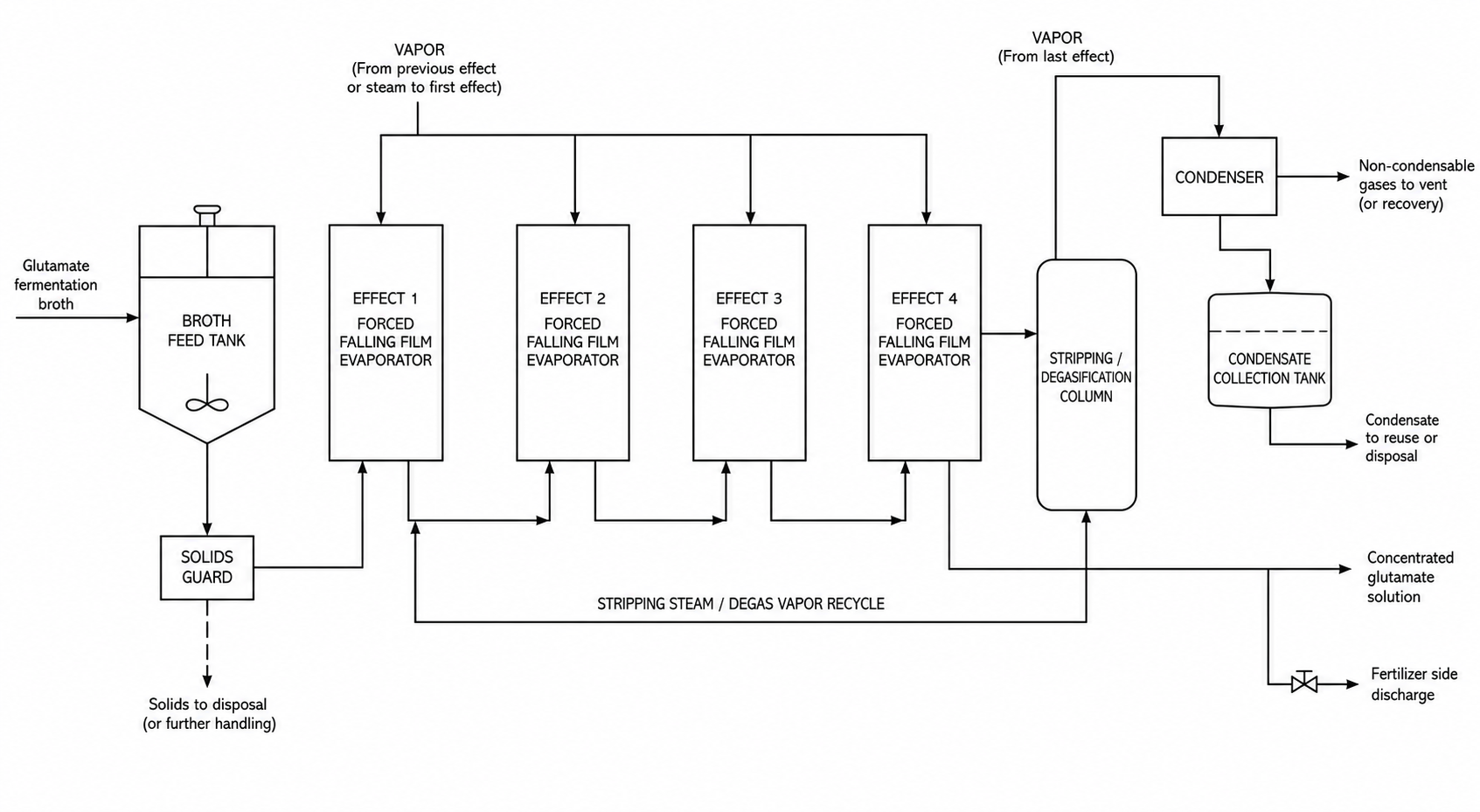
Project Parameters
| Parameter | Value |
|---|---|
| Process route | Four-effect forced falling-film evaporation with deammoniation |
| Industry | Fermentation — glutamate / compound fertilizer integration |
| Feed type & key components | Glutamate fermentation broth; dissolved ammonia, amino-acid organics |
| Evaporation capacity | 60 t/h |
| Plant context | Compound-fertilizer integration project of a comprehensive industrial base |
| Region | Xinjiang (Wujiaqu), Northwest China |
Representative process configuration compiled from published industry project data. Indicative values, not a process guarantee.
Project Description
Where glutamate is fermented at scale, the surrounding industrial base looks for the highest-value home for every stream — and in Xinjiang, that home is fertilizer. The published project behind this configuration belongs to the compound-fertilizer block of a comprehensive industrial complex: a 60 t/h evaporation train concentrating glutamate fermentation broth with deammoniation, turning a fermentation intermediate into concentrated feedstock for the fertilizer side of the same site.
The pairing is chemistry-driven. Fermentation broth from glutamate production carries nitrogen in exactly the forms fertilizer wants — amino nitrogen and ammonium — but diluted in the water the fermenters pumped in. Concentrating the broth sixty tonnes an hour while stripping its dissolved ammonia does two jobs for the fertilizer plant at once: it densifies the nutrient stream into a form the fertilizer process can absorb, and it recovers the ammonia separately as a controlled nitrogen input rather than a volatile loss.
Process Technology
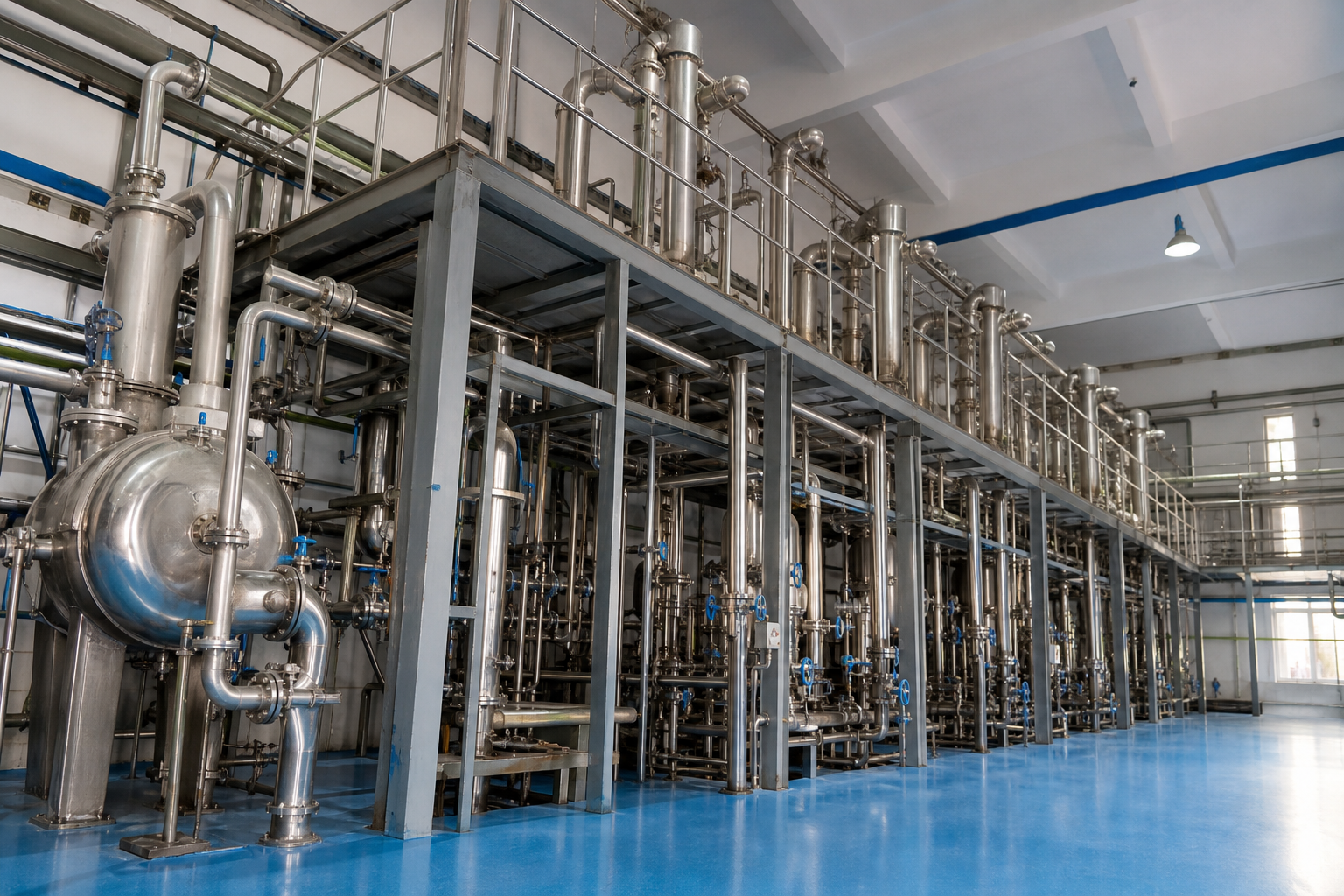
The train is published as four effects in forced falling-film form. The “forced” prefix is the engineering answer to fermentation broth: unlike refined syrup, broth arrives with cells, proteins and dissolved solids that challenge a pure gravity film. Forced falling-film operation — pumped distribution feeding a calibrated film — maintains tube wetting and film integrity at the higher viscosities and fouling tendency broth brings, while keeping the short hot-surface residence that protects amino-nitrogen from degradation.
Four effects stage the heat economy: live steam drives the first effect, each subsequent effect runs at lower pressure on the previous effect’s vapor, and the surface condenser closes the chain at the vacuum end. Vacuum staging holds the broth inside its thermal window across all four bodies — the same window discipline every amino-acid duty applies, with the stakes higher here because the product is destined for fertilizer nutrient accounting, not just downstream purification.
Deammoniation threads through the effects as it does in all amino-acid broth duties: pH management in the feed shifts ammonium toward free ammonia, the first effects’ vapor carries it out preferentially, and the condensing side segregates the ammonia-bearing condensate from the clean back-end condensate. The ammonia water collects as a stream the fertilizer block can dose; the clean condensate returns to the site water balance.
Concentrated broth discharges at the fertilizer-side feed density under inline control. Between campaigns the film distributors and separators clean in place — broth residues are protein-rich and unforgiving of skipped washes — and the train’s turndown accommodates the fermentation side’s batch rhythm, because a fertilizer-integration train lives on the fermentation schedule of its supplier.
Equipment Configuration
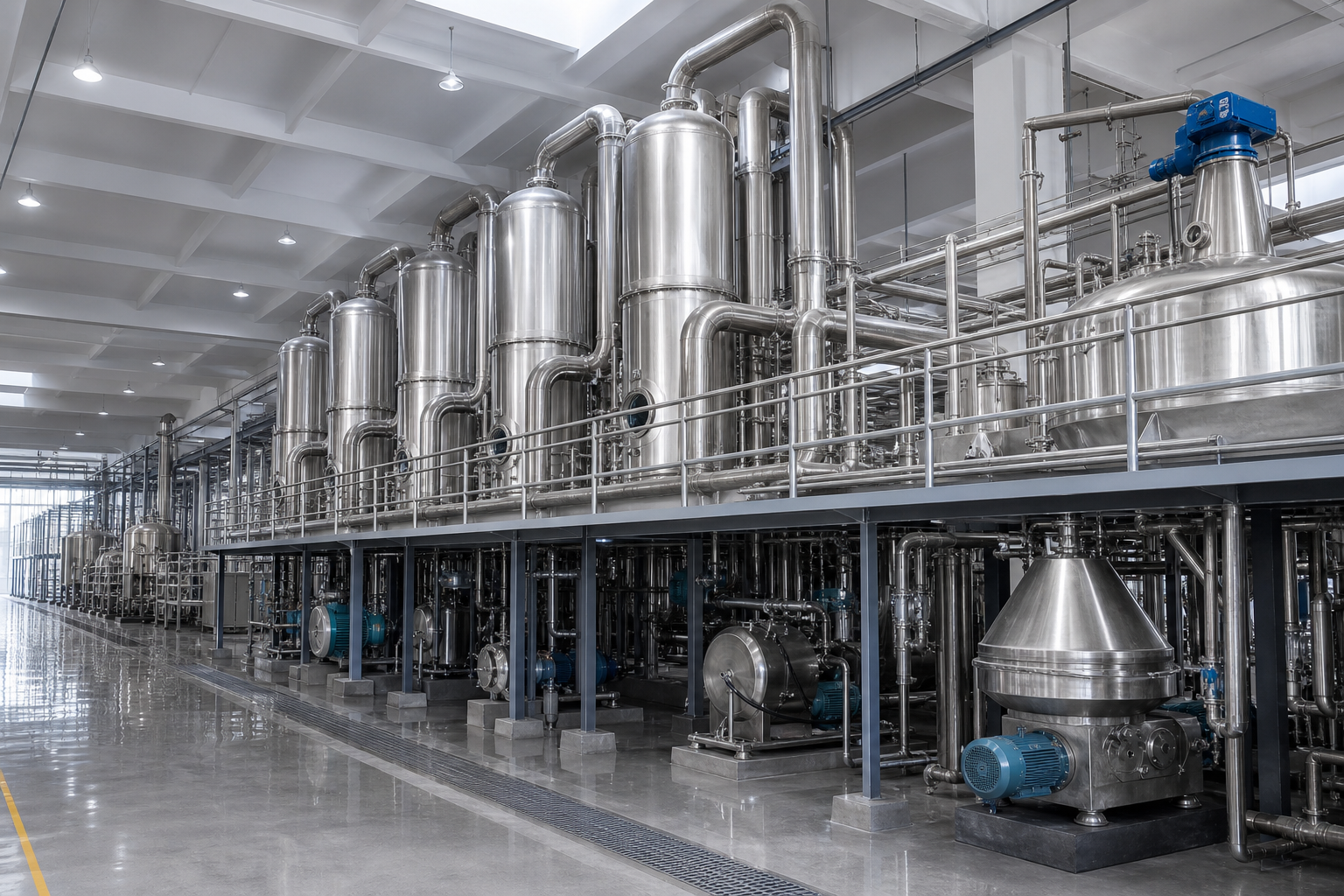
One set of the following equipment is typical for this duty:
- Fermentation broth feed tank with solids guard
- Four-effect forced falling-film evaporation train with vacuum staging
- Pumped liquid distribution for film integrity on broth service
- Deammoniation circuit: pH-managed feed, segregated ammonia-bearing condensation
- Ammonia-water collection for fertilizer-side nitrogen dosing
- Surface condenser and vacuum system; clean condensate return
- PLC control with density-based discharge and CIP
Performance & Outcome
Compiled from published industry project data, indicative: trains of this class concentrate 60 t/h of glutamate broth at four-effect steam economy with ammonia directed to a segregated recovery stream, feeding fertilizer integrations with dense nitrogen-bearing feedstock. Nutrient recoveries and energy figures are quoted per project broth specification.


