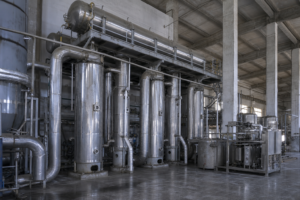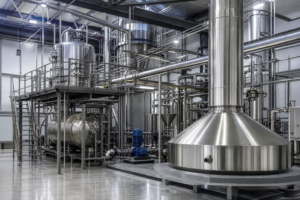
In a sugar beet factory, evaporation is the process: thin beet juice leaving purification must be concentrated several-fold into the high-brix thick juice that feeds the sugar crystallization pans, and the energy spent on that concentration is the factory’s largest single utility load. The modern solution is a falling-film MVR evaporation station. The juice circulates through the heating tubes while boiled-off secondary vapor is drawn in by a turbo compressor fan, pressurized, heated and returned to the heating chamber as the driving steam — so once started, the station generates no additional steam beyond start-up and compresses essentially all the latent heat of the secondary vapor into reuse. In vendor-published reference projects for the Chinese sugar industry (external industry references, not EvapCryst deliveries), this architecture runs at 12 t/h on molasses-based alcoholic wastewater and 50 t/h on purified syrups and residues, applied across four duty modes: evaporation and concentration, evaporation crystallization, low-temperature evaporation and drying.
The Duty: From Thin Beet Juice to Thick Syrup
A beet campaign starts with diffusion — sliced beet cossettes are counter-currently extracted with hot water to pull sucrose into what becomes raw diffusion juice. That juice carries non-sugar impurities: it undergoes purification (liming and carbonatation) to remove non-sugar components and neutralize acidity, increasing its purity before it reaches the evaporator. The purified thin juice is a dilute sugar solution; the crystallization stage that follows needs a concentrated syrup. Between those two states lies the evaporation station — historically the multi-effect evaporator bodies fed by boiler house steam, and increasingly a mechanical vapor recompression train that buys the same water removal for a fraction of the steam.
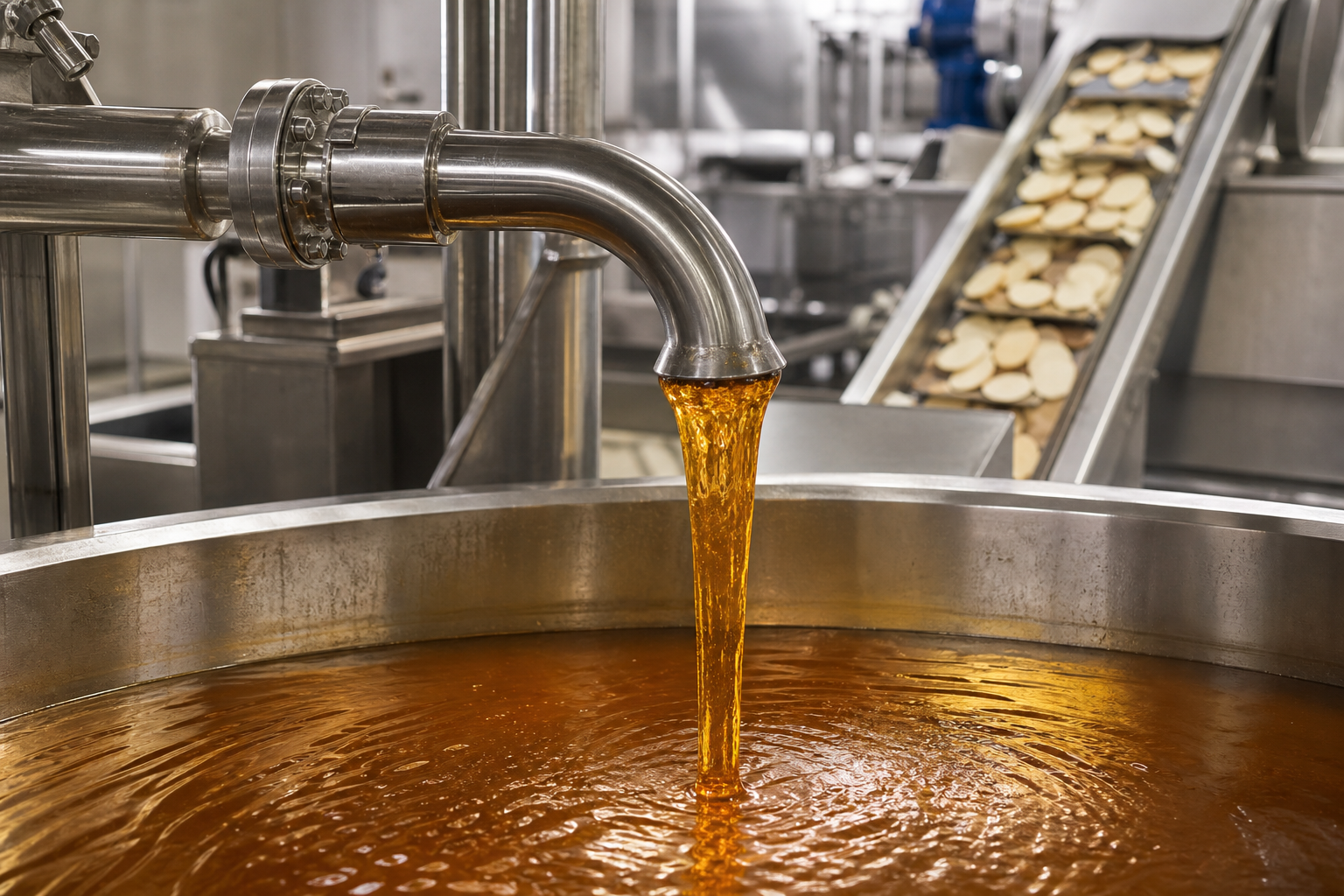
Beyond the main juice duty, a beet factory generates three more concentration tasks over a season: molasses-derived alcohol (vinasse) wastewater from on-site fermentation, purified syrups and pressed residues, and the low-temperature evaporation needed for heat-sensitive streams. A single MVR technology family covers all four.
Why Beet Juice Is a Demanding Evaporation Medium
Sugar liquors punish naive evaporator design in four specific ways:
| Property | Consequence for evaporation | Design response |
|---|---|---|
| High viscosity | Beet juice is typically viscous; viscosity climbs steeply with brix and with falling temperature | Falling-film tubes with liquid distributors sized for viscous films; generous circulation |
| Thermal sensitivity | Sucrose inverts and color bodies form at high temperature and long residence time | Low-temperature operation under vacuum; single-pass film evaporation with seconds of residence time |
| Scaling | Calcium salts and scale-formers surviving purification deposit on hot tubes | Small temperature approaches; scheduled cleaning; polishing of purification ahead of the station |
| Steam economy criticality | Evaporation dominates the factory energy balance | MVR vapor recycling instead of live steam consumption |
Falling-film geometry answers the first two directly: the liquor flows as a thin film down the inside of the tubes, wetted by a circulation pump, so heat transfer happens in seconds rather than the minutes a flooded calandria imposes, and the low holding volume limits sugar degradation and color formation.
How the Falling-Film MVR Station Works
The cycle, as applied in those vendor-published reference projects: the solution is circulated through the evaporator by a material circulation pump, distributed as a film inside the heating tubes. Fresh steam outside the pipes provides the initial heat to start boiling. The secondary vapor produced inside the tubes is drawn off and compressed by the MVR turbo compressor fan; after supercharging, its temperature and pressure rise, and it is routed back into the heating chamber as heating steam for continued circulation evaporation. From that point the loop is closed — the compressor keeps recycling the vapor it inhales, the evaporated water finally condenses and is discharged as hot condensate, and the station consumes essentially no additional steam beyond start-up.
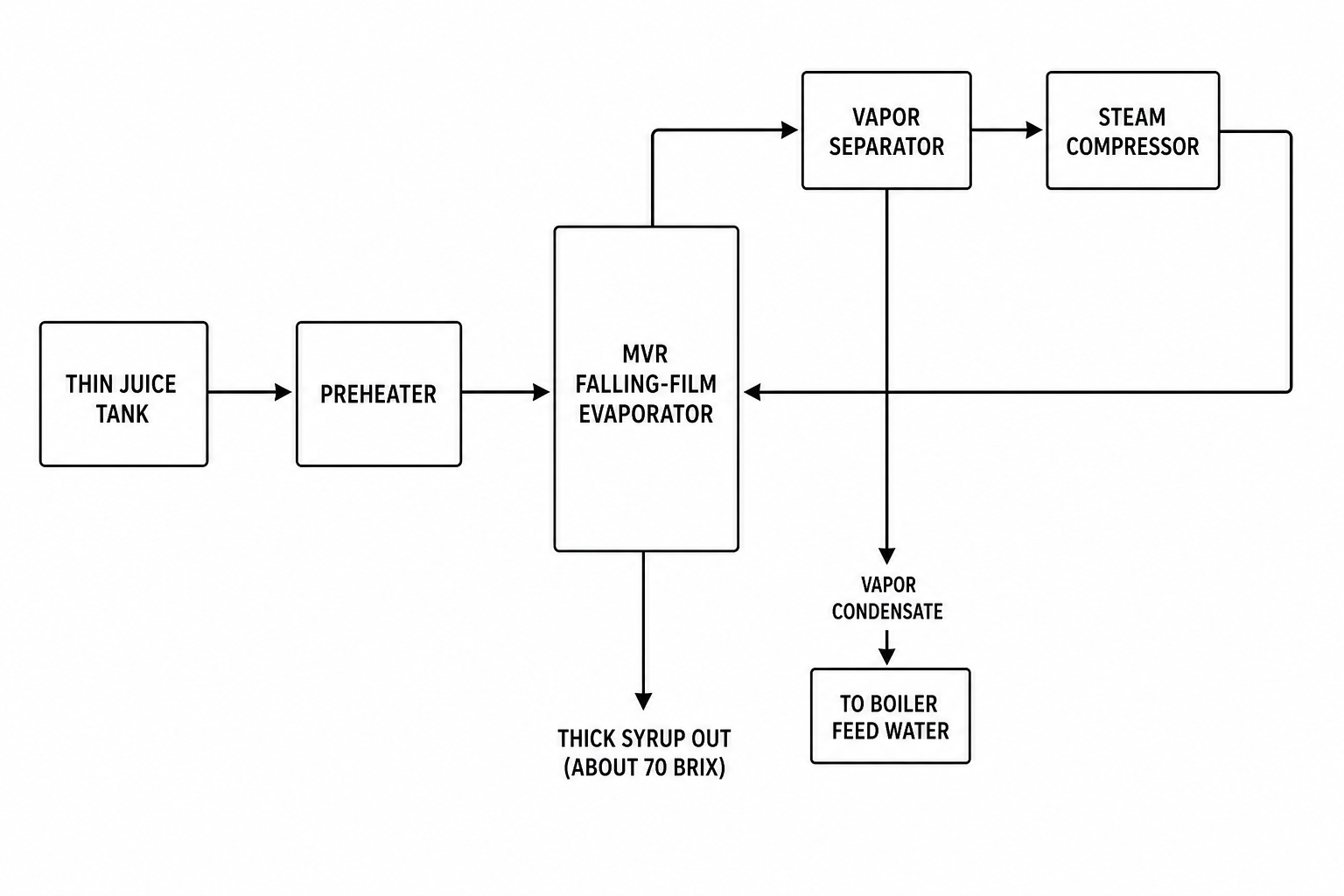
The energy logic is that the MVR evaporator compresses all the latent heat of the secondary vapor and puts it back to work, achieving high energy utilization per ton of water removed. Where a five-effect evaporator chain burns steam to create its temperature ladder effect by effect, the MVR station creates its temperature lift once, mechanically, in the compressor. The falling film evaporation technology page details the film hydraulics; the MVR evaporation page covers compressor selection and the vapor loop.
| Module | Candidate Equipment Types | Selection Rationale | Indicative Operating Envelope |
|---|---|---|---|
| Falling-film evaporation bodies | Tubular falling-film calandrias | Seconds residence protects sugar quality | Low-temperature operation under vacuum |
| MVR compressor fan | Centrifugal turbo fan | Recompresses secondary vapor as heating steam | Closed loop after start-up |
| Liquid distribution and circulation | Engineered distributors, circulation pumps | Keeps every tube wetted across campaign viscosity | Early thin juice to late high-brix syrup |
| Vapor loop and condensate system | Vapor piping, condensate segregation, hot-water routing | Turns the station into the factory water hub | Condensate to boilers, diffusion, juice heating |
| Pan heating and drying integration | Crystallizer heating, heat-pump drying tie-in | Extends MVR economics beyond the evaporator | Supersaturation control and by-product drying |
Configuration, materials, and operating ranges depend on the actual feed, brix and viscosity range, fouling behavior, site utilities, and project capacity.
Four Application Modes of MVR in a Sugar Factory
The MVR evaporator in the sugar industry has four application methods, and a well-planned factory uses several of them:
1. Evaporation and concentration. The core duty — thin juice to thick syrup, or vinasse and syrup-residue concentration. Continuous, high-capacity, quality-neutral water removal.
2. Evaporation crystallization. Where the concentrated liquor is driven into the sucrose or by-product salt crystallization zone, the MVR train works as a crystallizer heater, holding supersaturation steady in the pan while recycling the vapor boiled off the massecuite.
3. Low-temperature evaporation. Heat-sensitive streams — thick juice polishing, certain molasses fractions — are evaporated under vacuum at reduced boiling temperature, protecting color and avoiding sucrose inversion. MVR makes low-temperature evaporation economical because the compressor supplies the temperature lift electrically.
4. Drying. MVR heat pumping integrates with the drying of pulp, filter cake and by-products, upgrading waste vapor heat to drying duty rather than venting it.
Reference Project Parameters
An externally published project for the Chinese sugar industry, cited as a vendor case and external industry reference (not an EvapCryst delivery; figures indicative, not a project guarantee), combined two duties on one site, designed under GB standards:
| Item | Duty A | Duty B |
|---|---|---|
| Project | Alcoholic wastewater treatment | Purified syrups and residue treatment |
| Location | China | China |
| Evaporator capacity | 12 t/h | 50 t/h |
| Process | Evaporation and concentration | Evaporation and concentration |
| Raw material liquid | Alcoholic wastewater | Purified syrups and residues |
| Industry | Sugar | Sugar |
| Design standard | GB | GB |
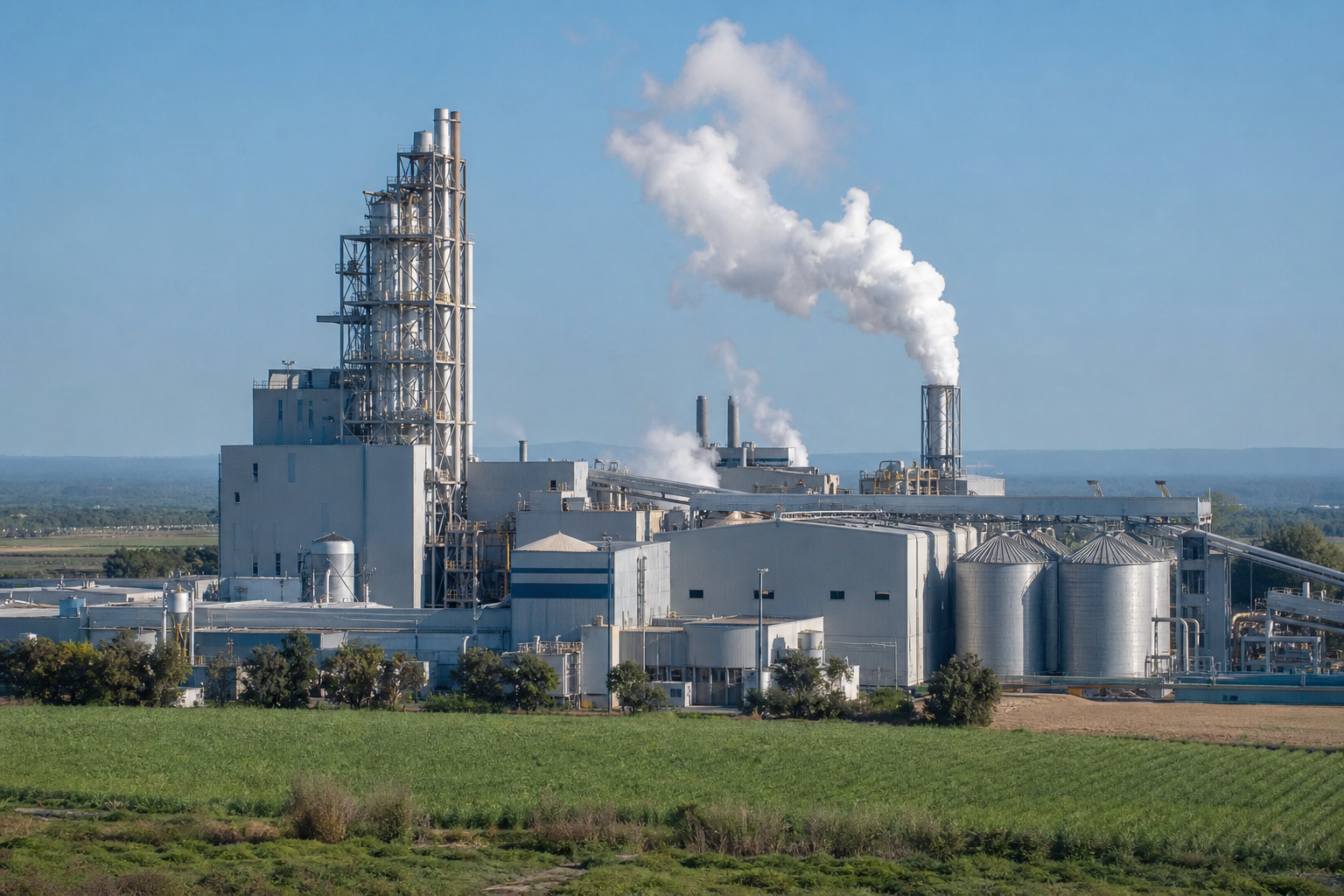
The pairing is instructive: the same technology that concentrates a factory’s main product syrup also cleans up its fermentation wastewater. The alcoholic (vinasse) stream from molasses fermentation is a high-COD, high-viscosity liquid whose volume makes disposal expensive; concentrating it cuts hauling cost, enables by-product use (potash-rich animal feed additive or fuel), and returns condensate as process water. The purified syrup duty at 50 t/h represents the mainline product side of the same site.
Energy: Closing the Vapor Loop
Sugar factories evolved elaborate steam economies because juice evaporation is so costly — turbine exhaust steam, multiple effects, thermocompressors, vapor bleeding to juice heaters and pans. An MVR station plugs into this economy as a steam generator in effect: every ton of water it evaporates electrically is a ton of boiler steam freed for other duties, or boiler capacity never built. During the campaign months, when the factory’s fuel balance is tightest, the MVR station effectively sells the plant steam it no longer burns. Payback tracks the local electricity-to-steam cost ratio; our MVR versus multi-effect energy cost comparison tool models the crossover for your own tariffs.
Design Considerations for Beet Service
Liquid distribution. Falling-film performance lives or dies on uniform tube wetting. Viscous juice at high brix demands distributors and top separators engineered for the full viscosity range of the campaign, from early-season thin juice to late-season concentrated syrup.
Color and thermal degradation. Film temperatures and residence times are held low; vapor temperatures after compression are selected so the heating surface never overshoots the color budget of the sugar spec.
Scaling management. Despite good purification, calcium scale accumulates. Cleaning-in-place cycles are planned into the campaign calendar, and heat transfer area carries margin for the intervals between cleans.
Retrofit versus greenfield. In existing factories the MVR station often replaces the first one or two effects of an old multi-effect train, with the remaining bodies repurposed as finishers — a staged retrofit that limits capital exposure while capturing most of the steam saving.
Condensate and water balance. The vapor condensed on the shell side leaves as clean, hot water. In a beet factory this condensate is worth managing deliberately: it can return to the boilers as make-up quality water, to diffusion and beet washing as process water, or to juice heating duties. Designing the condensate routing — including segregation of first-condensate fractions where trace organics concentrate — turns the evaporation station into the factory’s water hub, not just its steam saver. Done well, the station closes most of the site’s water balance during campaign.
Where This Fits in a Food-Processing Water and Energy Strategy
Beet sugar is one member of the food and fermentation evaporation family. Starch and sweetener plants face analogous duties — see starch, syrup and sweetener evaporation solutions; sugar-alcohol derivatives such as sorbitol and erythritol are covered under sugar alcohol evaporation and crystallization; and the vinasse side of the sugar-alcohol complex has its own page on vinasse and molasses distillery wastewater MVR treatment. The full vertical is framed on the Food, Fermentation and Bioprocessing evaporation program page.
When This Route May Not Fit
MVR juice concentration assumes the factory energy map rewards electrification. Sites with cheap cogeneration steam or abundant bagasse fuel may find multi-effect evaporation fed by turbine exhaust the lower-cost answer, exactly as the sugar industry did for a century. Campaign-only operation, three to five months per year, stretches payback and must be modeled on seasonal hours, not 8,000-hour assumptions. Very old factories with constrained electrical supply may not host a compressor train without a substation upgrade. Where purification is poor, calcium scaling punishes any evaporator, and fixing purification comes before recompression capital. Vinasse duties with extreme viscosity or high fouling may need forced-circulation finishing rather than film evaporation alone. Beet-specific economics also differ from cane: no bagasse fuel credit exists at a beet factory, which can cut either way on the electrification case.
What Must Be Verified
A beet evaporation project should verify the campaign reality before equipment is sized. Required checks: thin-juice characterization across the season (brix range, viscosity curve, color precursors, scaling ions surviving purification) because early and late campaign juices are different feeds; electricity-to-steam cost ratio on seasonal operating hours; electrical capacity for the compressor; purification performance and its calcium slip, which sets CIP frequency and area margin; and condensate routing options against the factory water balance. Sugar-quality targets such as color and inversion limits should be contractually defined against measured film temperatures, and vinasse duties need fouling trials at final concentration. For retrofit stations, tie-in windows and the repurposing plan for remaining effects belong in the verification scope.
Frequently Asked Questions
Can MVR replace the multi-effect evaporation station in a beet sugar factory?
Yes, in whole or in part. The MVR station takes over the bulk water removal electrically, and existing effects are often repurposed as finishers. After start-up the MVR loop needs no additional steam, freeing boiler capacity for pans, dryers and juice heating.
Does evaporation damage sugar quality?
Not when done as falling-film MVR. The juice spends seconds as a thin film at low temperature, so sucrose inversion and color formation are minimized compared with long-residence flooded bodies. Low-temperature evaporation mode under vacuum is used for the most heat-sensitive streams.
What was concentrated in the reference project?
Two duties on one Chinese sugar site (vendor-published external reference, not an EvapCryst delivery): 12 t/h of alcoholic wastewater from molasses fermentation and 50 t/h of purified syrups and residues, both by falling-film MVR evaporation and concentration under GB design standards.
What are the four MVR application methods in the sugar industry?
Evaporation and concentration (thin juice, vinasse, syrup residues), evaporation crystallization (pan heating and supersaturation control), low-temperature evaporation (heat-sensitive liquors under vacuum) and drying (pulp and by-product drying driven by recovered vapor heat).
How viscous can the feed be?
Beet juice is a typically viscous material and thickens further as brix rises, which is why the falling-film design uses circulation pumps and engineered liquid distributors to keep every tube wetted across the campaign’s full viscosity range.
For a first-pass screening of a beet evaporation or vinasse duty, send the juice or vinasse analysis, evaporation load, and campaign hours; in return you receive an indicative station architecture and energy comparison, before any detailed engineering.