Potassium nitrate (KNO3) production is an evaporation business disguised as a chemistry business: the compound’s solubility in water climbs from about 31.6 g per 100 g at 20°C to roughly 247 g per 100 g at 100°C, so both production routes — double decomposition (KCl + NaNO3) and neutralization (HNO3 + KOH) — require evaporating large volumes of water before anything crystallizes. The modern solution for plants above roughly 20,000 t/y is an MVR evaporation-crystallization train replacing steam-heated multi-effect evaporation — a published external reference case reports water-treatment cost falling from $8.50 to $3.20 per tonne with 14-month payback (supplier-published indicative figures, not a project guarantee) — while a downstream OSLO or DTB cooling crystallizer delivers uniform 20–40 mesh (0.4–0.8 mm) crystals at up to 99.9% purity, the grade earning a 15–20% premium in water-soluble fertilizer markets. Three potassium-specific problems stand in the way: boiling point elevation of 10–15°C that starves standard compressors, chloride-driven pitting that destroys 316L in months, and fine-crystal generation that cakes in the bag.
Why Evaporation Dominates the Operating Cost
Both mainstream routes end with a dilute liquor that must be brought to saturation; the scale factor is the temperature-dependent solubility itself:
| Temperature (°C) | KNO3 Solubility (g per 100 g water) | NaCl Solubility (g per 100 g water) |
|---|---|---|
| 0 | 13.3 | 35.7 |
| 20 | 31.6 | 36.0 |
| 40 | 63.9 | 36.6 |
| 60 | 110 | 37.3 |
| 80 | 169 | 38.4 |
| 100 | 247 | 39.8 |
The two columns tell the process story: KNO3 solubility rises almost eightfold across the range while NaCl barely moves, so high-temperature evaporation selectively salts out NaCl (filtered off) and cooling crystallization recovers KNO3 as solubility collapses. It also quantifies the energy burden — heating a saturated solution from 20°C to 100°C multiplies the dissolved load roughly eight times, which is why industry benchmarks put a conventional triple-effect evaporator at about 0.35–0.4 t of live steam per tonne of water, and why that steam bill is the controllable lever of plant economics.
The Evaporation Train: MVR with Real Temperature Lift
MVR recovers the latent heat of the secondary vapor: a centrifugal compressor raises the vapor’s enthalpy and returns it as heating steam, delivering 20–30 kW of thermal energy per kW of electrical input; live steam is consumed only during startup preheating. Two engineering realities distinguish a potassium nitrate MVR from a sodium chloride one:
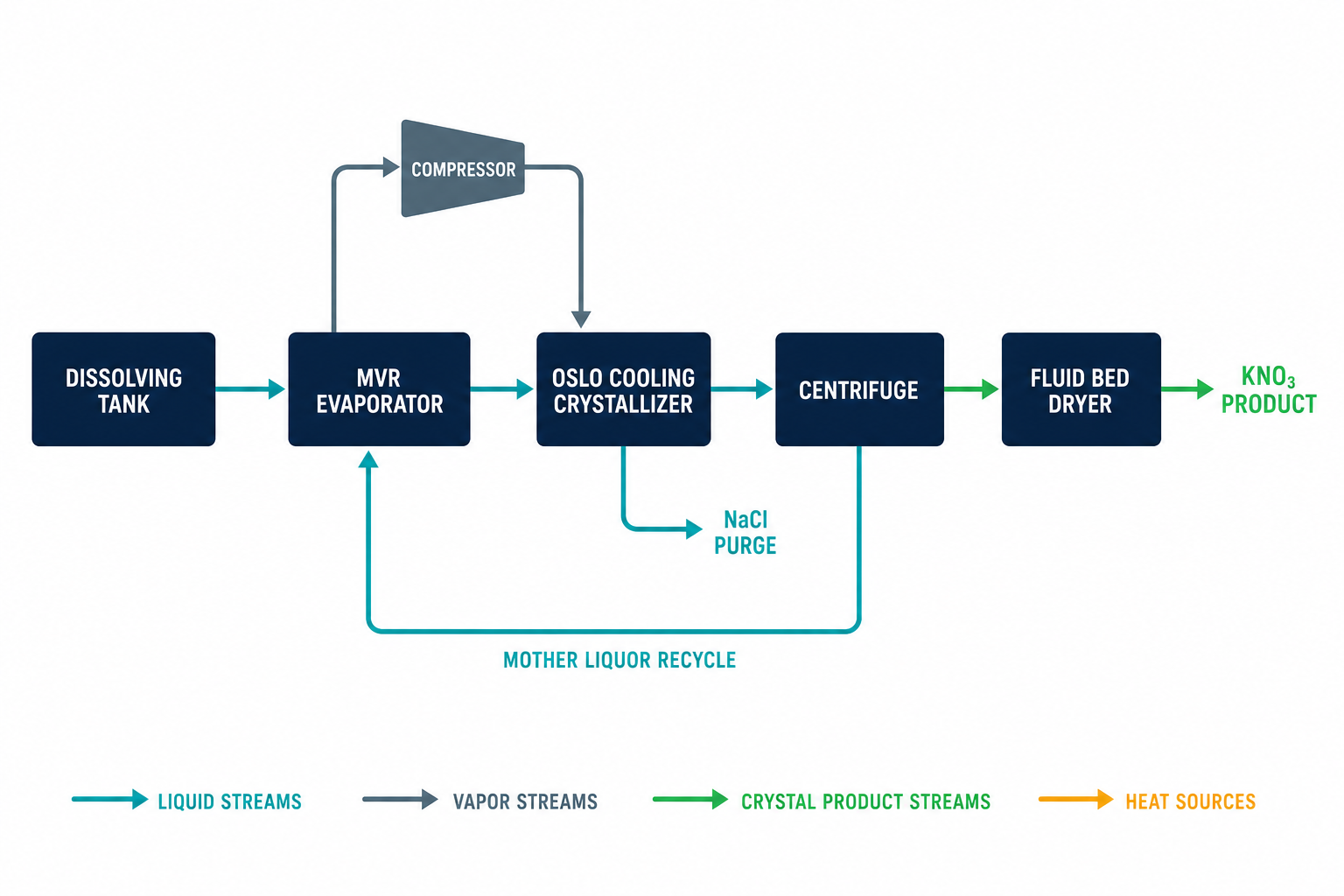
- Boiling point elevation of 10–15°C at high concentration eats directly into the available temperature difference, pushing a standard single-stage centrifugal compressor (typically under 20°C lift) toward its surge line. The proven fixes are two-stage compression or a hybrid MVR + TVR arrangement, together delivering effective lift exceeding 24°C and stable operation across 60–110% of design load.
- Fouling and CIP economics. Nitrate solutions scale, so well-engineered trains track the heat transfer coefficient (K-value) continuously and trigger cleaning-in-place on trend rather than on a calendar — cleaning without stopping production.
Compressor protection is standard: anti-surge logic monitors inlet/outlet differential and flow, opening bypass valves within milliseconds near the surge line. More background is in MVR evaporation systems.
Materials: Where 316L Goes to Die
Potassium nitrate is a strong oxidizing medium, and feedstock carried in from KCl or nitrate salts usually brings residual chloride. The wrong alloy choice fails fast and expensively:
| Process Section | Key Condition | Recommended Material | Expected Life |
|---|---|---|---|
| Feed preheater | Below 60°C, low concentration | SS316L | Over 10 years |
| MVR evaporation chamber | Above 90°C, high velocity, trace Cl⁻ | Duplex 2205 | Over 15 years |
| Forced-circulation pump impeller | Extreme velocity, crystal abrasion | CD4MCuN duplex cast steel | 3–5 years, periodic replacement |
| Crystallizer body | High solids (above 30%), Cl⁻ above 1000 ppm | Titanium Gr.2 | Over 20 years |
Life figures reflect supplier and industry engineering practice; actual life depends on the site’s chloride, temperature and velocity profile.
The failure mode of the cheap alternative is specific: above 90°C at high velocity, standard 316L pits within six months, and rusting hardware contaminates the product with heavy metals — knocking it out of agricultural-grade (>99%) and industrial-grade compliance. Materials here are not a procurement line item; they are the product-purity guarantee.
The Crystallizer Decides the Price You Get
If the evaporator sets the energy cost, the crystallizer sets the market price. Buyers in water-soluble fertilizer and industrial nitrate markets pay for flowability, and fines destroy it: small crystals have high surface area, absorb moisture and cake inside bags. Stirred-tank or forced-circulation (FC) crystallizers at high supersaturation generate exactly that fine fraction.
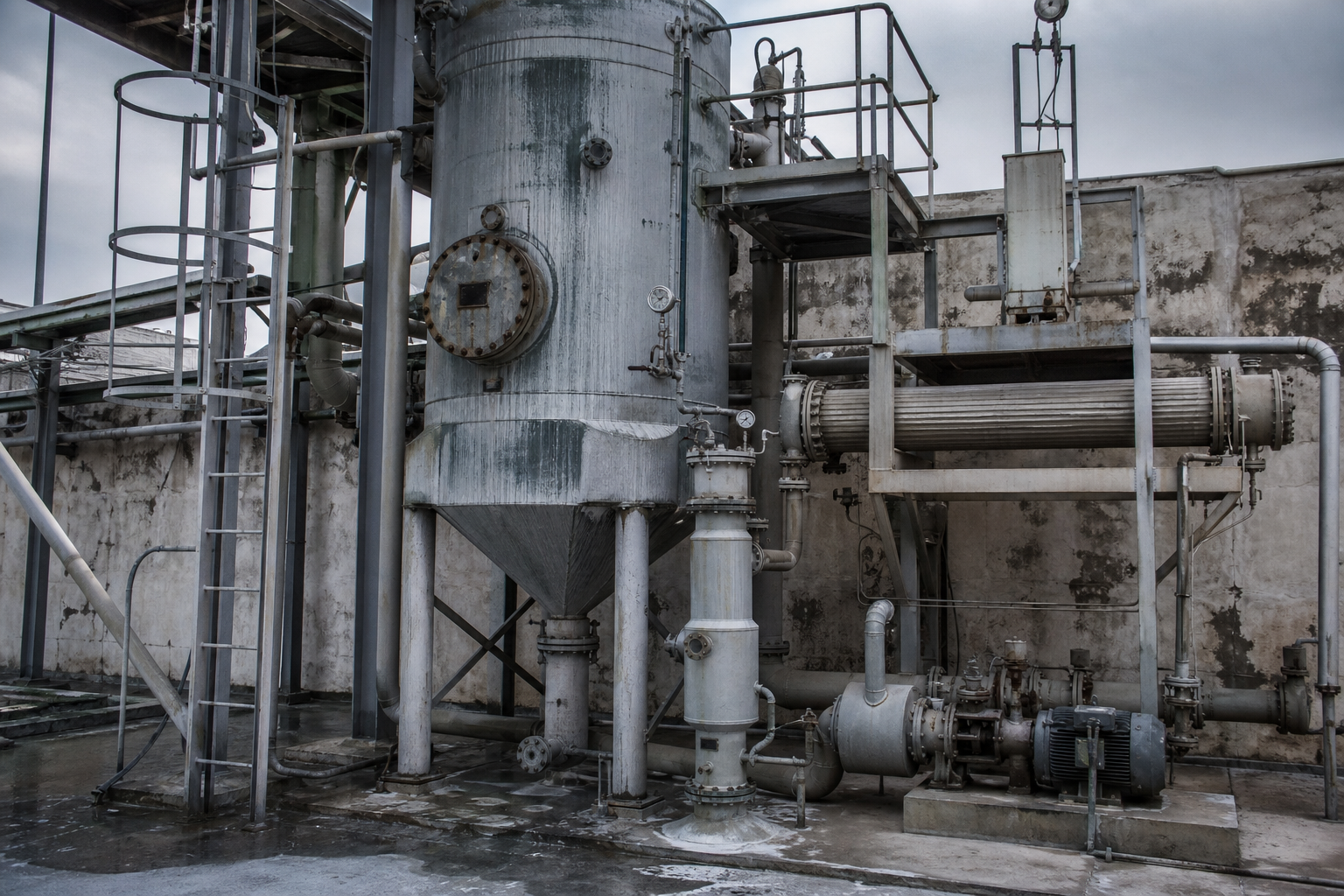
The recommended back end is therefore an OSLO (fluidized-bed) or DTB (draft-tube baffle) cooling crystallizer:
- Supersaturation control in a growth zone: KNO3 has a narrow metastable zone, and in an OSLO body supersaturated liquor passes through a suspended crystal bed, depositing solute onto existing crystals instead of nucleating explosively.
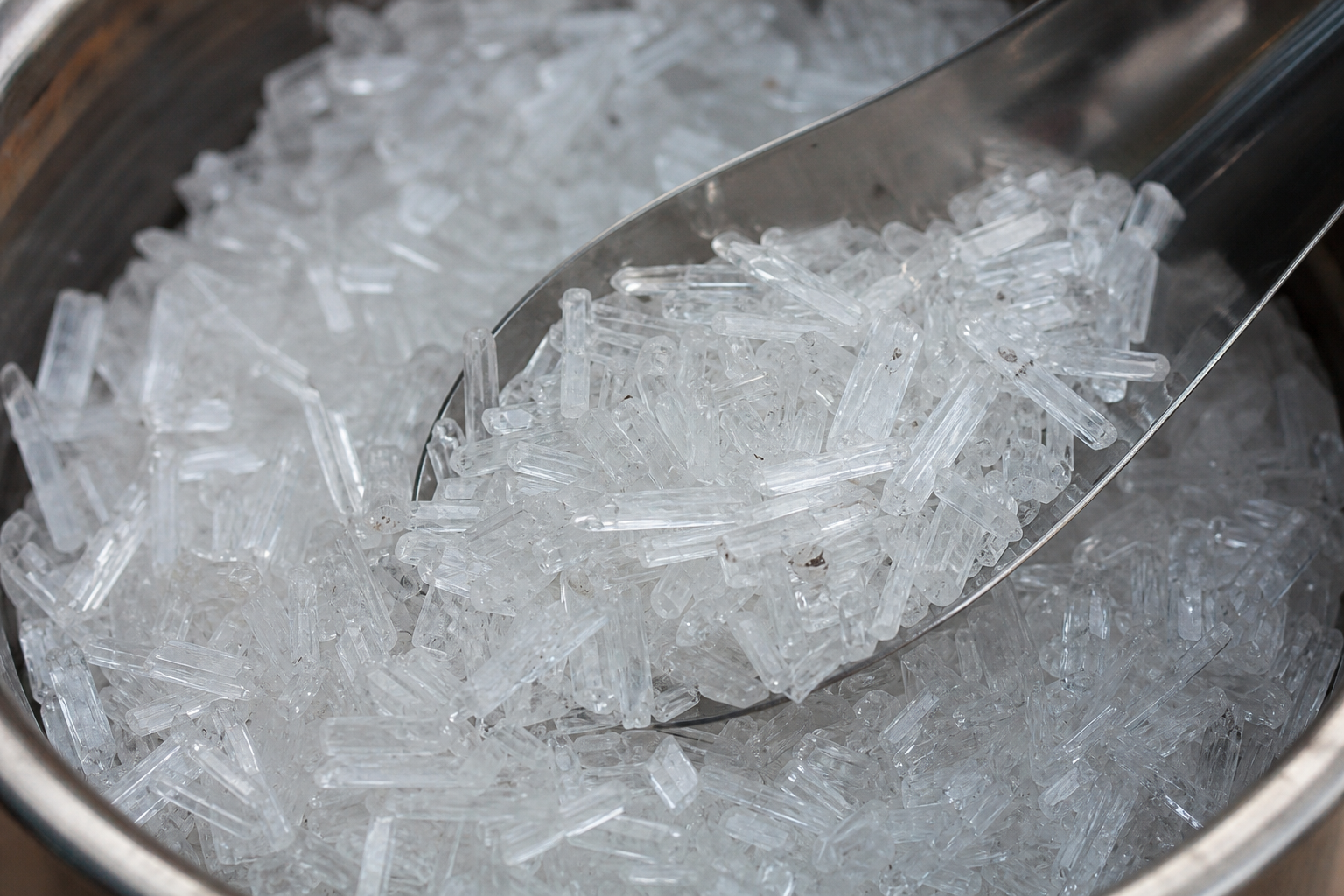
- Uniform coarse product: stable operation yields consistent 20–40 mesh (0.4–0.8 mm) crystals whose lower surface area resists moisture pickup and caking.
- Impurity rejection: uniform crystals wash efficiently in the centrifuge, stripping surface sodium and chloride, supporting purity above 99.9%.
External benchmarking references — published analyses of the world’s top five potassium nitrate producers — indicate that lines using continuous OSLO crystallization realize a 15–20% price premium in high-end water-soluble fertilizer markets versus conventionally crystallized product.
Managing Sodium Chloride in the Mother Liquor
Where feedstock brings NaCl, the system exploits the solubility table: high-temperature evaporation salts out NaCl, low-temperature cooling crystallization recovers KNO3, and the mother-liquor loop is purged periodically so impurities never reach the crystal surface — the same hot/cold coupling described in salt separation systems, applied to a nitrate-chloride pair.
OPEX Benchmarks and Payback
- Energy baseline: conventional triple-effect consumes roughly 0.35–0.4 t of live steam per tonne of water (2025 industry benchmarks); MVR reduces this to near-zero live steam at a COP-equivalent of 20–30 kW thermal per kW electric.
- Published retrofit case (external industry reference, not an EvapCryst project): in a Middle East project running three years, replacing a four-effect evaporator with MVR cut water-treatment cost from $8.50 to $3.20 per tonne, with payback in 14 months.
- New-line economics: for a 50,000 t/y line in a typical industrial park (steam $30/t, electricity $0.10/kWh), MVR saves on the order of $1.5 million per year versus triple-effect, with modeled ROI typically inside 12–18 months.
The governing variable is the local steam-to-electricity price ratio; the numbers above are benchmarks, not promises, and any serious quotation should be backed by a heat-and-material balance on the actual feed.
How the Project Should Be Executed
A potassium nitrate evaporation-crystallization line is delivered in a fixed sequence, and skipping steps is how projects fail. First, complete feed characterization — throughput, concentration, full impurity composition including chloride — because every alloy selection and purge rate hangs on it. Second, a heat-and-material balance with the vapor system simulated at end-of-concentration conditions, where BPE peaks, proving compressor lift before metal is cut. Third, bench crystallization on the real liquor to map the metastable zone and fix the OSLO/DTB growth rate. Fourth, vendor qualification against the materials table. Fifth, a performance test on the numbers that matter — specific energy per tonne of water, crystal size distribution, product purity — not generic capacity. Plants holding their supplier to those five gates get the benchmark economics; plants buying on price get the six-month pitting story.
| Process module | Equipment candidates | Selection basis | Indicative envelope |
|---|---|---|---|
| MVR evaporation | Forced-circulation MVR; two-stage or MVR+TVR | BPE 10–15°C lift requirement | To near-saturation, NaCl salts out |
| NaCl removal | Filter / centrifuge on salt-out | Flat NaCl solubility exploited | Salt filter cake |
| Cooling crystallization | OSLO / DTB fluidized bed | Growth-zone supersaturation control | 20–40 mesh, >99.9% purity |
| Dewatering and finishing | Centrifuge; fluid-bed dryer, anti-cake | Flowability lock-in | Low-caking product |
Configuration, materials and envelopes depend on the actual liquor analysis, chloride level, utilities and capacity.
Drying, Packing, and Plant Integration
Centrifuged crystals pass to fluid-bed or rotary drying and anti-cake conditioning before packing — locking in the crystallizer’s flowability work, covered in drying and packing systems. Modern trains wrap the line in a single control platform: one-click anti-surge logic, K-value-triggered CIP, and remote diagnostics watching compressor curves from the vendor’s office. The result is a plant that runs with the staffing profile of a utility, not a chemical unit. For a related inorganic-salt evaporation duty, see the aluminum sulfate evaporation and crystallization solution.
When This Route May Not Fit
This route earns its capital above roughly 20,000 t/y where energy prices reward electrification. It may not fit small producers, where the fixed cost of an MVR compressor train and its instrumentation never amortizes against the steam saved. It may not fit sites with genuinely cheap steam — industrial parks with by-product or coal-fired steam can keep a well-run triple-effect line cheaper than an electrified one. It may not fit where the product is low-grade industrial KNO3 sold on price alone, making the OSLO precision and titanium-grade metallurgy investment overshoot the market. And it may not fit where the power supply is expensive or unstable: an MVR train that trips on grid quality loses its economics in a season.
What Must Be Verified
Before the route is fixed, the validation focus is: a complete feed characterization — throughput, KNO3 tenor, and the full impurity slate including chloride and sodium, since every metallurgy and purge decision hangs on it. Then the boiling point elevation of the actual liquor at end-of-concentration, confirmed by simulation or measurement, because it sizes the compressor lift and decides single-stage versus two-stage or hybrid TVR. Then bench crystallization on the real liquor to map the metastable zone and predict crystal size distribution. Then the materials review: chloride level against temperature and velocity, section by section. Finally the steam-to-electricity price ratio, run through a heat-and-material balance, not a rule of thumb.
Required inputs: feed liquor analysis with chloride, capacity, and product grade target — in exchange, an initial direction on train configuration, compressor lift strategy and crystallizer selection.
Frequently Asked Questions
Why does potassium nitrate need such large evaporation capacity?
Solubility is extremely temperature-dependent — about 31.6 g/100 g at 20°C versus roughly 247 g/100 g at 100°C. Both routes yield dilute liquors that must be concentrated to saturation, so the evaporation section handles a very large water load and dominates the energy bill.
What does MVR change compared with multi-effect evaporation?
MVR compresses and reuses the secondary vapor, so live steam is needed only at startup and the primary energy input becomes electricity — typically delivering 20–30 kW of evaporation duty per kW of electrical input. Published external references report water-treatment cost falling from $8.50 to $3.20 per tonne with 14-month payback; for a 50,000 t/y line, modeled annual savings of roughly $1.5 million versus triple-effect are typical of industrial-park energy prices — indicative benchmarks, not guarantees.
Why not use 316L stainless steel throughout?
Hot, high-velocity nitrate liquor with residual chloride pits 316L within about six months above 90°C, contaminating product with heavy metals. Standard practice specifies SS316L only for cool dilute preheat duty, duplex 2205 for the hot chamber, CD4MCuN for pump impellers, titanium Gr.2 where chloride exceeds about 1000 ppm.
OSLO or forced-circulation crystallizer — which one?
For final product, OSLO or DTB. FC crystallizers generate fine crystals that cake in storage; OSLO/DTB bodies grow crystals in a fluidized bed, producing uniform 20–40 mesh (0.4–0.8 mm) product above 99.9% purity that resists caking and earns a 15–20% premium in water-soluble fertilizer markets.
How is sodium chloride impurity kept out of the product?
By exploiting the solubility gap: NaCl solubility is nearly flat with temperature while KNO3 solubility collapses on cooling. The train salts out NaCl during high-temperature evaporation, crystallizes KNO3 in the cold section, and purges mother liquor on schedule so impurities never reach the crystal surface.