Project Parameters
| Parameter | Value |
|---|---|
| Process route | Four-effect TVR falling-film evaporation with per-effect self-circulation |
| Industry | Food & beverage — instant coffee production |
| Working medium | Coffee extract |
| Treatment capacity | 22,000 kg/hr evaporation |
| Inlet / outlet concentration | 4–5 °Brix → 45 °Brix |
| Unit steam consumption | 1 tonne of steam evaporates approx. 3.9 tonnes of water |
| Construction materials | SS304/SS316L food-grade wetted parts |
Representative process configuration compiled from published industry project data. Indicative values, not a process guarantee.
Project Description
Instant coffee begins as an extraction problem and ends as an evaporation problem. Roasted and ground coffee is extracted under high temperature and pressure, yielding a liquor at 4–5 °Brix — mostly water, with the soluble solids that become the powder. Before spray drying can make product, that liquor must concentrate roughly tenfold in solids, to about 45 °Brix, and it must arrive there with aroma and flavor intact. The configuration behind this case does that duty at 22,000 kg/h of evaporation for an instant coffee producer in Indonesia, one of the world’s leading coffee origins.
The published project data defines the plant precisely: a four-effect falling-film evaporator with thermal vapor recompression (TVR), concentrating from 4–5 °Brix feed to 45 °Brix concentrate, with one tonne of live steam evaporating approximately 3.9 tonnes of water — the steam economy that multi-effect plus TVR delivers on this duty.
Process Technology
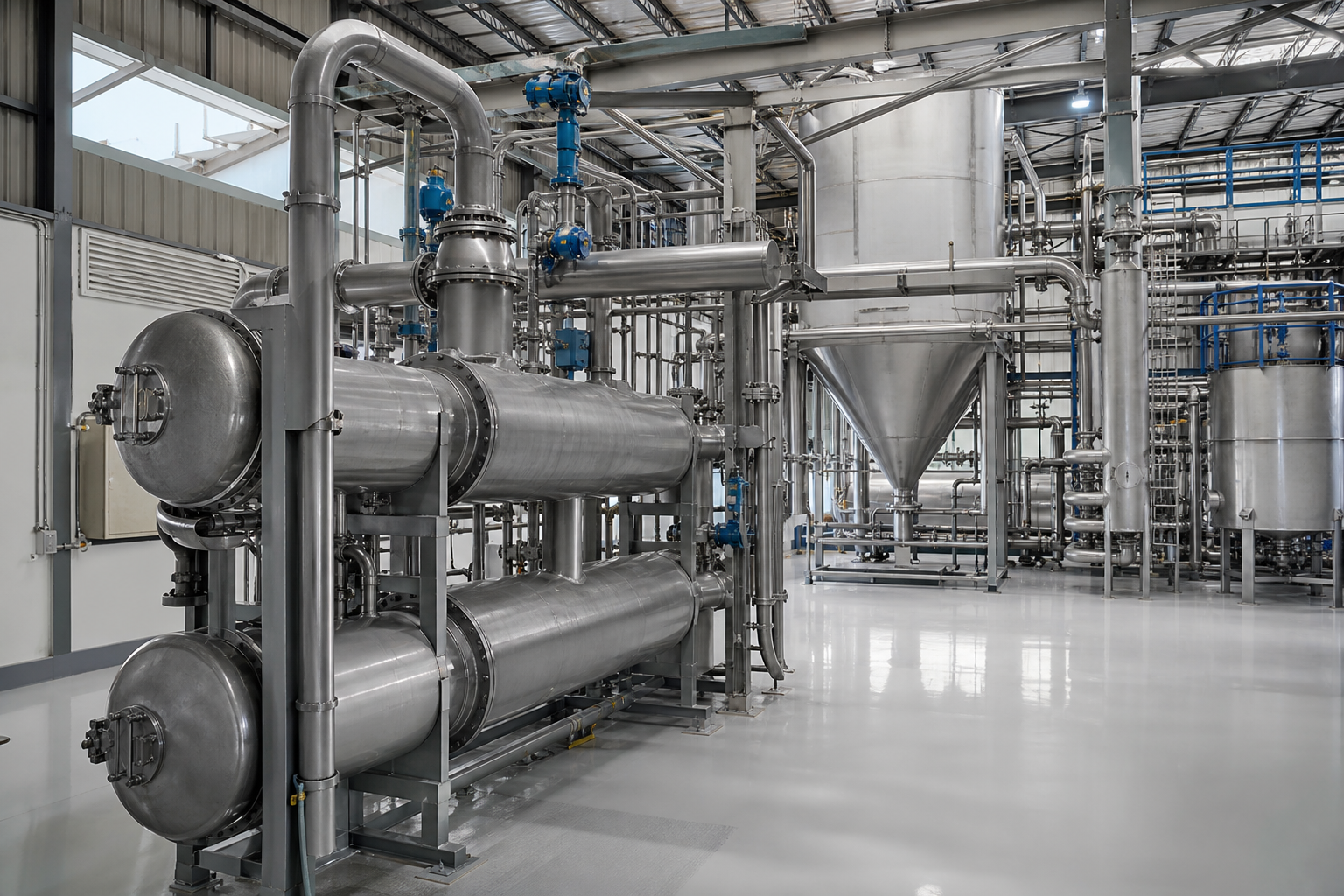
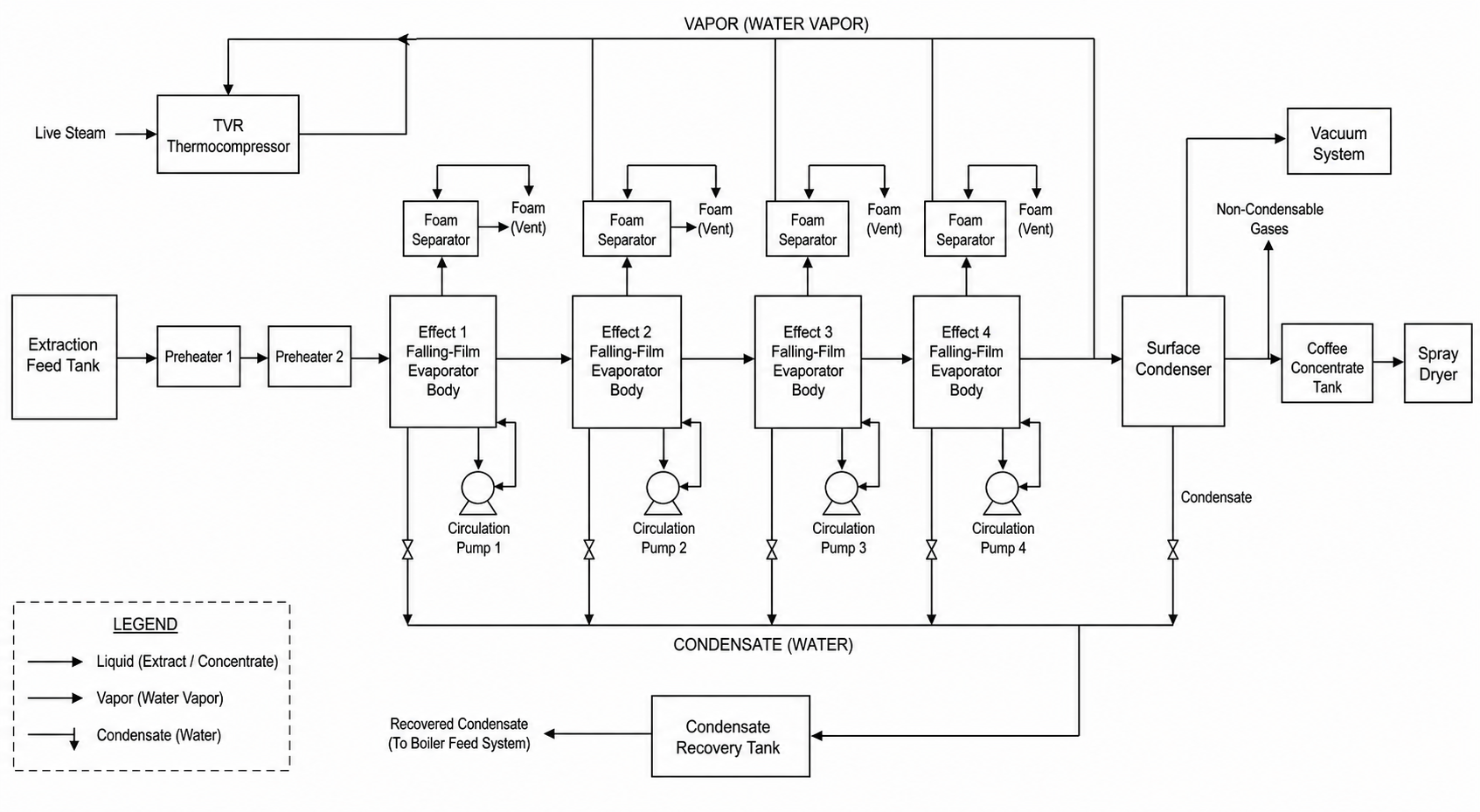
Filtered coffee extract is preheated in condensate and vapor exchangers — aroma conservation starts with energy integration — and enters the head of the four-effect train. Each effect is a falling-film body: the liquor descends the heating surfaces as a thin film, boiling at seconds of wall contact, which is what protects the volatile aroma compounds that survive extraction. Successive effects boil at lower temperature and pressure on the vapor of their predecessors; the TVR thermocompressor entrains effect vapor with live steam and re-compresses it back to the first-effect heating condition, multiplying the live steam’s work and lifting economy to the published 3.9:1.
Two coffee-specific designs are documented for this configuration. Each effect runs with its own circulation loop — self-circulation at high flow rate — which keeps tube walls wetted, prevents fouling on the surfaces where coffee solids would deposit, simplifies maintenance, and stabilizes long-run operation. And the vapor-liquid separators are deliberately enlarged in diameter and height, because coffee extract foams vigorously during evaporation: proteins and melanoidins stabilize vapor bubbles, and an undersized separator would carry concentrate over into the vapor system and lose product.
The final effect condenses against a surface condenser under vacuum, holding the boiling chain at gentle temperatures. Concentrate at 45 °Brix leaves the last body to feed spray drying, where the remaining water leaves as mist and instant coffee powder forms. Condensate from the train — hot water carrying only traces of volatiles — is recovered for extraction and cleaning use. Between campaigns the train cleans in place with hot water circuits, because coffee deposits are tenacious but water-soluble.
PLC control runs the plant automatically with real-time process visibility, per the published configuration — standard for modern coffee plants where the evaporator sets the pace of the whole line.
Equipment Configuration
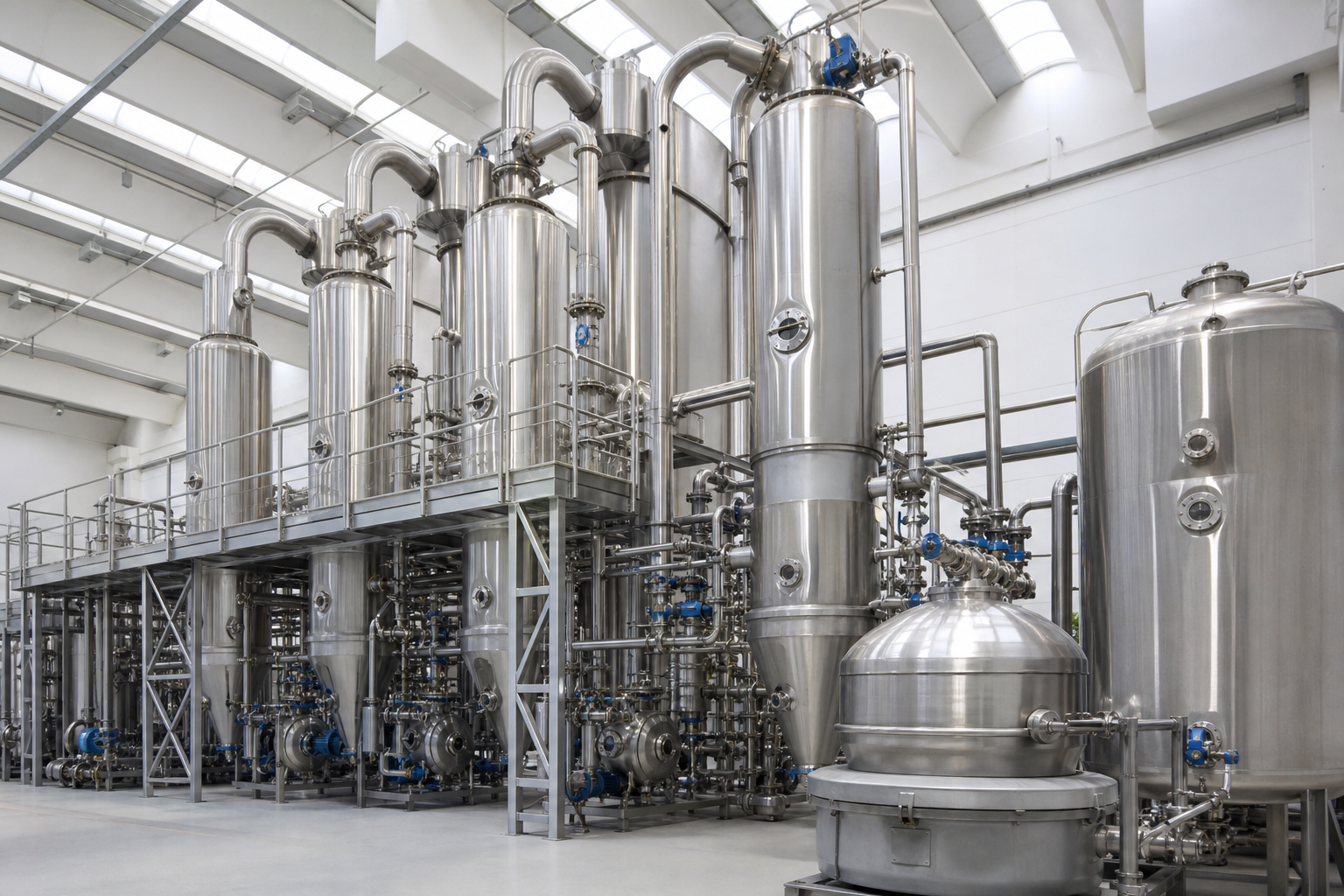
One set of the following equipment is typical for this duty:
- Extract feed tank, polishing filtration and vapor/condensate preheating
- Four-effect falling-film evaporator train with per-effect self-circulation
- TVR thermocompressor on live steam for vapor recompression
- Enlarged separators (diameter and height) for coffee-foam handling
- Surface condenser and vacuum system; condensate recovery to extraction
- SS304/SS316L food-grade construction; PLC control with CIP circuits
Performance & Outcome
Compiled from published industry project data, indicative: 22,000 kg/h evaporation from 4–5 to 45 °Brix at a steam economy of approximately 3.9 tonnes of water per tonne of steam, with stable long-run operation and aroma-preserving low-temperature profiles. Aroma retention is quoted per project roast and blend.