Instant coffee production lives or dies on one unit operation: lifting roast-and-ground coffee extract from roughly 4–5 °Brix at the extractor outlet to about 45 °Brix at the spray dryer inlet, without cooking the aroma out of it. The reference solution is a four-effect falling film evaporator with thermal vapor recompression (TVR) — a configuration documented in a vendor-published 22,000 kg/hr instant coffee project in Indonesia — an external industry reference, not an EvapCryst delivery, indicative rather than a project guarantee — where one tonne of live steam evaporates approximately 3.9 tonnes of water while product temperatures stay low enough to preserve flavor. Gentle thermal treatment, generous vapor-liquid separation for a foaming liquor, per-effect self-circulation against fouling, and full PLC automation are the four design signatures that separate a coffee-grade evaporator from a generic one.
The Process Position of the Evaporator
Instant coffee manufacture follows a fixed chain. Roasted beans are ground and extracted under high temperature and pressure to pull soluble solids into a liquor containing the aromatics. The extract is filtered to remove insoluble fines, and the clear liquor — at only 4–5 °Brix — must then be concentrated. The evaporator removes the bulk of the water; the concentrate at approximately 45 °Brix feeds spray drying, which produces the soluble powder consumers dissolve in a cup. Spray drying is energetically brutal per kilogram of water removed, so every unit of water the evaporator removes cheaply and gently ahead of it protects both operating cost and product quality.
Why Falling Film Technology Fits Coffee
Coffee extract is heat-sensitive in the specific way that matters for consumer acceptance: volatile aroma compounds degrade and unpleasant cooked notes form when the liquor sits hot on a heated surface. Falling film evaporation answers that directly:
- Seconds of residence time. The liquor descends as a thin film inside vertical tubes, so no hold volume of product sits at wall temperature.
- Low operating temperature. The train runs under vacuum, with each effect at a successively lower temperature, keeping the hottest coffee contact brief and modest.
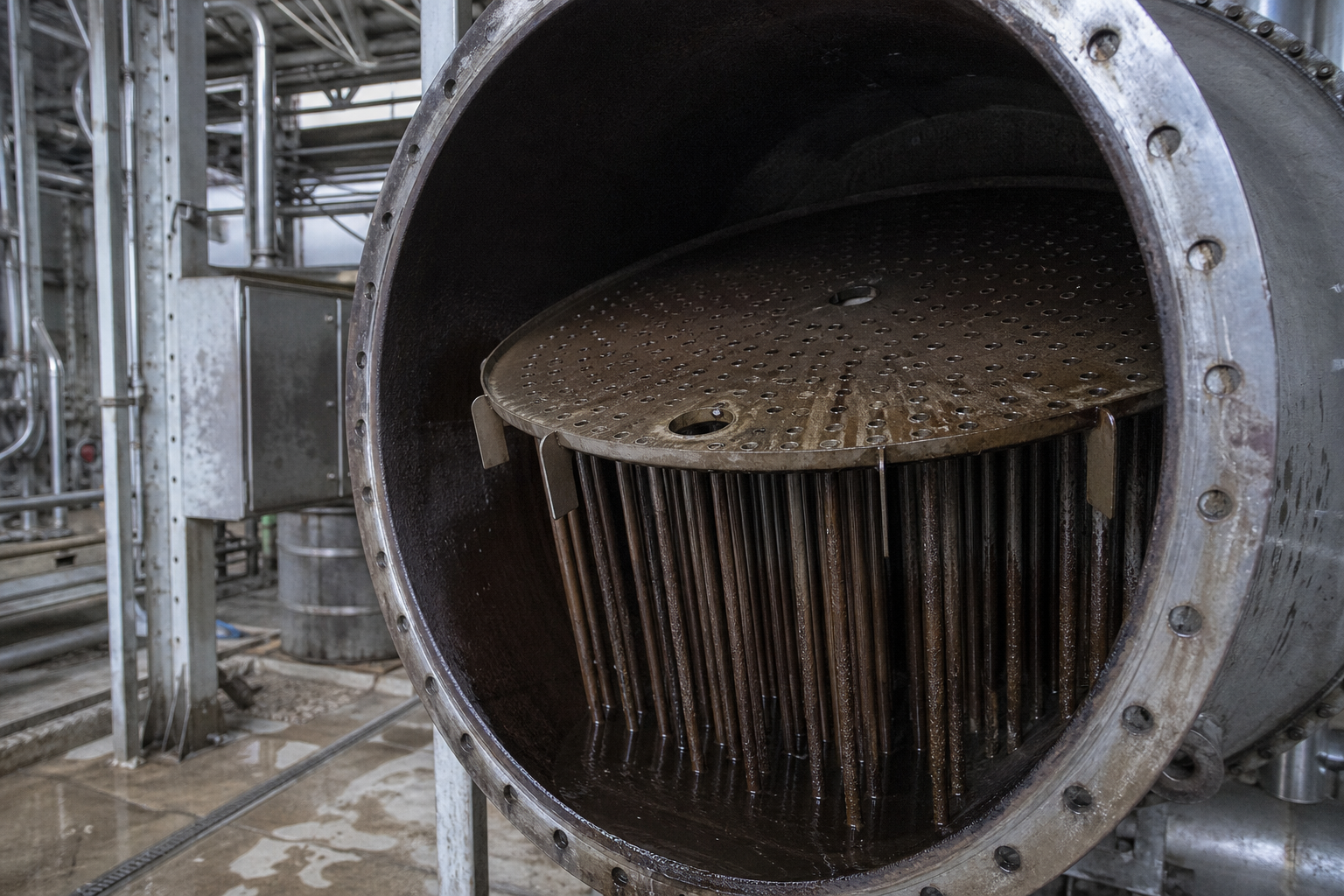
- Uniform wetting. Distributors spread the liquor evenly across the tube sheet, preventing dry patches that would caramelize product onto the wall and appear later as dark specks in the powder.
- Cleanability. Straight vertical tubes of sanitary design support effective CIP cycles between production runs.
How the Four-Effect TVR Train Works
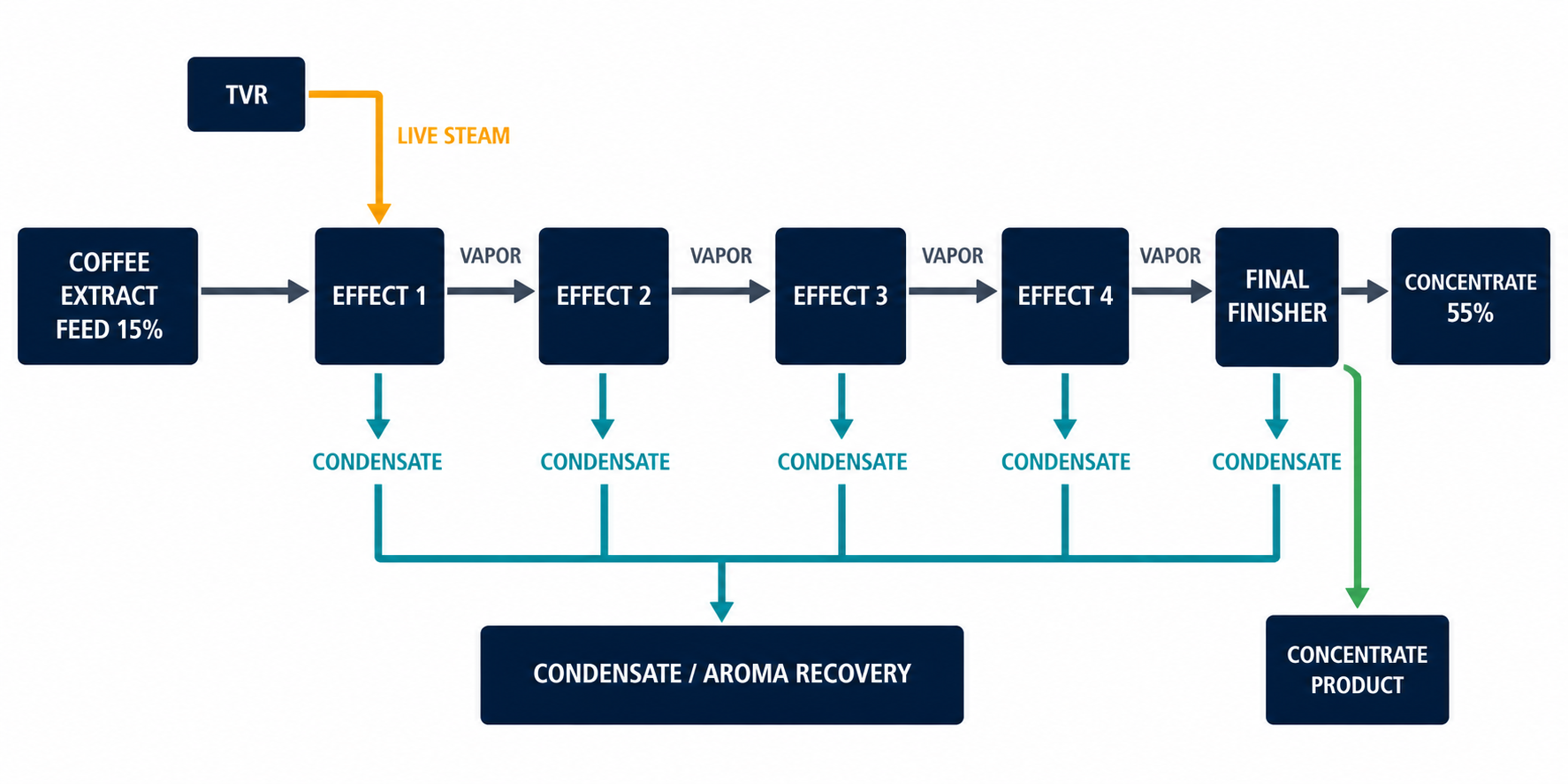
Vapor from the effect operated at the highest temperature is split: a portion is recompressed by a steam-ejector TVR using live steam as motive, and re-used as heating steam; the balance cascades to the next effect as in a conventional multi-effect train. Each subsequent body boils at lower temperature and pressure, driven by the previous body’s vapor. The TVR acts as a thermodynamic heat pump, upgrading part of the vapor so the same live steam does more evaporation work. On the Indonesian reference project this delivered a specific steam consumption near one tonne of steam per 3.9–4.0 tonnes of evaporated water — roughly half or less of what a single-effect design would demand, consistent with the industry-reported up-to-50% steam reduction range the configuration targets.
| Process Module | Candidate Equipment Types | Selection Rationale | Indicative Operating Envelope |
|---|---|---|---|
| Extract feed handling | Agitated feed tank; filtration tie-in | Smooths blend and extraction-severity swings | ~4–5 °Brix inlet (typical extractor outlet) |
| Preheating | Condensate and vapor preheaters | Recovers latent heat ahead of the first effect | Per train heat balance |
| Four-effect falling-film evaporation | Calandria bodies with liquid distributors; per-effect self-circulation | Seconds-scale film residence preserves aroma; circulation checks fouling | Vacuum staged effect-by-effect; 22,000 kg/hr in published reference |
| TVR recompression | Steam-ejector TVR on first-effect vapor | Upgrades vapor so the same live steam does more work | ~1 t steam per 3.9–4.0 t evaporated water (published reference) |
| Vapor-liquid separation | Enlarged separators with demisters | Handles foaming coffee liquor; protects yield and condensate | Sized for foaming service |
| Discharge & control | PLC with density-based discharge loop | Holds the spray-dryer feed specification | ~45 °Brix concentrate |
Configuration, materials, and operating ranges depend on actual feed, temperature, pressure, corrosion review, fouling behavior, utilities, and project capacity.
Four Coffee-Specific Engineering Signatures
1. Enlarged Vapor-Liquid Separators
Coffee liquor foams during boiling: proteins and melanoidins stabilize bubbles, and entrainment carries precious solids into the condensate. Coffee evaporators therefore specify separators with increased diameter and height compared with standard designs, giving vapor room to slow down and droplets room to disengage. Carryover is not a cosmetic issue — it is lost yield and contaminated condensate.
2. Per-Effect Self-Circulation
Each effect circulates liquor through its own body at high flow. The resulting wall velocity keeps fouling in check during long campaigns, stabilizes heat transfer as concentration rises effect by effect, and simplifies maintenance because each circuit can be cleaned and inspected independently.
3. Controlled, Gentle Temperature Profile
Effect sequencing and pressure staging are chosen so the first-effect temperature — where the liquor is still dilute — does the most work, while the final, most concentrated effect operates at the lowest temperature. This counterintuitive pairing (dilute product meets hot surface briefly; concentrated product meets only gentle heat) is what preserves the top notes that distinguish premium instant coffee.
4. Automation and Visibility
A PLC system runs the train automatically: feed rate, effect temperatures, vacuum level, and discharge density are monitored in real time, with the concentrate density loop closing onto product discharge. Minimal manual intervention is the operational goal, both for consistency between shifts and because aroma preservation depends on never dwelling at off-spec conditions.
Configuration Options and Steam Economics
The table below compares the common evaporation configurations for coffee extract duty.
| Configuration | Indicative Steam Economy | Notes for Coffee Duty |
|---|---|---|
| Single-effect falling film | ~1 kg water per kg steam | Simple; highest steam cost; for small lines only |
| Double- or triple-effect | ~1.8–2.7 kg water per kg steam | Standard mid-size choice; good retrofit target |
| Four-effect + TVR | ~3.9–4.0 kg water per kg steam (reference project) | Proven benchmark for large instant coffee lines |
| MVR (electric) falling film | Steam-free; electrically driven | Attractive where steam is expensive or electrification is targeted; compressor selection must respect aroma and foam service |
Indicative industry-reported economies, not project guarantees; realized values depend on Brix range, effect count, TVR motive steam pressure, and site conditions.
CIP, Fouling Management and Campaign Length
Even with self-circulation, coffee solids gradually film the tubes, and a planned CIP cadence — alkaline cleaning for organics followed by rinses validated for food contact — keeps heat-transfer coefficients and steam economy from drifting. Sizing the train means sizing the cleaning plan at the same time: longer campaigns trade a few points of steam economy against production availability, and the control system should trend effect temperatures so the plant knows exactly when coefficient loss says it is time to clean.
Beyond Coffee: The Same Duty Elsewhere in Food Processing
One further planning note for new lines: the evaporator should be selected together with the extractor, not after it. Extractor design fixes the solids profile and temperature history of the liquor the evaporator must live with, and spray dryer selection fixes the exact Brix target that maximizes overall throughput. Treating the three as one system — and giving the evaporator supplier the real extract analysis, including foaming tests — is what turns a generic falling film unit into a coffee machine.
The requirements that define coffee evaporation — heat-sensitive solubles, foaming tendency, sanitary construction, dense final product — recur across the food sector in plant extracts, starch sweeteners and fermentation broths. A supplier fluent in coffee-grade falling film systems brings that same discipline to adjacent duties, and the engineering choices transfer almost one-to-one.
Upgrading an Existing Coffee Evaporator
Many operating plants run older evaporators that were sized for yesterday’s volumes and yesterday’s steam prices; the Indonesian reference project was itself an upgrading commissioning, not a greenfield build. Retrofit opportunities cluster in four places. Adding an effect or converting to TVR lifts steam economy without touching the extract handling. Replacing undersized separators eliminates chronic carryover losses. Modernizing the control system with density-based discharge control stabilizes the 45 °Brix target that spray drying depends on. And rebalancing the per-effect circulation circuits restores fouling margins lost as production crept upward. Because instant coffee lines rarely stop long, retrofit engineering is scheduled around production windows, with pre-assembled modules and pre-tested loops compressing the tie-in outage.
Operating Considerations: Feed, Water and Quality Drift
Evaporator performance in coffee service follows the extract, and extract is never constant. Blend changes shift soluble solids and foaming propensity; extraction severity shifts fines load onto the pre-filters; seasonal bean variation moves acidity, which nudges fouling rates. Operators who trend first-effect heat-transfer coefficients and separator differential pressures see these shifts weeks before they become downtime. Condensate quality is the other running indicator: clean condensate confirms that separators and demisters are healthy and opens the door to reusing it for boiler feed or CIP make-up, an easy win in plants where water procurement is becoming a cost and ESG line item. Finally, holding the 45 °Brix discharge specification tightly is not perfectionism — spray dryers respond to feed-solids swings with powder moisture and density drift, and the cheapest place to correct that is upstream, in the evaporator control loop.
When This Route May Not Fit
A four-effect TVR train is not the right capital shape everywhere. Small specialty lines running modest extract flows justify single- or double-effect units, where the added effects never repay their capital in steam. Sites without boiler infrastructure depend on live steam a TVR train cannot live without — electrification via MVR, or outsourcing concentration, fits better. Where the product is a liquid concentrate rather than spray-dried powder, the 45 °Brix target that sizes this train may not apply at all. Extreme-foaming extracts beyond standard separator design push specialized, costlier separation. And plants whose production windows cannot host a retrofit outage should not commit to one until scheduling reality is proven.
What Must Be Verified
Validation focus: the real extract analysis across blends and seasons — Brix range, fines load, acidity drift, and foaming tests — because separator and circulation sizing follow from it. The aroma heat budget should be demonstrated against the planned first-effect temperature and residence profile, not assumed from the reference. Foam behavior must be measured, not estimated, for separator sizing. Steam economy needs verification against the site’s motive-steam pressure and condenser cooling conditions, and the CIP regime must be validated for food contact on the actual soil. Finally, fix the discharge Brix specification jointly with the spray-dryer envelope before the train is frozen.
FAQ
What concentration does instant coffee extract need before spray drying?
Approximately 45 °Brix. Extraction delivers only about 4–5 °Brix, so the evaporator removes the overwhelming majority of the water in the process — which is why its steam economy dominates plant energy cost.
Why is TVR used on coffee evaporators?
Thermal vapor recompression uses a steam ejector to upgrade part of the process vapor back to first-effect heating duty. On a four-effect coffee train it lifts steam economy to roughly 3.9–4.0 kg of evaporated water per kg of live steam, cutting steam use by up to about half versus plain multi-effect operation.
How is coffee aroma preserved during evaporation?
Three measures together: falling film residence times of seconds, vacuum operation with the hottest surface contacting only dilute liquor, and enlarged separators that prevent foaming carryover. Aroma-recovery condensate handling can be added where the market demands it.
Can MVR replace steam-driven evaporation for coffee?
Yes, where electricity is cheaper than steam or electrification is a goal. MVR drives the train electrically with essentially no live steam. The compressor and separator design must account for foaming service, and the retrofit economics depend on the site’s steam-to-power price ratio.
How much feed can a coffee evaporator handle?
Trains are sized per project; the reference four-effect TVR configuration handles 22,000 kg/hr of extract from 4–5 °Brix to 45 °Brix. Larger duties are met with wider tube bundles and parallel bodies under the same process logic.
Planning a coffee extract concentration line or upgrade? Send the extract analysis (Brix range and foaming behavior), throughput, and site steam and power prices — in exchange you will receive a first-pass screening of the configuration (multi-effect TVR versus MVR), its expected steam economy band, and the retrofit scope your duty supports.
EvapCryst designs and delivers food-grade falling film evaporation systems for coffee extract and adjacent duties, from multi-effect TVR trains to MVR configurations. See the broader food and beverage evaporation solutions and our work on starch, syrup and sweetener concentration for the same engineering discipline in neighboring processes.