Project Parameters
| Parameter | Value |
|---|---|
| Process route | Waste-heat driven multi-effect evaporation |
| Industry | Petrochemicals — PTA (purified terephthalic acid) production |
| Feed type & key components | PTA process wastewater; organic acids, cobalt/manganese catalyst traces, high temperature |
| Evaporation capacity | 1,020 t/h total installed water removal |
| Construction materials | SS316L / duplex (indicative) |
Representative process configuration compiled from published industry project data. Indicative values, not a process guarantee.
Project Description
A world-scale PTA complex in Ningbo, Zhejiang Province — a 3 million ton-per-year purified terephthalic acid plant with its expansion phases — operates a wastewater stream whose defining feature is not its contaminant load but its energy state: the process water arrives hot from oxidation and purification sections, laden with organic acids and traces of the cobalt and manganese catalysts that drive the oxidation. At this scale every megawatt matters twice, so the plant’s evaporation system is built around a single thermodynamic idea: the wastewater is treated with heat the plant was already rejecting.
The reference configuration is a multi-effect evaporation system with 1,020 t/h total installed water-removal capacity, driven by process waste heat — low-grade vapor and condensate streams from the PTA process itself — rather than by extracted live steam or electric recompression. The multi-effect count re-uses each unit of waste heat several times in descending temperature steps, which is what turns a marginal energy source into the driver for one of the largest evaporation duties in the polyester chain.
Process Technology
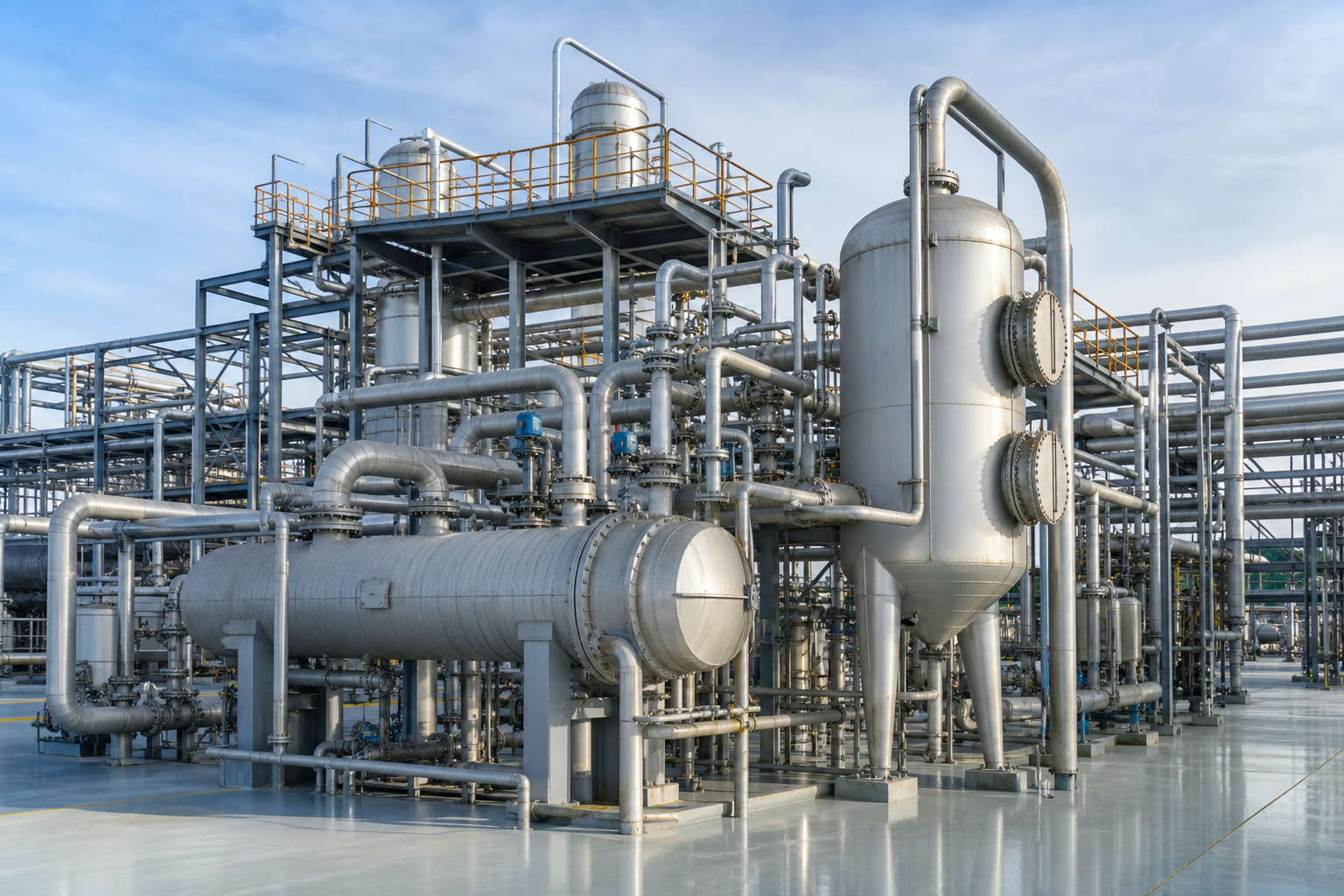
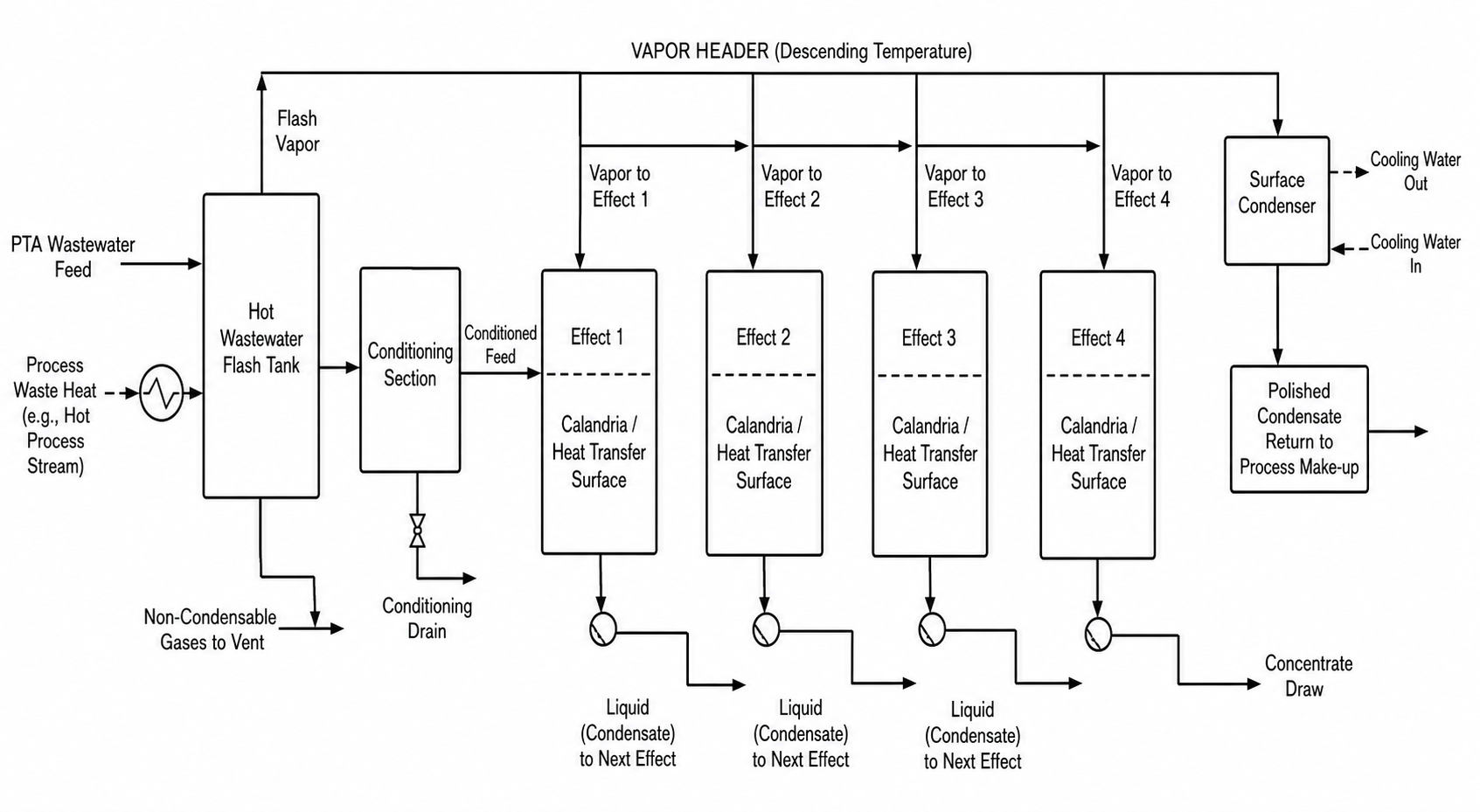
Hot process wastewater is collected and flashed to recover its sensible heat, then routed through conditioning that manages the catalyst metals and organic acid load ahead of the trains. The multi-effect bodies are arranged in a descending temperature cascade: the first effect is heated by the highest-grade waste-heat stream available, and each subsequent effect is heated by the vapor boiled off in the one before it at lower pressure. Because the feed arrives hot, the temperature lift the system must supply is small — the waste heat only has to drive the cascade, not raise cold water to boiling.
Water recovery is the primary product: the condensate swept out of the cascade is collected, polished against organic acid traces, and returned in large part to the process as washing and reaction make-up water — at 1,000 t/h class capacity, the recovered water is a utility stream in its own right. The concentrated liquor, carrying the organic acids and catalyst residues, is drawn at controlled concentration toward the site’s residual-waste handling or further recovery stages.
The engineering challenge at this scale is integration rather than novelty: matching effect temperatures to the waste-heat grades the PTA process actually releases, keeping the cascade balanced as the plant swings between operating phases, and sizing the huge vapor and condensate headers that move more than a thousand tons of water per hour through the system.
Equipment Configuration
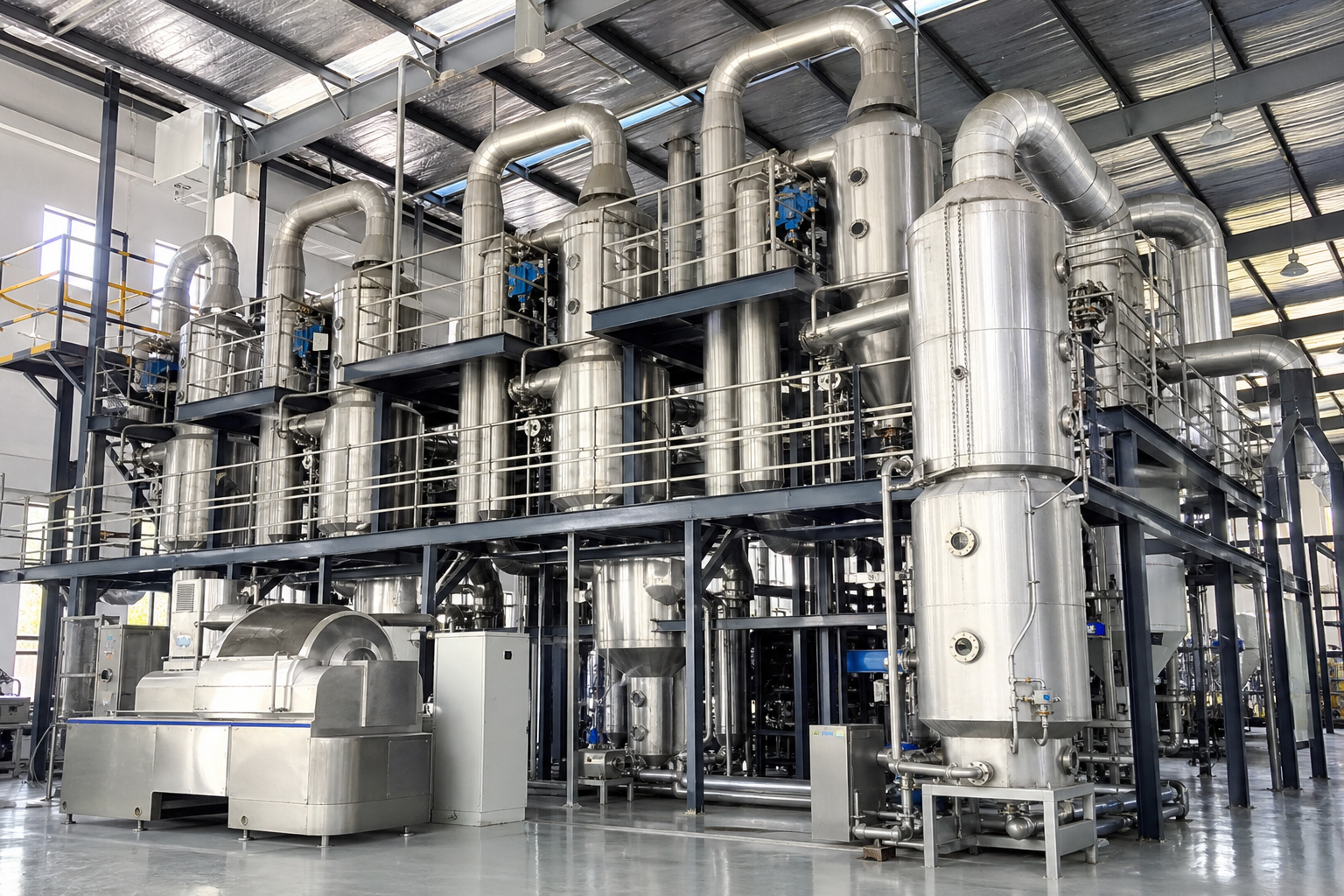
A system of this class comprises:
- Hot wastewater collection with flash-heat recovery and conditioning for catalyst and acid management
- Multi-effect evaporator bodies arranged for waste-heat grades, with large-area heat transfer surfaces
- Inter-effect vapor and transfer piping at world-scale diameters; vacuum system on the final effect
- Condensate collection, polishing and large-volume return to process make-up
- Concentrate draw at controlled density to residual handling or recovery
- Plant-DCS-integrated control balancing the cascade against PTA operating phases
SS316L and duplex are indicative for the organic-acid service, with materials upgraded where hot acid concentrations are highest.
Performance & Outcome
Compiled from published industry project data, indicative: waste-heat multi-effect systems of this class treat PTA wastewater at total capacities above 1,000 t/h using process heat rather than live steam or electric recompression, recovering the water fraction for process make-up and concentrating the acid and catalyst residues for managed handling. Energy integration figures, water recovery ratios and effect counts depend on the waste-heat grades of the host plant and are engineered per project.