Manganese sulfate crystallizes the “wrong way round”: unlike most salts, its solubility in water falls as temperature rises. That single property makes evaporator selection decisive – a conventional tube-side boiling design deposits MnSO4 scale on the heating surface within days, while a correctly configured train (falling-film pre-concentration, countercurrent multi-effect evaporation, or MVR with external-circulation crystallization) concentrates dilute leach liquor into monohydrate crystal continuously, cutting energy consumption by an industry-reported 50-70% against open-pan or coil-kettle concentration. This page explains why MnSO4 misbehaves, which process routes work, and how the choice between multi-effect and MVR is made in practice.
What Makes Manganese Sulfate Different: Inverse Solubility
Most inorganic salts dissolve more readily in hotter water; manganese sulfate is a well-known exception. As the solution temperature climbs, saturation concentration drops – meaning that a saturated or near-saturated liquor becomes supersaturated the moment it is heated. Inside an evaporator, the hottest point in the circuit is the heating-tube wall. For an inversely soluble salt, that wall is therefore the preferred nucleation site: crystals form directly on the heat-transfer surface, build an insulating layer, restrict flow, and force shutdown for mechanical cleaning.
The consequences compound quickly. The scale layer degrades heat-transfer coefficient, so the same duty demands higher temperature difference, which raises wall temperature, which accelerates crystallization on the wall – a self-reinforcing failure loop. Field experience on forced-circulation units shows that simply raising circulation velocity to scour the tubes does not solve it; the geometry of where boiling and heating happen has to change instead. That is the central design insight behind every reliable MnSO4 process.
Where MnSO4 Solutions Come From
Manganese sulfate is a workhorse base salt across chemical, light industry, feed, and food applications, and increasingly a battery-materials intermediate for EMD electrolysis and NMC-precursor routes. Plants produce the solution by several routes, all of which end at the same evaporation-crystallization bottleneck:
- High-temperature calcination of manganese ore followed by leaching
- Direct acid leaching of ore concentrates
- Two-ore-plus-acid processes (pyrolusite plus a reductant mineral in sulfuric acid)
- Sulfur dioxide absorption/reduction routes
- Aniline (organic reductant) processes
The routes differ mainly in the leaching step; downstream, all converge on atmospheric evaporation-crystallization to isolate the product. One trend raises the stakes for evaporator efficiency: high-grade manganese ore is increasingly scarce, and plants now process lean ore with manganese content below 20%, which yields dilute leach liquor. The lower the feed concentration, the more water must be evaporated per ton of product – so energy performance per ton of water evaporated translates directly into cost per ton of MnSO4·H2O.
The Classic Failure Modes of Conventional Concentration
Two weaknesses dominate older MnSO4 concentration installations:
- Excessive steam consumption. Coil kettles and single-effect evaporators burn steam at the theoretical single-stage rate, with no reuse of latent heat.
- Secondary steam wasted to atmosphere. In many legacy plants, the vapor boiled off is vented or condensed against cooling water, carrying its heat with it. Combined with inverse-solubility fouling, the result is an installation that consumes ever-rising energy per ton between cleanouts while demanding significant manual descaling labor.
Both problems are addressed not by harder operation of the same equipment but by changing the evaporation architecture.
Process Route 1: Falling-Film Pre-Concentration
On dilute feed – the lean-ore case above – a falling-film evaporator is the efficient first stage. A precision liquid-distribution system spreads MnSO4 solution as a thin, uniform film down the inner wall of each heating tube. The film contacts the heating surface with very small temperature rise and short residence time, so the liquor never dwells at wall conditions that trigger wall nucleation.
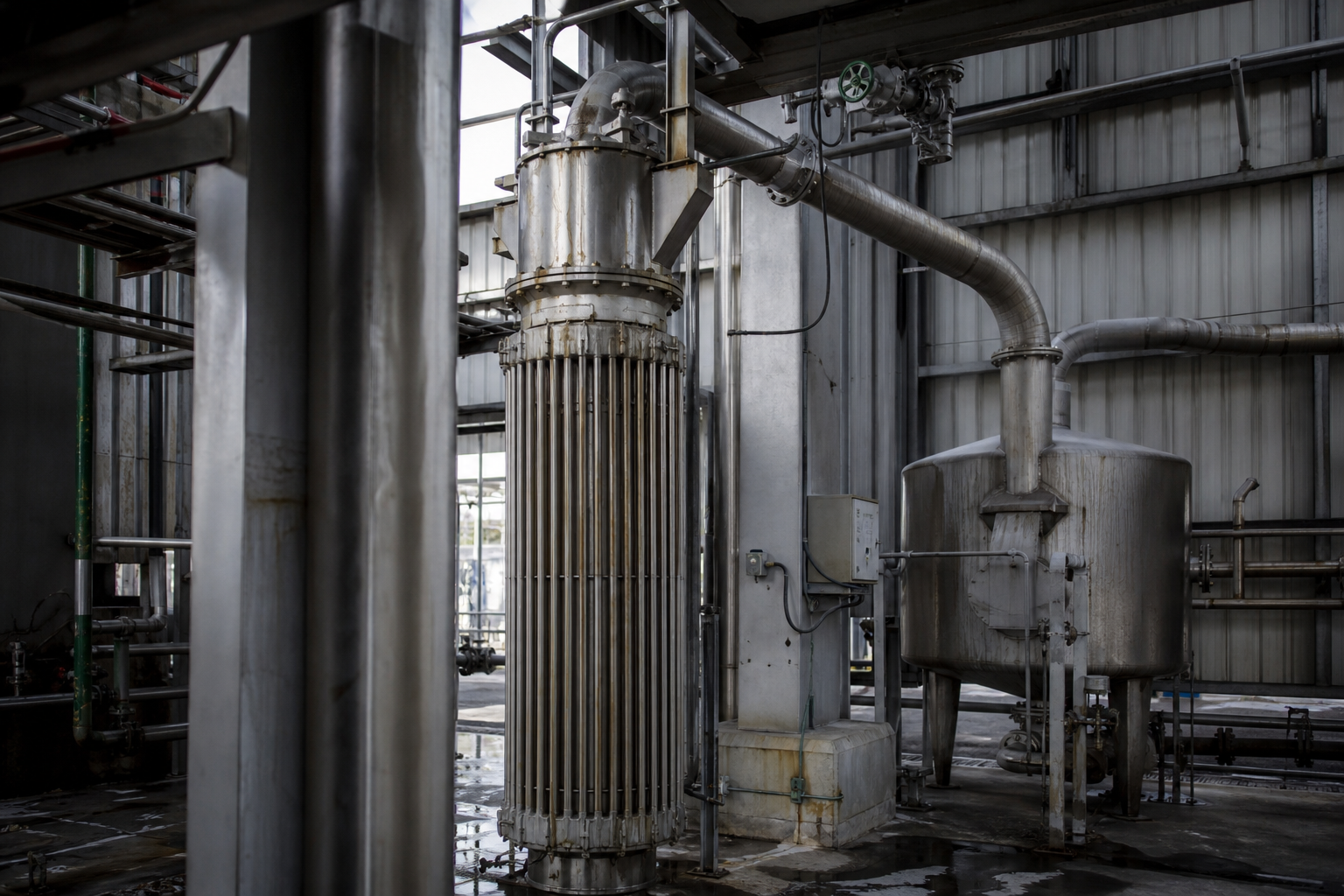
Because film heat transfer is intrinsically efficient, these units deliver industry-reported heat-transfer performance on the order of 30% above traditional concentration equipment at comparable duty. Constructed in 316L or duplex 2205 to match the sulfate-medium corrosion budget, with anti-fouling internals and automatic (CNC-controlled) cleaning cycles, the falling-film stage handles the bulk water removal cleanly and hands a concentrated liquor to the crystallization stage.
Process Route 2: Countercurrent Multi-Effect Evaporation
For the concentration-to-crystallization stretch, multi-effect evaporation remains a strong choice where steam is available. The configuration that suits MnSO4 specifically is countercurrent (reverse) feed: liquor advances from the low-temperature effect to the high-temperature effect, so it becomes progressively more concentrated as it becomes progressively hotter. Because MnSO4 solubility falls with rising temperature, the salt’s behavior and the effect-to-effect temperature ladder stay aligned along the feed path – the process works with the thermodynamics rather than against them.
Multi-effect vacuum crystallization designs exploit the same alignment: by operating under vacuum and staging the concentration, crystallization is induced at controlled, appropriate conditions instead of on the hottest available surface. Each kilogram of live steam is reused across effects, cutting steam demand dramatically versus single-effect operation.
Process Route 3: MVR with External-Circulation Crystallization
Mechanical vapor recompression replaces purchased steam with electricity: the secondary vapor is compressed, its temperature raised, and it is reused as the heating medium in a closed loop. For MnSO4, the decisive detail is where boiling occurs. In a conventional forced-circulation crystallizer with process liquid inside the tubes, the liquor is heated through the tube wall exactly where inverse solubility wants crystals to form – rapid tube fouling and blockage are the signature failure.
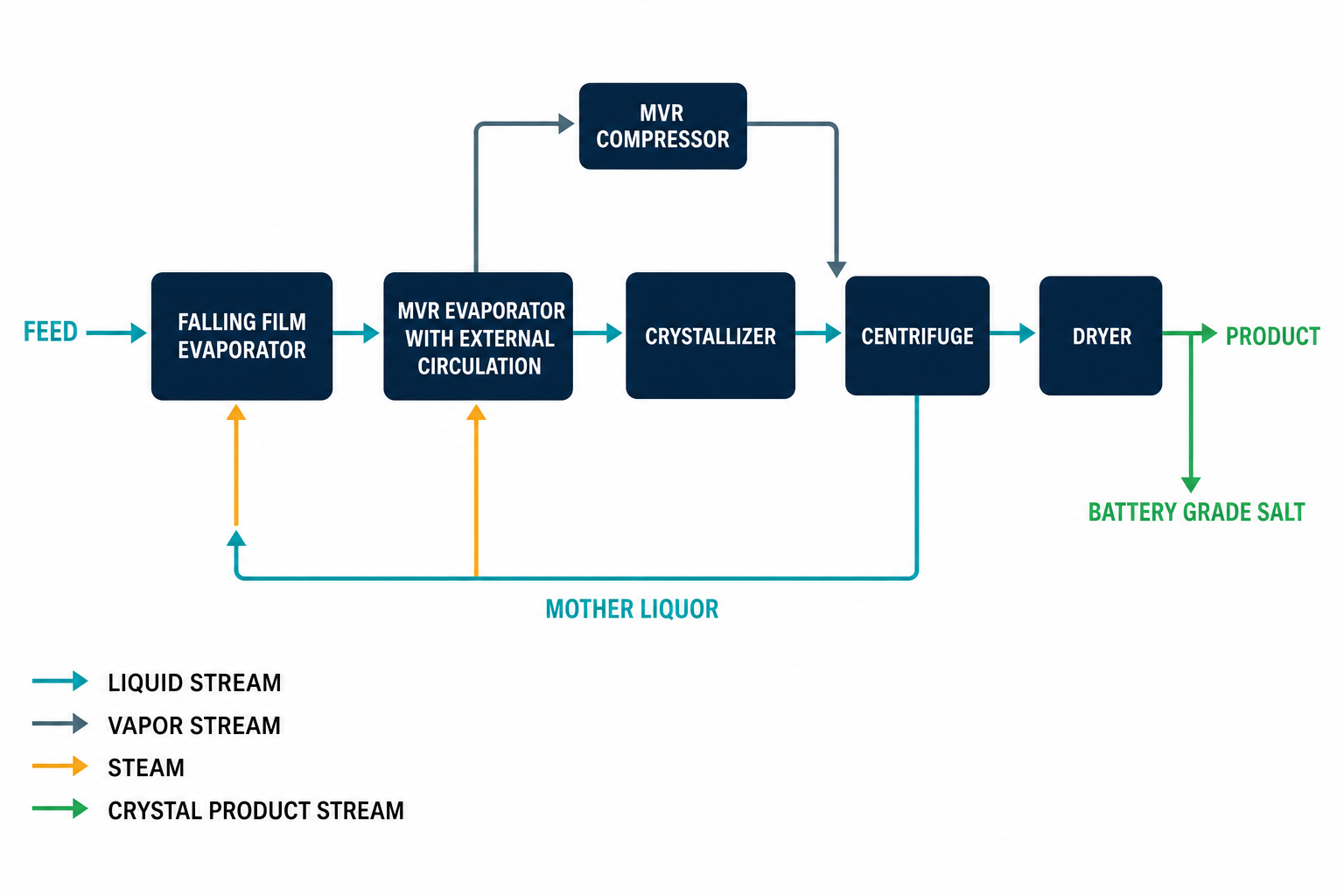
The proven answer is an external-circulation arrangement: heating happens across a surface with the process liquid circulating outside the tubes, and the more vigorous the circulation, the thinner the stagnant boundary layer at the heat surface. Crystallization proceeds in the bulk liquid rather than at the wall. Even if some deposition starts, it cannot anchor as a stable, growing layer – agitation keeps detaching it, and the scale self-sheds instead of accumulating. This geometry change, not higher pumping, is what makes MVR dependable for manganese sulfate.
Choosing Between the Routes
| Criterion | Falling-film pre-concentration | Countercurrent multi-effect | MVR external-circulation |
|---|---|---|---|
| Best position in train | Dilute feed, bulk water removal | Mid-to-high concentration with steam available | Final concentration + crystallization |
| Energy basis | Steam or MVR-driven | Live steam, reused across effects | Electricity only |
| Fouling exposure | Low (short residence, small delta-T at wall) | Moderate (managed by countercurrent alignment) | Low at wall (bulk-liquid boiling) |
| Capital cost | Low to medium | Medium | Higher (compressor) |
| Automation | Full PLC with auto CIP | Basic to full | Full PLC, unattended |
In practice the routes are complementary rather than competing: a common plant design runs falling-film pre-concentration on dilute liquor, then countercurrent multi-effect or MVR crystallization to product. The selection between multi-effect and MVR at the crystallization stage comes down to site energy economics – steam price versus electricity price – and utilization: the more hours per year the plant runs, the faster the MVR compressor premium pays back. Our MVR technology overview walks through the compressor and thermodynamic details.
Whichever route is chosen, the plant decomposes into standard process modules:
| Process module | Equipment candidates | Selection basis | Indicative envelope |
|---|---|---|---|
| Feed conditioning | Settling; cartridge filtration | Leaching insolubles must not reach the film distributor | Per feed survey |
| Pre-concentration | Falling-film evaporator, 316L or duplex 2205 | Dilute lean-ore liquor; low wall temperature rise | Duty set by feed concentration |
| Concentration & crystallization | MVR external-circulation crystallizer; countercurrent multi-effect | Energy economics and utilization | Industry-reported 50-70% saving class |
| Crystal recovery & drying | Thickener; centrifuge; rotary or flash dryer | Monohydrate handling; drying temperature limits | Matched to crystal rate |
| Cleaning | Programmed CIP | Inverse-solubility fouling discipline | Interval set by pilot fouling data |
Configuration, materials, and operating ranges for each module depend on the actual feed, temperature, pressure, corrosion review, fouling behavior, utilities, and project capacity.
Materials and Cleaning Strategy
Manganese sulfate is a sulfate medium without chloride aggression, so the corrosion envelope is gentler than lithium-chloride duty: 316L serves general service, with duplex 2205 specified where design temperature and stress justify the upgrade – including better resistance to the scaling that defines this application. Anti-scaling structure plus an automated cleaning system (programmed CIP rather than manual tube drilling) is what converts a fouling-prone duty into a continuously operating one; every serious MnSO4 quote should state the cleaning philosophy explicitly.
Reference Installation
As an external industry reference, published vendor cases describe manganese-sulfate MVR service of this class: one China-based installation reports treating MnSO4-bearing process water at 1 t/h with external-circulation crystallization, running continuously between programmed cleanings, holding mother liquor in circulation for yield recovery, and discharging crystal slurry to thickening and centrifugation before drying and packing as monohydrate product. These are supplier-reported figures for the duty class – an indicative range, not a project guarantee, and not a statement of EvapCryst delivery experience.
Battery-Chain Context
Manganese sulfate sits inside the same battery-materials landscape as lithium salts: EMD production for alkaline and lithium-manganese batteries electrolyzes high-purity MnSO4 liquor, while NMC and LMFP precursor synthesis consumes high-purity manganese sulfate solution. In every case, the evaporation-crystallization step controls both energy cost and the impurity purge that mother-liquor management provides. Related duties on this site include our lithium chloride MVR solutions, the sulfate-salt sibling zinc sulfate solutions, and closed-loop designs under zero liquid discharge.
When This Route May Not Fit
This route is the wrong tool when the duty is genuinely small or intermittent: batch kettles serving a few hundred tons of monohydrate per year rarely justify a continuous train with automated CIP. Sites with very cheap captive steam and expensive electricity may find countercurrent multi-effect better priced than MVR at the crystallization end. Where the feed carries significant chloride, the sulfate-friendly materials budget assumed above no longer holds and corrosion-resistant alloys reprice the project. And where battery-grade purity is the target, evaporation-crystallization alone does not deliver it: heavy-metal removal ahead of the evaporator, not the evaporator itself, sets the impurity ceiling.
What Must Be Verified
Before committing to a route, four inputs must be verified against the actual stream. First, a full leach-liquor analysis – manganese content, sulfate baseline, and the impurity slate of calcium, magnesium, iron, and heavy metals – because these set the crystallization purity path and the purge strategy. Second, scaling behavior: for an inversely soluble salt, a bench or pilot concentration test measuring the cleaning interval on the candidate heat-transfer geometry is worth more than any datasheet. Third, the site energy pair – steam price against electricity price, with annual operating hours – which settles multi-effect versus MVR. Fourth, the product specification itself: feed-grade versus battery-grade duty changes the upstream purification scope, and monohydrate drying temperature limits set the finishing design.
Frequently Asked Questions
Can manganese sulfate solutions be evaporated and crystallized at all?
Yes – MnSO4 solution is routinely processed by evaporation-crystallization, and the product of atmospheric evaporation is monohydrate crystal (MnSO4·H2O). The design constraint is inverse solubility, which dictates where boiling occurs, not whether it can.
Why does my forced-circulation evaporator scale up so fast on MnSO4?
Because tube-side heating puts the liquor’s hottest point against the tube wall exactly where inverse solubility drives crystallization. Raising circulation velocity alone does not fix it; moving boiling to the bulk liquid via external circulation, or using falling-film pre-concentration with low wall temperature rise, does.
Is MVR or multi-effect better for manganese sulfate?
Both work. Multi-effect suits sites with cheap available steam; MVR suits high-utilization plants with reasonable electricity prices, delivering an industry-reported 50-70% energy reduction against traditional single-effect concentration. Many plants combine falling-film pre-concentration with either option for crystallization.
What materials are used for MnSO4 service?
316L for general duty, duplex 2205 for elevated temperature and scaling resistance. Titanium grades are not normally required because the medium is a sulfate, not a chloride.
Does lean ore change the evaporator specification?
Yes. Lean ore (below roughly 20% Mn) yields dilute leach liquor, which multiplies water removal per ton of product. The falling-film pre-concentration stage becomes economically essential, and specific energy per ton of water evaporated becomes the controlling cost metric.
The short version: manganese sulfate rewards designers who respect its inverse solubility. Route the heat through falling films on dilute feed, keep boiling off the tube wall at the crystallization end, align concentration with temperature in countercurrent where multi-effect is chosen, and automate the cleaning. Done this way, MnSO4 evaporation-crystallization holds stable output at half to two-thirds the traditional energy bill – and the same architecture scales smoothly from feed-grade salt to battery-grade liquor purification. To screen this route for a specific liquor, share the feed analysis, the target production rate, and the product-grade specification – enough for an initial process-direction assessment.