Project Parameters
| Parameter | Value |
|---|---|
| Process route | Ten-body seven-effect falling-film evaporation with plate heat exchangers |
| Industry | Pulp & paper — semi-chemical pulping black liquor recovery |
| Feed type & key components | Semi-chemical pulp black liquor; dissolved organics, alkali lignin and silicate carry-over typical of semi-chemical cooking |
| Evaporation capacity | 300 t/h water evaporation |
| Construction materials | SS316L wetted parts (indicative for this service) |
Representative process configuration compiled from published industry project data. Indicative values, not a process guarantee.
Project Description
A large packaging-paper base in Northeast China operates semi-chemical pulping lines whose black liquor must be concentrated from weak-liquor solids to firing strength before the recovery boiler — and the evaporation plant that does it is one of the largest single chemical-recovery utilities on the site, rated at 300 t/h of water removal. The published configuration arranges ten falling-film evaporator bodies across seven effects, with plate heat exchangers throughout, a scale typically reached only by the biggest integrated paper bases.
Semi-chemical black liquor is a harder feed than kraft liquor from the same duty. The cooking chemistry leaves more dissolved silicate and hemicellulose fragments in the liquor, which raises viscosity at a given solids content and sharpens the fouling risk on heat transfer surfaces. The design answer published for this project is plate-type falling film: high heat transfer coefficients at low temperature difference, compact bodies, and surfaces that tolerate the elevated viscosity better than conventional tube bundles.
Process Technology
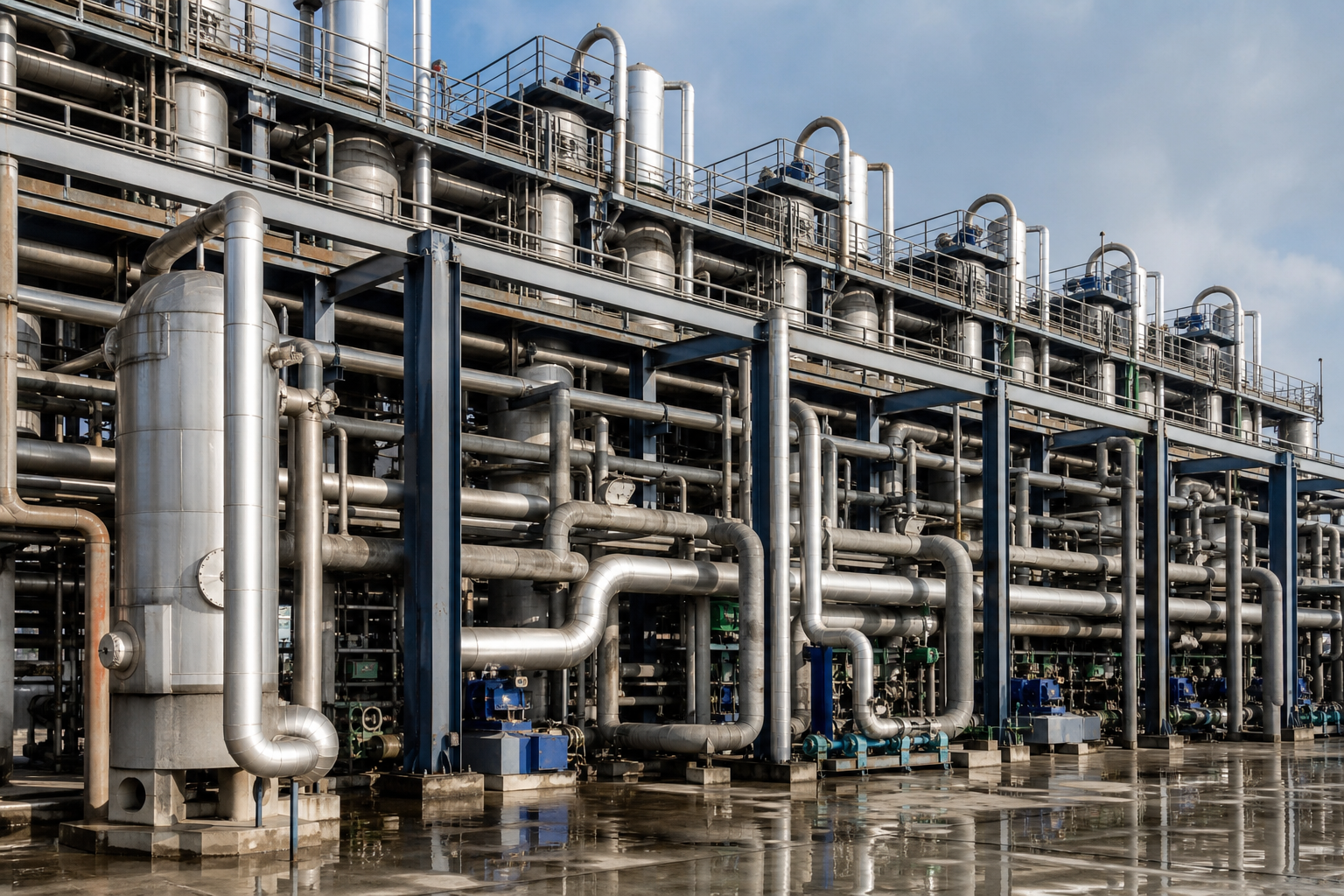
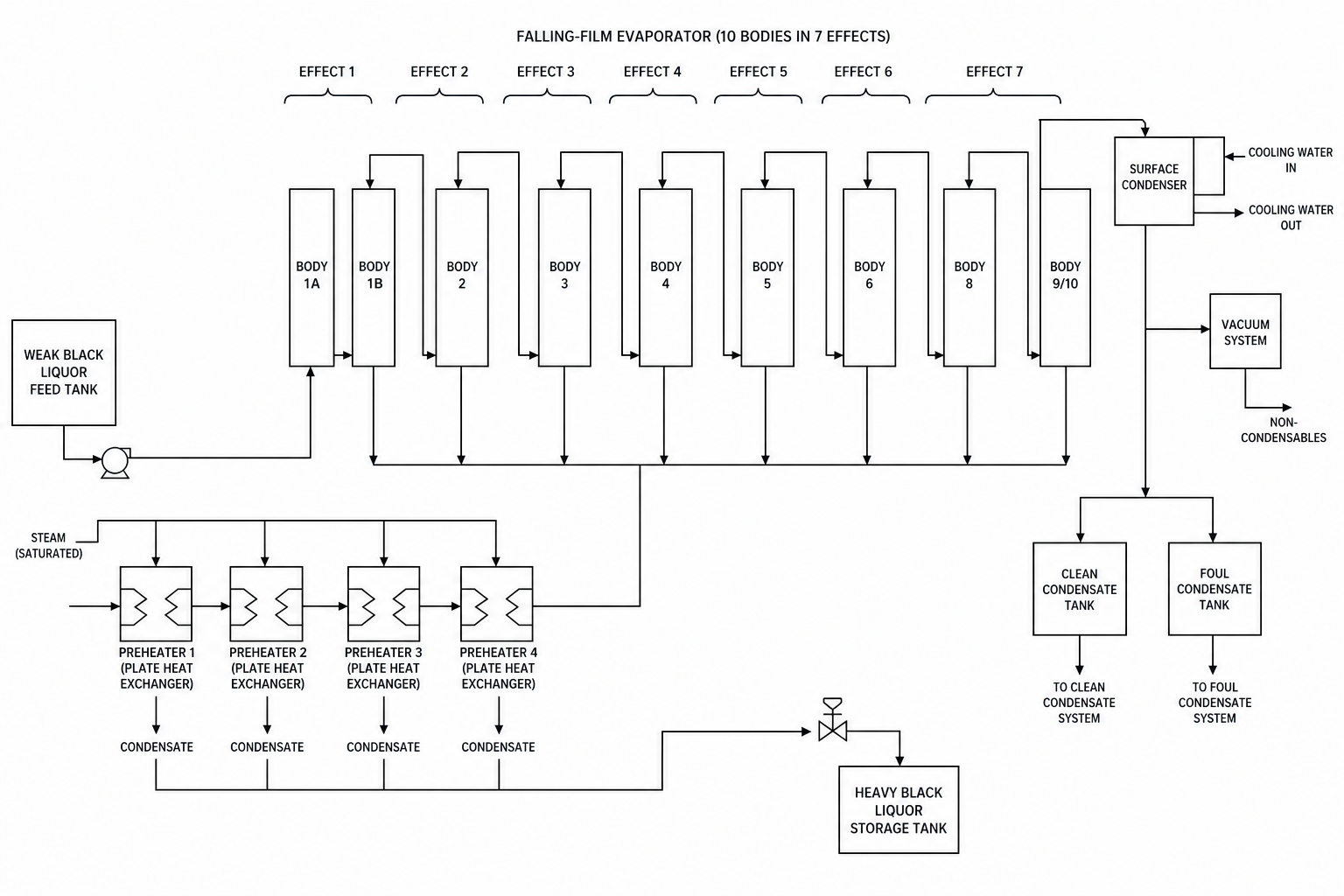
Weak black liquor from the washing plant is screened for fiber carry-over and preheated in condensate exchangers, then distributed to the head of the train. The ten bodies are arranged across seven effects: the vapor-hungry head effects are split into parallel bodies to keep liquor distribution and vapor load balanced, while the tail effects run single bodies as volume falls. Live steam drives the first effect only; each subsequent effect boils on the vapor of its predecessor at progressively lower temperature and pressure, dividing the live steam demand per tonne of water by close to seven in ideal service.
Plate heat exchangers carry the duty in every effect. Their corrugated plates sustain turbulence at low temperature difference, which matters for semi-chemical liquor: the film stays mobile as solids climb, and the low approach temperature protects the organics from thermal degradation that would otherwise raise scaling. Falling-film geometry adds short contact time — seconds per pass — which keeps the liquor’s viscosity and fouling behavior inside the design envelope through the mid-effects.
The tail of the train concentrates to heavy liquor under vacuum, with a surface condenser and vacuum system holding boiling temperatures down. Condensate is segregated by contamination class: clean hot condensate from the later effects returns to pulp washing, while first-effect condensate with volatile organics is collected for foul condensate treatment. Heavy liquor at firing solids reports to the recovery boiler or liquor storage, closing the chemical recovery loop.
Fouling management is designed-in rather than reactive: CIP circuits route hot wash water or alkaline solution through bodies in rotation, and the plate construction shortens cleaning outages relative to tube bundles — the property that has made plate falling film the default choice for new semi-chemical and straw-liquor duties in China.
Equipment Configuration
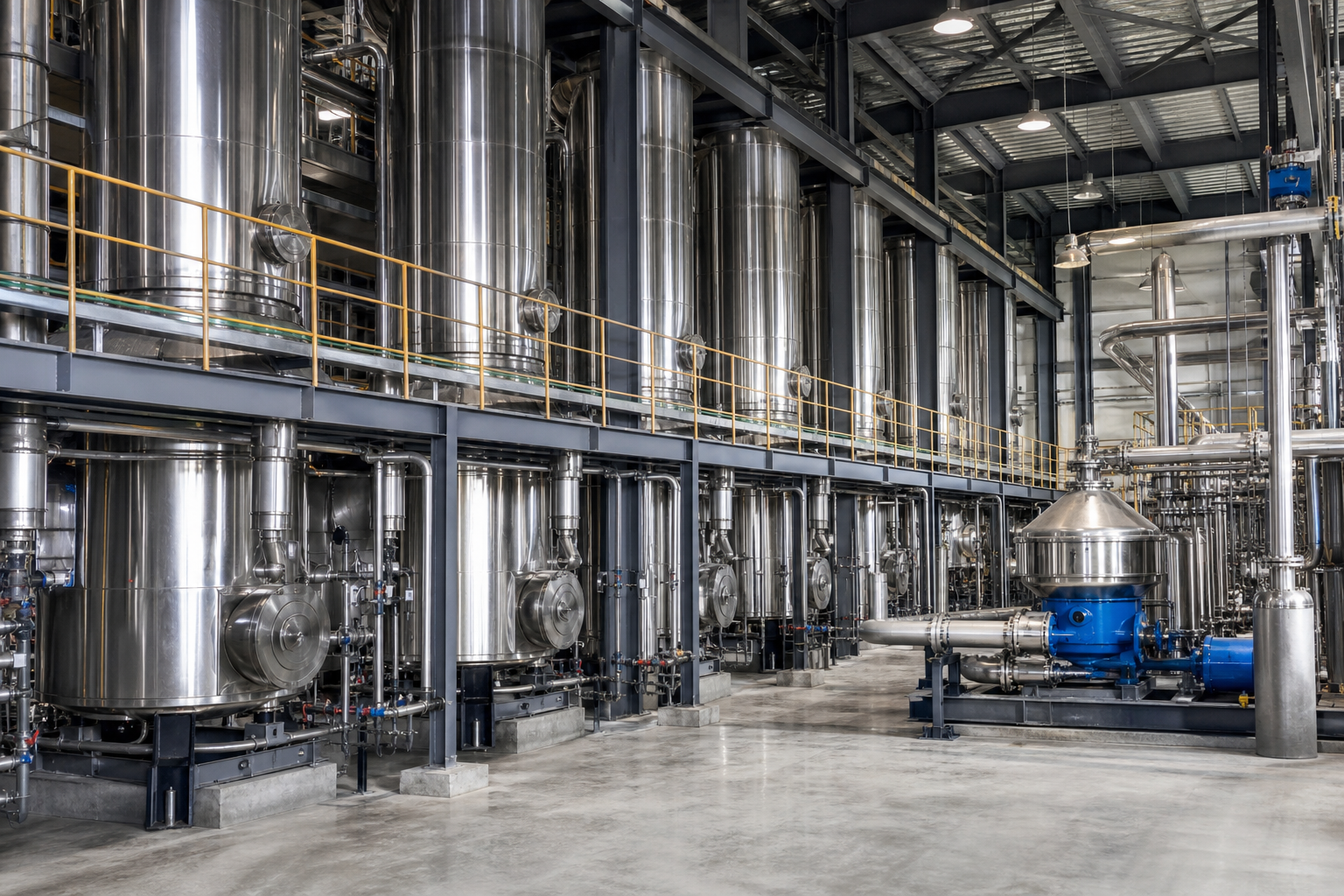
One set of the following equipment is typical for this duty:
- Weak black liquor screening and condensate-based preheating
- Ten plate-type falling-film evaporator bodies arranged across seven effects
- Live-steam head effect with vapor forwarding between effects
- Surface condenser and vacuum system on the final effect
- Segregated clean / foul condensate collection with recovery to pulp washing
- Heavy liquor storage and forwarding to the recovery boiler
- Rotating CIP system for plate surfaces; SS316L wetted parts
Performance & Outcome
Compiled from published industry project data, indicative: trains of this class concentrate semi-chemical black liquor at 300 t/h on seven-effect steam economy with plate falling-film bodies, returning clean condensate to washing and heavy liquor at firing solids to the recovery boiler. Steam per tonne of water and run length between cleanings are quoted per project liquor.