Project Parameters
| Parameter | Value |
|---|---|
| Process route | TVR + triple-effect falling-film evaporation, seven concentration stages |
| Industry | Tea extract & beverage ingredients (Fujian, Southeast China) |
| Feed type & key components | Tea extraction liquor: tea polyphenols, caffeine, aroma compounds, heat-sensitive solids |
| Evaporation capacity | 24 t/h |
| Construction materials | SS316L wetted parts (food-grade finish) |
Representative process configuration compiled from published industry project data. Indicative values, not a process guarantee.
Project Description
Fujian is one of China’s core tea-producing provinces, and its tea extract industry supplies beverage makers with concentrated tea liquor — the base for bottled tea drinks, instant tea powder and ingredient formulations. The extraction stage pulls soluble solids, polyphenols and caffeine from the leaf with hot water; the concentration stage then removes most of that water again to ship extract instead of shipping water. The published project for this duty is a 24 t/h evaporation train at a tea extract producer in the province: mid-scale by food-evaporation standards, but demanding at the chemistry level.
Tea extract is a delicately balanced product. The polyphenols that carry the health-positioned value are heat-sensitive; the aroma fraction that carries the character is volatile; and the liquor&rsquos color darkens with thermal abuse. The concentration train therefore works under the same disciplines as coffee and TCM extract evaporation — low temperature, short residence time, and aroma management — while hitting the throughput of a commercial beverage-ingredient plant.
Process Technology
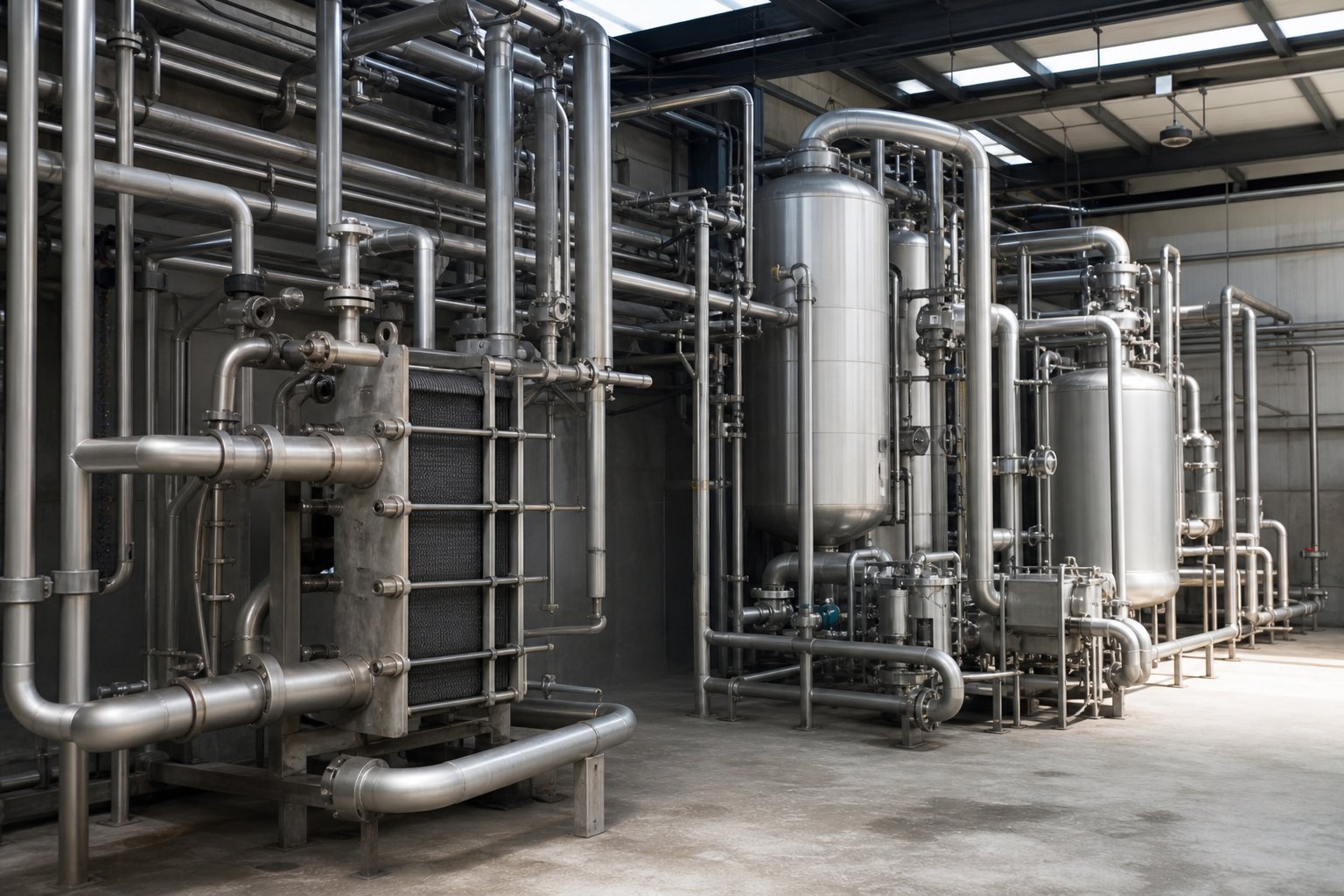
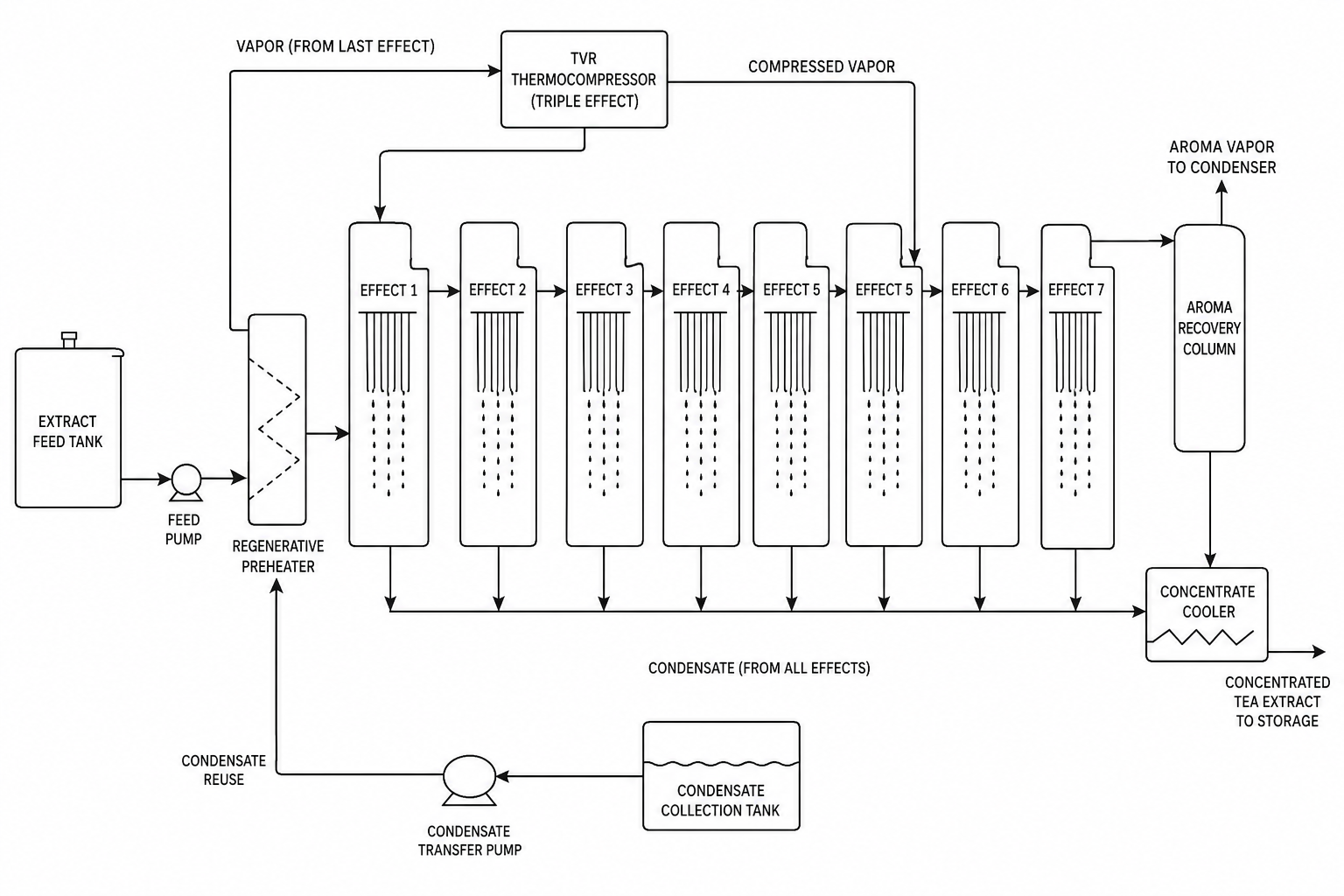
Clarified tea extract from the extraction and filtration stage is preheated in regenerative exchangers and fed to the first effect of a triple-effect falling-film train arranged across seven concentration stages. Falling film is the body type this product family converges on: the liquor descends as a thin film inside the calandria tubes, evaporating at low temperature difference with residence time measured in seconds — the regime that concentrates heat-sensitive extracts without cooking color and flavor into them. Seven stages spread across three effects give the train fine control over the concentration path, stepping the extract up gently rather than in few violent jumps.
The TVR thermocompressor drives the train: live steam through an ejector entrains and recompresses recycled secondary vapor, so each kilogram of boiler steam motivates well more than a kilogram of evaporation across the three effects. At 24 t/h, TVR is the classic economics — the site has steam, and the thermocompressor delivers multi-effect-level steam economy without the electrical machine of an MVR system.
Volatiles management is part of the process, not an afterthought: aroma-bearing first-effect vapor is condensed in a way that allows aroma recovery and re-blending into the concentrate, the practice that keeps instant tea tasting like tea. Concentrated extract is cooled quickly and held in finished-product tankage for spray drying or aseptic packing. Condensate from the later effects is clean hot water reused in extraction and CIP.
Equipment Configuration
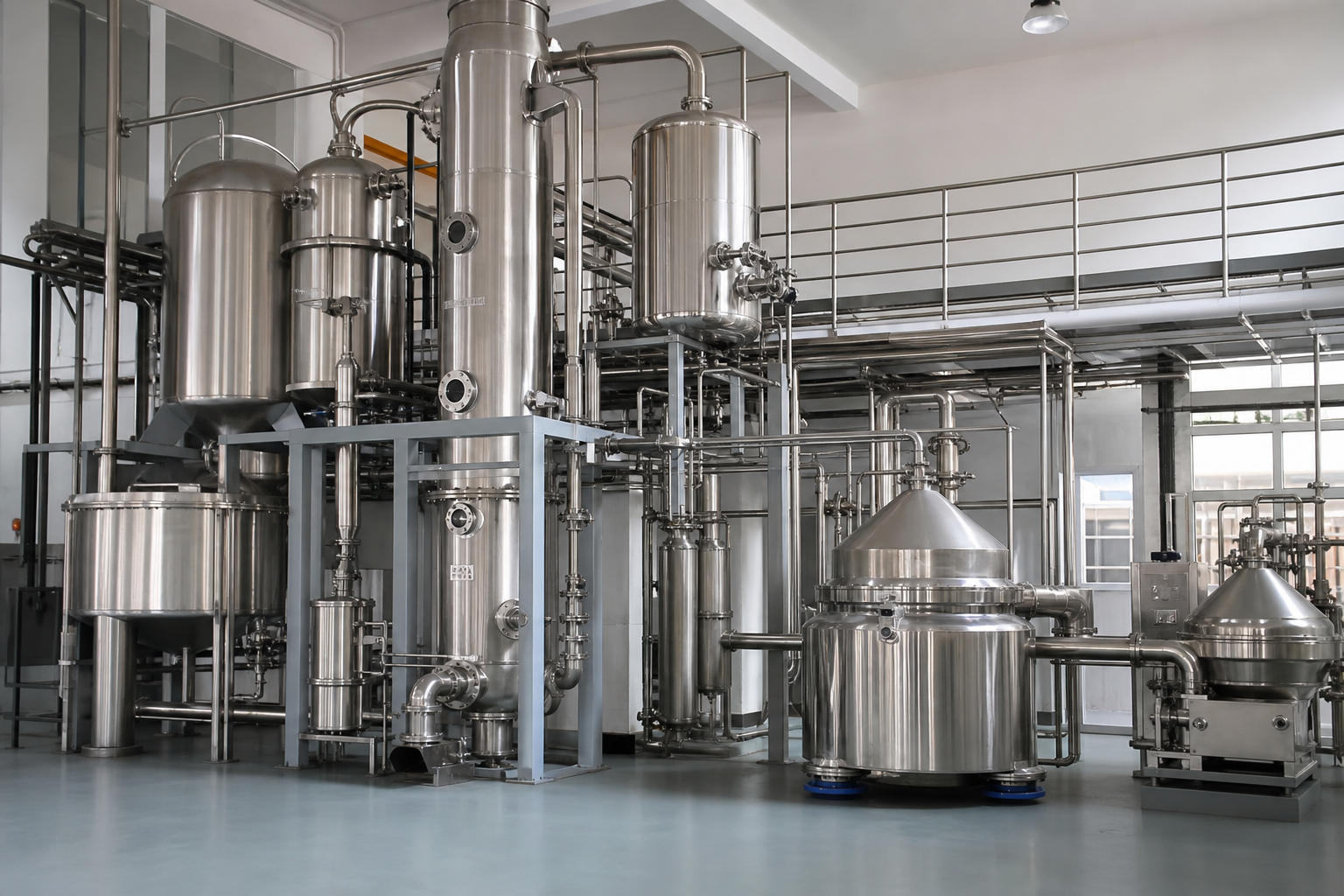
One set of the following equipment is typical for this duty:
- Extract feed tank with clarification protection and regenerative preheating
- Triple-effect falling-film train with seven concentration stages, food-grade SS316L
- TVR thermocompressor on the first effect with steam conditioning
- Aroma recovery condensation from first-effect vapor with re-blending
- Concentrate cooling and finished-product tankage; spray dryer / packing interface
- CIP system; PLC control of stage temperatures and concentrate Brix
SS316L with food-grade surface finish is the reference construction; all product-contact surfaces designed for clean-in-place.
Performance & Outcome
Compiled from published industry project data, indicative: trains of this class concentrate tea extract at 24 t/h on TVR steam economics with seven-stage gentle concentration, preserving polyphenols, color and aroma. Steam per tonne of water and concentrate Brix targets are quoted per project.
A comparable process routing is covered in Food and Beverage Evaporation Solutions.