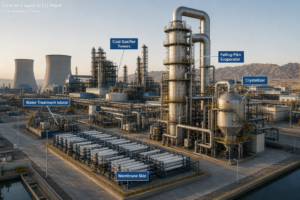
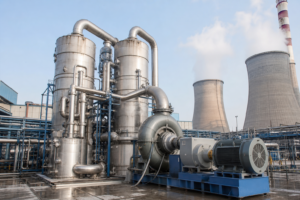
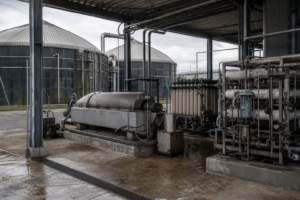
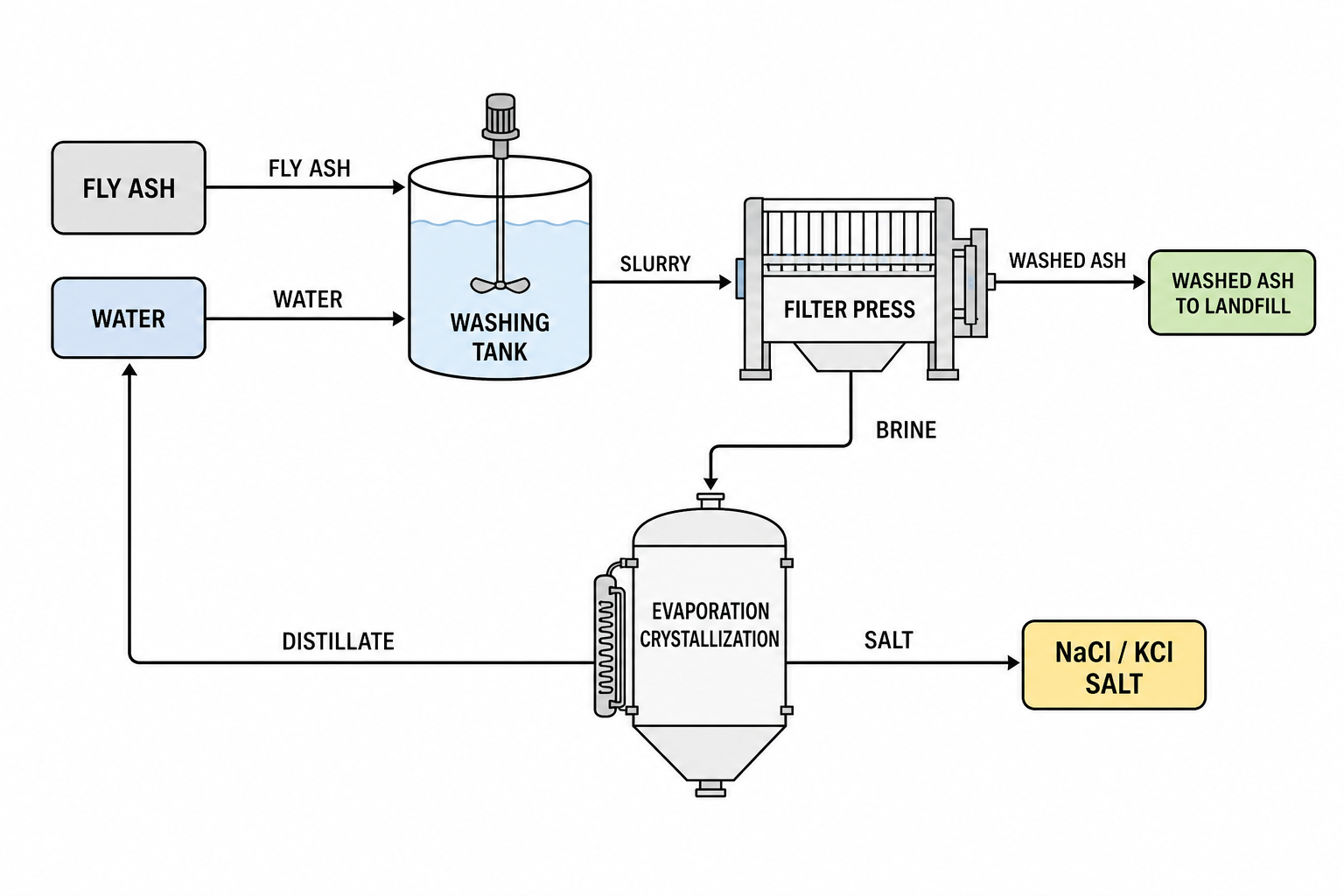
Washing municipal solid waste incineration (MSWI) fly ash, then treating the wash water with MVR evaporation crystallization, converts a hazardous dust into three benign outputs: dechlorinated ash that enters cement kilns, industrial-grade sodium chloride and potassium chloride salts, and recycled wash water. Fly ash from waste incinerators is classified as hazardous waste because it concentrates dioxins and heavy metals — chromium, cadmium, mercury, lead — together with a heavy load of soluble chlorides that block direct use in cement. The washing circuit moves the chlorides into water; the MVR evaporator moves them out as crystalline salt. Published operating data for this process family — external industry references drawn from equipment-vendor material and China’s HJ 1134-2020 technical specification, not EvapCryst project records — report dioxin destruction above 99% in the pre-treatment stage (residues below 30 ng-TEQ/kg, vendor-reported, against the 50 ng-TEQ/kg limit HJ 1134-2020 sets for treated fly ash), washed ash chlorine below 1% for cement co-processing, evaporator energy 50–80% below conventional evaporation, and condensate recycle above 90% back to washing: indicative ranges, not project guarantees. The fly ash stops being a landfill liability and becomes feedstock.
Why Fly Ash Cannot Go Anywhere Without Dechlorination
Acid-gas scrubbing with lime deliberately pushes chlorine, with dioxin congeners and condensed heavy metals, into the flue-gas cleaning residues — that is what fly ash is. The soluble chloride content (commonly several percent, dominated by NaCl and KCl from food waste and PVC) is the barrier to reuse: chlorine above roughly 1% attacks kiln linings, volatilizes as HCl, and recirculates as alkali-chloride deposits that throttle capacity. Dioxins and leachable metals are the second barrier — they demand either thermal destruction or stable mineral fixation. Chelate solidification and landfill manages the risk but consumes landfill forever and wastes the ash’s calcium–silicon–aluminum matrix, nearly a cement raw meal. Washing unlocks the resource route: remove the chlorides into water, destroy or fix the dioxins, and let the kiln do what it does best at 1,450 °C.
The Process Chain
| Process module | Equipment candidates | Selection basis | Indicative envelope (reported) |
|---|---|---|---|
| 1. Thermal de-dioxin treatment | Inert-atmosphere rotary or kiln-type reactor | Destroy dioxins before handling, outside the 250–450 °C re-formation window | ~350 °C, ~30 min hold; >99% degradation; <30 ng-TEQ/kg vendor-reported (HJ 1134-2020 limit: 50 ng-TEQ/kg) |
| 2. Staged counter-current washing | Multi-stage counter-current wash columns | Transfer soluble chlorides and metals to water at minimum fresh-water input | Engineered water-to-ash ratio; ash chlorine <1% |
| 3. Brine clarification & polishing | Coarse then fine filtration; hardness and heavy-metal removal | Protect the evaporator from suspended ash and scale formers | Dual filtration; polishing as brine analysis requires |
| 4. MVR evaporation + salt splitting | MVR forced-circulation evaporator-crystallizer, hot and cold stages | Energy closure on saturated chloride brine; NaCl/KCl solubility split | Energy 50–80% below conventional evaporation; NaCl GB/T 5462, KCl GB 6549 |
| 5. Ash routing | Filter press, cake handling, kiln feed system | Resource use of dechlorinated ash | Cement co-processing ≤3% of raw meal; ceramsite alternative |
| 6. Water loop | Condensate return, closed wash circuit | Close the wash circuit with zero discharge | >90% condensate recycled |
Configuration, materials, and operating ranges depend on the actual ash, wash chemistry, corrosion review, fouling behavior, utilities, and project capacity.
Step 1 in Detail: Destroying Dioxins Without Re-Forming Them
Dioxins decompose at moderate temperature, but naive heating in air re-synthesizes them catalytically on fly-ash surfaces in the 250–450 °C window. The reported solution holds the ash at about 350 °C for roughly 30 minutes under inert atmosphere — hot enough for better-than-99% PCDD/F degradation yet far below the fuel cost of full oxidation — bringing residues under 30 ng-TEQ/kg (vendor-reported), within the 50 ng-TEQ/kg limit HJ 1134-2020 sets for treated fly ash. Inert-atmosphere control and tight temperature regulation prevent the re-formation trap at acceptable cost.
Step 2 in Detail: Counter-Current Washing
Multi-stage counter-current contact moves NaCl and KCl — plus soluble heavy-metal species — from ash to water at minimum fresh-water input: fresh water meets the cleanest ash, each successive stage reuses dirtier liquor against dirtier ash, and the brine leaves the circuit near saturation while the exiting ash meets its chlorine target (reported below 1%, the cement-kiln threshold). Slurrying is agitated to controlled solids content; separation uses coarse screening then fine filtration so the wash water carries minimal suspended ash into the evaporator — fines are the classic cause of fouled heat transfer and cloudy salt. Washed-ash cake moisture control and, where needed, a light acid or additive wash to tune metal solubility round out the stage.
Step 4 in Detail: MVR Evaporation and Salt Splitting
The chloride brine enters the MVR train through preheaters recovering sensible heat from condensate and discharge vapor, then concentrates in the evaporation chamber. The mechanical vapor recompressor lifts the boiled-off secondary steam to higher temperature and pressure so it can serve as the heating medium again — this is the closed heat loop that operators report cuts evaporation energy 50–80% versus steam-driven evaporation — a supplier-published indicative range, not a project guarantee. As the liquor reaches supersaturation, crystallization begins; in split-salt operation the high-temperature stage crystallizes sodium chloride first (its solubility is nearly temperature-flat), and the cooled mother liquor then yields potassium chloride, whose solubility rises steeply with temperature, so cooling the liquor crystallizes it out — the same solubility logic our sintering dust salt recovery solution applies to steel-plant brines.
Crystallizer slurry is centrifuged, and the salt cake is dried and checked — including heavy-metal content — against GB/T 5462 for sodium chloride and GB 6549 for potassium chloride. Mother liquor returns in a closed loop with a controlled purge to cap impurities. Process control centers on evaporation temperature, vapor pressure, and liquor density, with automatic adjustment of compressor load and feed rate; pH, agitation, and solids are monitored upstream.
Product and Residue Destinations
| Output | Specification | Destination |
|---|---|---|
| Sodium chloride | GB/T 5462 industrial salt (reported) | Industrial salt markets |
| Potassium chloride | GB 6549 (reported) | Potash/industrial use |
| Dechlorinated ash | Chlorine <1%; dioxin <30 ng-TEQ/kg (vendor-reported; HJ 1134-2020 limit 50) | Cement kiln co-processing ≤3% of raw meal (1,450 °C, metals fixed in clinker to GB 175); ceramsite feed alternative |
| Condensate | >90% recycled | Returns to washing circuit |
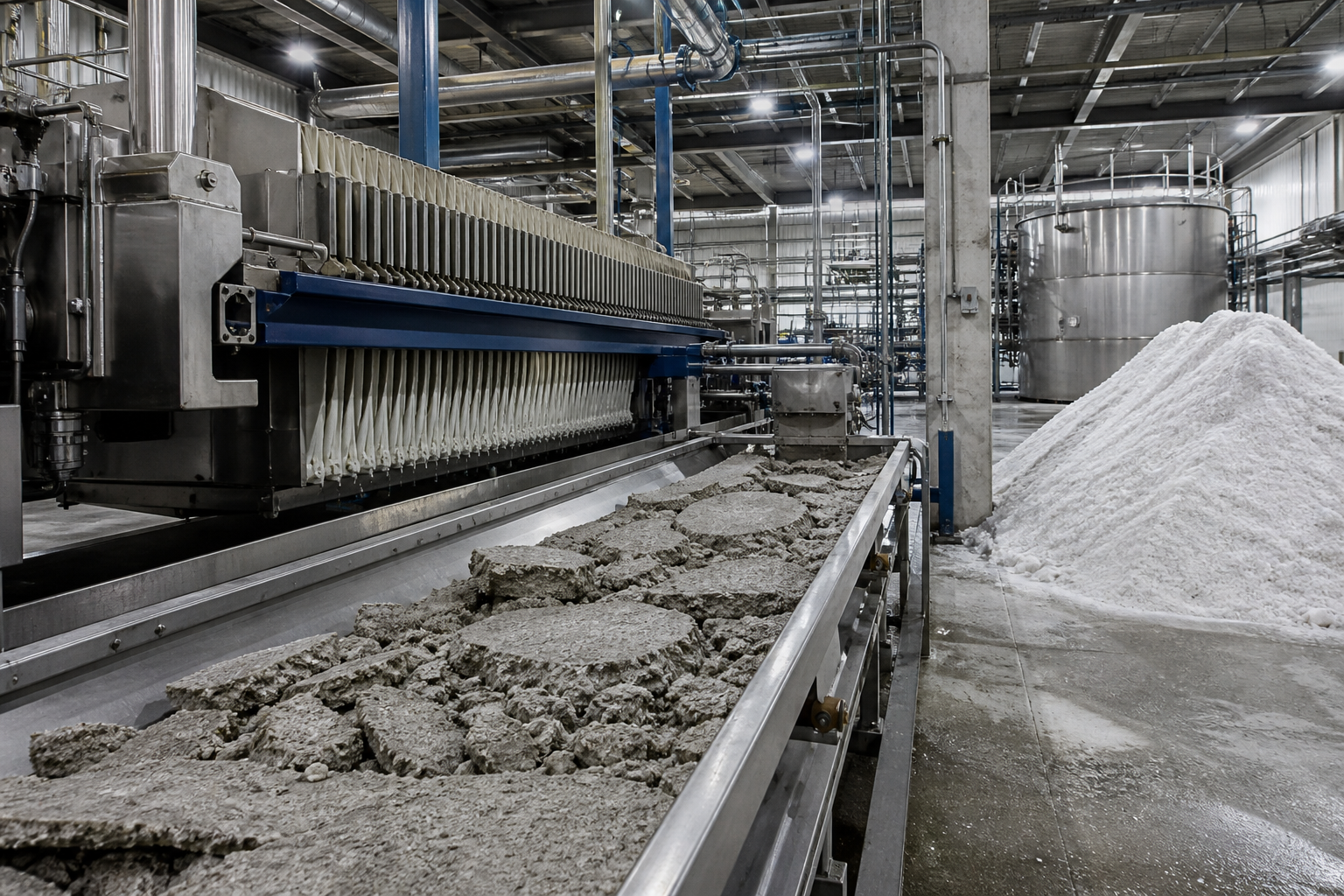
The cement route makes the economics close: co-processed at up to about 3% of raw meal, the ash’s calcium-silicon-aluminum content substitutes real raw materials while 1,450 °C clinkering destroys residual organics and fixes heavy metals into clinker meeting GB 175. Where kiln capacity is distant, sintered lightweight aggregate (ceramsite) is the established alternative.
Engineering Watch-Points Specific to Fly Ash Brines
- Solids discipline. Fine ash carryover into the evaporator fouls tubes and discolors salt; dual filtration and settling before the MVR train are non-negotiable.
- Ammonium and surfactants. Residual ammonia and detergent organics foam and follow the vapor; demisting plus condensate polishing protects reuse quality.
- Heavy-metal partitioning. Soluble Pb/Zn/Cd move partly into brine; the purge and any upstream precipitation step must be designed so product salt passes its metals limit.
- Chloride metallurgy. Near-saturated chloride service dictates titanium or equivalent alloys on wetted evaporator duty, with stainless or polymer selections in cooler zones.
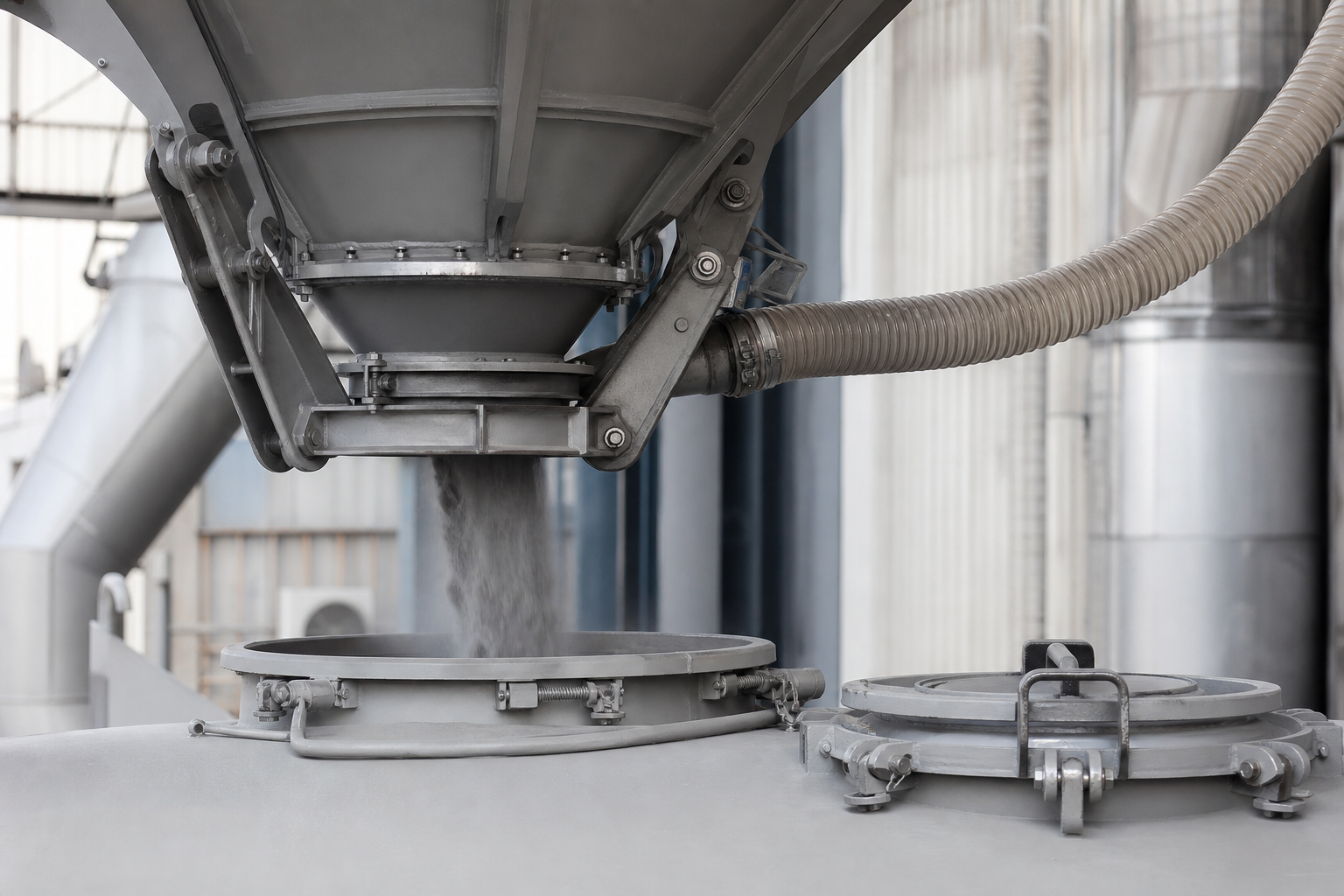
- Dust and handling. Fly ash is fine and hygroscopic; enclosed pneumatic transfer, covered storage, and humidity control keep the plant clean and feed consistent.
The same wash-concentrate-crystallize architecture, tuned for a different feed, powers our SCR catalyst wastewater solution; the equipment logic behind the evaporation core is on the MVR evaporation and salt separation pages, with solids conditioning under drying and packing. Sector framing for power and steel adjacent streams is on the power, steel and FGD industry page, and the water-closure framework under high-salinity ZLD systems.
When This Route May Not Fit
Washing-plus-recovery earns its place only when the barriers are real. Ash already below roughly 1% chlorine needs no wash circuit — it can route to the kiln directly. Plants far from any cement kiln and from a ceramsite market gain little from dechlorination they cannot monetize or dispose of nearby. Very small ash generators cannot spread the fixed capital of the thermal pre-treatment and MVR train. Where the brine’s Na/K balance or metal load yields a mixed off-spec salt with no buyer, the recovery leg degrades into expensive drying.
What Must Be Verified
Verification starts with the ash: a representative analysis across seasons and waste inputs — chlorine, dioxin TEQ, leachable metals, moisture — because every module is sized from it. Second, a washability test tying water-to-ash ratio to achieved dechlorination, since that ratio sets fresh-water demand and brine strength. Third, full brine chemistry: Na/K ratio, hardness, and metals decide whether salt splitting is worth building and which metallurgy survives. Fourth, salt marketability against GB/T 5462 and GB 6549 including heavy-metal limits. Fifth, the receiving kiln’s permit, substitution cap, and logistics.
Frequently Asked Questions
Does washing remove the heavy metals from fly ash?
Washing removes the soluble chloride fraction and a share of soluble metal species; the mineral-bound metals stay with the washed ash and are fixed into clinker phases during 1,450 °C cement co-processing. Brine-side metals are managed by precipitation and the purge stream so product salt stays within standard.
What happens to the dioxins?
Reported practice destroys over 99% of them in an inert-atmosphere ~350 °C / ~30-minute pre-treatment, holding residues below 30 ng-TEQ/kg (vendor-reported), comfortably inside the 50 ng-TEQ/kg limit of HJ 1134-2020. Any residuals are destroyed outright in the cement kiln.
Why is the ash washed instead of sent directly to the kiln?
Chlorine. Above roughly 1% Cl the ash causes kiln corrosion, HCl emissions and alkali-chloride circulation. Washing below that threshold is what permits kiln co-processing at meaningful substitution rates.
Is the recovered salt genuinely marketable?
Operating reports cite NaCl at GB/T 5462 industrial-salt grade and KCl at GB 6549 grade. Grade depends on brine purity discipline — filtration, metals control and mother-liquor management decide saleability.
How much energy does the MVR stage use?
Operators report 50–80% lower energy than conventional evaporation, because the compressor recycles secondary steam as the heating medium instead of drawing live steam. The exact figure scales with capacity and electricity tariffs — our energy comparison tool models this per project.
To screen this route for a specific ash stream, share the ash analysis (chlorine, dioxin TEQ, heavy metals), the throughput, and the intended outlet — kiln co-processing, salt recovery, or both; enough for an initial route assessment.