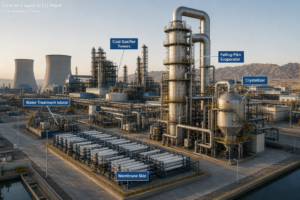
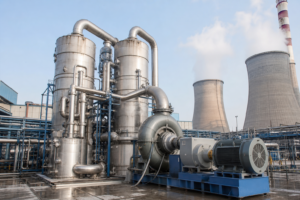
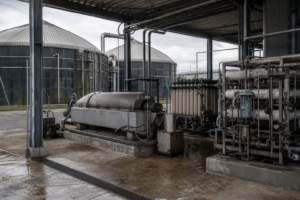
For semi-coke (blue-coke) plants, zero liquid discharge hinges on one stream: the high-salt concentrate left behind by membrane recovery, and the only technology that closes it is evaporation followed by crystallization. Semi-coke production — low-temperature carbonization of weakly caking coal at roughly 600–700 °C, concentrated in China’s Shaanxi Yulin, Xinjiang, Inner Mongolia and Ningxia energy corridors — generates wastewater that combines high COD (commonly in the thousands of mg/L and extreme cases far higher), ammonia nitrogen in the hundreds to low thousands, phenols and tar oils, all riding on a saline background that biology cannot touch. After oil removal, ammonia stripping, dephenolization and biological treatment, two-thirds or more of the water is recovered by reverse-osmosis trains — and what remains is a tens-of-grams-per-litre brine loaded with sodium salts, residual organics, silica and hardness. A forced-circulation MVR evaporation–crystallization train is the end-of-line unit that turns that concentrate into dry salt and reusable condensate, closing the plant’s water balance in regions where water, not permits, is often the binding constraint.
The Semi-Coke Industry and Its Water
Semi-coke (also sold as blue coke or lan-coke) is the solid product of retorting Jurassic-age, low-metamorphism coal at temperatures of roughly 600–700 °C — well below metallurgical coking — yielding a low-ash, high-fixed-carbon reductant that ferroalloy and calcium-carbide furnaces consume in large volumes, with additional demand from blast-furnace injection and clean domestic fuel substitution. The production regions are arid: Yulin in Shaanxi, the Junggar basins of Xinjiang, Inner Mongolia and Ningxia. That geography does two things to wastewater engineering. First, water itself is scarce enough that reuse is an economic objective, not an environmental gesture. Second, zero discharge is frequently a licensing condition, because there is no receiving water body to dilute an effluent with.
Wastewater arises wherever raw gas is cooled and cleaned: flushing and separation liquor (ammonia liquor) from gas condensation, quench and scrubbing water, gas-liquid separation drains, and purification-section blowdowns. Mixed together they form one of the most refractory industrial waters in common practice.
Water Chemistry That Breaks Conventional Treatment
- High organic load. COD commonly reaches the thousands of mg/L — severe cases run far higher — with a phenolic fraction (volatiles plus refractory di-/tri-hydroxybenzenes) that depresses biodegradability. BOD/COD ratios are low; the biomass works hard for modest removal.
- Ammonia nitrogen in the hundreds to low thousands of mg/L, requiring steam stripping or break-point treatment ahead of biology.
- Oils and tar. Dispersed and emulsified tar fouls exchangers and membranes unless gravity, centrifugal and coalescing separation run first.
- Salinity that only accumulates. Sodium chloride, sulfate and — depending on gas-cleaning chemistry — ammonium salts pass through every biological and oxidative step untouched, concentrating with each internal recycle.
The standard front end therefore reads: tar and oil removal, ammonia stripping, solvent dephenolization where economics justify, hydrolytic-acidification plus anoxic/oxic biological oxidation, and advanced polishing (coagulation, Fenton or catalytic ozonation, activated carbon) to pull residual COD down to reuse-plant quality. That train is well understood. Its product is clean permeate — and a concentrate that now concentrates everything the membranes rejected.
Why the Membrane Concentrate Is the Real Design Problem
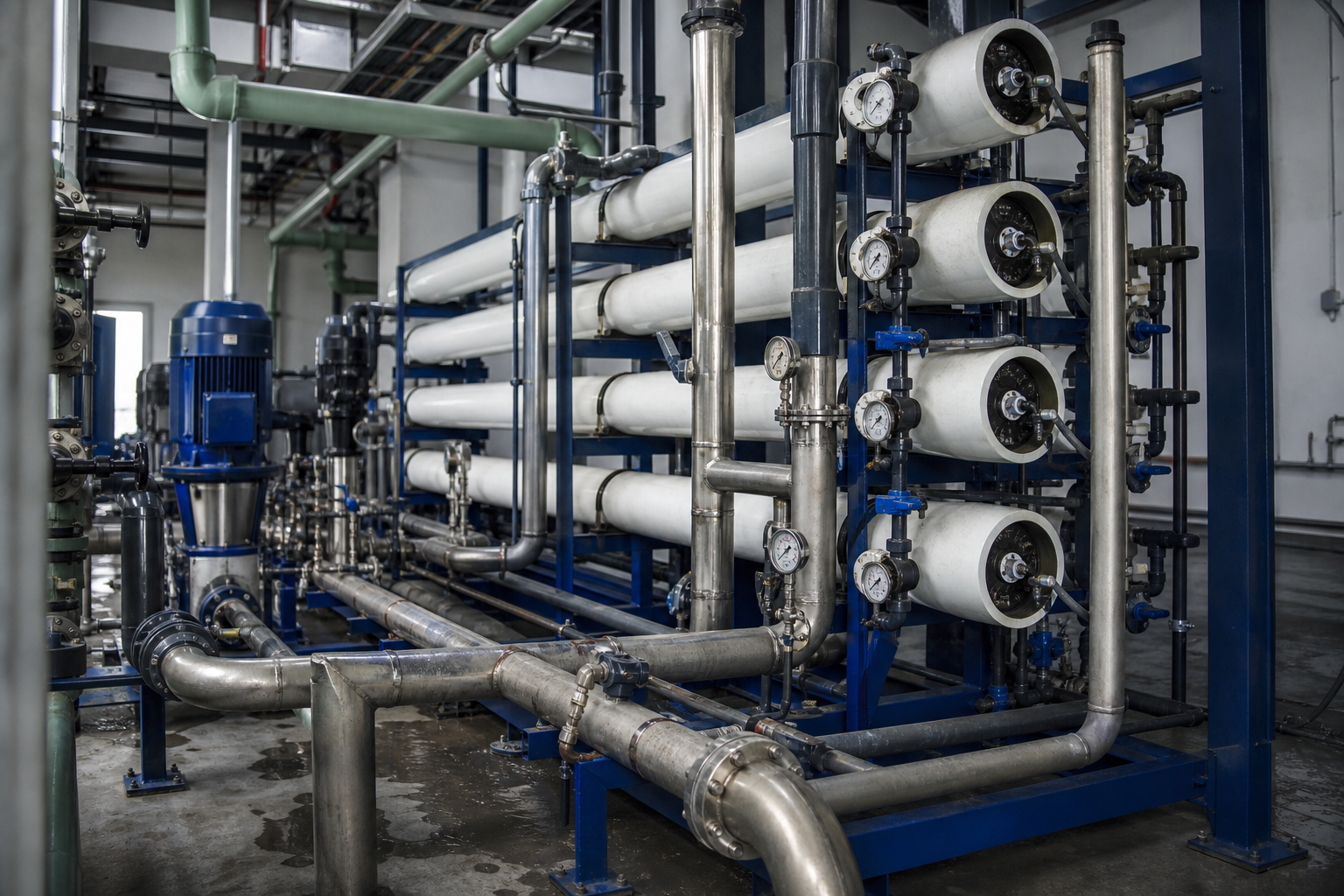
A reverse-osmosis block recovering 65–80% of the water as permeate leaves a concentrate whose TDS typically sits in the 30,000–60,000 mg/L range in published plant practice (higher where brine-concentrating staged designs are used; illustrative, not project data), and whose character is defined by what traveled with the salt:
| Concentrate feature | Illustrative origin | Consequence in the evaporator |
|---|---|---|
| Silica | Coal mineral matter dissolved in gas cleaning | Polymerized silica gel scales tubes irreversibly above its solubility envelope |
| Calcium / magnesium hardness | Make-up water and process additions | Sulfate and carbonate scaling on heat-transfer surfaces |
| Residual organics | Biorefractory COD that survived polishing | Foam, condensate contamination, colored salt, viscosity creep |
| Ammonium | Stripping carryover, ammonium salts | Reports to condensate as free ammonia at high pH; needs management or polishing |
| Mixed NaCl / Na₂SO₄ / ammonium salts | Coal chlorine and sulfur plus gas-cleaning reagents | Crystallization chemistry decides mixed salt versus split products |
Illustrative concentrate features compiled from published semi-coke plant practice and stated design assumptions — not customer or project data; the site water analysis governs every actual design.
This is why a semi-coke ZLD cannot be bought as a standard evaporator: the unit must be engineered around a concentrate analysis, or it will spend its life offline for cleaning.
The Evaporation–Crystallization Train
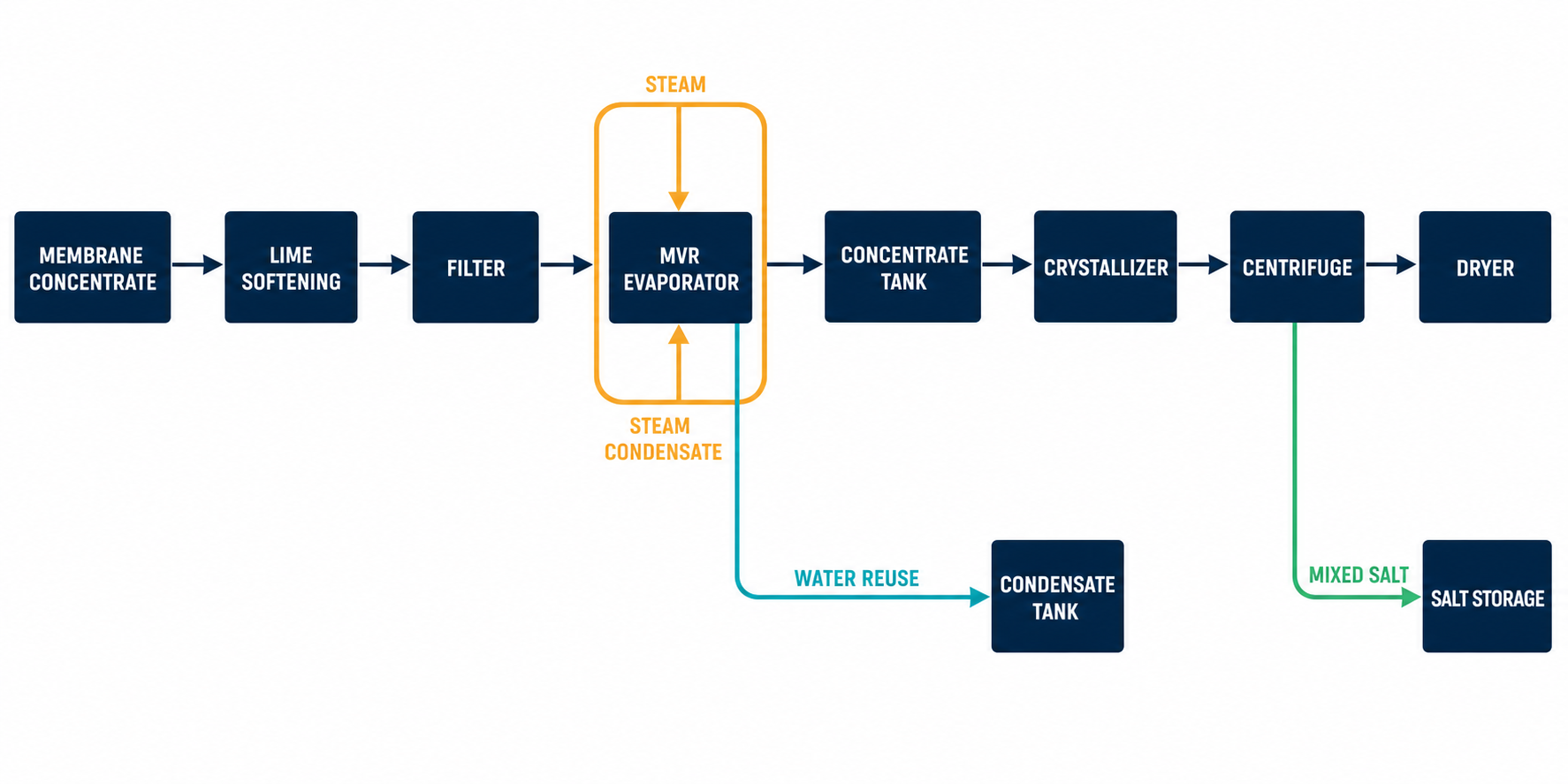
- Concentrate softening. Lime–soda or two-stage precipitation (with magnesium-agent silica removal where needed) strips hardness and silica before any boiling begins; ion-exchange polishing is the alternative where water chemistry justifies it.
- Feed conditioning. pH is set to bound ammonia in ionic form or route it to a treatable condensate slipstream; antifoam strategy is established from jar and foaming tests.
- MVR forced-circulation evaporation. The softened brine concentrates under mechanical vapor recompression — the compressor recycles secondary steam as the heat source, cutting energy use dramatically relative to live-steam designs and sparing the plant a boiler dependency common in remote coal-park locations.
- Crystallization. Slurry-density-controlled forced-circulation (or DTB) crystallizers grow salt to centrifugeable size. Where the sulfate fraction justifies it, a cooled or freeze sulfate stage splits sodium sulfate from chloride following the same solubility logic described in our coking wastewater salt-separation solution; where it does not, the plant crystallizes a mixed salt and economizes on complexity.
- Dewatering, drying, storage. Enclosed centrifuges, a flash or fluid-bed dryer, and covered storage produce a stable, shippable solid.
- Mother-liquor purge and condensate polishing. A defined purge — sized from a full material balance on chloride, sulfate, organics and trace metals — caps impurity build-up; condensate is polished (ion exchange, carbon or RO, as the analysis demands) and returned to the plant.
| Process Module | Candidate Equipment Types | Selection Rationale | Indicative Operating Envelope |
|---|---|---|---|
| Concentrate softening | Lime–soda or two-stage precipitation; magnesium-agent silica removal; ion-exchange polishing | Strips hardness and silica before any boiling begins | Set by concentrate analysis |
| Feed conditioning | pH control; antifoam strategy from jar and foaming tests | Bounds ammonia; prevents foam carryover into the vapor path | Per ammonia route selected |
| MVR forced-circulation evaporation | FC evaporator with mechanical vapor recompression compressor | Cuts energy use; spares remote coal parks a boiler dependency | Feed typically 30,000–60,000 mg/L TDS (published range) |
| Crystallization | FC or DTB crystallizers; optional cooled or freeze sulfate stage | Grows centrifugeable salt; splits sulfate where justified | Slurry-density controlled |
| Dewatering & drying | Enclosed centrifuge; flash or fluid-bed dryer; covered storage | Produces a stable, shippable solid | Per moisture specification |
| Purge & condensate polishing | Density-signaled mother-liquor purge; IX / carbon / RO polishing | Caps impurity build-up; returns recovered water to the plant | Sized from full material balance |
Configuration, materials, and operating ranges depend on actual feed, temperature, pressure, corrosion review, fouling behavior, utilities, and project capacity.
Design Countermeasures, Mapped to the Failure Modes
| Failure mode | Countermeasure |
|---|---|
| Silica gel fouling | Upstream silica removal; high circulation velocity; scheduled chemical cleaning designed in from day one |
| Foam and entrainment | Generous vapor space, two-stage demisting, standby antifoam; compressor-protective knock-out |
| Condensate contamination | Upstream COD polishing, pH window control for ammonia, condensate polishing loop |
| Boiling-point-rise creep | Mother-liquor purge on density signal; impurity balance audited seasonally against coal source changes |
| Chloride corrosion | Titanium or high-alloy wetted parts; zoned metallurgy by temperature and chloride concentration |
| Feed variability | Concentrate equalization tank sized to membrane-cleaning cycles; design margin on the crystallizer |
What the Outputs Are Worth
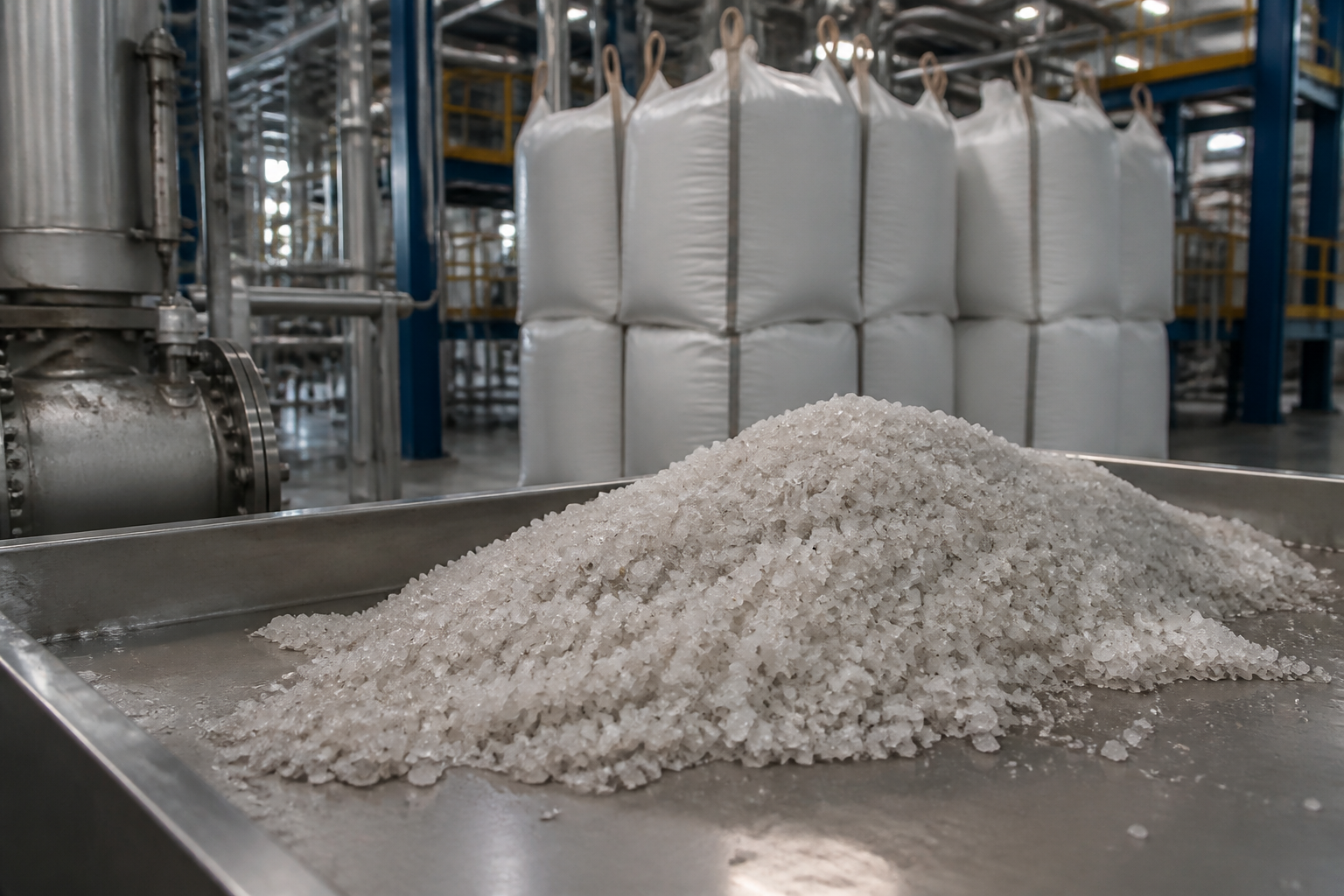
Salt from semi-coke concentrate is usually a managed industrial solid rather than a premium product: mixed sodium salt is stable for licensed reuse or disposal, and split NaCl/Na2SO4 streams can reach industrial-salt and sulfate markets when the organic and metals discipline upstream holds. The condensate is the valuable stream — typically the largest single water recovery in the plant — feeding quench, scrubbing and coal-moistening duties. In aggregate the train converts a concentrate that could not be discharged, stored or injected into dry solids plus process water, which is the entire commercial proposition of ZLD in the arid coal parks.
The wider architecture is shared with our coking wastewater ZLD solution — semi-coke is, chemically, the low-temperature cousin of coking, and the membrane-concentrate-to-crystallizer core is the same. Equipment background sits on the MVR evaporation and forced-circulation evaporation pages; sector context on coal chemical and mining wastewater; and the water-closure framework under high-salinity ZLD systems. For smaller remote sites, skid-mounted modular construction compresses schedule and commissioning risk.
When This Route May Not Fit
Thermal ZLD is not the only honest endpoint in the coal parks. Where a park operates a licensed mixed-salt landfill and stable haulage contracts exist, concentrating partway and trucking the residue can beat crystallization on total cost. Concentrates whose organics survive softening and polishing will color the salt and contaminate the condensate, and if upstream COD cannot be pulled down, the water-recovery proposition fails first. Extremely high silica or hardness that resists economical softening spends plant availability fighting scale instead of evaporating. Remote sites without dependable power cannot host MVR, and retrofit projects whose outage windows cannot be secured should not start one. Where the salt has no compliant outlet at all, volume reduction plus licensed disposal is the honest scope.
What Must Be Verified
Validation focus: a concentrate analysis with coal-source and seasonal swing — TDS, chloride, sulfate, ammonium, silica, hardness, COD, and trace metals — because softening, purge sizing, and crystallizer selection all follow from it. Softening must be demonstrated to the silica and hardness levels the evaporator can tolerate, and the ammonia split between brine and condensate quantified against the reuse specification. Silica polymerization behavior needs confirmation inside the planned temperature envelope. The mother-liquor material balance sizes the purge honestly, and the mixed-salt versus split-salt decision needs an offtake study before complexity is committed. Retrofit projects must verify utilities and the outage window before fabrication.
Frequently Asked Questions
Why does semi-coke wastewater need evaporation at all — isn’t biological treatment enough?
Biology and oxidation remove organics and ammonia; they remove no salt. Every reuse loop concentrates the dissolved solids until only evaporation-crystallization can close the balance. The evaporator is the terminus of the train, not an optional extra.
What is actually in the membrane concentrate?
Typically 30,000–60,000 mg/L TDS (higher with brine-concentrating stages) as mixed sodium chloride, sulfate and some ammonium salts, with residual refractory COD, silica and hardness. The exact mix follows the coal and gas-cleaning chemistry — the design is always built on a site water analysis.
Mixed salt or split salts?
Splitting into NaCl and Na₂SO₄ adds crystallization stages but can produce two marketable products; mixed salt is simpler and cheaper where salt markets are remote or the organics burden makes product grade unrealistic. The decision is an economic study against local offtake.
Is the condensate clean enough to reuse?
With upstream COD polishing, pH-window ammonia control and a condensate polishing step, yes — it becomes the plant’s main recovered water stream for quenching, scrubbing and coal handling.
Does this work for existing plants as a retrofit?
Yes. Most semi-coke ZLD projects are retrofits bolted onto an existing biological-plus-RO block: soften the concentrate, evaporate it, crystallize the residue. Skid-mounted modular trains keep the outage short.
Closing a semi-coke water balance? Send the membrane-concentrate analysis, daily volume, coal-source variability, and site utility situation — in exchange you will receive a first-pass screening of the softening requirement, train arrangement, and salt disposition (mixed versus split) your concentrate supports.