Project Parameters
| Parameter | Value |
|---|---|
| Process route | Twin four-effect falling-film evaporation lines |
| Industry | Food ingredients — starch-based sweeteners |
| Feed types | Glucose syrup, fructose syrup, maltose syrup |
| Evaporation capacity | 25 t/h total (10 t/h + 15 t/h twin lines) |
| Region | Philippines (Southeast Asia) |
Representative process configuration compiled from published industry project data. Indicative values, not a process guarantee.
Project Description
Southeast Asia’s food industry buys its sweetener infrastructure the way it buys everything: reliably, food-safely, and sized to the market. The published project behind this configuration serves a glucose producer in the Philippines with twin four-effect falling-film evaporation lines — 10 t/h and 15 t/h — handling glucose, fructose and maltose syrup duties across the pair. It is published as an export-supplied installation for a Southeast Asian food plant.
The twin-line architecture mirrors the product slate. Three syrups with three evaporation personalities — glucose liquor from saccharification, high-fructose syrup from isomerization, maltose syrup from the maltogenic route — share a plant, and twin lines let the producer campaign them without cross-contamination and turn down by line rather than by grade. The 10 t/h line takes the smaller campaigns; the 15 t/h line carries the volume syrup. Between them, the plant runs the sweetener market’s full calendar.
Process Technology
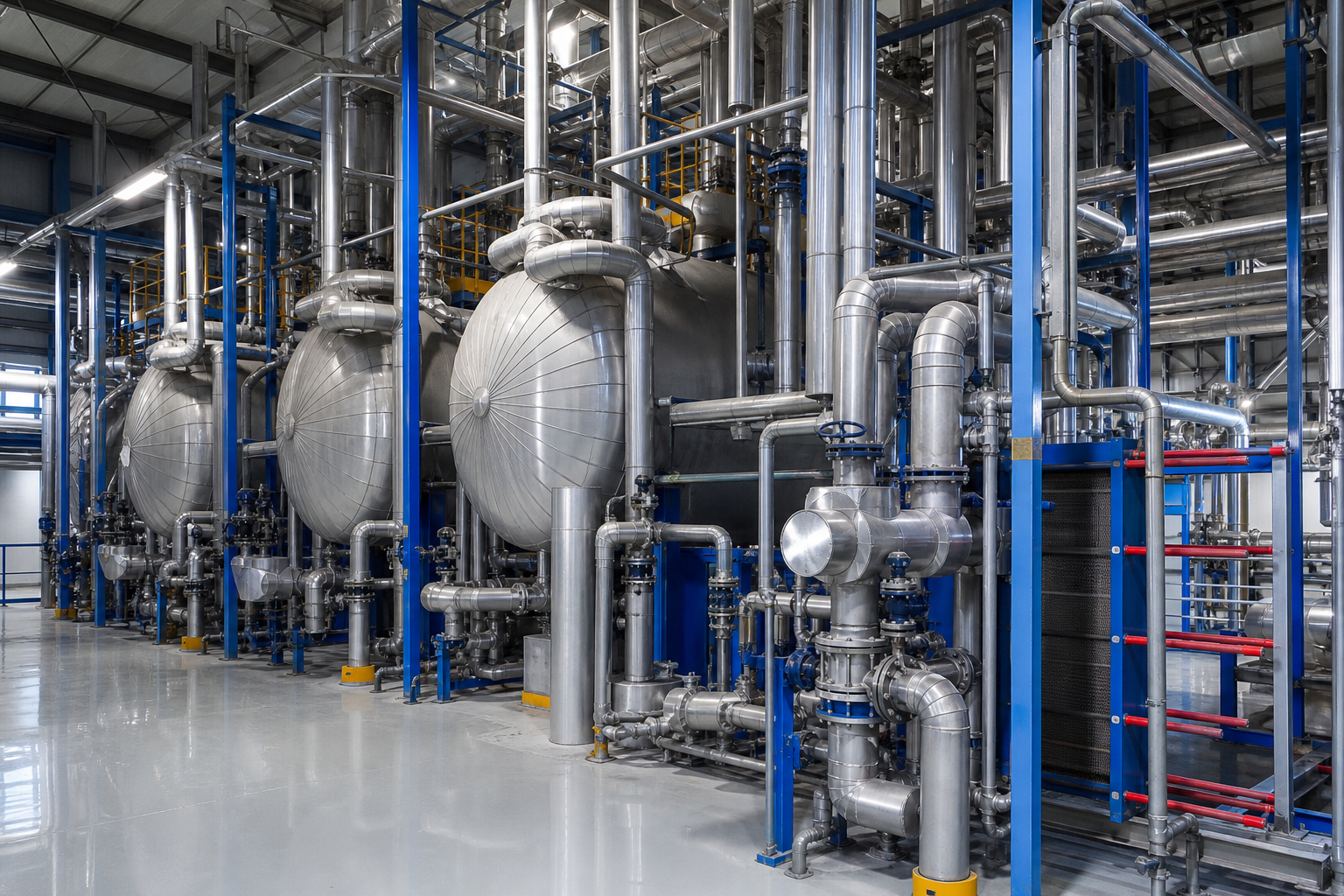
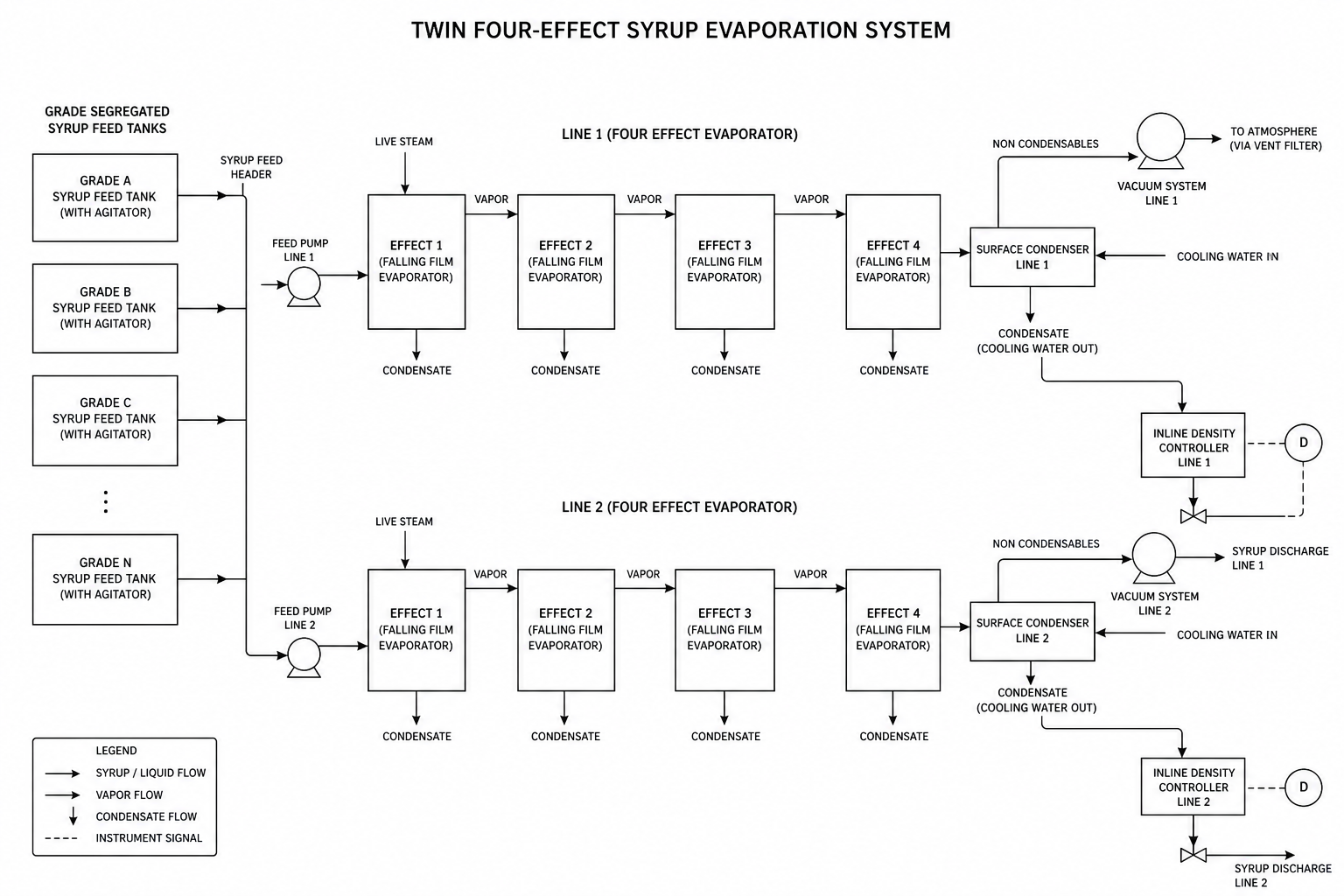
Both lines are four-effect falling-film trains in the food-syrup standard configuration. Each line stages four bodies in pressure: live steam to the first effect, effect vapor cascading through the rest, surface condensation at the vacuum end. Four effects is the balanced selection for this capacity class — three effects would spend more steam, five would spend more capital than 25 t/h of duty justifies — and the twin lines’ staggered campaigns let their steam loads share the boiler house politely.
Falling-film geometry does the quality work. Food syrups are color-sensitive and viscosity-steep: the film mechanism holds hot-surface residence to seconds per pass, vacuum staging keeps every effect below the temperature where syrup color bodies form, and distributor capacity carries the viscosity rise from refined-thin to product-brix-thick. Fructose, the most delicate of the three, gets the shortest path and the gentlest effect — the routing freedom twin lines exist to provide.
Food-plant discipline wraps the process: polished stainless product contact, clean-in-place between syrup grades, condensate from the clean effects recovered for the washing and dissolution duties a syrup plant runs on, and density control inline on every discharge so the filling tanks receive syrup at specification brix, not at operator judgment. The evaporation lines are certified food equipment in a food economy — the engineering bar the published project clears.
Equipment Configuration
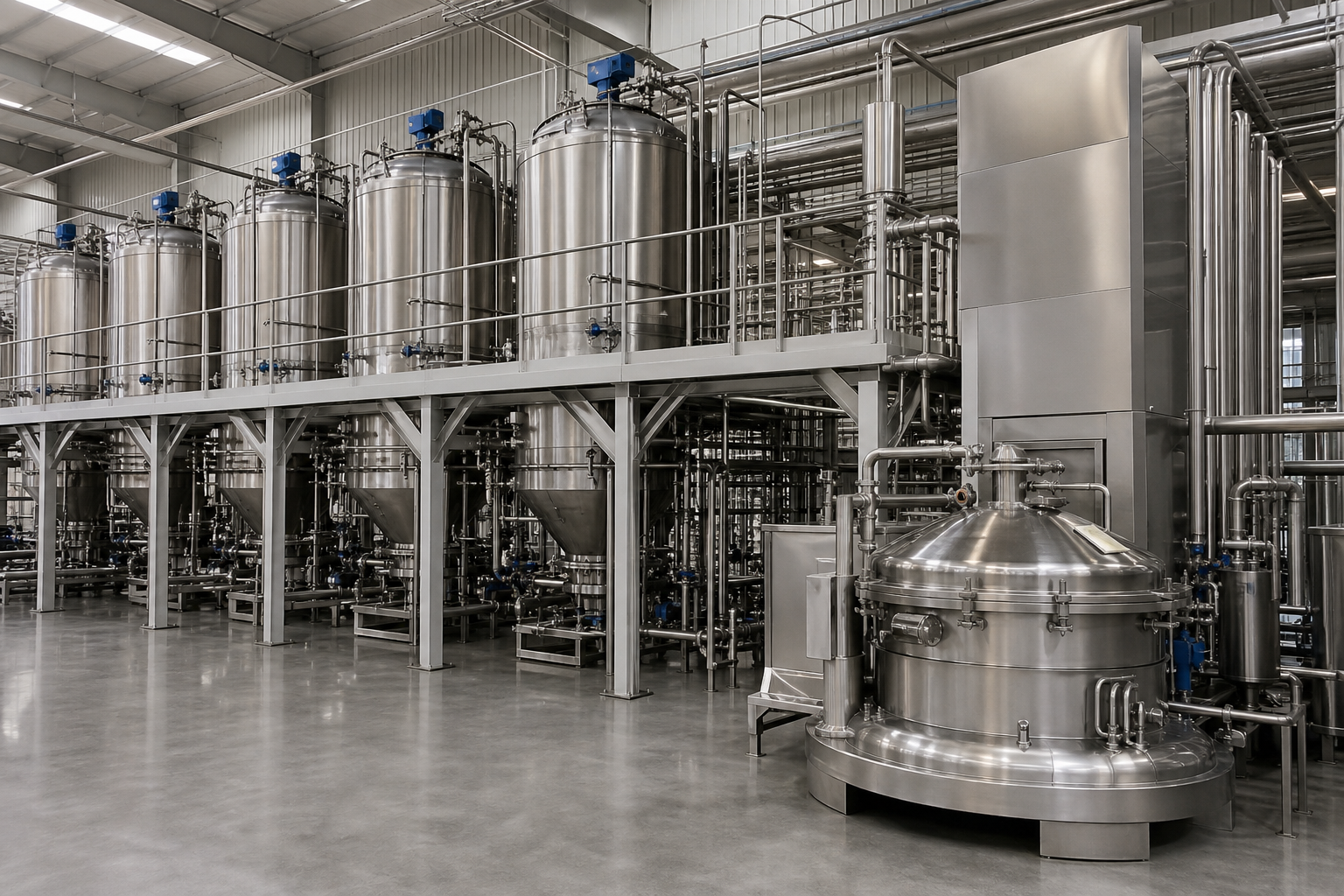
One set of the following equipment is typical for this duty:
- Syrup feed tanks with grade segregation (glucose / fructose / maltose)
- 10 t/h four-effect falling-film evaporation line
- 15 t/h four-effect falling-film evaporation line
- Surface condensers, vacuum systems and feed preheaters per line
- Food-grade stainless construction with polished product contact
- Inline density control on syrup discharge to filling/storage
- CIP systems between syrup grades
Performance & Outcome
Compiled from published industry project data, indicative: twin-line plants of this class evaporate 25 t/h of glucose, fructose and maltose syrups at four-effect steam economy under food-grade conditions, serving Southeast Asian sweetener producers as export-supplied installations. Color retention and specific steam are quoted per project syrup specification.
Simplified PFD
The simplified process flow diagram above shows the twin four-effect lines, grade-segregated feed, and condensate recovery.