Project Parameters
| Parameter | Value |
|---|---|
| Process route | Six-effect falling-film evaporation with continuous sterilization integrated in the train |
| Industry | Fermentation — threonine production base (new build) |
| Feed type & key components | Glucose solution as fermentation carbon source |
| Evaporation capacity | 40 t/h |
| Plant context | Utility block of a large new threonine fermentation complex |
| Region | Inner Mongolia (Tongliao area), Northern China |
Representative process configuration compiled from published industry project data. Indicative values, not a process guarantee.
Project Description
Threonine, like lysine before it, is made by fermentation with glucose as the carbon backbone — and a new amino-acid complex begins with a reliable, sterile, concentrated glucose supply. The published project behind this configuration serves exactly that beginning: a 40 t/h six-effect falling-film evaporation train with continuous sterilization duty, built as part of a large new threonine production base in Inner Mongolia.
Two requirements shape the design. The fermentation house wants glucose liquor at the carbon concentration its broth recipe calls for — not dilute syrup trucked with water the fermenters would only have to heat and sterilize themselves. And the sterilization regime wants the sugar stream heated to sterilizing temperature and cooled back continuously, in-line, without holding up in dead legs. The published train answers both with one heat-integrated system: six effects of falling-film concentration and a continuous sterilization section coupled to the same vapor and condensate economy.
Process Technology

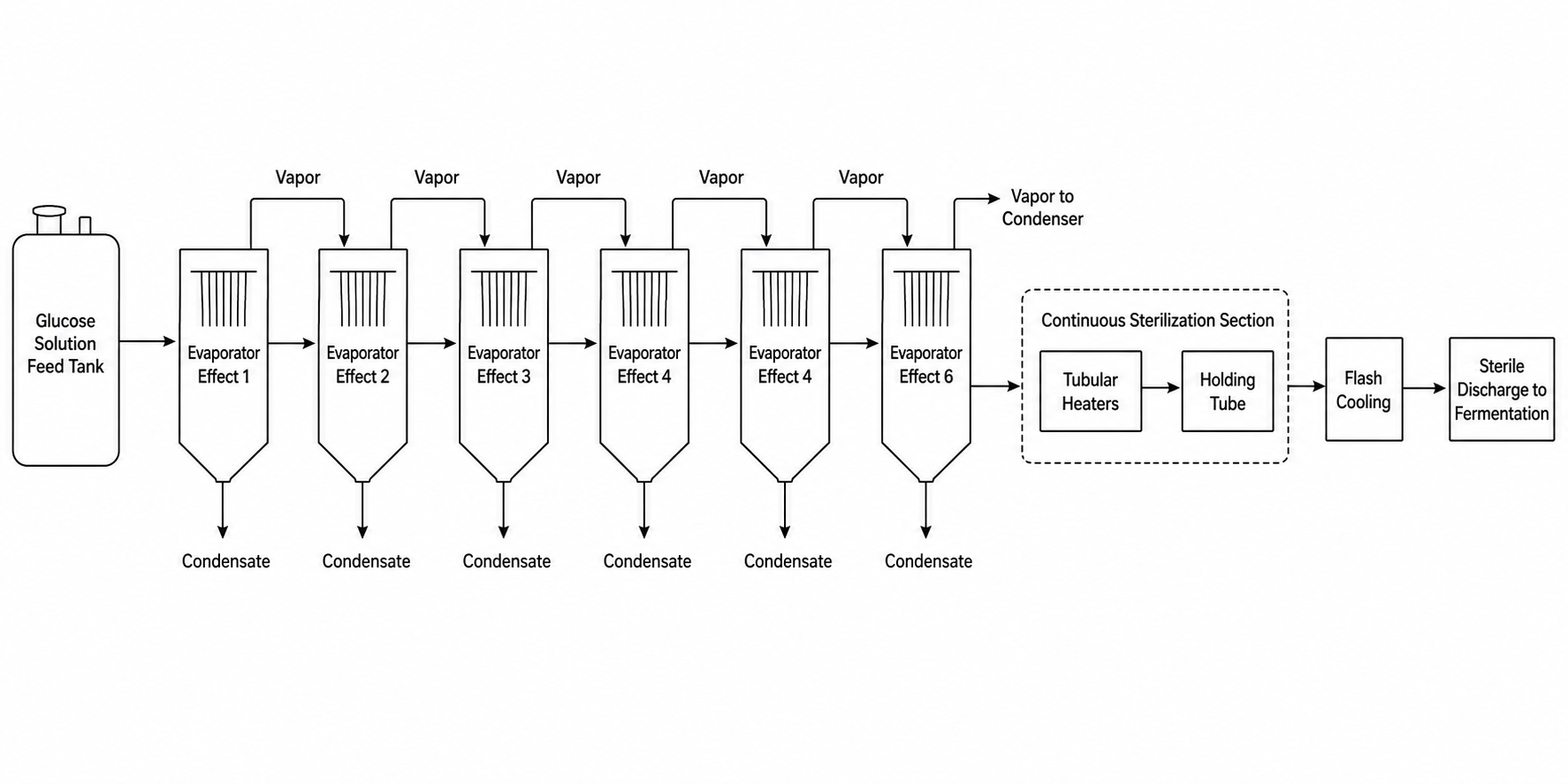
Glucose solution from the saccharification or syrup receiving side enters the first effect of a six-effect chain. Each effect runs at a lower pressure than the one before it, so the vapor boiled off in effect one heats effect two, and so on down the train — five reuses of the same latent heat between one tonne of live steam and the surface condenser. Six effects is the economy choice for a plant with steady base-load duty: the marginal effect is cheap steam saving bought with heat-transfer area, and at 40 t/h the arithmetic publishes in the plant’s favor.
Falling-film geometry protects the product through all six effects. Glucose liquor colors and fouls under thermal dwell; the film spends seconds per pass on the tube wall, and vacuum staging holds every effect inside the temperature window dextrose tolerates. Distributor capacity is sized for the viscosity rise across the train, and the final effect discharges at the fermentation-side brix set-point under inline density control.
The continuous sterilization section is the fermentation-specific signature. Rather than batch-cooking tanks of sugar, the concentrated liquor is pumped through tubular heaters to sterilizing temperature, held for a controlled residence time in a holding tube, and flash-cooled under clean conditions before forwarding to the seed and fermentation trains. Coupled to the evaporator’s condensate and vapor economy, the sterilizer recovers its heat into feed preheating — the same heat-integration discipline the six-effect chain applies to concentration.
Condensate grades out cleanly at the front effects and returns to the complex’s water balance; later-effect condensate with trace organics segregates to secondary use. Between campaigns and at product changeovers, the film distributors and the sterilizer loop clean in place, because a sterile feed system tolerates no residue.
Equipment Configuration
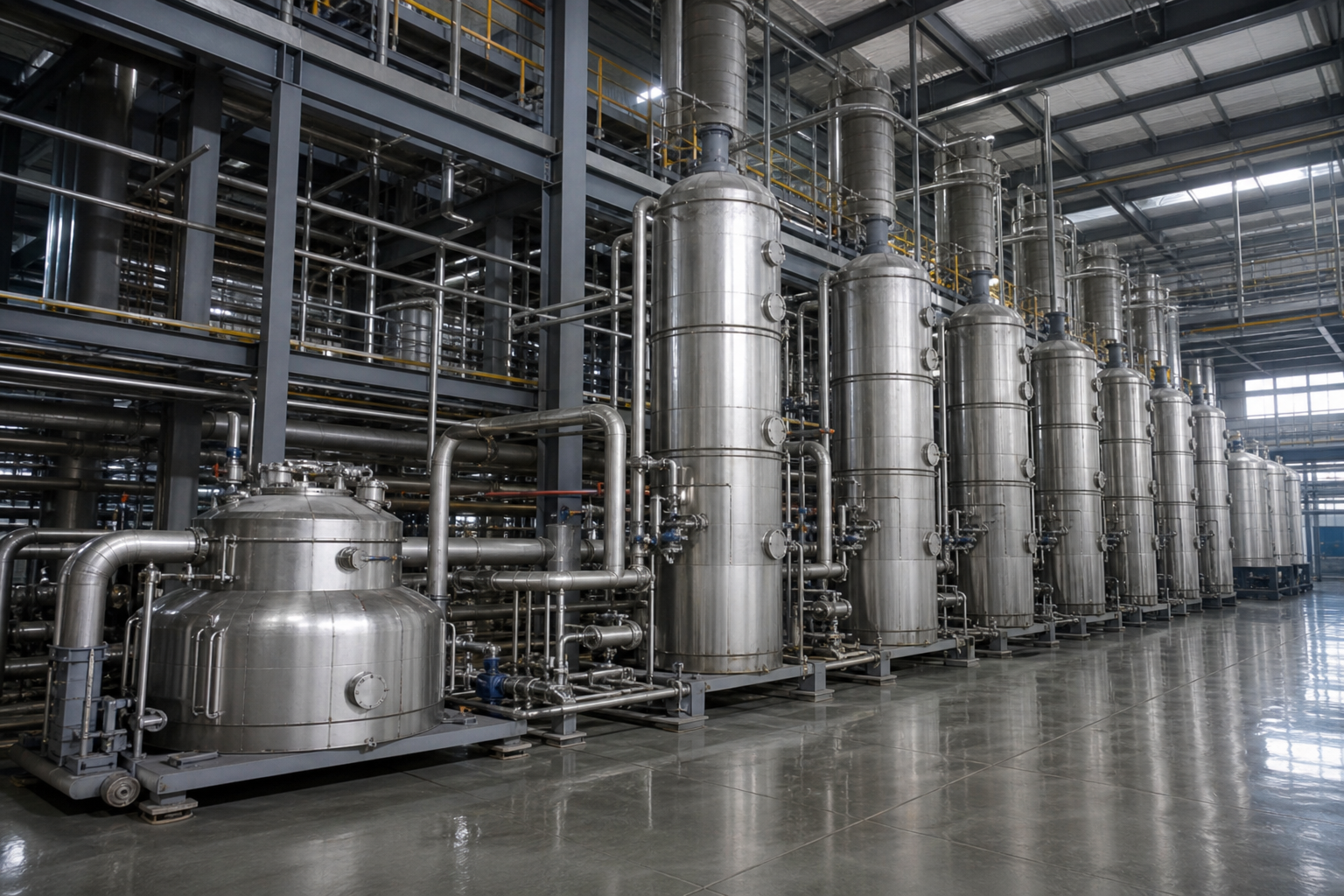
One set of the following equipment is typical for this duty:
- Glucose solution feed tank with filtration
- Six-effect falling-film evaporation train with vacuum staging
- Continuous sterilization section: tubular heaters, holding tube, flash cooling
- Heat-recovery train coupling sterilizer heating/cooling to feed preheat
- Surface condenser and vacuum system
- Density-controlled sterile discharge to the fermentation feed system
- PLC control with sterilization sequencing and CIP
Performance & Outcome
Compiled from published industry project data, indicative: trains of this class evaporate 40 t/h of glucose liquor at six-effect steam economy with continuous sterilization integrated, feeding new amino-acid fermentation complexes sterile carbon-source liquor at fermentation brix. Specific steam and sterilization temperatures are quoted per project fermentation specification.
Project economics of this scale are discussed further in Threonine Fermentation Broth Evaporation & Crystallization.