
Oslo Crystallizer: Principle and Application
Oslo (fluidized-bed / Krystal) crystallizers decouple supersaturation generation from crystal growth to deliver 2-5 mm crystals, CV under 5%, and impurities below 0.1%. Structure,

Oslo (fluidized-bed / Krystal) crystallizers decouple supersaturation generation from crystal growth to deliver 2-5 mm crystals, CV under 5%, and impurities below 0.1%. Structure,

MVR vs multi-effect evaporation compared on energy, CAPEX, OPEX, payback, BPE limits, capacity fit, retrofit paths, and carbon impact, with typical consumption figures for
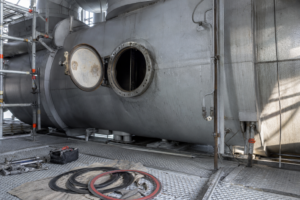
Evaporator troubleshooting guide: scaling, corrosion, foaming, entrainment, and falling evaporation rate diagnosed with cause chains, the seven-cause capacity checklist, compressor and vacuum deep-dives, and
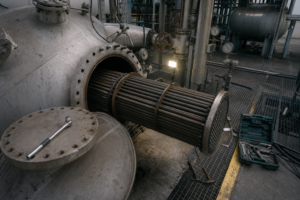
Complete evaporator operation and maintenance guide: pre-start checks, four running parameters, salt crystallization temperature discipline, sequenced shutdown, three-tier downtime maintenance, winter protection, and a
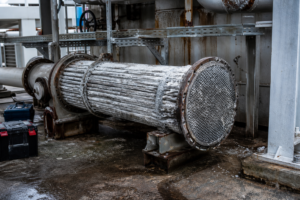
Evaporator fouling and scaling mechanisms, seven warning signs, hardness control at ~100 ppm, antiscalants raising solubility 3-4x, seed slurry control, and mechanical, chemical and
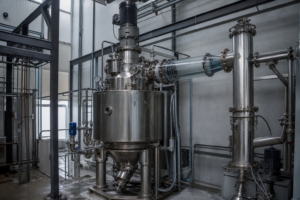
Scraped surface = wiped film = agitated thin film evaporator: one machine for 100,000 cP feeds with seconds of residence time. Blade gap 0.5-1.5
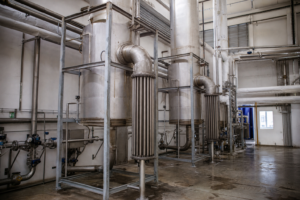
External circulation evaporators run the loop outside the boiling vessel; natural circulation drives it by thermosiphon alone. Design numbers that decide fouling or clean

Evaporator sizing from first principles: material balance W=F(1-x0/x1), heat balance Q=Wr, Q=KAdT with four series resistances, effective temperature difference after BPE, a worked 10
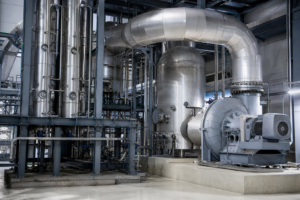
Cut evaporator energy cost 65-86%: steam economy basics, MVR vs TVR vs multi-effect comparison with COP and payback, 100 t/d full cost model, multi-effect
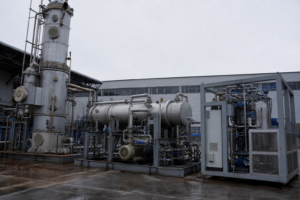
How to select an evaporator: the 5-step method, wastewater characterization (BPE, chloride, fouling), material grades, TDS bands, and the MEE vs TVR vs MVR