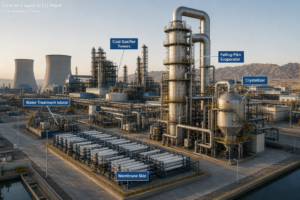
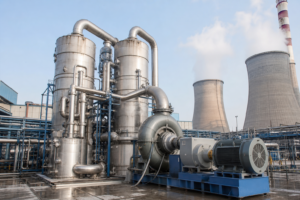
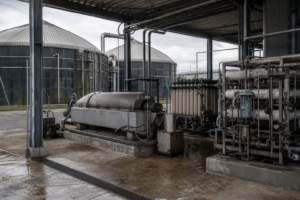
MVR evaporation—mechanical vapor recompression—replaces boiler steam with electricity by recompressing the vapor an evaporator produces and feeding it back as its own heating medium, cutting energy consumption per ton of evaporated water by 70–90% against conventional multi-effect systems. A well-designed MVR system evaporates water on 15–50 kWh per ton depending on boiling-point elevation, where a multi-effect train demands 150–250 kWh of steam-equivalent energy, which is why MVR has become the default concentration stage in zero liquid discharge, lithium refining, fermentation, and high-salinity wastewater plants. This page treats MVR as a project system — configuration, energy economics, delivery and documented results; the thermodynamics, the component-level design walk-through and the ΔT/compression-ratio engineering parameters are covered in depth in our MVR working principle and system design deep-dive.
How MVR Works: A Closed Energy Loop
In one sentence: the evaporator boils its own feed, captures the secondary vapor, mechanically compresses it to a usable temperature lift (typically 15–25°C), and condenses it back against the incoming liquor — so the latent heat circulates in a closed loop and fresh steam is needed only for startup and trim. The practical consequences that matter at project level: the plant runs on electricity plus small auxiliaries, needs no large condenser (shrinking footprint and cooling-water demand), and the small, stable temperature difference between vapor and liquor makes for gentle evaporation on heat-sensitive products.
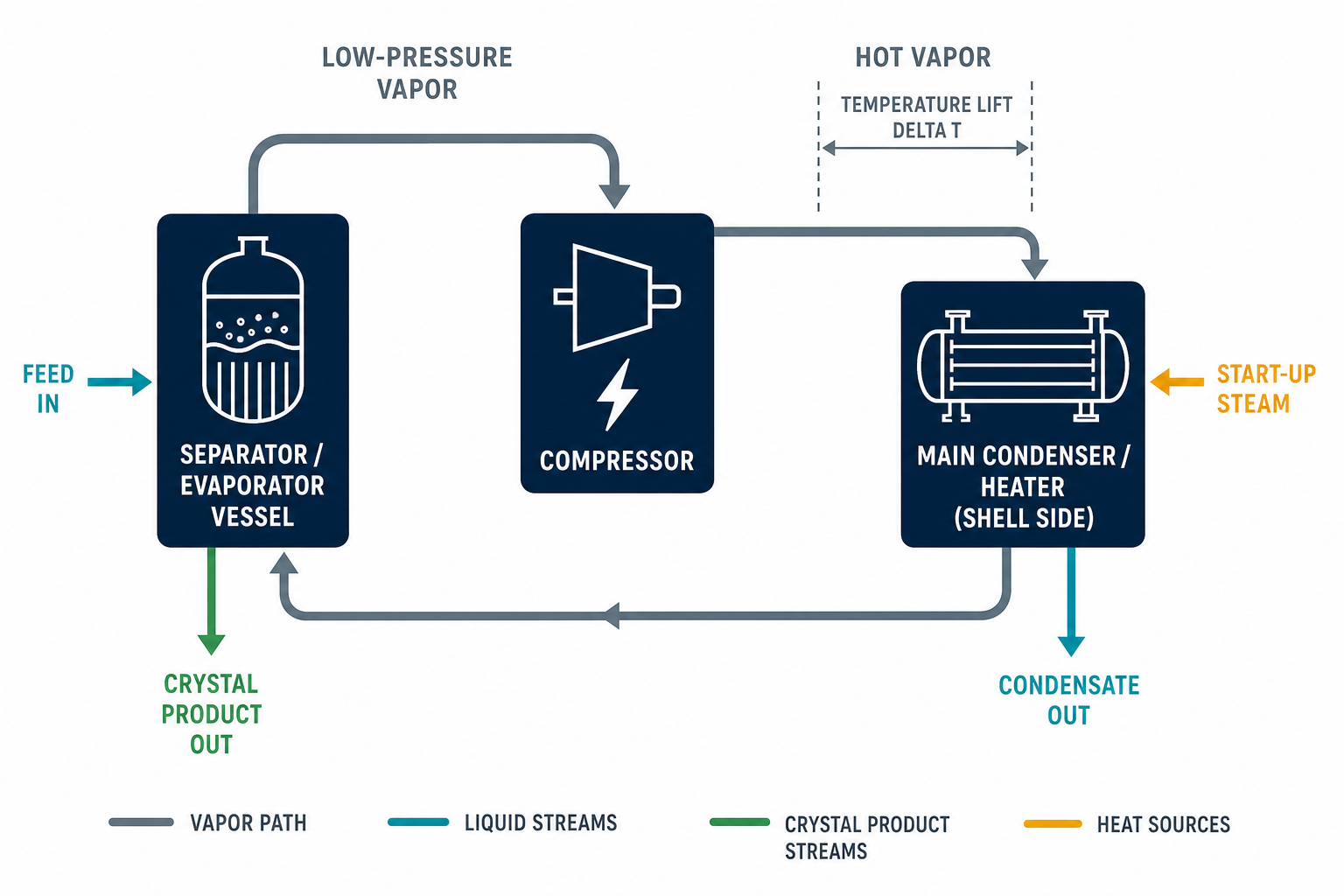
The step-by-step working cycle, the nine core components, the thermodynamic reasoning and the small-ΔT design trade-offs are laid out once in our MVR working principle and system design deep-dive — this page moves straight to the numbers and decisions a project owner faces.
The Energy Math: Reading Specific Energy Consumption
The only performance number that matters when comparing systems is specific energy consumption (SEC) in kWh per ton of evaporated water. Percentages and multipliers quoted in brochures normalize against inconsistent baselines; kWh/ton does not. Published industry benchmarks give the following bands.
| System | Specific Energy Consumption | Notes |
|---|---|---|
| Multi-effect (MEE), wastewater duty | 150–250 kWh/ton | Electrical + steam allocation basis |
| MVR, low-BPE feed | 15–30 kWh/ton | Clean, dilute streams |
| MVR, high-BPE conditions | 30–50 kWh/ton | High-TDS and chemical streams |
Translated to operating cost at typical Chinese utility prices: 40 kWh of electricity costs roughly RMB 32 per ton of water, against roughly RMB 80 for the 0.4 tons of steam the same duty consumes in a conventional system. A single MVR train saving 8 million kWh per year, about RMB 6.4 million at those prices, is an externally published operating result, not a projection (external industry reference, not an EvapCryst delivery). Published ROI figures against the higher capital cost of MVR typically land within 1.5–3 years, driven by the local steam-to-electricity price ratio.
MVR versus Multi-Effect: When Each Wins
MVR is not universally the right answer, and the crossover points are identifiable before any vendor meeting. Multi-effect evaporation improves with more effects, but each additional effect buys a smaller increment; MVR pulls decisively ahead on energy as hourly capacity grows. The decision matrix below summarizes the practical boundaries.
| Condition | Favored Route | Why |
|---|---|---|
| Large hourly evaporation capacity | MVR | Compressor economics amortize with throughput; energy advantage widens |
| Cheap or excess plant steam available | MEE or TVR+MVR hybrid | Steam at marginal cost erodes MVR’s operating advantage |
| Very small throughput | MEE / single effect | Compressor capital does not amortize at low utilization |
| Weak local grid / power reliability issues | MEE | MVR depends entirely on continuous electrical supply |
| Heat-sensitive product | MVR | Low stable ΔT protects quality |
| Greenfield, tight plot, no cooling water | MVR | No large condenser; compact footprint (reported ~40% smaller) |
Boiling Point Elevation and Compressor Selection
Boiling point elevation (BPE) is the technical dividing line between average and high-end MVR suppliers. Dissolved salts raise the boiling temperature of the liquor above that of pure water at the same pressure, which eats into the available temperature difference and forces the compressor to a higher pressure ratio. As concentration climbs toward crystallization, BPE grows—and if the compressor cannot deliver the matching lift, capacity collapses precisely when the plant needs it most.
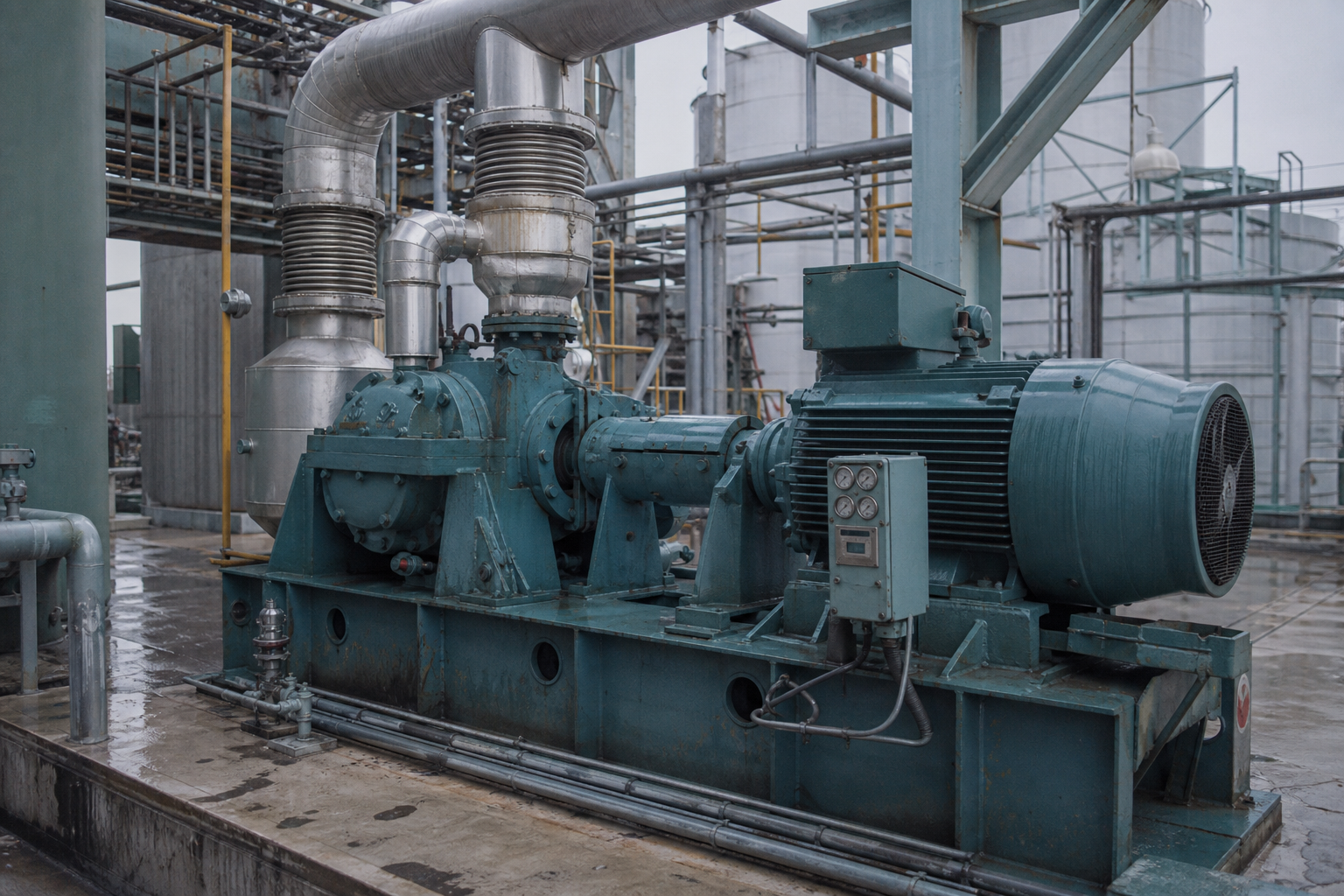
Compressor selection follows BPE class. The mapping below reflects published engineering practice.
| Feed BPE Class | Recommended Compressor | Characteristics |
|---|---|---|
| Low BPE (< 3°C) — dilute wastewater | Roots or low-speed centrifugal | Stable, simple, economical |
| Medium–high BPE (3–10°C) | High-speed centrifugal with VFD | Wide turndown, real-time optimization |
| Extreme BPE (> 10°C) | Turbine or multi-stage compressor | Handles high pressure ratios; needed near crystallization |
Systems engineered for severe chemical service are reported in vendor publications operating stably at BPE above 15°C, using high-speed centrifugal machines with variable frequency drives. When evaluating proposals, require the vendor’s BPE calculation for your feed at final concentration—not the inlet—because that is where the compressor must actually work.
Evaporator Body and Crystallizer Configuration
MVR is a heating concept, not an evaporator geometry; it pairs with several body types, and the pairing follows the liquor’s fouling and viscosity behavior.
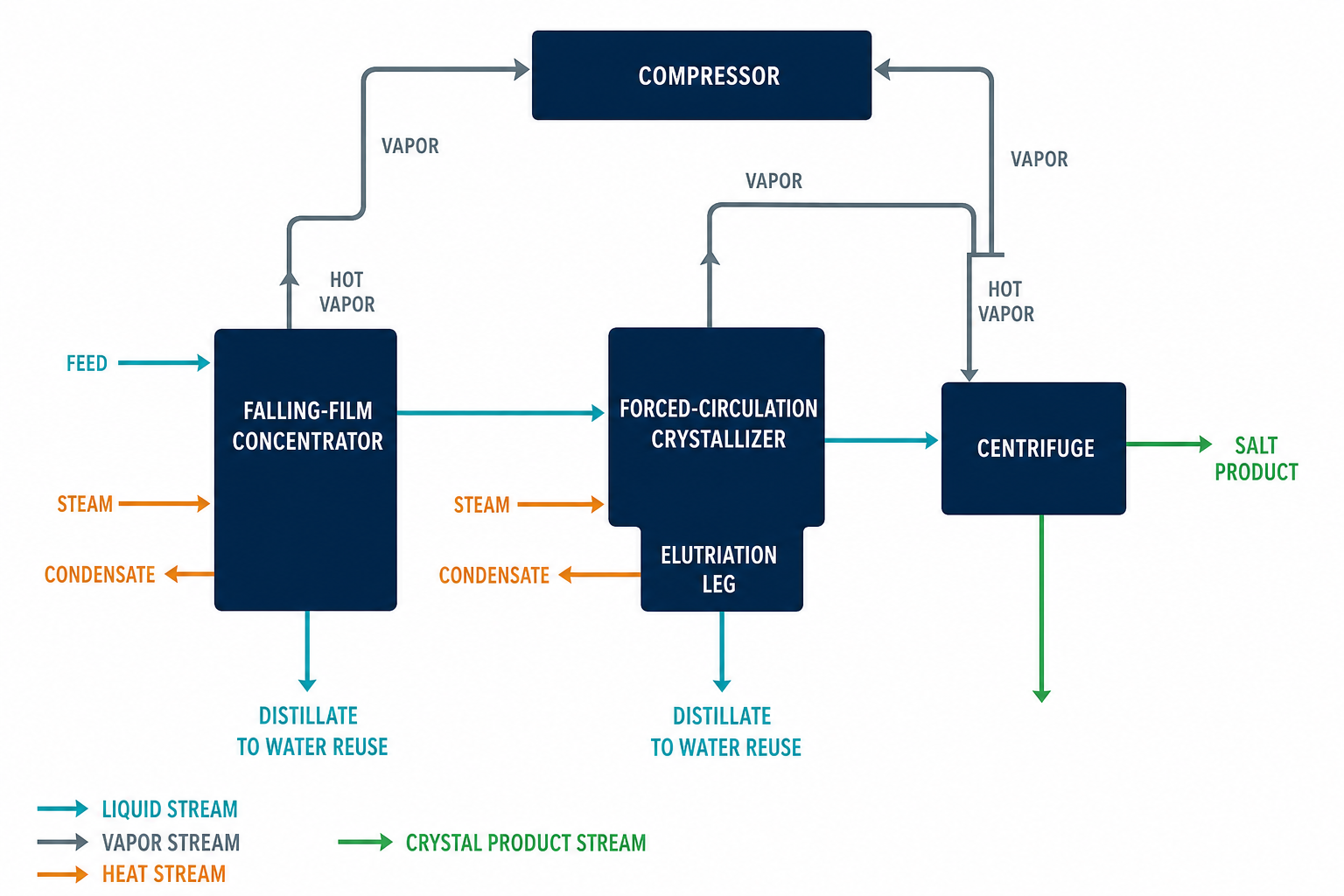
Falling film evaporators suit clean, low-viscosity, low-fouling streams—fermentation broth concentration, dairy, juice, lithium liquor clarification. Liquid forms a thin film down the tube wall with low liquid holdup and short residence time; heat transfer is excellent, and the gentle treatment preserves product quality.
Forced circulation evaporators are the workhorse for scaling and crystallizing service—high-salinity wastewater, brine concentration, salt production. Circulation pumps push liquor through the calandria at velocities that suppress wall nucleation, trading some energy efficiency for reliability on fouling duty.
DTB and OSLO crystallizers attach downstream or inline when the product is crystal rather than concentrate. DTB (draft tube baffle) crystallizers grow uniform crystals in a classified zone with low supersaturation at the boiling surface; OSLO (classified suspension) types grow crystals in a fluidized bed completely separated from the vapor zone. Both deliver larger, more uniform crystals than plain forced circulation, which matters directly for centrifuge dewatering, washing, and final salt purity.
| Module | Candidate Equipment Types | Selection Rationale | Indicative Operating Envelope |
|---|---|---|---|
| Preheater and feed system | Plate or shell-and-tube preheaters, feed tank | Recovers condensate heat; conditions feed to body | Feed cleaned to guideline solids and oil levels |
| Evaporator body | Falling-film or forced-circulation calandria | Body type follows fouling and viscosity behavior | Vacuum, low-temperature boiling |
| MVR compressor | Roots, high-speed centrifugal, turbine/multi-stage | Compressor class follows BPE at final concentration | Temperature lift typically 15–25°C |
| Crystallizer stage | DTB or OSLO classified-growth crystallizer | Uniform crystals when product is salt, not concentrate | Near-crystallization concentration, high BPE |
| CIP and condensate system | Citric/EDTA clean-in-place loop, condensate routing | Holds heat-transfer coefficients at design | Scheduled cleaning between fouling campaigns |
Configuration, materials, and operating ranges depend on the actual feed, corrosion review, fouling behavior, site utilities, and project capacity.
Materials: Surviving Chloride, Sulfate, and Acid Streams
Chemical wastewater with high chloride or sulfate content, and acidic food streams such as whey, attack standard austenitic stainless steel through pitting and stress corrosion cracking. Published material strategies for MVR heat exchange surfaces and wetted parts are consistent: duplex stainless steel for high-chloride environments; titanium tubes and 316L duplex constructions for severe corrosion duty; Hastelloy for the most aggressive chemistry. Titanium heat exchange tubes in 316L duplex bodies are described in vendor literature as delivering triple the corrosion resistance (supplier-published, indicative) of conventional materials with service life beyond ten years on chemical service.
Material selection is also an economic decision: titanium and Hastelloy carry significant cost premia, so the engineering task is zoning—reserve the exotic alloys for the surfaces that actually see the corrosive phase at concentration, not the whole plant. A vendor who cannot articulate the chloride exposure map of their proposed system has not done the corrosion engineering.
Modular and Skid-Mounted Delivery
Delivery model affects cash flow as much as technology affects operating cost. Traditional stick-built evaporation plants require 6–12 months of on-site installation and piping after equipment arrival. Modular MVR delivery inverts this: evaporation chamber, compressor, heat exchanger, and PLC cabinet are pre-installed and interconnected on skids in the factory, with about 90% pre-assembly and factory acceptance testing before shipment (industry-reported modular delivery figures). On-site work shrinks by roughly 70%, modules are set and hooked up in 4–8 weeks, and production startup advances by 3–6 months—a direct improvement to project payback.
Certification follows the delivery: pressure parts to ASME or PED, CE marking for the European market, and PLC programming to international standards for global deployability. Skid delivery also standardizes spare parts and simplifies the 48-hour regional spare supply model that separates serious suppliers from equipment merchants.
Applications and Documented Results
The application map now spans essentially every industry with a concentration or wastewater duty. Results below are compiled from vendor-published and third-party references — external industry references, not EvapCryst deliveries; indicative, not project guarantees:
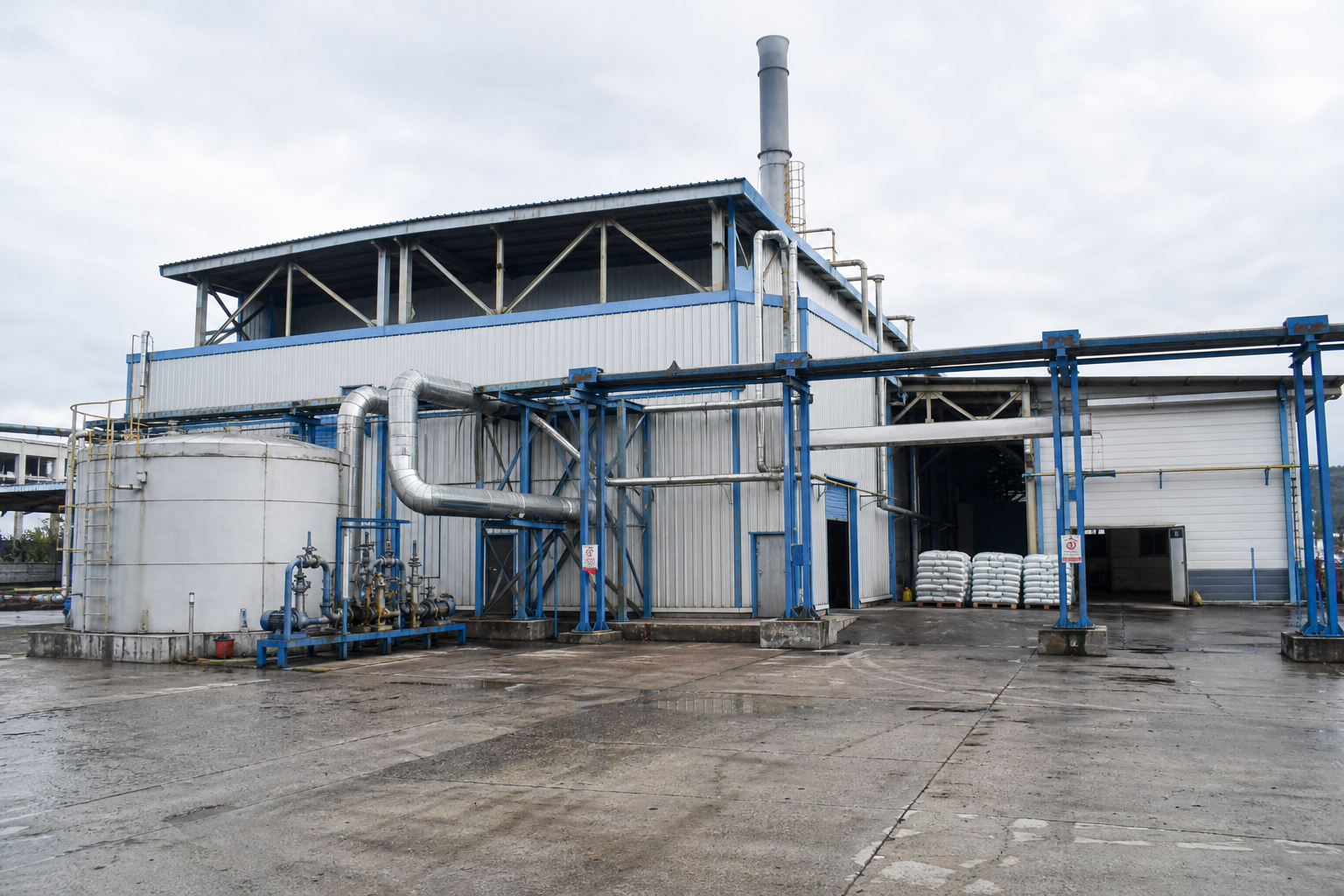
Zero liquid discharge. MVR concentrators raise feed from dilute inflow to 10–50% solids, cutting the load on downstream crystallizers, while condensate returns to the plant as process water. In an externally published Jiangsu chemical-park case, five MVR units in parallel treat 1,200 tons per day of high-salinity wastewater with crystal purity at 96%—sufficient for the salt to be classified as general industrial solid waste and disposed at 80% lower cost than hazardous stream rates.
Food and fermentation. An externally published soy sauce producer case treated wastewater at COD up to 15,000 mg/L and recovered sodium chloride at 99.5% purity meeting table salt standard GB 5461; another published seasoning-manufacturer case recovered 1,200 tons of edible salt per year worth about RMB 840,000. A published corn starch plant case cut wastewater treatment cost from RMB 80 to RMB 35 per ton, saving RMB 4.5 million annually with a 14-month payback.
Chemical and agrochemical. Pesticide intermediate producers combined MVR crystallization with multi-effect evaporation to cut hazardous-waste volume by 70%—a published external case reduced disposal fees from RMB 5 million to RMB 1.5 million per year. Coal chemical service, in published external cases, has MVR crystallizers processing wastewater at up to 20% TDS with crystals containing 98% sodium sulfate sold as Glauber’s salt to glass manufacturers.
Lithium and battery materials. MVR trains concentrate lithium mother liquor and support iron phosphate production; vendor-published references (external, not EvapCryst deliveries) include 68–70 t/h MVR evaporation crystallization lines on 50,000–100,000 tpa iron phosphate projects, plus battery-grade lithium carbonate and hydroxide refining duty.
Feedwater Quality and Operational Discipline
MVR tolerance for feed variation is wide in chemistry but narrow in physical cleanliness. Suspended solids and oil foul heat transfer surfaces faster than any dissolved salt: keep feed SS ≤ 50 mg/L and oil ≤ 50 mg/L (industry-published guideline values), with pretreatment—filtration, flotation, carbon—sized accordingly. In operation, the CIP system (clean-in-place with citric acid or EDTA chemistry, with ultrasonic assistance optional) keeps heat transfer coefficients at design; predictive monitoring that flags scaling risk days in advance converts cleaning from emergency to schedule. The industry-reported frontier is unplanned downtime under 24 hours per year on well-run systems with remote diagnostics and regional spare inventories.
To go deeper on the underlying equipment, see our MVR evaporation technology page and modular skid delivery. For application contexts, start with zero liquid discharge solutions, salt separation systems, and our solution pages on waste salt recycling and pesticide mother liquor treatment.
When This Route May Not Fit
MVR loses its advantage wherever cheap steam exists. Plants with surplus turbine exhaust, waste heat, or bagasse-fired boilers should spend that heat first; TVR or multi-effect captures it with less capital and no electrical dependence. Weak grids and unreliable power supply break a compressor-centered plant, and high electricity-to-steam price ratios can invert the economics entirely. Duties with extreme boiling point elevation push compressor machinery into expensive multi-stage territory that erodes the energy saving. Very small or intermittent throughputs never amortize compressor capital. Feeds that cannot be cleaned to guideline solids and oil levels will foul any evaporator, MVR included, into an availability problem. Sites planning electrification anyway may still choose MVR strategically despite near-term price parity.
What Must Be Verified
An MVR project’s numbers must be verified on the actual duty before commitment. The feed needs full characterization: TDS and ionic profile, boiling point elevation at final concentration (measured, not assumed), suspended solids and oil against the cleanliness guideline, and scaling tendency. The site needs auditing for power capacity and reliability, steam marginal cost for the crossover math, and cooling-water constraints. Compressor proposals should be checked for BPE at outlet conditions, turndown range, and materials zoning against the chloride map. Condensate quality targets and any salt byproduct specification belong in the verification basis. Where the duty is new or fouling-prone, a pilot or slipstream trial remains the cheapest insurance before full-scale capital. Each check replaces a brochure number with project-specific evidence.
FAQ
How much energy does MVR save compared to multi-effect evaporation?
70–90% on energy cost for the same duty. Benchmark specific consumption is 15–30 kWh per ton of evaporated water for MVR on low-BPE feeds and 30–50 kWh/ton under high-BPE chemical conditions, against multi-effect systems in the 150–250 kWh/ton range on wastewater duty.
What is the payback period for an MVR system?
Typically 1.5–3 years against the higher capital cost, driven by the local price ratio of electricity to steam. Published external cases include a 14-month payback on a corn starch wastewater project saving RMB 4.5 million per year.
Does MVR work with high-salinity wastewater that has high boiling point elevation?
Yes, with the right compressor. BPE above 10°C requires turbine or multi-stage compression, and engineered systems are documented running stably at BPE above 15°C using high-speed centrifugal compressors with VFD control. The key check is the BPE calculation at final concentration, not the feed.
What feed quality does an MVR evaporator require?
Suspended solids ≤ 50 mg/L and oil ≤ 50 mg/L to protect heat transfer surfaces; dissolved chemistry is far more flexible. Pretreatment—filtration, carbon adsorption, pH adjustment—handles streams outside these limits before the evaporator.
Can recovered salt from MVR crystallization be sold?
At purity ≥ 98% NaCl it qualifies as industrial by-product salt; at ≥ 99.1% with no harmful substances it can pursue food-grade certification. Published external cases include 99.5% pure salt meeting GB 5461 table salt standard and 98% sodium sulfate sold as Glauber’s salt.
Is MVR better than TVR?
They occupy different niches. TVR (thermal vapor recompression) uses motive steam and suits plants with cheap boiler steam; MVR uses electricity and delivers deeper energy savings where steam is expensive. Facilities with steam networks sometimes run TVR+MVR hybrids to optimize the mix.
For a first-pass screening of your MVR suitability, send the feed analysis, evaporation duty, and site energy prices; in return you receive an indicative SEC estimate, compressor class, and body-type direction, before any detailed engineering.