In reconstituted tobacco leaf (RTL) production, evaporation is the step that converts a dilute, hard-to-handle extract into a concentrated, high-value flavor stream — and it is also the largest consumer of energy in the whole extraction plant. Mechanical vapor recompression (MVR) evaporation is the preferred configuration for this duty because supplier-published figures indicate it cuts live-steam consumption by 80–90% compared with single-effect evaporation (indicative range, not a project guarantee) and holds product temperatures low enough to protect heat-sensitive aroma and nicotine components. This page explains where evaporation sits in the tobacco process chain, what makes tobacco extract a difficult feed, and how the equipment should be configured.
Where Evaporation Sits in Reconstituted Tobacco Production
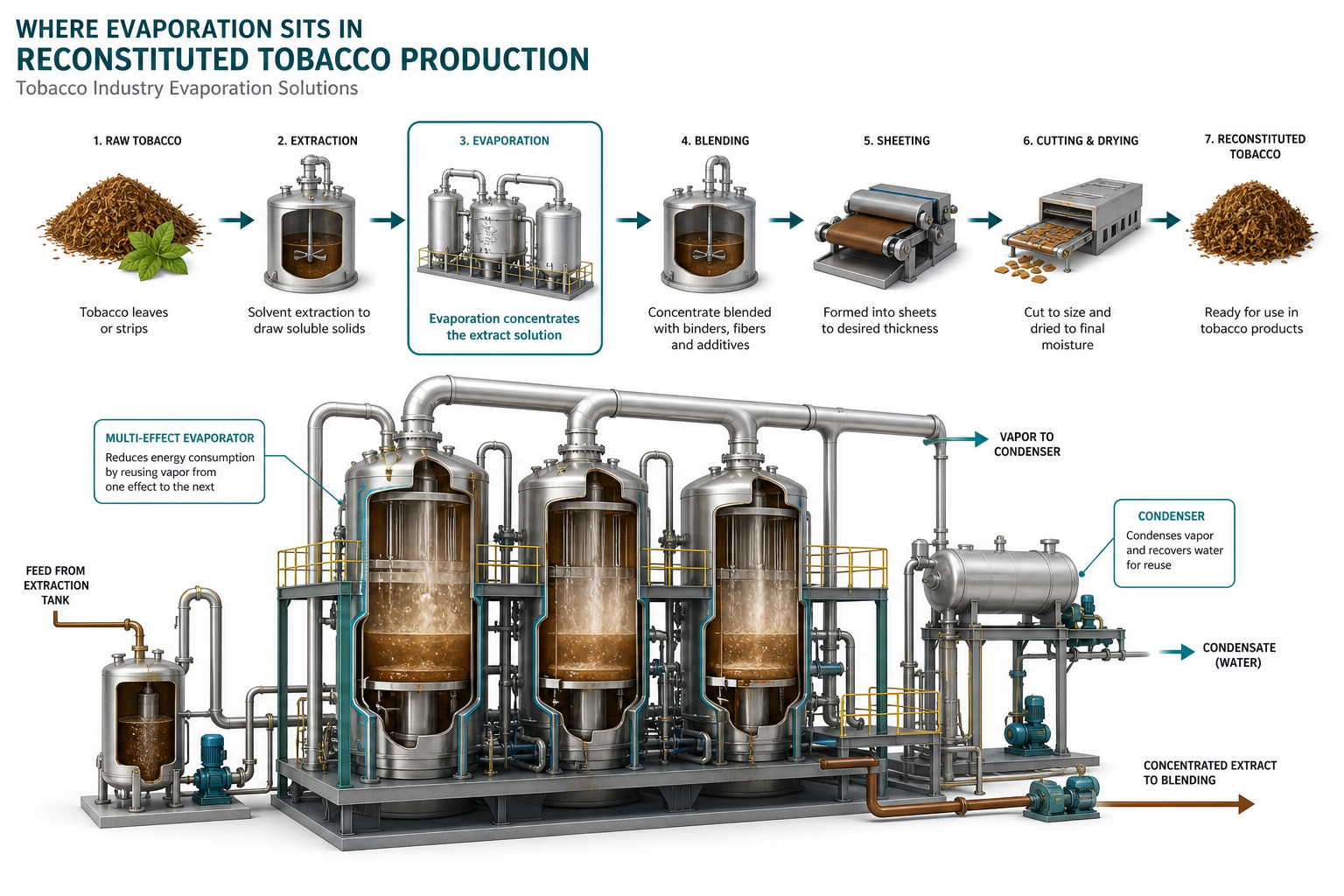
Reconstituted tobacco is made from by-products of primary processing — stems, fines, dust, and sheet scraps that cannot be used directly in blends. These are deep-extracted with water or a water–ethanol solvent, and the resulting extract carries the soluble flavor, nicotine, and sugar fraction of the raw material. The extracted solids are formed into a base sheet, while the extract is concentrated and later re-applied.
The process chain around the evaporator is fixed by material balance logic:
- Extraction: stems and fines are washed and extracted, typically at 50–80 °C, producing a thin extract with a low dissolved-solids content.
- Purification and filtration: multiple filtration and clarification stages remove fines, waxes, and insolubles before the extract reaches the evaporator — this protects the heat-transfer surface.
- Concentration: the purified extract is concentrated, first to an intermediate solids level for handling and storage, then to the final solids level required for dough preparation, coating, or flavor-essence sales.
- Solvent recovery: when ethanol or another solvent is used, the evaporated vapor is condensed and the solvent is recovered and recycled to the extraction stage.
Every tonne of water removed from the extract is energy spent. On a plant processing by-products at industrial scale, the evaporator train commonly removes several tonnes of water per hour — which is why the choice between steam-driven and MVR-driven evaporation dominates the operating cost of the extraction island.
What Makes Tobacco Extract a Difficult Evaporation Duty
Treat the feed descriptions and temperature bands across this page as an illustrative envelope built from published tobacco-process practice — not customer or project data; the actual extract must be characterized on a sample. Within that envelope, tobacco extract is not a clean sugar solution, and four properties drive the design:
- Heat sensitivity. Aroma compounds and reducing sugars degrade and brown rapidly at elevated temperature. Long residence time at high wall temperature produces Maillard-type reactions that darken the concentrate and flatten the sensory profile. Low-temperature operation — typically below 70 °C under vacuum — and short residence time are mandatory, which points to falling-film geometry for the bulk of the duty.
- Fouling by resins and tars. Tobacco resins, waxes, and polymerized phenolics deposit on hot tube walls. Fouling layers add thermal resistance within days if wall temperatures and wall superheat are not controlled, and they harden with time.
- Viscosity rise at high solids. As the extract approaches the final solids target, viscosity climbs steeply, film distribution on falling-film tubes deteriorates, and dry-patch risk appears. This sets a practical ceiling on what a falling-film effect alone can finish.
- Corrosivity. Organic acids and chloride-bearing streams in some extraction recipes require stainless steel 316L as a baseline, with higher-alloy options evaluated against the specific chloride level.
The Two-Stage Concentration Strategy
Because no single evaporator geometry is optimal across the whole concentration range, well-engineered tobacco plants split the duty:
Stage 1 — Falling-Film Pre-Concentration
A falling-film evaporator (with MVR recompression of the vapor) handles the dilute end of the range, where the extract is thin and wetting is easy. Falling-film evaporators achieve their heat transfer through a thin liquid film gravity-draining the tube bundle; single-pass residence time is measured in seconds, and operation under vacuum keeps temperatures in the 55–70 °C band (engineering-practice envelope). This stage typically performs the large majority of total water removal, at the highest thermal efficiency.
Stage 2 — Forced-Circulation Finish
For the final push to high solids, a forced-circulation (FC) evaporator takes over. FC units pump the liquid through the heater at 1.5–3.5 m/s (engineering-practice range), suppressing boiling inside the tubes (flash evaporation occurs in the separator instead). This makes them tolerant of the viscous, fouling, near-final-solids liquor that would foul a falling-film unit, at the cost of higher specific pumping power. The split point between the two stages is set by the viscosity–solids curve of the specific extract, measured on a real sample rather than assumed.
Solvent Recovery: Closing the Loop
Where water–ethanol extraction is used, the evaporator and a small rectification column work as a pair. The vapor leaving the first effect is condensed and fed to the column, which returns recovered ethanol to the extraction stage as reflux-quality solvent and sends the water-rich bottoms forward. Coupling the distillation column to the same MVR heat pump — compressing column-top vapor to drive the reboiler — is an established way to cut the energy cost of solvent recovery dramatically; in published industrial references on comparable solvent duties (external industry references — indicative, not a project guarantee), MVR-heated distillation has reduced annual operating cost by 70–80% versus live-steam operation. The same logic applies to ethanol recovery anywhere in the flavor-essence plant.
Energy Comparison: MVR vs. Multi-Effect vs. TVR
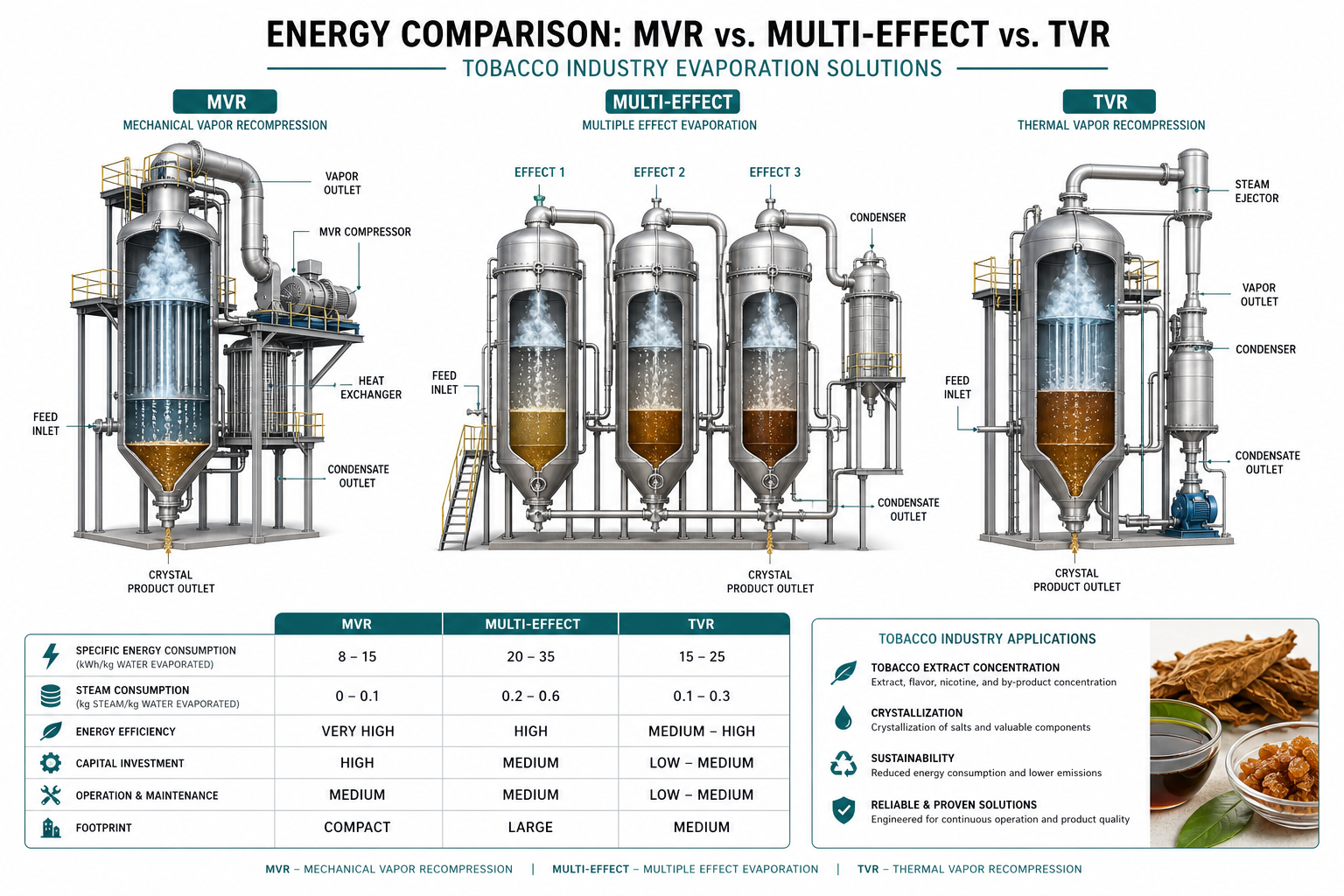
The three standard evaporation architectures trade capital against energy source. The figures below are an illustrative envelope of typical planning ranges for an aqueous duty, drawn from industry-published data — not a project guarantee; a plant-specific selection should be based on actual electricity and steam prices.
| Parameter | Multi-Effect (3-effect) | TVR | MVR Falling-Film |
|---|---|---|---|
| Primary energy input | Live steam | High-pressure motive steam | Electricity only |
| Typical specific consumption | ~0.4 t steam per t water | Roughly one effect better than the equivalent multi-effect train | 25–45 kWh per t water |
| Steam system required | Yes, boiler sized for duty | Yes, plus HP steam header | No (small start-up steam only) |
| Sensitivity to power price | Low | Low | High — favors sites with cheap or renewable power |
| Moving parts in heat-recovery loop | None | None (ejector) | Compressor (rotating machine, maintenance item) |
| Best fit | Sites with cheap steam | Retrofits with existing HP steam | New plants, steam-lean sites, high operating hours |
For tobacco extraction plants — which usually run continuously beside a primary processing line and often have no spare boiler capacity — MVR is frequently the only architecture that fits without a new steam system. Where waste steam or hot exhaust is reliably available, TVR or multi-effect deserves the comparison; see our technology comparison and waste heat & TVR solutions for that branch of the decision tree.
Fouling Management and Clean-in-Place
Resin fouling is the operational reality of tobacco extract evaporation, and the design must assume it rather than fight it:
- Low wall superheat: heating-medium temperature difference is kept tight, because fouling rate accelerates with wall temperature.
- Scheduled CIP: alkaline cleaning cycles remove organic deposits; the interval is set from pilot or reference-plant data. Forced-circulation loops in the finisher tolerate extended runs between CIP because high shear scrubs the tube wall.
- Pre-filtration discipline: wax and insoluble removal upstream is the cheapest anti-fouling investment in the whole plant.
Downstream: Concentrate Handling and Wastewater
The final concentrate goes to coating or dough preparation; where a crystallized or dried product is required, the evaporation train hands off to a crystallization or drying and packing stage. The plant’s own wastewater — equipment rinses, CIP effluent, and extraction residuals — is a high-COD stream that is increasingly regulated; it can be treated in a dedicated zero liquid discharge (ZLD) train rather than trucked off-site.
Scope of Supply for a Tobacco Evaporation Plant
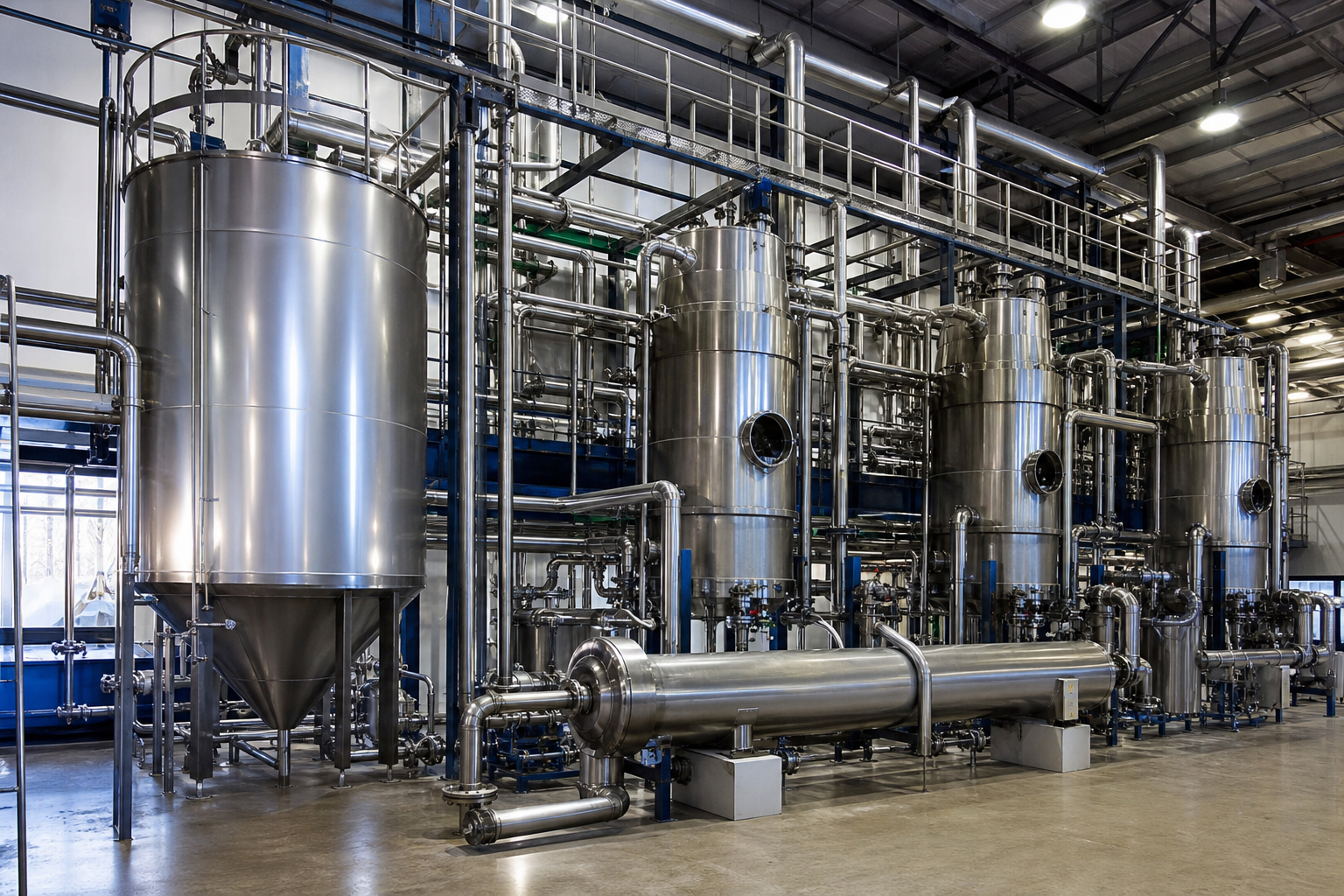
A typical delivery scope covers the complete concentration island, module by module:
| Process Module | Candidate Equipment Types | Selection Basis | Module Function |
|---|---|---|---|
| Pre-concentration | Falling-film effect with MVR compressor, separator, surface condenser | Dilute-stage efficiency, temperature ceiling | Performs the bulk of water removal at gentle temperature |
| Final finish | Forced-circulation finisher | Viscosity at final solids, fouling load | Carries the liquor to final solids without film dry-out |
| Solvent recovery | Rectification column with heat integration | Ethanol vs pure-water extraction | Returns reflux-quality solvent to extraction |
| Utilities and vacuum | Vacuum system, pumps, tanks, interconnecting piping | Site plot and utility portfolio | Holds vacuum and moves product through the island |
| Control and CIP | PLC with solids/density instrumentation; CIP skid with fouling monitoring | Unattended operation, fouling rate | Holds endpoints and schedules cleaning on measured degradation |
Configuration, materials and operating envelopes above are potential considerations; actual selections depend on feed composition, temperature, pressure, corrosion review, fouling behavior, utilities and project capacity.
Configuration work starts from a sample of the actual extract: viscosity-vs-solids and boiling-point-rise curves define the stage split, the temperature profile, and the heat-transfer area. For related duties in flavor and fermentation processing, see our food & fermentation industry solutions.
Conclusion
Tobacco extract concentration is a heat-sensitive, fouling-prone, energy-intensive duty — and all three constraints push toward the same answer: vacuum falling-film pre-concentration with MVR recompression, finished in forced circulation, with solvent recovery integrated into the same heat pump where extraction uses ethanol. Plants that get the stage split and the fouling management right run their extraction island as a profit center instead of a utility burden.
When This Route May Not Fit
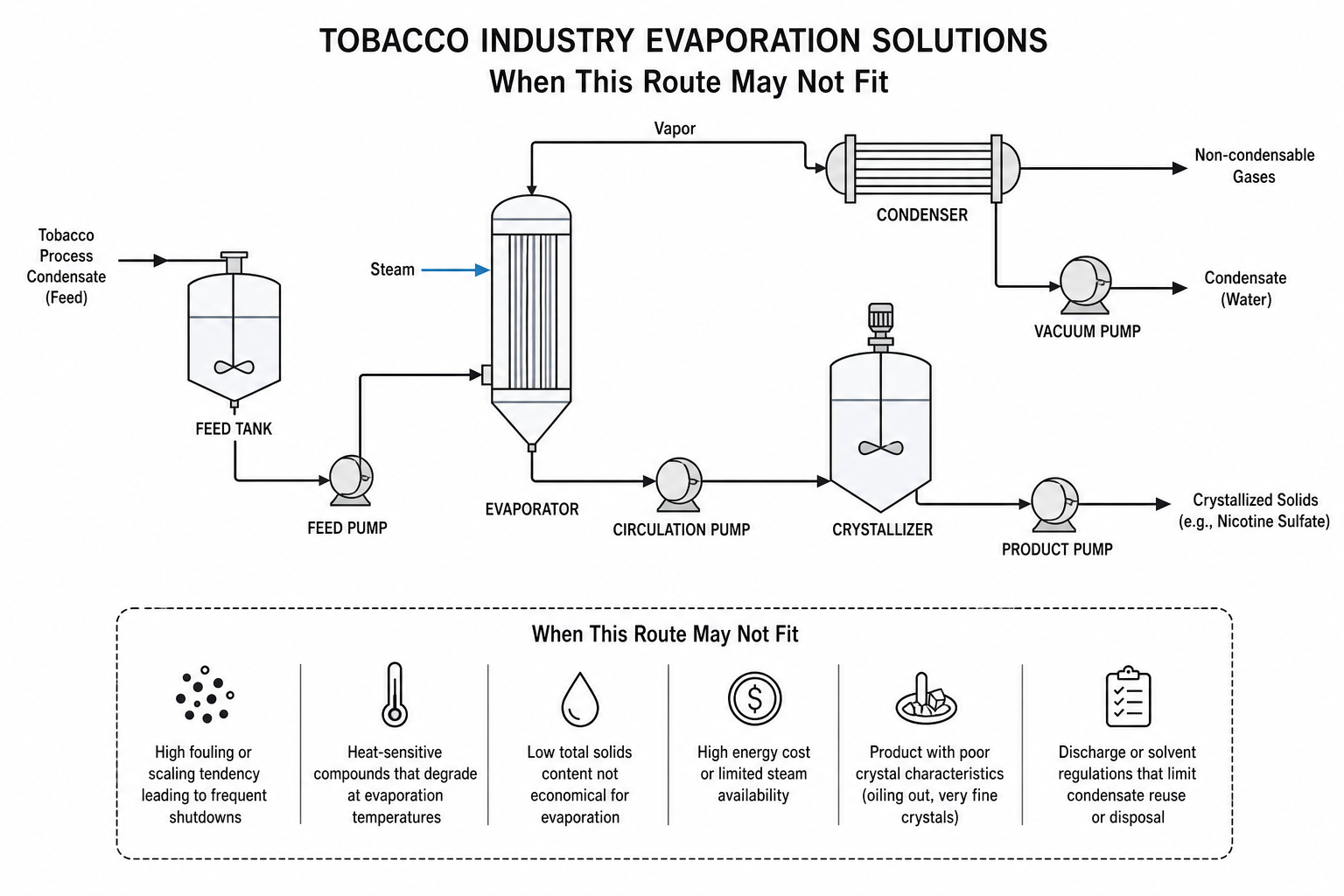
MVR two-stage concentration assumes a continuous, heat-sensitive, aqueous-or-ethanolic extract duty at meaningful scale. It may not fit when: reliable waste steam or a high-pressure header already exists at the site, making TVR or multi-effect the cheaper architecture on both capex and opex; the plant runs small campaign batches, where a simple steam pan or tolling arrangement beats a compressor island; electricity is expensive and steam cheap, inverting the energy economics; the extract is pure-water based with no solvent loop, removing the rectification synergy that strengthens the MVR case; or the true product target is a crystallized or spray-dried powder, which shifts the engineering weight downstream regardless of how the concentration step is driven.
What Must Be Verified
Before this configuration is fixed, verify on a real sample of your extract: the viscosity-versus-solids curve, which sets the falling-film stop point and the finisher duty; the boiling-point rise at final solids, which sizes the compressor lift; fouling propensity under vacuum boiling, which sets the CIP interval and the wall-superheat budget; foaming behavior, which sizes separator and demisters; chloride and organic-acid levels, which fix the metallurgy class; and a sensory or analytical aroma-retention check across the proposed temperature profile, because color and flavor are the commercial specification. Where ethanol is used, the solvent-loop mass balance should be confirmed before the column is sized. Energy figures on this page are industry-published indicative ranges — not a project guarantee.
FAQ
Why is MVR preferred for tobacco extract concentration?
Because tobacco extract is heat-sensitive and the duty is continuous: MVR removes the need for a large live-steam supply, cuts specific energy consumption to a supplier-published indicative 25–45 kWh per tonne of water evaporated, and allows vacuum operation below 70 °C so aroma compounds and color are preserved.
What solids content can be reached?
The falling-film stage concentrates the dilute extract to an intermediate level, and a forced-circulation finisher takes the liquor to final solids in the range commonly required for coating and dough preparation. The exact endpoint is set by the viscosity–solids curve of the specific extract rather than by equipment limits alone.
How is fouling from tobacco resins controlled?
Through pre-filtration of waxes and insolubles, low wall superheat, high circulation velocity in the finisher, and scheduled alkaline CIP. Forced-circulation geometry tolerates fouling service far better than film-type geometry at high solids.
Can ethanol from extraction be recovered?
Yes. The evaporator condensate is processed in a rectification column that returns solvent-grade ethanol to extraction; when the column reboiler is driven by the same MVR heat pump, the energy cost of the recovery loop drops to a fraction of live-steam operation.
Does the plant still need a boiler?
An MVR-based plant needs only minor start-up and sterilization steam. This is often the deciding factor at sites with no spare boiler capacity or at plants planning electrification and decarbonization of utilities.
To position your extraction plant correctly, share a sample characterization or extract analysis, water-removal duty and site utility prices — EvapCryst returns a first-pass process-direction screening for your case.