Tartaric acid is one of the few commodity organic acids whose solubility in water rises steeply with temperature – roughly 139 g per 100 g of water at 20 C climbing to more than 340 g at the boiling point. That steep solubility curve is the single reason continuous cooling crystallization, rather than evaporative crystallization, is the workhorse separation for L-(+)-tartaric acid refinement: cooling a saturated liquor from 70-80 C down to 15-25 C recovers the majority of the dissolved acid as clean, prismatic crystals while leaving impurities in the mother liquor. Getting it right at industrial scale is less about the vessel and more about how precisely you manage supersaturation, nucleation density, and mother-liquor impurity build-up across weeks of continuous operation.
Why Cooling Crystallization Fits Tartaric Acid Chemistry
Tartaric acid (2,3-dihydroxybutanedioic acid) occurs naturally in grapes, where it accumulates as potassium bitartrate and settles out of wine as argol – the raw material behind most L-(+)-tartaric acid production. Whether the feedstock is wine-derived argol, calcium tartrate from winery by-products, or fermentation broth, the refinement route converges on the same sequence: dissolve, decolorize and polish, then crystallize. Because the acid’s solubility approximately doubles between room temperature and 70 C, thermal concentration is usually unnecessary before crystallization – the evaporation duty is either small or already covered upstream when the feed comes as a crude liquor.
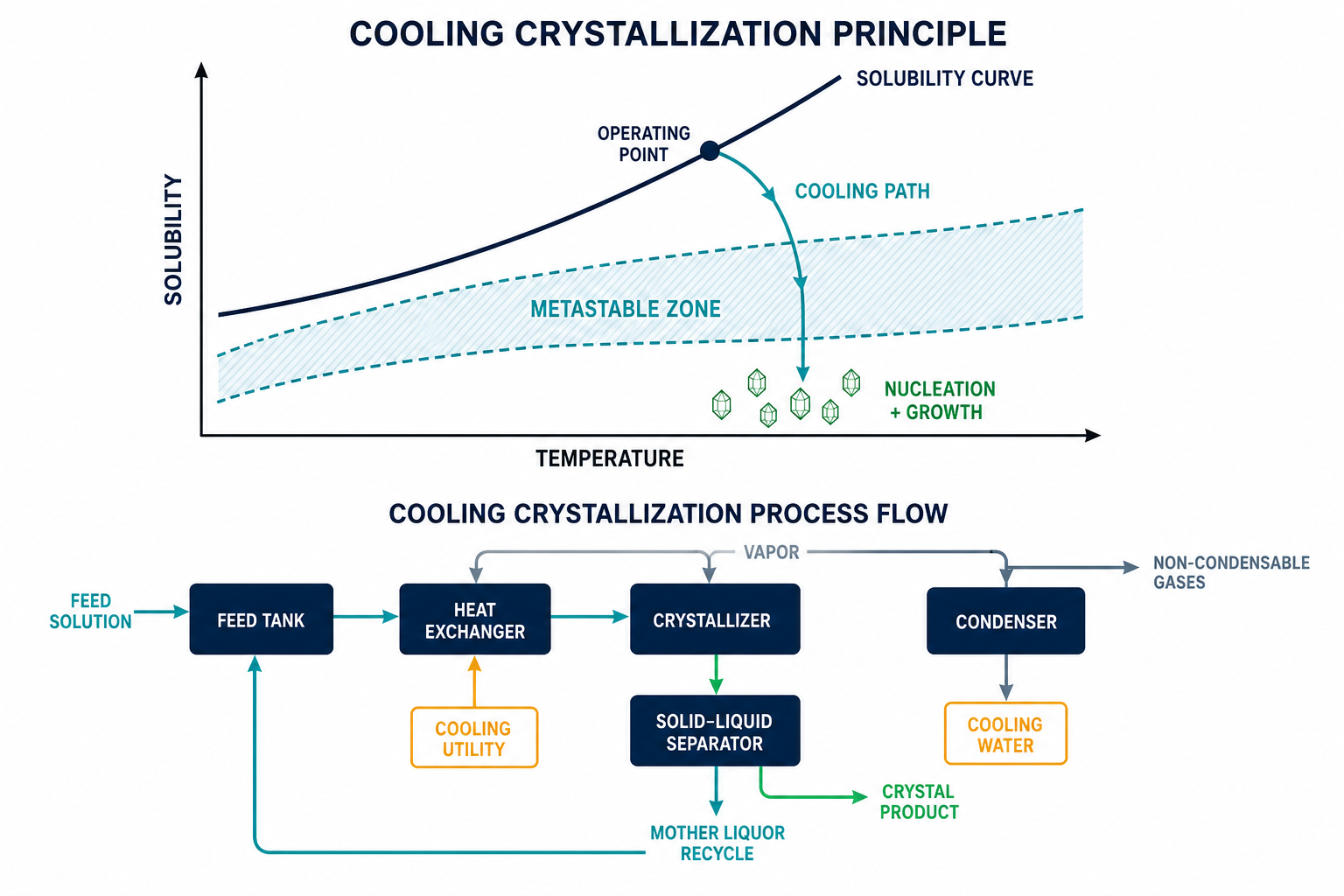
This is also why forced evaporation is actively avoided for food- and pharma-grade tartaric acid. Evaporative crystallization operates at boiling temperature, which concentrates color bodies and degradation products at the crystal surface and drives fine, encrusted crystals. Cooling crystallization instead works across a falling temperature ramp, so crystal growth happens in a controlled metastable zone where large, well-formed prisms – the crystal habit buyers pay for – develop naturally.
Typical Continuous Process Route
A production-scale continuous cooling crystallization train for tartaric acid typically runs as follows:
- Feed preparation. Crude tartaric acid liquor (from argol dissolution, acidulate conversion of calcium tartrate, or decolorized fermentation broth) is polished by activated carbon and filtration to remove anthocyanins, tannins, and suspended fines.
- Hot saturation. The polished liquor is adjusted to a saturation concentration at 70-80 C, usually in an agitated dissolving and hold vessel, so the acid is fully dissolved at the top of the cooling ramp.
- Continuous cooling crystallization. The hot liquor passes through 2-4 crystallization stages in series, each held at a successively lower temperature. Stage temperatures are set along the solubility curve so that the supersaturation generated per stage stays inside the metastable zone – typically a 10-15 C drop per stage with interstage residence of one to several hours.
- Crystal separation. The slurry is centrifuged or filtered on a continuous basket, giving crystals washed with chilled water to displace adhering mother liquor.
- Drying and mother-liquor recycling. Crystals are dried in a fluidized bed or flash dryer at moderate temperature. Mother liquor returns to the dissolving section, with a controlled purge.
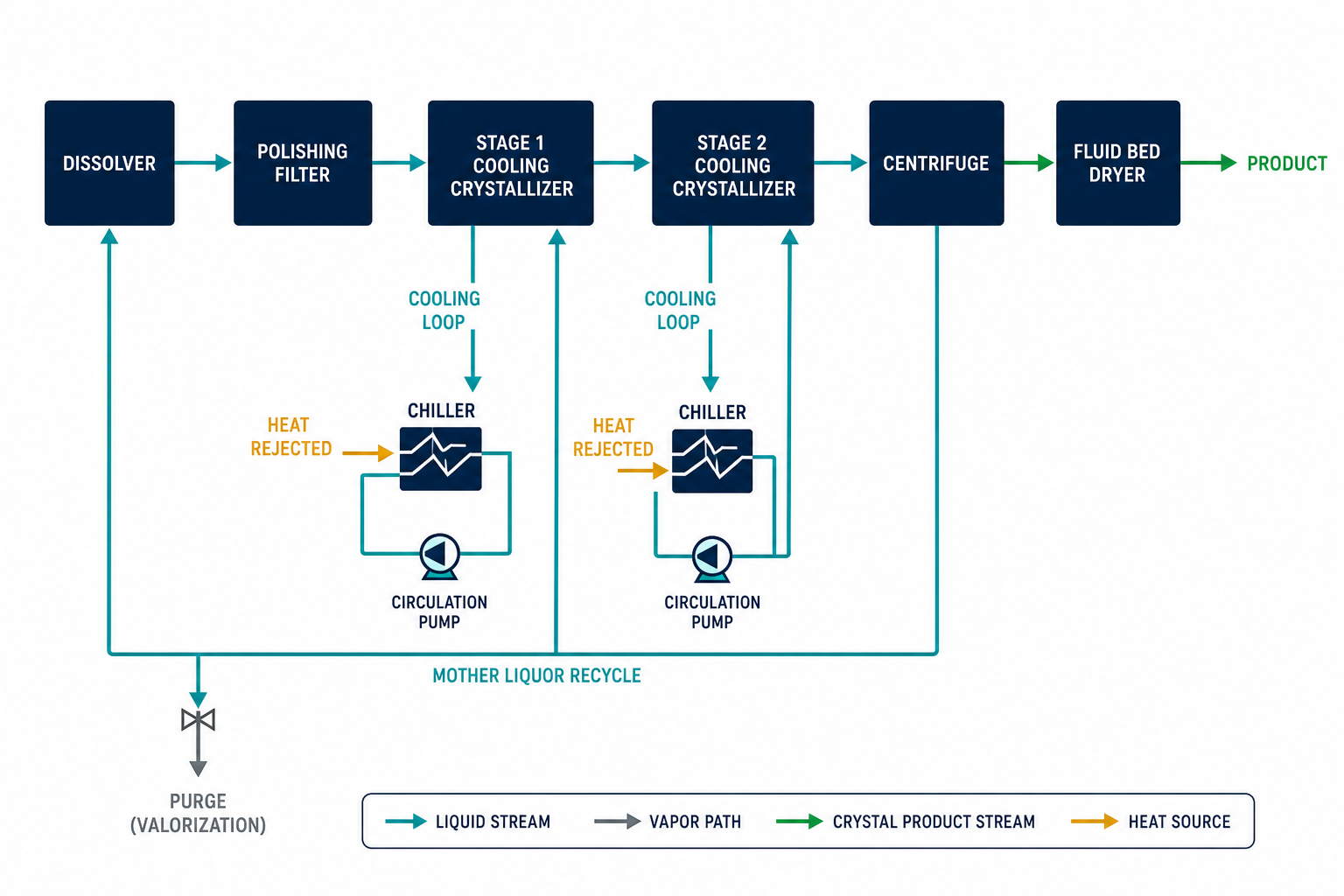
Read as process modules, the continuous train looks like this – candidate equipment types, the selection rationale, and the indicative operating envelope each module must cover (envelopes derived from published industry data, not project specifications):
| Process Module | Candidate Equipment Types | Selection Rationale | Indicative Operating Envelope |
|---|---|---|---|
| Feed preparation | Activated-carbon polish, filtration | Removes color and fines before crystallization | Crude liquor from argol, acidulate, or broth |
| Hot saturation | Agitated dissolving and hold vessel | Fully dissolves acid at the top of the ramp | Saturation at 70-80 C (typical design range) |
| Cooling crystallization | 2-4 stirred stages; DTB or Oslo geometry | Stage drops held inside the metastable zone | 10-15 C per stage; final 15-25 C |
| Crystal separation | Continuous centrifuge or basket filter with chilled wash | Displaces mother liquor without redissolving product | Chilled wash a small fraction of crystal mass |
| Drying | Fluidized bed or flash dryer | Protects luster; prevents caking | Moderate-temperature duty |
| Mother-liquor recycle and purge | Controlled bleed with second-grade recovery | Impurity ceiling held across recycles | Purge typically 10-20% of circulating liquor |
| Refrigeration | Indirect jacket or coil; brine on final stage | Wall-temperature limits keep encrustation out | Coldest brine (about -10 C) on final stage only |
Configuration, materials, and operating ranges depend on the actual feed, temperatures, pressures, corrosion review, fouling behavior, utilities, and project capacity.
The Mother-Liquor Purge Is the Hidden Design Variable
Competitor literature on tartaric acid crystallization rarely addresses the variable that dominates long-run product purity: impurity accumulation in recycled mother liquor. Grape-derived feeds carry potassium bitartrate, calcium tartrate, malic acid, and colored colloids. Each crystallization cycle rejects these into the mother liquor, so their concentration climbs cycle over cycle. In practice, after roughly three to four recycles the impurity level begins to measurably depress crystal purity and distort crystal habit, and a purge stream – typically 10-20% of the circulating mother liquor – must be drawn off. The purge itself is a recovery target: cooled further, it yields a second-grade crop, and the residual liquor can be sold into technical-grade applications or processed for potassium sulfate by-product recovery.
Plants that skip purge management see the classic failure signature: on-spec product for the first days after start-up, then a slow drift in sulfate ash, color, and optical purity values that no amount of wash water corrects.
Continuous vs. Batch: Where the Real Differences Sit
| Criterion | Batch Cooling Crystallizer | Continuous Cooling Crystallizer |
|---|---|---|
| Crystal size distribution | Wide; each batch nucleates differently | Narrow; steady-state supersaturation gives repeatable CSD |
| Cooling control | Ramp programmed per batch; risk of local overcooling on the jacket | Fixed stage temperatures; interstage delta-T locked by design |
| Labor and supervision | Operator attention per batch | Largely unattended; PLC-driven |
| Footprint for equal capacity | Larger (full-volume vessels, standby capacity) | Compact; smaller vessels at same annual tonnage |
| Mother-liquor control | Purge decided batch by batch | Continuous bleed matched to impurity mass balance |
| Best-fit scale | Small lots, multiple grades, pharma campaigns | Single large-volume grade, 24/7 operation |
Key Equipment and Design Parameters
| Parameter | Typical Design Range | Engineering Notes |
|---|---|---|
| Hot-end saturation temperature | 70-80 C | Balances high dissolved load against color formation risk |
| Final crystallization temperature | 15-25 C | Chilled-water territory; below 15 C the refrigeration cost per kg of yield rises quickly |
| Per-stage temperature drop | 10-15 C | Held inside the metastable zone to suppress secondary nucleation |
| Cooling approach | Indirect, via coolant in jacket or coil | Direct coolant contact is avoided; -5 to -10 C brine on final stages only |
| Slurry density | 15-30 vol% crystals | High enough for stable suspension, low enough to pump |
| Wash water | Chilled, small fraction of crystal mass | Displaces mother liquor without redissolving product |
Choosing the Crystallizer Vessel
Three vessel geometries cover nearly all continuous cooling duties for organic acids like tartaric acid. The DTB (draft tube baffle) crystallizer is the default choice when crystal size and a classified product discharge matter: the draft tube gives gentle internal circulation, and the baffle annulus returns the smallest crystals for redissolution. The Oslo fluidized-bed crystallizer grows the largest crystals of the three because nucleation is physically separated from the growth zone – attractive for pharma-grade tartaric acid where large, uniform prisms are desired – at the cost of a taller vessel and more sensitive operation. The forced-circulation crystallizer, the workhorse of evaporative duty, appears in tartaric acid plants mainly on the by-product and recovery sides, where robustness against scaling outranks crystal perfection. Our crystallizer selection tool walks through the same trade-offs interactively.

Heat Removal: The Utility Side of the Balance
Cooling crystallization trades steam for refrigeration, and the refrigeration system deserves as much design attention as the vessel. The total cooling load is the sum of sensible heat removed from the liquor and the exothermic heat of crystallization released as crystals form – both must be removed through the heat-transfer surface without driving the wall temperature far below the bulk temperature. Excessive wall temperature difference causes local supersaturation spikes, and those spikes are where encrustation starts. A well-designed system keeps the approach temperature between the coolant and the process fluid modest, circulates coolant at high velocity, and reserves the coldest brine (down to roughly -10 C) for the final stage only. Heat recovery from warm streams back into feed preheating routinely recovers a meaningful share of the duty in plants that also run an evaporation section upstream – the same integration logic we apply on MVR evaporation projects.
Quality Control Points That Separate Grades
Food-grade, pharma-grade (monograph-compliant), and technical-grade tartaric acid come off the same crystallizer; the difference is discipline at five control points. First, feed polish – residual color that survives activated carbon will report on the crystal surface. Second, wash efficiency on the centrifuge, which sets the sulfate ash and heavy-metal carryover. Third, purge rate, which governs long-run optical purity. Fourth, drying temperature, kept moderate to prevent caking and loss of crystal luster. Fifth, screening, which blends the size fractions different customers specify. Plants producing for pharmacopoeial markets add a final recrystallization pass, accepting a yield penalty for the purity guarantee.
Common Failure Modes and How They Present
Three failure patterns account for most continuous tartaric acid crystallizer upsets. Encrustation on cooling surfaces shows up as a slow rise in required coolant flow to hold stage temperature, ending in a forced shutdown for hot-water cleaning – mitigate with wall-temperature limits and scheduled CIP. Fines generation appears as an increase in crystals below the target cut, usually traceable to an over-aggressive stage temperature drop or a worn impeller tip clearance shifting the nucleation balance. Finally, feed-composition shocks – a spike in calcium or potassium from a raw-material lot change – masquerade as a purity problem but are actually a tartrate double-salt precipitation issue that the standard wash cannot fix; the correction is tighter incoming-spec control plus a temporary purge increase.
Where the Acid Goes: Applications That Set the Specs
Tartaric acid’s demand profile explains the grade structure. The food industry consumes it as an acidulant and stabilizer – the tartness agent in beverages and confectionery and the cream of tartar family in baking – where taste and color specs dominate. Pharmaceuticals use it as an excipient and chiral resolving agent, which adds optical purity and monograph compliance to the spec sheet. Industrial users consume it in metal cleaning, electroplating baths, and as a bio-based building block for degradable polymers and coatings, where technical grade suffices. A crystallization line designed for the food and pharma grades can always down-spec; the reverse is not true, so utility and metallurgy selections are set by the top grade the plant intends to sell.

Validation focus. Before a tartaric acid crystallizer is configured, three questions must be answered on the actual feed: its solubility and metastable-zone width (they set the safe per-stage temperature drop and the number of stages), its impurity profile across raw-material lots (potassium, calcium, malic acid, and colloids set the purge policy and the wash design), and its color behavior through the hot-saturation step. Verification runs on characterized feed samples – solubility curves, MSZW measurement, and bench cooling-crystallization trials – because the same vessel produces food, pharma, or technical grade only by the precision of these inputs, not by hardware alone.
How EvapCryst Approaches a Tartaric Acid Project
We treat a tartaric acid crystallization project as a separation-specification problem before it is an equipment problem: samples of the actual feed liquor are characterized for solubility behavior and impurity profile, a metastable-zone width measurement sets the safe per-stage temperature drop, and only then are vessel geometry, staging, and refrigeration duty fixed. The deliverable is a continuous train matched to your grade target and tonnage, with the mother-liquor purge strategy and CIP design built in rather than bolted on. Where the feed arrives dilute – as some fermentation and acidulate routes do – we combine the cooling train with upstream concentration using falling-film evaporation or a multiple-effect system, so the evaporator does the water removal cheaply and the crystallizer does the purity work precisely. Related process lines are described on our food and fermentation industry page and our concentration and crystallization solutions page.
When This Route May Not Fit
Cooling crystallization pays because tartaric acid’s solubility falls steeply on cooling. Acids or salts with flat solubility curves get nothing from the same hardware – their duty is evaporative. Small pharma campaigns running multiple grades may suit batch crystallizers better than a continuous train, as the comparison table above concedes. Where the raw material shifts from grape-derived argol to synthetic or fermentation routes, the impurity profile changes enough that an existing purge and wash design must be revalidated rather than inherited. And sites without chilled-water or brine capacity should price the refrigeration plant before committing to the cold end.
What Must Be Verified
On the feed: solubility behavior of the actual liquor (not handbook curves for the pure acid), metastable-zone width at working concentrations, and the impurity profile across raw-material lots – potassium and calcium spikes masquerade as purity problems until incoming specs are tightened. On the design: per-stage temperature drops inside the measured metastable zone, wall-temperature approach on cooling surfaces to keep encrustation out, and the purge rate matched to the impurity mass balance. On utilities: chilled-water and brine capacity for the final stages, and heat-recovery potential if an evaporation section exists upstream. Each input changes vessel geometry, staging, or refrigeration duty; none can be assumed from generic organic-acid practice.
FAQ
Why is cooling crystallization preferred over evaporation for tartaric acid?
Because tartaric acid solubility in water rises steeply with temperature – from roughly 139 g/100 g at 20 C to over 340 g at 100 C – most of the dissolved acid can be recovered just by cooling a hot saturated solution, without boiling. Cooling also preserves crystal quality and color better than high-temperature evaporation, which matters for food- and pharma-grade product.
What temperature window does a continuous tartaric acid crystallizer use?
A typical train saturates the liquor at 70-80 C and cools through staged crystallizers down to a final temperature of 15-25 C, with each stage dropping 10-15 C so that supersaturation stays inside the metastable zone and crystal growth dominates over nucleation.
How is crystal purity maintained over weeks of continuous operation?
Through mother-liquor management. Impurities rejected by crystallization accumulate in the recycled mother liquor, so a continuous purge – commonly 10-20% of the circulating liquor – is drawn off after about three to four recycles worth of impurity build-up, with the purge itself chilled for second-grade recovery.
Which crystallizer type suits tartaric acid best?
DTB (draft tube baffle) crystallizers are the common choice for a balance of size control and throughput; Oslo fluidized-bed crystallizers grow the largest, most uniform prisms for pharma grades; forced-circulation crystallizers are reserved for by-product and scaling-prone recovery duties.
Can tartaric acid mother liquor be valorized instead of discharged?
Yes. Chilled second-stage crystallization recovers an additional crop of technical-grade acid, and the residual liquor can be processed for potassium sulfate by-product or sold into technical applications, which converts a waste stream into revenue and reduces effluent load at the same time.
To begin a first-pass screening, send the feed liquor analysis (solubility check, impurity profile, color) and the target outputs – grade specification and tonnage – for this crystallization route.