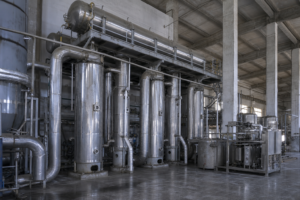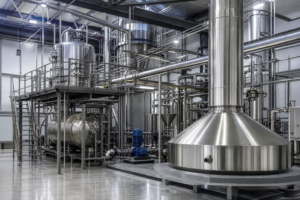
An ethanol plant is, in energy terms, two plants in one: a distillery separating alcohol from water, and a feed factory drying everything left behind. The second half — concentrating thin stillage into DDGS (distillers dried grains with solubles) — is typically the largest steam and thermal consumer on site, and where evaporation choices move operating cost most. A well-configured chain combines decanter centrifugation, MVR or multi-effect evaporation of thin stillage into syrup, a rotary dryer with integrated scattering unit, and anaerobic treatment of evaporator condensate that turns wastewater into biogas.
Why Stillage Handling Decides Ethanol Plant Economics
Every kilogram of corn leaves fermentation through one of three outlets: ethanol, carbon dioxide, or stillage. The industry rule of thumb for a dry mill: one bushel (56 lb, 25.4 kg) yields roughly 2.8 gallons of ethanol and 17–18 lb of DDGS — close to a third of incoming grain mass returns as a wet by-product to be dewatered, dried, stored and sold. The moisture and energy in that stream is pure cost unless recovered efficiently.
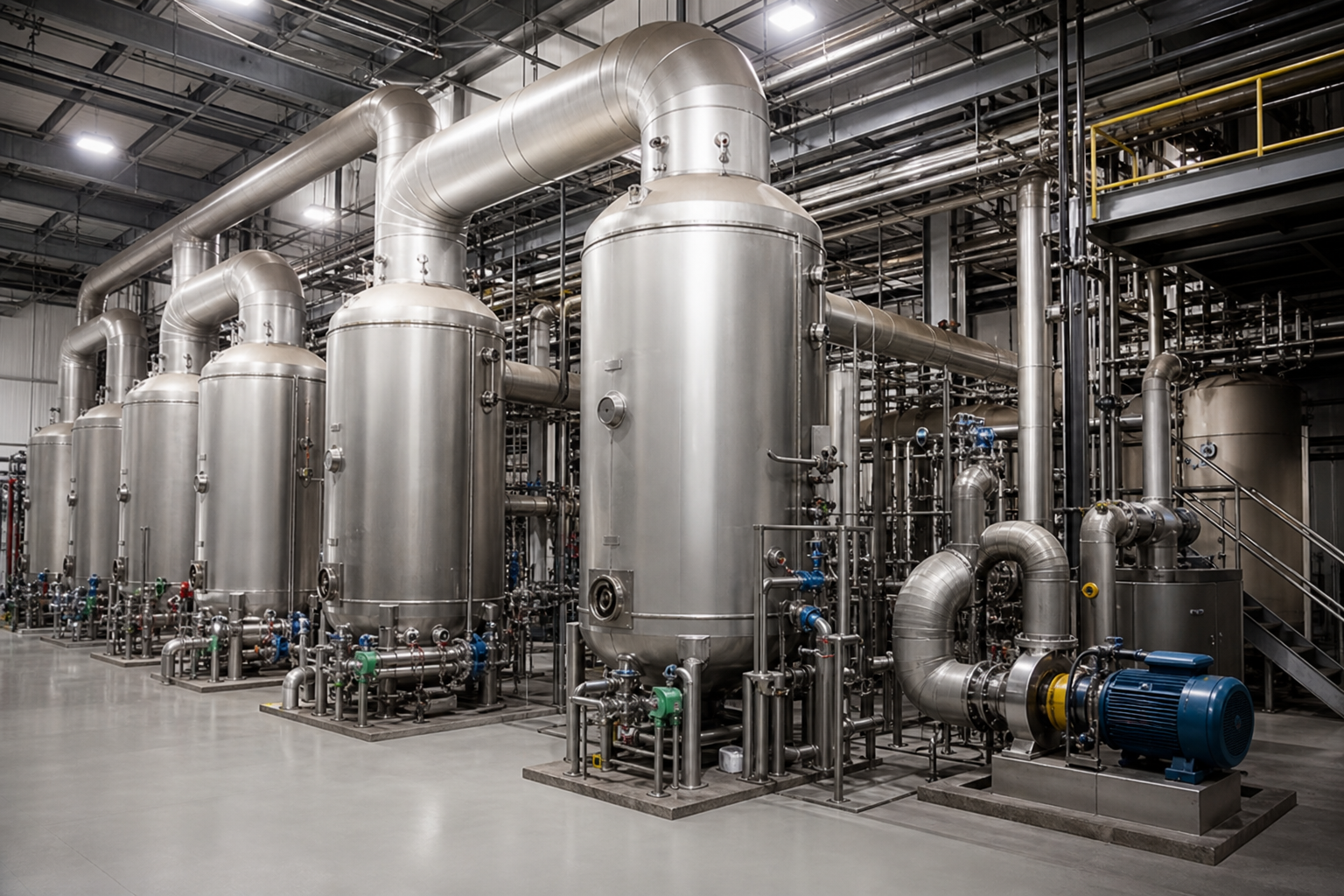
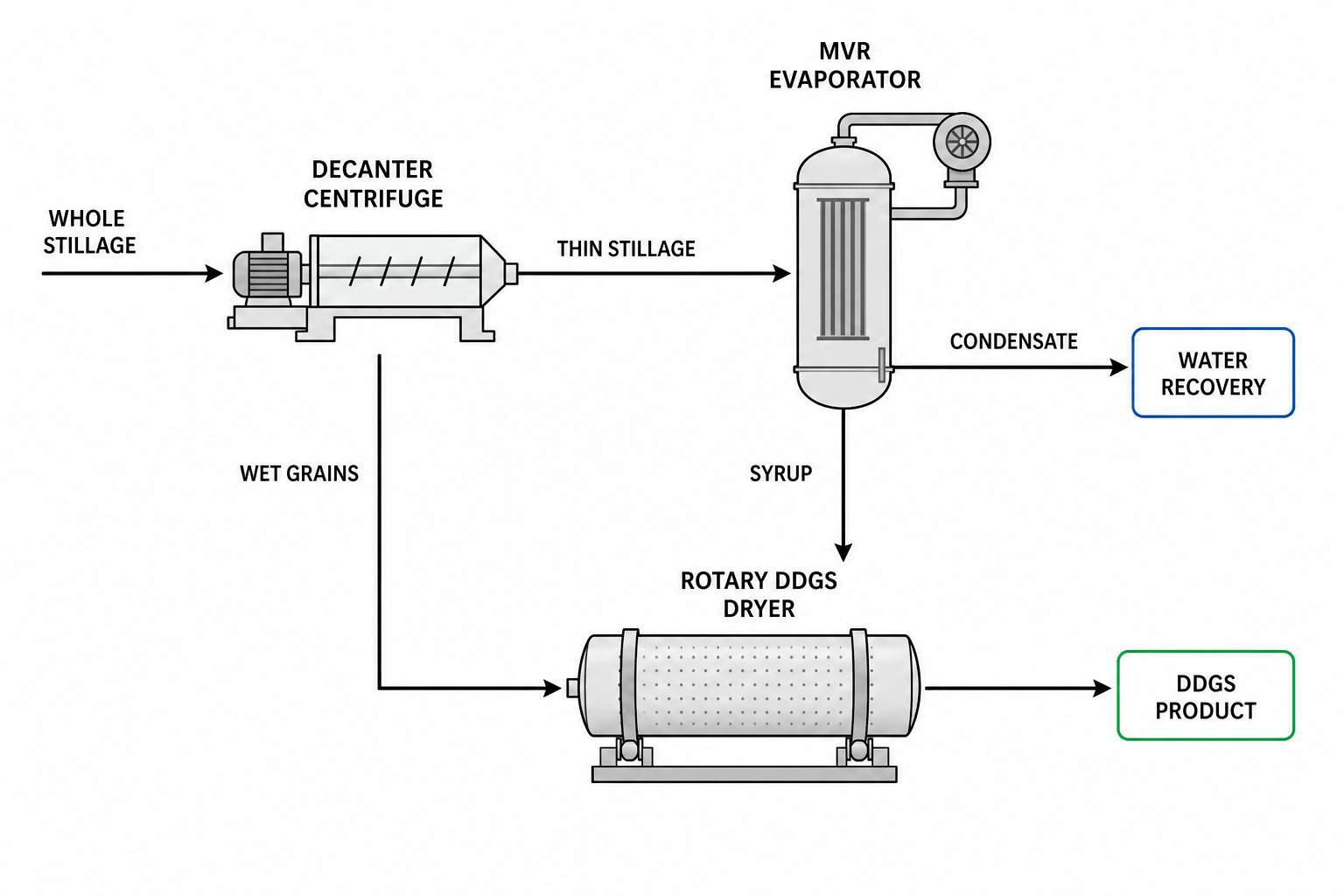
Whole stillage from the beer column carries an illustrative 7–12% total-solids envelope. Splitting it is the first economic decision: a decanter separates coarse grain (wet distillers grains, 30–35% solids) from thin stillage at roughly 5–9% solids. Sending thin stillage straight to the dryer would evaporate enormous water in the most energy-intensive unit on site; evaporating first to 30–35% syrup keeps fuel consumption defensible — which is why the evaporator train, not the dryer, is the usual retrofit focus.
The Complete Process Chain: From Corn Grinding to Feed Product
A dry-mill ethanol and DDGS line integrates five sections, and the quality of each interface matters more than any single machine:
- Grinding and liquefaction: cleaned corn is hammer-milled, mixed with water and high-temperature liquefying enzyme, then passed through a jet cooker and maintenance tube to swell and gelatinize the starch. The mash is flashed, cooled and pH-adjusted to inactivate the enzyme.
- Saccharification and fermentation: the mash is cooled to about 60 °C for saccharification, then further cooled for fermentation, where yeast converts sugars to ethanol with CO₂ recovery and alcohol vapor stripping from the vent gas.
- Distillation and dehydration: mature mash passes the crude distillation column (beer column), purification column, rectifying column and methanol removal column in series to reach super-grade ethanol; the vinasse leaving the beer column bottom is essentially ethanol-free and becomes the DDGS feedstock.
- DDGS section: vinasse is desanded, decanter-centrifuged, the thin stillage evaporated to syrup, syrup blended back with the wet cake, and the mixture dried, cooled and transferred to the feed product silo.
- Wastewater section: evaporator condensate and tank-washing water are equalized, pH-adjusted, treated anaerobically (UASB) with biogas recovery, then finished in an aerobic SBR before discharge or reuse.
| Process module | Equipment candidates | Selection basis | Indicative envelope |
|---|---|---|---|
| Liquefaction | Hammer mill, jet cooker, maintenance tube | Starch gelatinization, enzyme dose, flash cooling | Liquefied mash output |
| Saccharification | Saccharification tanks, heat exchangers | ~60 °C hold, pH adjustment | Saccharified mash |
| Fermentation | Fermenters, CO₂ scrubber | Temperature control, yeast propagation, mash loading rate | Mature mash |
| Distillation | Beer column, purification, rectifying, methanol columns | Reboiler steam, reflux ratio, impurity heads cut | Super-grade ethanol |
| DDGS | Decanter centrifuge, evaporator train, rotary dryer with scattering unit | Thin stillage 5–9% TS to syrup 30–35% TS | Final moisture 10–45%; DDGS feed product |
| Wastewater | UASB reactor, biogas holder, SBR | COD load, alkalinity, anaerobic/aerobic split | Biogas + compliant effluent |
Thin Stillage Evaporation: Choosing Between MVR and Multi-Effect
Thin stillage is fouling, foaming and high-viscosity, worsening as it concentrates — viscosity rises steeply past roughly 25% solids, which is why syrup is capped around 30–35% and why the design must anticipate cleaning, not just heat transfer. Falling-film bodies handle the dilute front end; a forced-circulation finisher is standard for the viscous final effect, where tube wetting and fouling control run length.
The core selection is the energy source for the evaporator train. Textbook ranges are instructive: a quadruple-effect steam-driven train consumes on the order of 0.25–0.35 t of fresh steam per ton of water evaporated, while an MVR train recompresses its own secondary vapor with a compressor and typically needs only about 25–40 kWh of electricity per ton of water evaporated, depending on viscosity and temperature lift. Where steam is expensive and electricity cheap, MVR cuts evaporation energy cost dramatically; where cheap low-pressure steam or waste heat exists, multi-effect remains competitive with a lower capital entry price. For a detailed technology comparison see MVR evaporation and multi-effect evaporation.
Two engineering details deserve more attention than they usually get. First, vapor-scrubbing between effects: entrainment carries protein and oil into the condensate and silently loads the downstream UASB. Second, condensate segregation — first-effect condensate is clean enough for boiler feed or mashing water in many plants, while final-effect condensate carries volatile organics and belongs in the wastewater line. Splitting them costs almost nothing and saves water purchase year after year.
DDGS Drying: The Rotary Dryer with Scattering Unit
After syrup is blended with wet cake, the dryer removes the remaining water down to the target product moisture. The reference configuration is a rotary dryer with built-in scattering unit — documented in 10+ installed projects (external industry references, not EvapCryst project records): the scattering rotor breaks up the sticky wet cake as it enters, exposing fresh surface to the hot gas. Reported results include 50% shorter drying chamber and land area versus a conventional rotary of equal capacity, 10–15% lower energy from improved thermal efficiency, and roughly 25% lower civil and equipment investment for the drying island — supplier-reported indicative figures, not project guarantees.
Flexibility of final moisture is a commercial feature, not a technical footnote. The same machine can be set to deliver product moisture anywhere between 10% and 45%, which lets a plant modulate between high-moisture wet distillers grains sold locally (lower fuel cost, short shelf life) and low-moisture DDGS for export and long storage — anything above about 12–15% moisture requires careful storage management to avoid mold and nutrient loss. Heat sources can be coal or natural gas depending on local fuel economics and emissions permits, and modern plants run the entire drying island under automatic control with hot-air temperature, retention time and product moisture as the controlled variables.
Condensate, Biogas and the Water Balance
Evaporator condensate from stillage concentration is hot, sour and far too high in COD to discharge — which is why it is valuable. Routed to a mixing pool with tank-washing water and pH adjustment, it feeds a UASB reactor where anaerobic digestion converts organic load into biogas: after gas-water separation it is stored and offsets natural gas in the dryer furnace or boiler. Part of the digestate recycles to maintain alkalinity; the remainder passes air flotation and an SBR before discharge, with sludge streams conditioned, flocculated and filter-press dewatered.
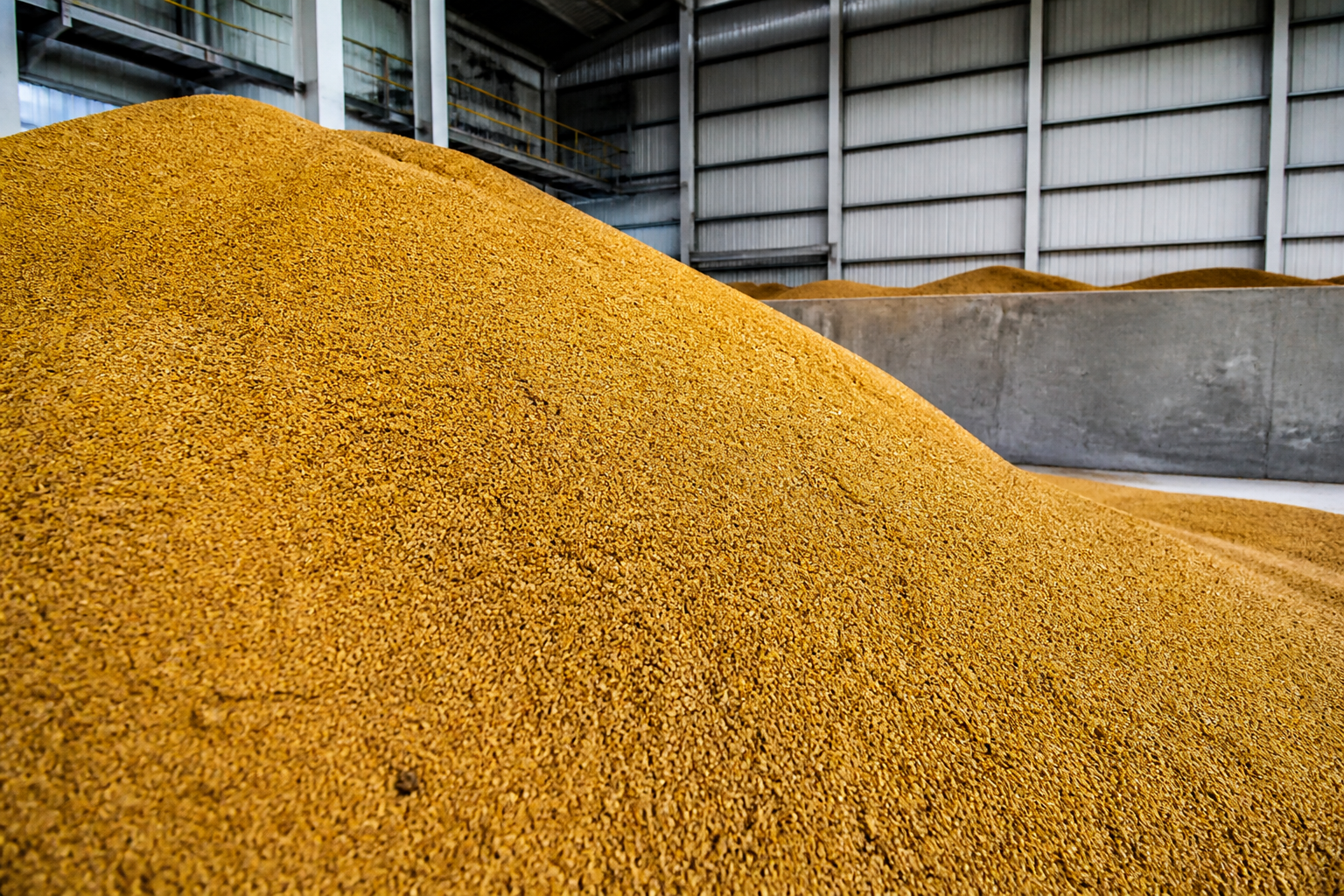
Closed this way, the plant’s water balance tightens considerably: condensate and treated water can replace fresh water in mashing and cleaning, the biogas displaces purchased fuel, and the only liquid leaving the site is treated effluent at compliance level. Plants planning this configuration should review the zero liquid discharge approach to see how far the same logic can be pushed when discharge permits tighten.
Retrofit Economics: Where the Payback Is
For existing plants, the highest-return projects rank consistently. First, replacing steam-driven evaporation with MVR on the thin stillage train — the largest steam consumer on site, and a well-understood retrofit package (see energy retrofit and decarbonization solutions). Second, condensate segregation and reuse — plumbing-level investment against water and sewer savings. Third, dryer upgrades — scattering-unit retrofits and exhaust heat recovery — cutting dryer fuel 10–15%. Debottlenecking evaporation also unlocks dryer throughput, because the dryer is rarely first constraint when the evaporator is fouling-limited.
New build projects in the food and fermentation sector should size the evaporation train with fouling margins — design for 30–40% spare surface or a clean-in-place regime from day one — because stillage fouling, not thermodynamics, sets the real capacity ceiling. More context on equipment sizing is in the forced-circulation evaporator and falling-film evaporator technology pages, and on fermentation-sector applications generally at food and fermentation industries. For plants producing oilseed-based co-products alongside alcohol, the sister article on lecithin concentration and drying covers the thin-film evaporation route for viscous gums.
When This Route May Not Fit
Not every ethanol plant needs the full chain. Facilities with a strong local wet-cake market — feedlots within hauling distance — can sell wet distillers grains and skip most of the evaporation and drying investment. Very small spirit or craft producers discharge stillage to municipal or agricultural reuse under permit. Plants whose fuel and electricity prices both run high may find neither MVR nor multi-effect clears the economics against simply selling wet. And where grain sourcing is seasonal or campaign-based, continuous-duty evaporation trains sit underused much of the year.
What Must Be Verified
Verification starts with the stillage itself: total-solids envelope, viscosity curve with concentration, and fouling propensity of the actual mash — ideally from a pilot concentration run, because stillage fouling, not thermodynamics, sets the capacity ceiling. Second, the energy price pair at site: electricity versus steam versus dryer fuel, which decides MVR versus multi-effect and gas versus coal drying. Third, condensate COD and its anaerobic treatability, sizing the UASB. Fourth, the DDGS market specification — moisture target, and whether export or local sale sets it. Fifth, the water-discharge permit that determines how far biogas-and-reuse closure must go.
FAQ
What is DDGS and why does an ethanol plant need to dry it?
DDGS (distillers dried grains with solubles) is the concentrated, dried by-product of grain fermentation — the protein, fat and fiber fraction of the corn that yeast does not consume. Drying it from wet cake plus syrup down to 10–12% moisture makes it storable, transportable and sellable as animal feed; without drying, wet distillers grains must be consumed locally within days.
MVR or multi-effect evaporation for thin stillage — which is better?
MVR usually wins on operating cost where electricity is reasonably priced, consuming roughly 25–40 kWh per ton of water evaporated instead of fresh steam; multi-effect wins on capital simplicity where cheap steam or waste heat already exists. Fouling behavior of stillage is similar in both, so cleaning regime and viscosity management matter more than the energy source in determining uptime.
How concentrated should thin stillage syrup be before drying?
Typically 30–35% total solids. Above that range viscosity rises steeply, pumping and heat transfer degrade, and fouling accelerates. The economically optimum cut point balances evaporator energy (cheap per unit water) against dryer energy (expensive per unit water) and is usually confirmed by pilot evaporation on actual stillage.
Can evaporator condensate be reused instead of treated and discharged?
Partially, yes. Clean first-effect condensate is often suitable for mashing water or boiler makeup after polishing. Final-effect condensate carries volatile organics and should be routed to anaerobic treatment — where it becomes biogas feedstock rather than a treatment burden.
What final moisture should DDGS be dried to?
For long storage and export, 10–12% moisture is the standard target. Rotary dryers with scattering units can operate across a 10–45% final moisture window, allowing plants to sell higher-moisture product locally when fuel prices make deep drying uneconomic, provided storage discipline is in place.
To screen this route, share the stillage solids and viscosity profile, the energy prices, and the DDGS outlet plan — enough for an initial chain-configuration assessment.