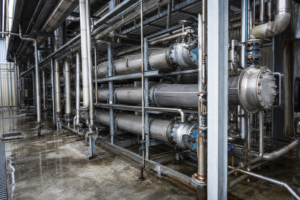
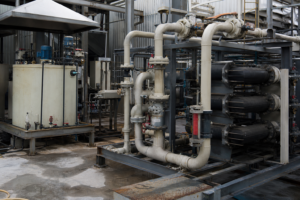
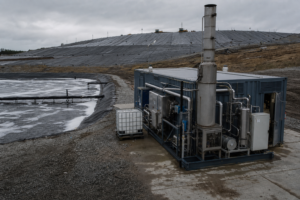
Industrial park integrated wastewater ZLD works when it is built as a treatment train, not a single machine: pretreatment and biological polishing, membrane concentration with MBR plus reverse osmosis, then MVR evaporation-crystallization on the membrane reject to recover reusable water and solid salt. Plants built this way report over 90% reduction in freshwater consumption and elimination of liquid effluent, with the RO stage alone removing about 99% of dissolved salts from the water it treats — industry-reported figures, not site guarantees.
Why Industrial Park Wastewater Is the Hardest ZLD Case
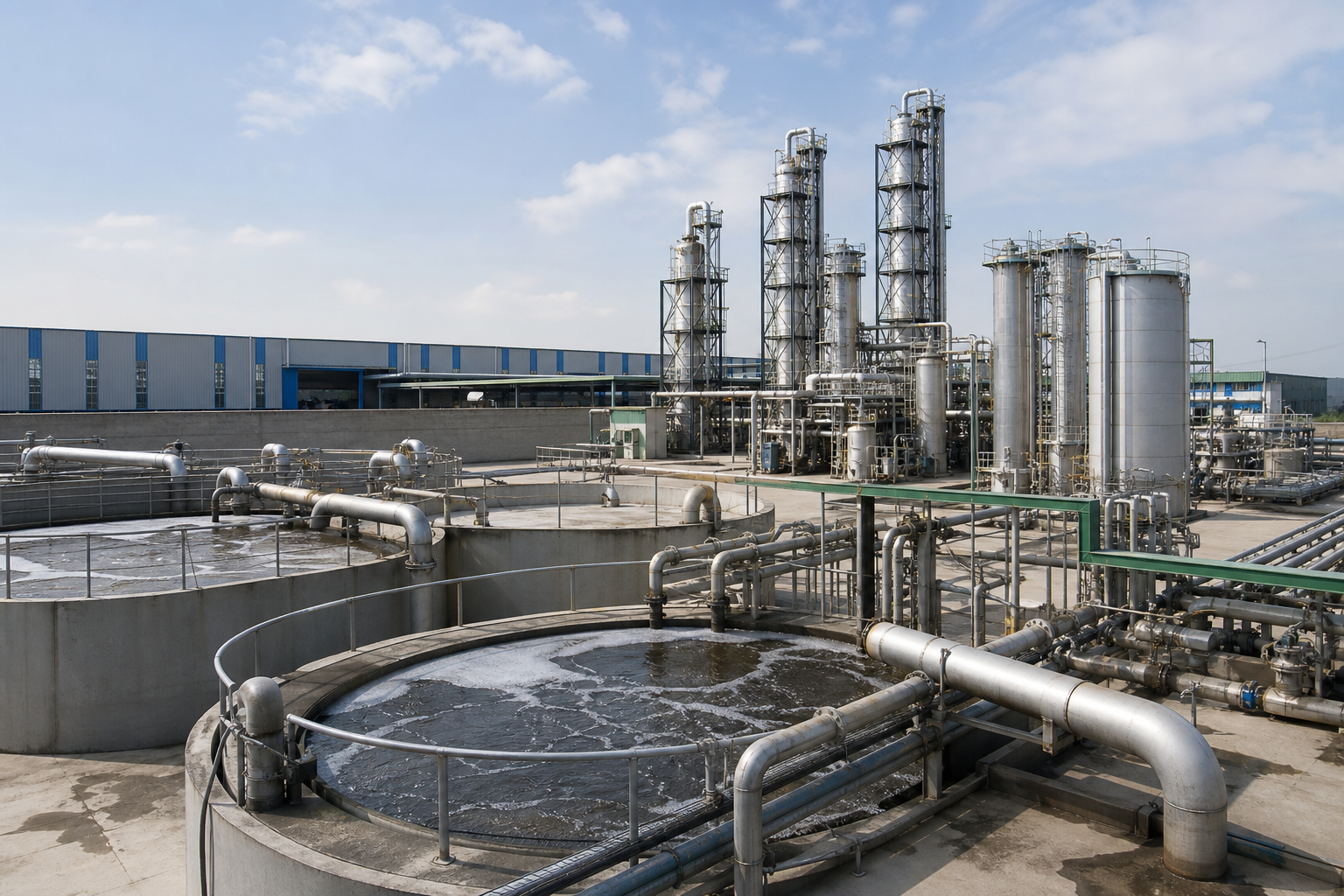
An industrial park wastewater plant receives effluent from dozens of unrelated factories: electroplating shops, chemical synthesis units, food processors, textile dyers, and metal fabricators, all discharging into one shared network. Three consequences follow directly from this mixing.
First, composition swings hourly. A batch discharge from a single tenant can shift chloride load, pH, or COD by an order of magnitude within an hour, so every downstream unit needs equalization. Second, the salt matrix is a genuine mixture: sodium chloride, sodium sulfate, calcium salts, and trace organics arrive together, which defeats single-salt crystallizer logic and pushes design toward mixed-salt handling or salt separation. Third, liability is collective: the park operator, not the individual tenant, answers for the outfall, which is why parks were among the earliest adopters of ZLD in China under national discharge policy.
ZLD resolves the compliance question structurally rather than marginally. A zero liquid discharge plant is a closed-loop process in which no liquid waste is released: all wastewater is treated, purified, and reused, while residual solids such as salts are recovered for disposal or sale.
The Standard Four-Stage Treatment Train
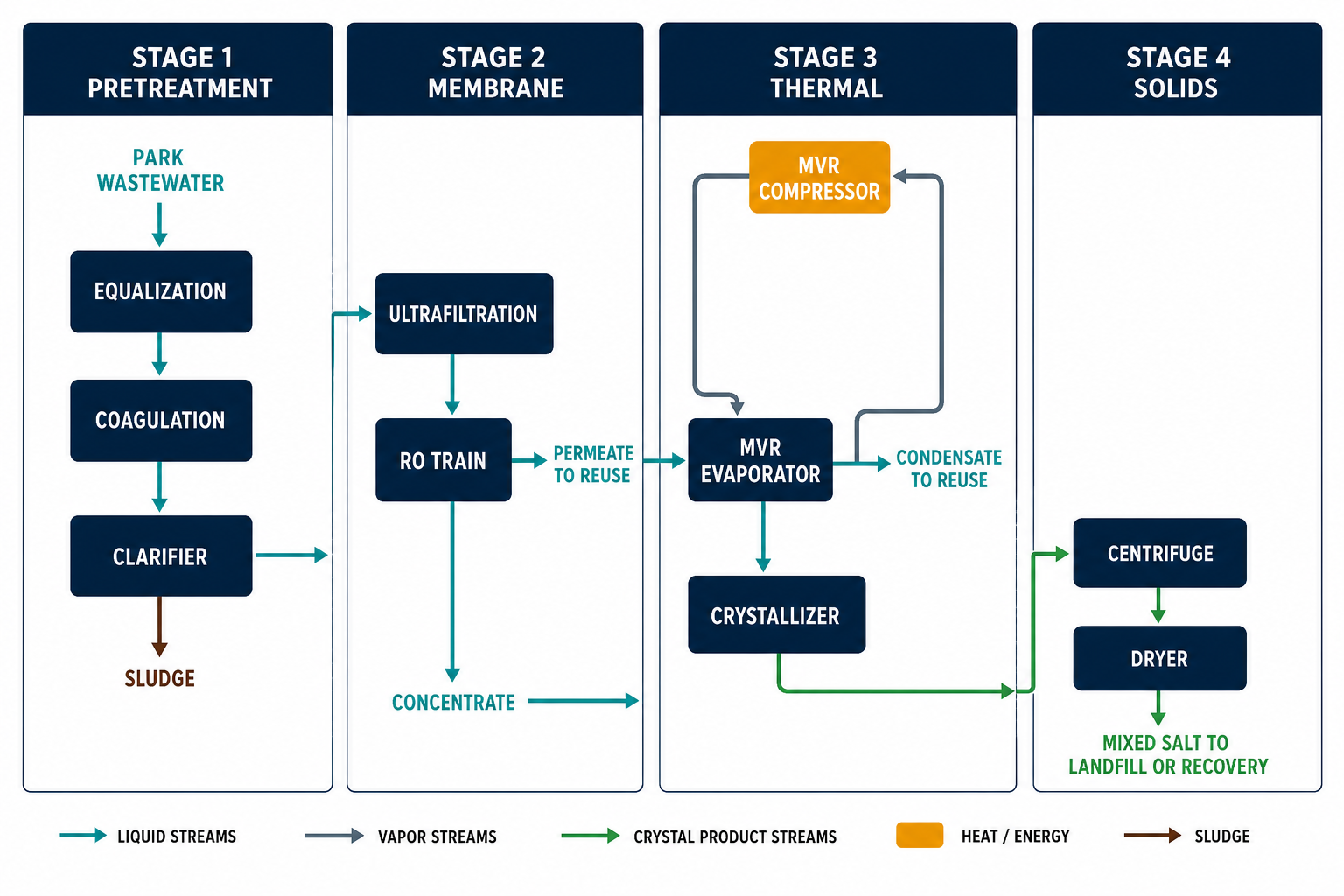
Mature park-scale ZLD plants converge on four stages:
| Process Module | Candidate Equipment | Function & Selection Basis |
|---|---|---|
| 1. Pretreatment | Screening, pH correction, oil and grease removal, chemical softening | Remove suspended solids, oils, and scaling precursors; protect membranes — sized on screened peak loads |
| 2. Biological + membrane | MBR (membrane bioreactor), UF, two-stage RO | Remove organics and about 99% of dissolved salts from the permeate stream — recovery capped by osmotic pressure |
| 3. Brine concentration | High-pressure RO, electrodialysis (ED), or forward osmosis (FO) | Shrink the brine volume before thermal treatment — chosen by brine chemistry |
| 4. Evaporation and crystallization | MVR or multi-effect evaporation with forced-circulation crystallizer | Convert brine to distilled water for reuse and solid salt — set by salt matrix |
Note: module configurations and envelopes are indicative; final selection depends on actual feed, fouling behavior, utilities, and capacity.
The logic of the train is economic: each stage removes bulk load cheaply so the expensive thermal stage at the end sees the smallest flow. Every cubic meter the RO stage recovers ahead of the evaporator is a cubic meter the evaporator does not have to boil.
Stage 2 in Detail: MBR Plus Reverse Osmosis
The membrane stage couples a membrane bioreactor, which combines biological treatment with membrane filtration, with reverse osmosis. The MBR handles dissolved organics that would otherwise foul downstream units, producing a low-turbidity effluent. RO then removes roughly 99% of dissolved salts, producing a permeate clean enough for cooling tower or boiler make-up.
Two limitations define where the membrane stage stops. Osmotic pressure caps RO recovery on concentrated brine, so the reject stream leaving the RO block typically remains far too dilute for salt recovery. And the mixed organics, metals, and scale formers in park wastewater are persistent membrane foulants, hence non-negotiable upstream softening and antiscalant dosing. The RO concentrate, not the raw wastewater, is what feeds the evaporator.
Stage 4 in Detail: MVR Evaporation and Crystallization
Mechanical vapor recompression evaporators close the loop. By compressing and reusing the vapor generated during evaporation as the heating medium, MVR systems cut energy consumption dramatically versus conventional thermal evaporation, with suppliers reporting energy reductions of up to 80% — a supplier-published indicative range, not a project guarantee. The brine is concentrated in a forced-circulation evaporator body to supersaturation; a forced-circulation crystallizer converts it into solid salt drawn off by centrifuge.
For park applications two MVR attributes matter more than peak efficiency: load flexibility, because the evaporator feed inherits the park’s hourly composition swings and must tolerate them without shutdown; and modularity, since compact skid-mounted designs add capacity in steps as occupancy grows rather than one oversized civil build.
Case Reference: Coal-Chemical Park ZLD
The following is an external industry reference from published vendor case literature — not an EvapCryst project or evidence of our delivery record. In that configuration for high-salinity park wastewater with toxic organics and heavy metals, multi-stage RO for water recovery was combined with MVR evaporation for brine concentration, followed by crystallization to recover sodium sulfate and sodium chloride as separate products. The vendor-reported results: 100% of treated wastewater reused in cooling systems, zero effluent discharge, and compliance with China’s GB 31570-2015 standard, with site freshwater consumption falling by more than 90% — indicative reference figures, not a guarantee.
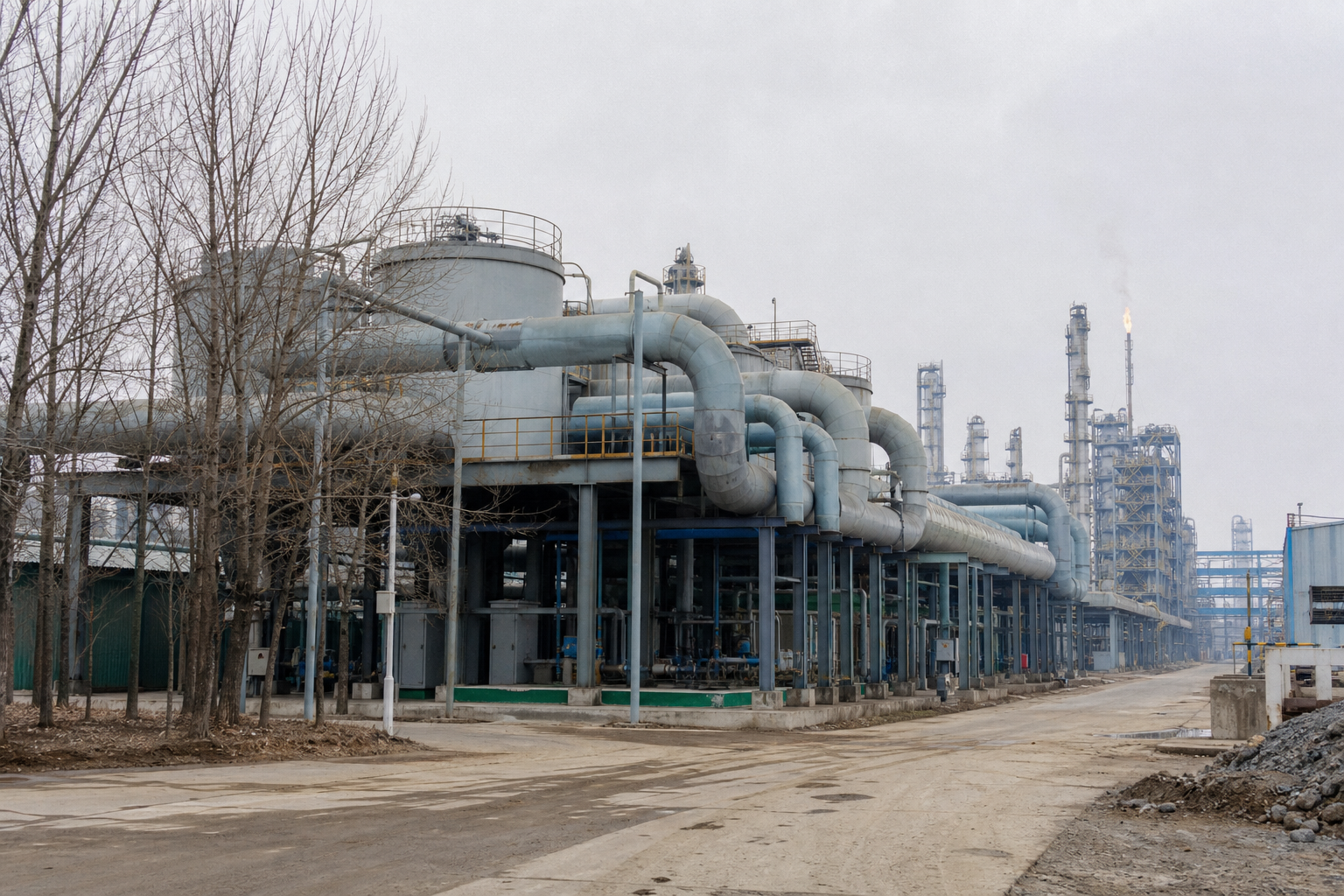
GB 31570-2015 governs water pollutants from petroleum refining and petrochemical discharges in China and is among the strictest regimes for park-type mixed effluent; meeting it with a closed loop removes the discharge permit as a constraint on park expansion.
Design Rules That Decide Project Economics
Five design decisions dominate both capital and operating cost of a park ZLD plant:
- Segregate before mixing. High-salinity and low-salinity streams should be collected separately wherever the park sewer layout allows. Sending dilute streams through membrane recovery and only true brines to the evaporator shrinks the thermal stage — the single most expensive block to build and operate.
- Equalize aggressively. Buffer tankage that flattens peak loads protects membranes and stabilizes evaporator operation; undersized equalization shows up as membrane replacement cost.
- Recover salt as product, not waste. A crystallizer train that separates sodium sulfate and sodium chloride into marketable streams offsets disposal cost with byproduct revenue; a mixed-salt cake only accrues landfill fees.
- Match water quality to reuse destination. MVR condensate suits most process and washing uses; RO permeate suits boilers and cooling. Over-specifying all recovered water to boiler grade wastes membrane capacity.
- Pilot before committing. A wastewater audit followed by pilot testing of the RO and MVR stages on the actual mixed liquor is the standard validation sequence; fouling on mixed park effluent cannot be predicted from design tables.
Technology Comparison at the Brine Stage
| Technology | Role in park ZLD | Limitation |
|---|---|---|
| MBR + RO | Bulk water recovery; ~99% dissolved salt rejection | Osmotic recovery ceiling; fouling on mixed organics |
| Electrodialysis (ED/EDR) | Selective ion removal on high-salinity streams | Does not remove organics; needs paired polishing |
| Forward osmosis (FO) | Low-energy concentration of difficult brines | Draw solution recovery adds cost; fewer full-scale references |
| MVR evaporation-crystallization | Terminal ZLD step; water plus solid salt output | Highest energy intensity per cubic meter; economics depend on upstream volume reduction |
Implementation Sequence for a Park-Scale ZLD Project
Park ZLD projects that reach stable operation follow a four-step implementation sequence. The wastewater audit comes first: flow rates, contaminant inventory, and reuse demand are measured across the park over representative cycles, because downstream sizing depends on these numbers. Pilot testing follows, validating the selected RO and MVR stages on the actual mixed liquor, with attention to fouling rates and cleaning frequency. The customized design phase then fixes the train configuration, segregation strategy, and buffer volumes against lifecycle cost. Finally, operation and maintenance is resourced as a permanent discipline: automated controls reduce staffing, but membrane replacement, salt logistics, and evaporator cleaning remain recurring cost centers.
When This Route May Not Fit
Park ZLD as a four-stage train is not the right answer everywhere. If the park’s aggregate salinity is low and discharge permits remain available, a conventional biological plant with polishing may meet compliance at a fraction of the cost. If tenant streams cannot be segregated and equalized — old sewers, shared pits — the evaporator inherits shock loads it was never sized for. If the recovered mixed salt has no disposal route or no buyer, the crystallizer converts a liquid problem into a solid one. And where park occupancy is still growing, a thermal stage built for build-out capacity can idle for years carrying capital cost without throughput. Whether the route stands depends on compliance economics more than technology readiness.
What Must Be Verified
Before this train is committed at park scale, four inputs must be verified on site with real data, not desk estimates. First, a wastewater audit across tenants over representative cycles: flow, salinity, COD, heavy metals, and the hourly swing that sizes equalization. Second, pilot testing of the RO and MVR stages on the actual mixed liquor — fouling, cleaning frequency, and scaling propensity cannot be read from design tables. Third, the salt route: whether sodium sulfate and sodium chloride can be sold, stored, or must be landfilled, and at what gate-fee cost. Fourth, the reuse match: how much condensate and permeate the park can absorb into cooling, boiler, and process demand, and which discharge or reuse standard governs the outfall.
FAQ
What does ZLD mean for an industrial park in practice?
It means no liquid effluent leaves the site boundary. All collected wastewater is treated through pretreatment, membrane, and evaporation-crystallization stages; recovered water returns to cooling towers, boilers, or process use, and the residual dissolved solids leave as dewatered salt.
Why can’t reverse osmosis finish the job alone?
RO rejects roughly 99% of dissolved salts from the water it treats, but its concentrate remains too dilute for salt recovery and continues to carry foulants. As brine concentration rises, osmotic pressure caps recovery, so the RO reject must be routed to thermal evaporation to reach dry salt.
How much freshwater can a park actually save?
Implementations report reductions above 90% (industry-reported); the exact figure depends on how much condensate and permeate the park can match to reuse demand.
What standard governed the reference coal-chemical park project?
The external reference case (vendor-published, not an EvapCryst project) achieved zero effluent discharge meeting China’s GB 31570-2015 while recovering sodium sulfate and sodium chloride as separate crystalline byproducts.
Should high-salinity and low-salinity tenants’ streams be combined?
No. Segregated collection keeps dilute streams on the cheap membrane path and reserves the energy-intensive evaporator for true brines, which is the single largest lever on both capital and operating cost in park ZLD design.
Required inputs for screening: park-audit feed composition and flow, target reuse rate, governing standard — enough to outline the train.