Project Parameters
| Parameter | Value |
|---|---|
| Process route | TVR + four-effect falling-film evaporation with aroma recovery |
| Industry | Food & beverage — coffee processing (Vietnam, Dak Lak province) |
| Feed type & key components | Coffee extraction liquor; heat-sensitive solids, acids and volatile aroma compounds |
| Evaporation capacity | 23.3 t/h |
| Construction materials | SS304 / SS316L food-grade wetted parts |
Representative process configuration compiled from published industry project data. Indicative values, not a process guarantee.
Project Description
Vietnam’s Central Highlands — Dak Lak province above all — grow the robusta that anchors global instant coffee and coffee extract supply. Processing plants there convert roast-and-ground coffee into extraction liquor, then concentrate that liquor into the extract and instant-coffee feedstock the export market buys. The reference configuration runs a 23.3 t/h concentration train at a coffee plant in the region, part of the processing capacity build-out that keeps value addition inside the growing country rather than at destination.
Coffee extract is among the most heat-sensitive concentration duties in food processing: the aroma compounds that define coffee character are volatile and boil off early, the color bodies form at temperature, and the solids climb steeply in viscosity as the extract approaches commercial concentration. The train is engineered around all three — vacuum falling-film geometry for short contact, aroma recovery for the volatiles, and staged concentration for the viscosity curve.
Process Technology
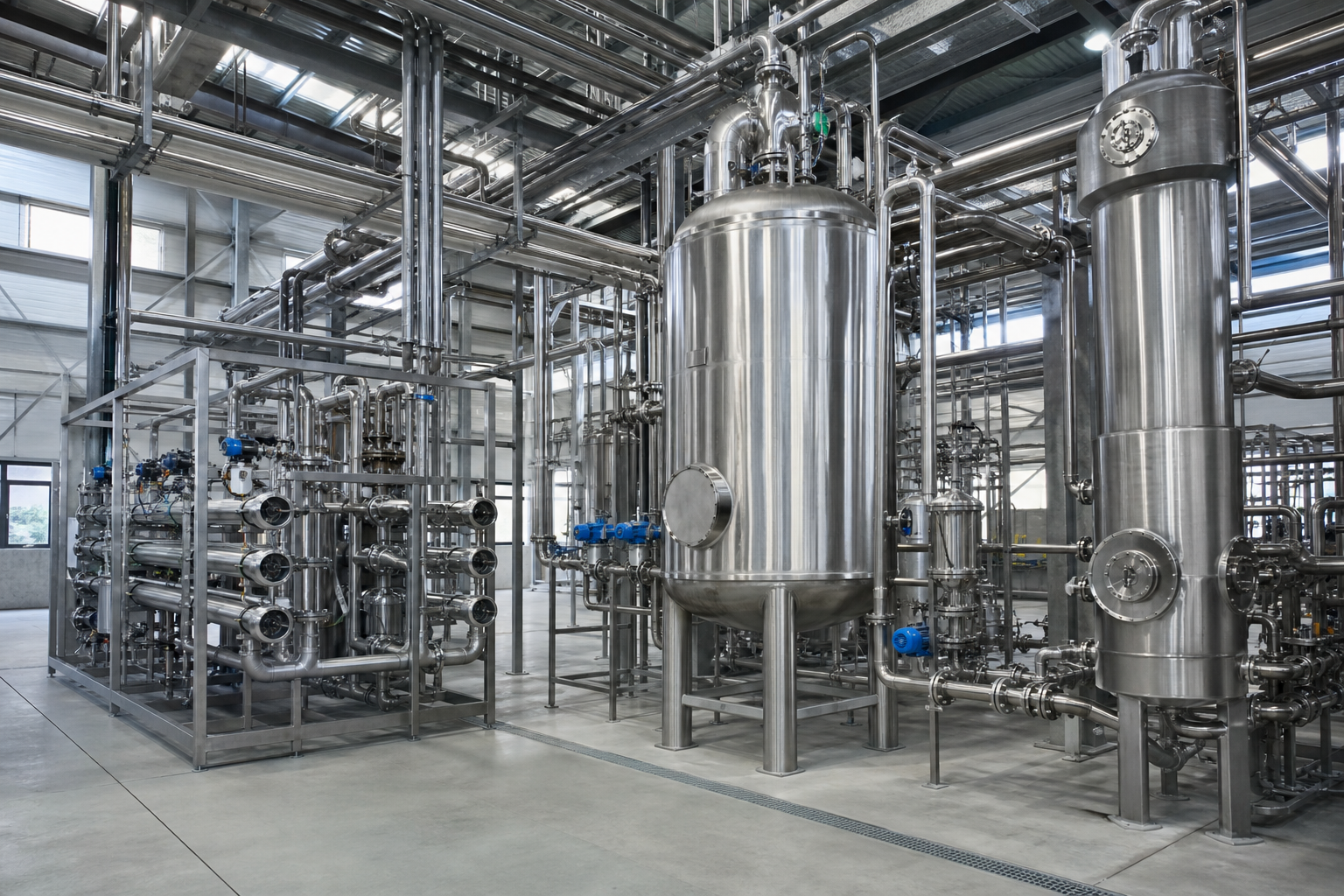
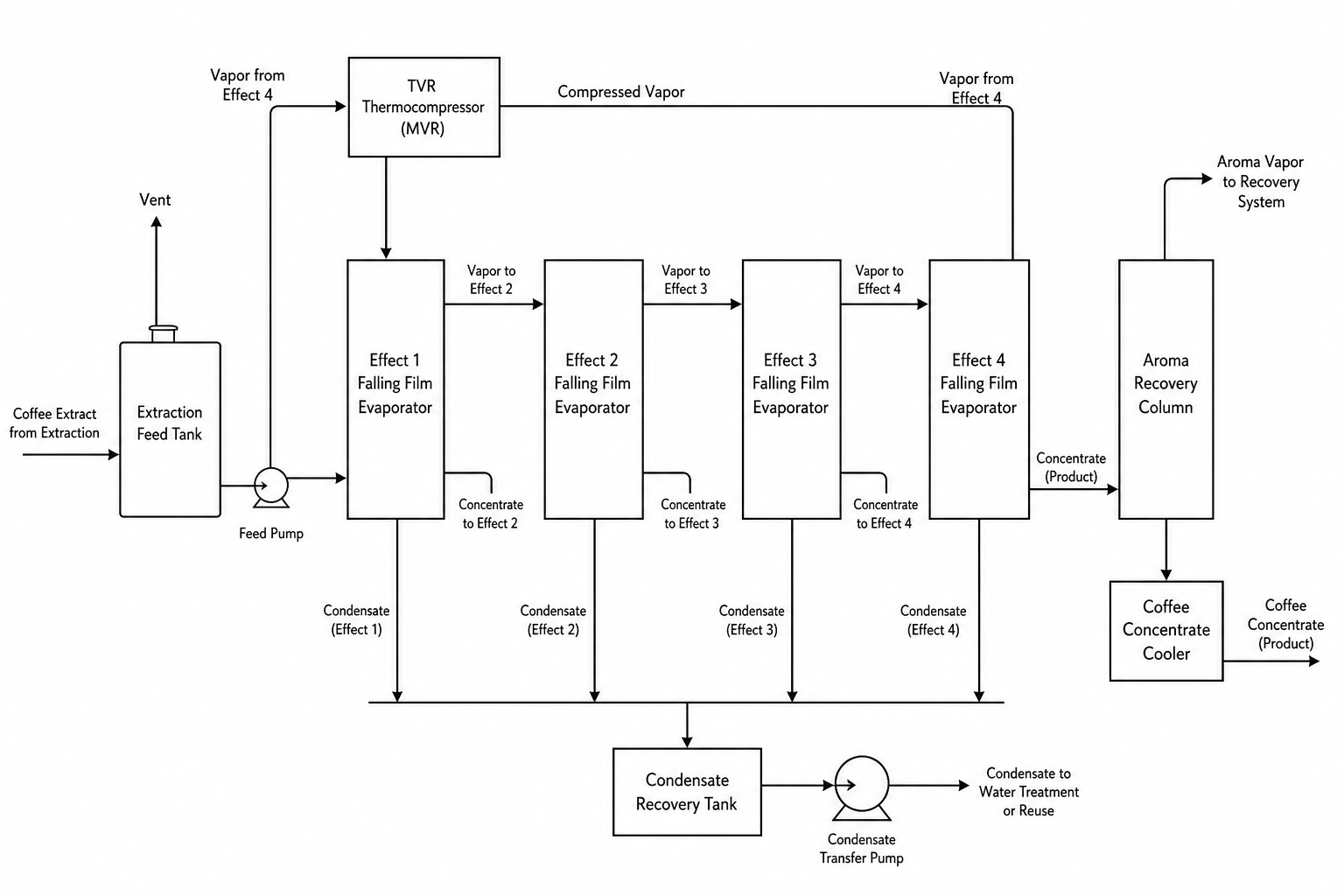
Extraction liquor from the extraction batteries is screened, degassed and preheated through condensate exchange. The four-effect train then concentrates it in falling-film service: the liquor descends the calandria surfaces as a thin film, evaporating under vacuum at seconds of wall contact — the geometry that keeps color and flavor chemistry inside specification.
The TVR thermocompressor motivates the train: live steam through an ejector entrains and recompresses recycled secondary vapor, driving the first effect at a fraction of the steam a plain multi-effect train would draw. Four effects then step down in temperature and pressure, each boiling on its predecessor’s vapor — the standard steam economy for a mid-size food plant with a modest boiler house.
Aroma recovery is integrated at the first vapor draw: the volatile fraction — the compounds a plain evaporator would send to the condenser and lose — is condensed separately and dosed back into the finished extract, restoring the fresh-roast character. Without this stage, concentrated extract tastes cooked; with it, the product holds its origin profile.
The concentrated extract at target solids is cooled regeneratively against incoming liquor and routed to spray drying or export packing as extract. Condensate from the effects is warm, clean water reused in extraction and CIP; in a coffee plant during peak season, that water balance matters operationally. Between product runs, CIP circuits clean the film surfaces — coffee solids deposit steadily and the wash schedule is part of the plant rhythm.
Equipment Configuration
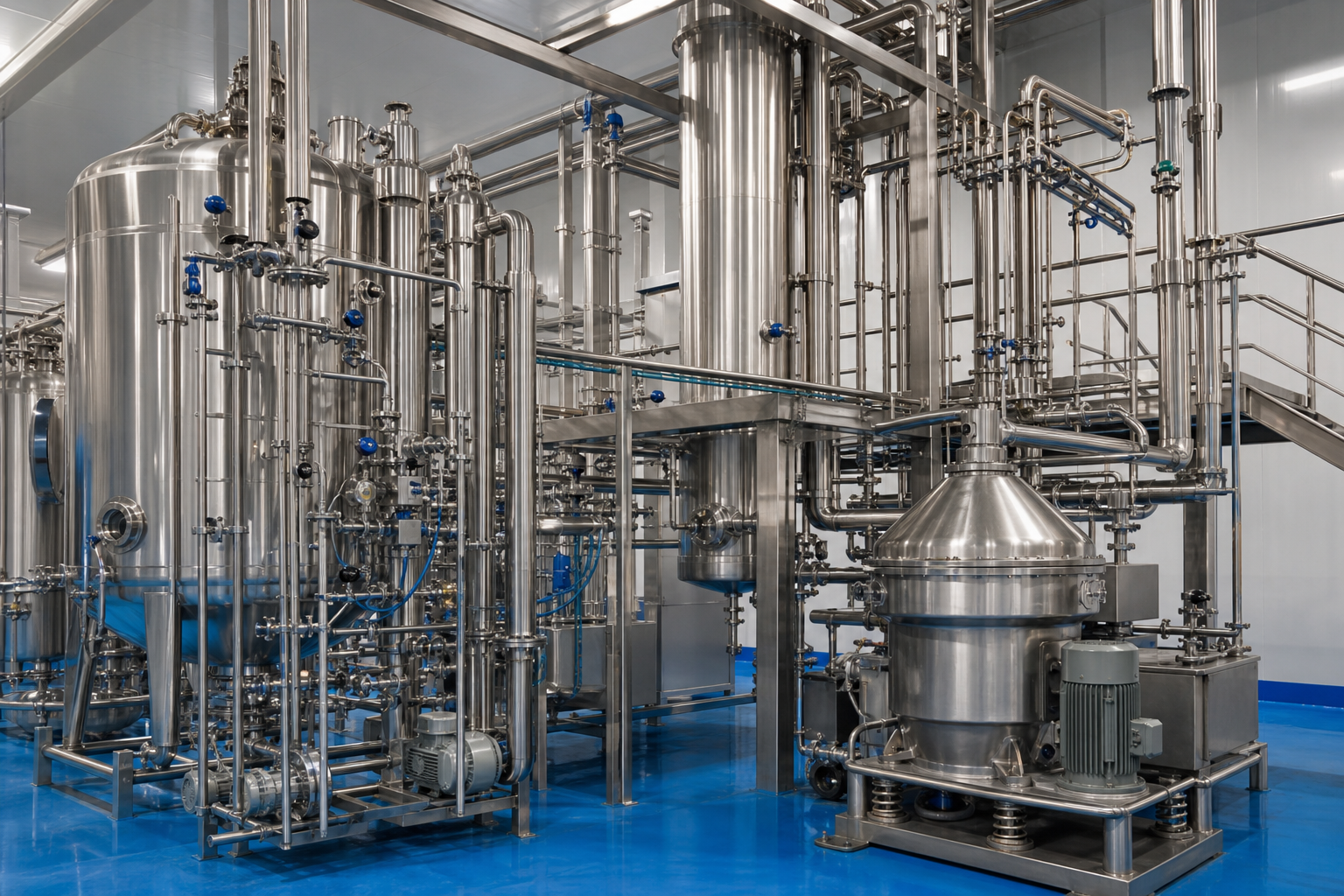
One set of the following equipment is typical for this duty:
- Feed screening, degassing and condensate-based preheating
- Four-effect falling-film evaporation train with TVR thermocompressor
- Aroma recovery condenser with controlled dosing back to finished extract
- Vacuum system and surface condenser; regenerative extract cooling
- Extract tankage and transfer to spray drying / export packing
- Food-grade SS304/316L; PLC control of solids profile with CIP between runs
Performance & Outcome
Compiled from published industry project data, indicative: trains of this class concentrate coffee extract on TVR four-effect steam economy with aroma recovery, protecting color and flavor profile through the concentration step. Steam per tonne and aroma retention are quoted per project product specification.