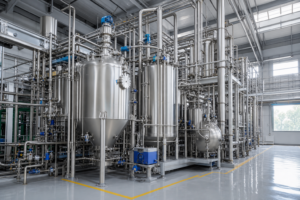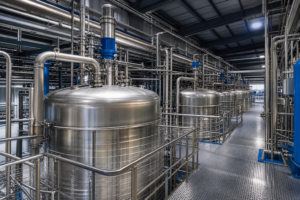
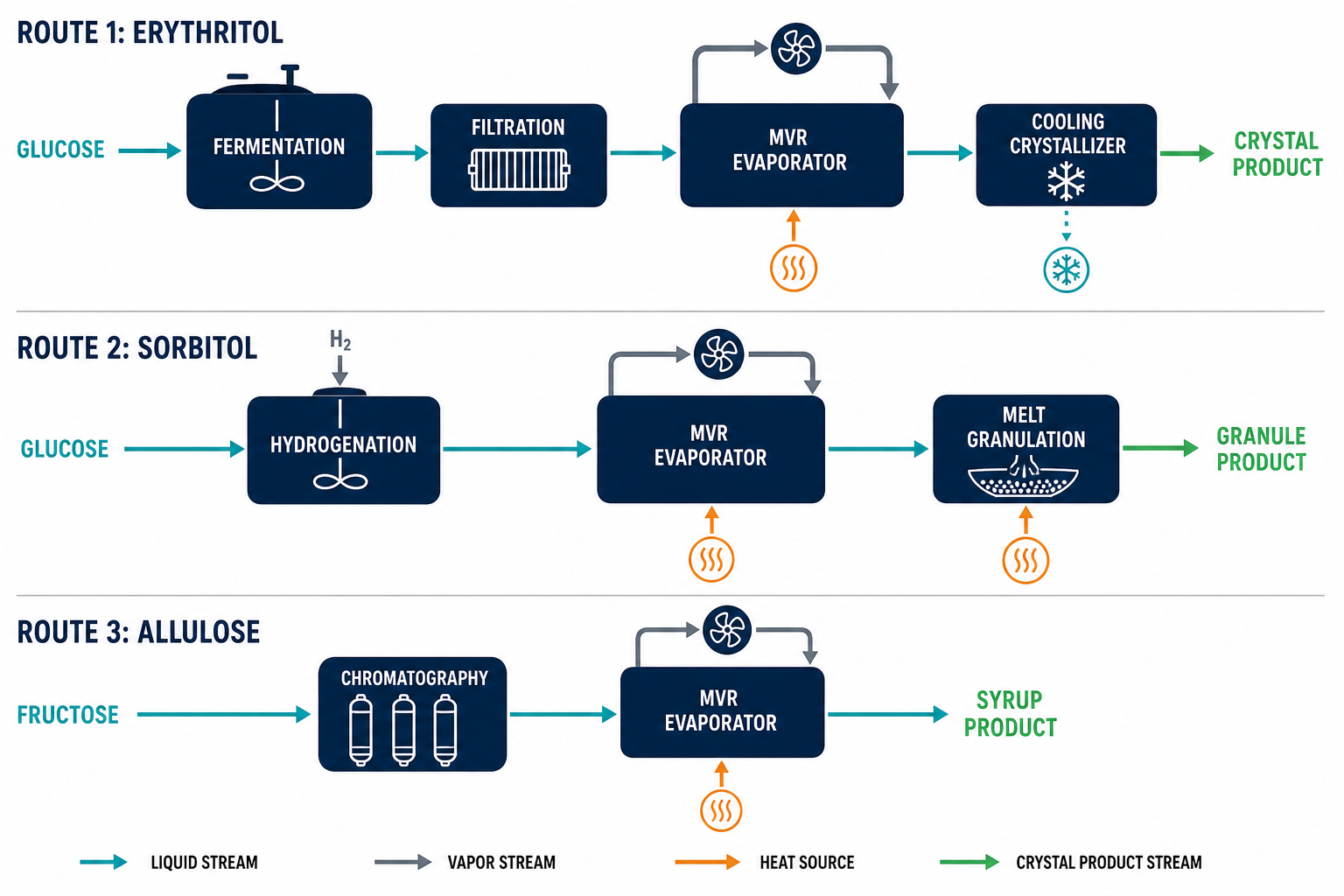
Sugar alcohol plants concentrate and crystallize some of the most heat- and viscosity-sensitive liquids in the food industry, and the equipment choices follow directly from each product’s chemistry: erythritol is fermented, membrane-purified, and cooled to crystallize; sorbitol is hydrogenated and either spray-granulated from a melt or crystallized from solution; allulose is enzymatically isomerized and chromatographically separated before crystallization. Across all three routes, MVR multi-stage falling-film evaporators have displaced five-effect trains for concentration, cutting fresh steam consumption by more than 90% in operating plants (documented references, indicative) while holding syrup above 68% solids at residence times short enough to prevent Maillard browning. The crystallizer is specified per product: one that works for erythritol will not serve a sorbitol melt-granulation line.
Three Sugar Alcohols, Three Process Routes
Procurement teams often ask for a generic sugar alcohol line, but the flowsheets diverge early and completely:
| Product | Upstream conversion | Purification before concentration | Concentration target (indicative) | Crystallization route |
|---|---|---|---|---|
| Erythritol | Glucose fermentation (Moniliella or Trichosporonoides strains) | Membrane separation, activated carbon, ion exchange | Syrup above ~68% solids | Controlled cooling crystallization, centrifugation, vacuum or spray drying |
| Sorbitol | Catalytic hydrogenation of glucose (purified dextrose feed) | Chromatographic split of high- and low-sorbitol fractions | Concentrated to the DS required for melt granulation | Melt spray with seed crystals, rotary cooling, milling and sieving |
| Allulose | Enzymatic epimerization of fructose | Chromatographic separation from fructose-rich raffinate | High-purity liquor to near saturation | Controlled cooling crystallization of the separated fraction |
The common thread: every route places evaporation between purification and crystallization, and every route is unforgiving about color. Food and pharma specifications — FDA, CE, GMP execution — leave little room for syrup that darkened in the concentration step.
Why MVR Falling Film Evaporators Dominate Sugar Alcohol Concentration
Sugar solutions degrade through Maillard reactions between residual reducing sugars and amino compounds, accelerating sharply with temperature and residence time. Multi-effect trains handle this under vacuum but still require long transfer lines between effects and substantial fresh steam to the first effect.
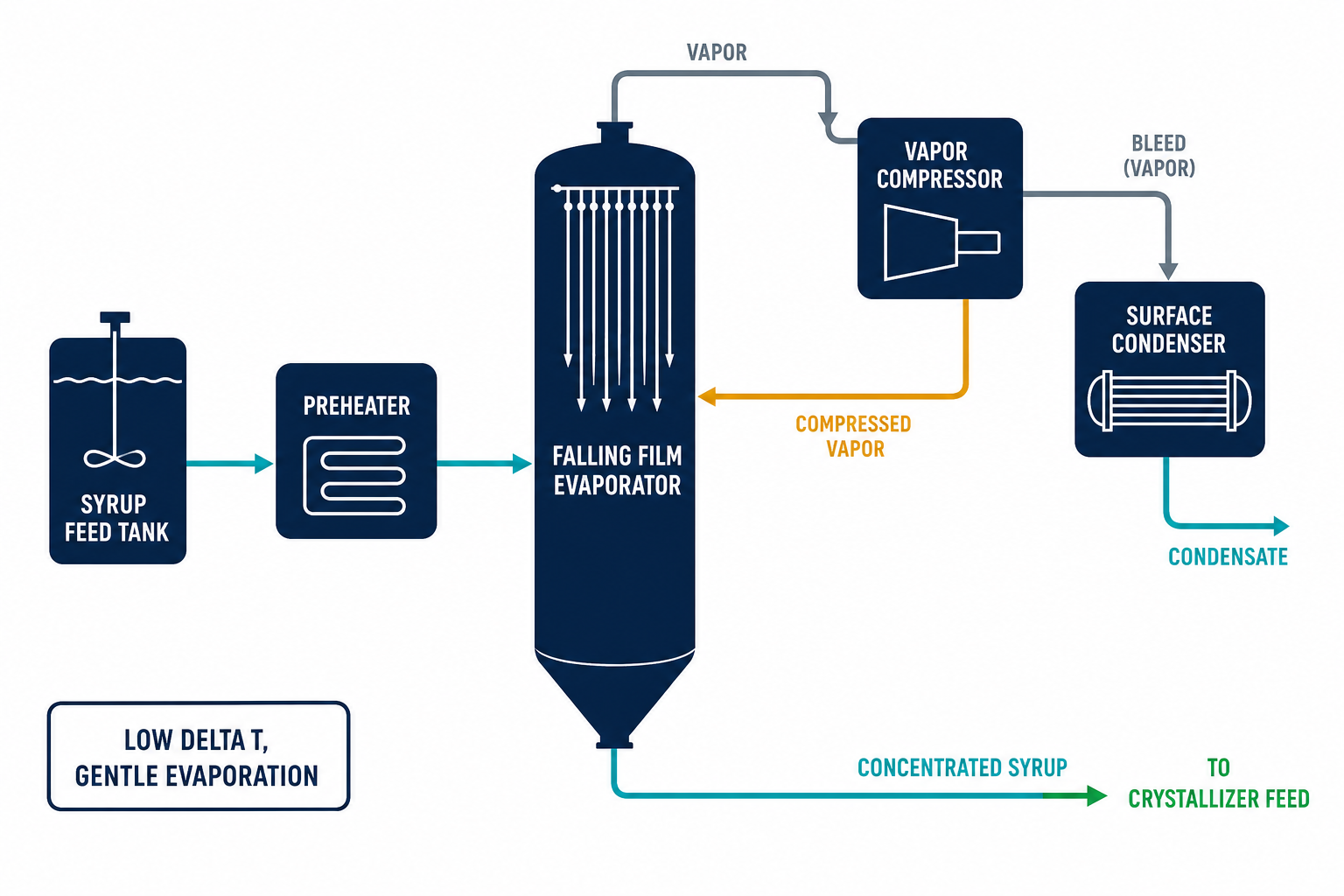
The standard configuration integrates multiple falling-film stages inside a single shell: syrup passes chamber to chamber, the whole duty completes in one pressure vessel, and residence collapses to seconds. The MVR compressor adiabatically recompresses secondary vapor and returns it as heating steam, so live steam is needed essentially only at start-up. Externally documented operation — industry references, not EvapCryst project records — includes a sugar group reporting concentration-stage steam consumption down over 90%, and a biotechnology producer running a 39 t/h continuous erythritol evaporator delivering syrup above 68% solids with fresh steam more than 90% below a five-effect alternative (vendor-published, indicative figures).
The design principles of the evaporator body itself are covered on our falling film evaporation page, and the recompression cycle on the MVR evaporation page.
Energy Configuration: Five-Effect Versus MVR
For plants weighing a steam-driven train against an electric one, the comparison comes down to utilities and utilization:
| Criterion | Five-effect + TVR train | MVR multi-stage falling film |
|---|---|---|
| Live steam | Continuous, ~0.10–0.15 kg per kg water after TVR | Start-up only; compressor electricity dominates |
| Temperature exposure | Vacuum stages, but longer piping and hold-up between effects | Single shell, seconds of residence, small ΔT per stage |
| Color protection | Good, dependent on train layout | Better: minimal hot hold-up, Maillard suppression by geometry |
| Best fit | Sites with very cheap steam or waste heat | Sites where electricity is competitive with steam; carbon-constrained plants |
Because the plant also runs crystallizers, centrifuges, and dryers on steam and electricity, the evaporation energy choice ripples through the utility block and should be made with the site tariff sheet in hand. Our MVR vs multi-effect energy cost comparison tool runs this calculation against local prices.
The Viscosity Boundary: Where Falling Film Hands Over
Falling film works best below roughly 100 cP; above that the film becomes unstable, channels, and leaves dry patches that foul and darken. Concentrated sorbitol and erythritol syrups approach this limit precisely at the solids the crystallizer wants, which is why the finishing stage is engineered explicitly:
- Larger tube diameters and recirculation loops restore wetting at the concentrate end, at the price of some residence time.
- Wetting rate is held within its stable band (on the order of 0.25–1.0 kg per meter of tube circumference per second for water-like feeds, higher for viscous syrups) by the liquid distributor design, which is the single most fouling-sensitive component in the train.
- Where final solids push viscosity beyond what a film can carry, the last stage switches to forced circulation, trading energy for the ability to pump and flash a thick liquor without burning it.
Read by module, all three product routes share the same skeleton with product-specific candidates:
| Process module | Equipment candidates | Selection basis | Indicative envelope |
|---|---|---|---|
| Purification | Membranes, carbon, ion exchange; chromatography | Remove impurities before any heat | Product-specific |
| MVR concentration | Multi-stage falling film in single shell | Maillard suppression; steam elimination | >68% solids; seconds residence |
| Finishing | Forced-circulation stage or vacuum melter | Viscosity boundary near 100 cP | Per product DS |
| Crystallization | Cooling crystallizer; melt granulation | Product chemistry dictates the route | Erythritol vs sorbitol hardware |
| Drying & sizing | Centrifuge, vacuum or spray dryer, mill and sieve | Particle specification | Per customer band |
Configuration, materials, and operating ranges depend on the actual liquor, thermal sensitivity, fouling behavior, utilities, and project capacity.
Erythritol: Fermentation, Purification, Cooling Crystallization
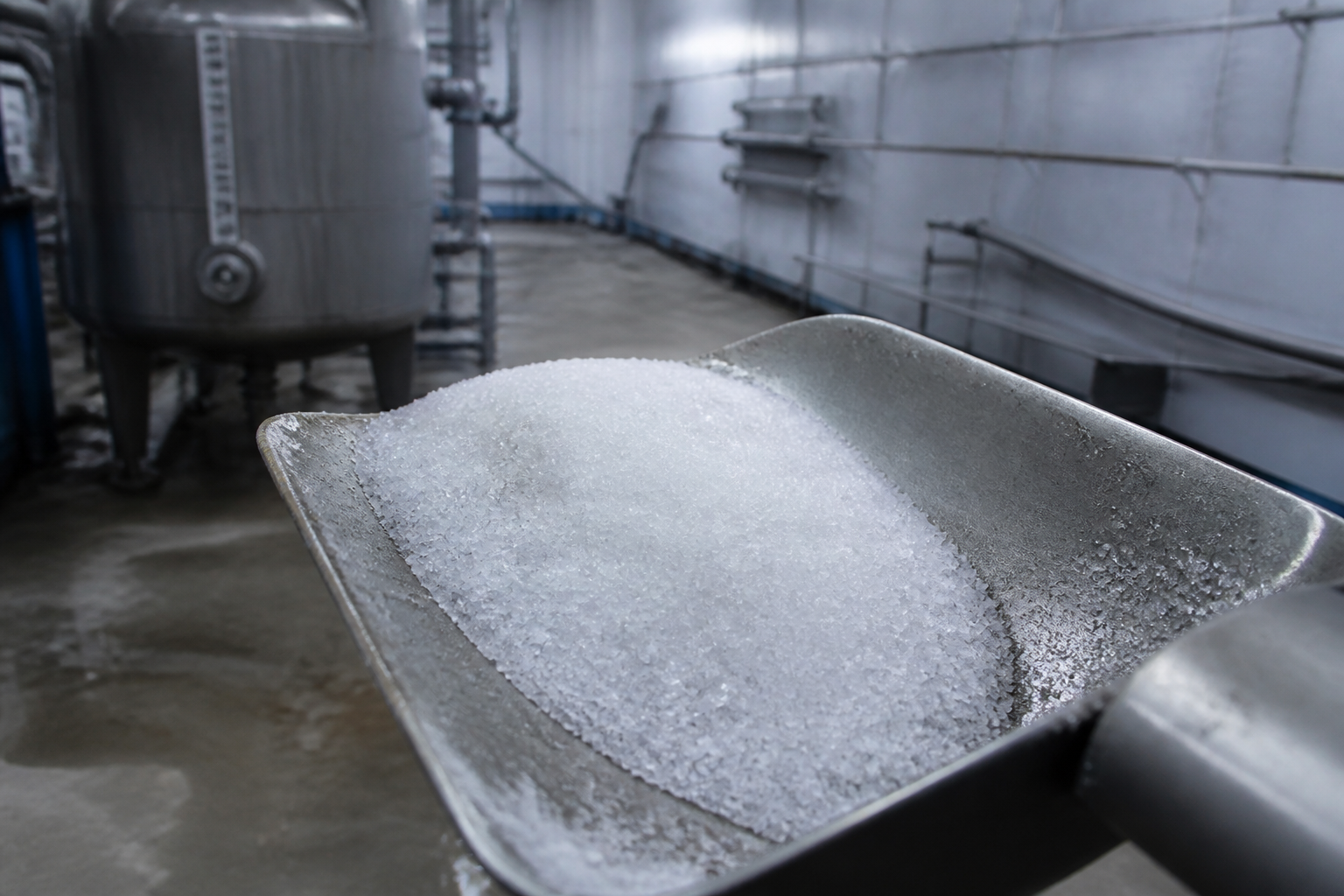
Erythritol starts as corn starch enzymatically hydrolyzed to glucose, then fermented under controlled conditions. The broth is purified by membrane separation, activated carbon, and ion exchange before any water is removed — the ordering matters, because proteins, salts, and color bodies surviving into the evaporator concentrate along with the erythritol and surface as impurity inclusions in the crystal. Only after polishing does the liquor concentrate past 68% solids and enter controlled cooling crystallization, followed by centrifugation and vacuum or spray drying. The market context explains the investment: market-research projections put global erythritol roughly doubling from about USD 250 million in 2023 to over USD 500 million by 2030 on sugar-reduction demand, so lines are built for round-the-clock operation where continuous crystallization and stable evaporation translate into throughput.
Sorbitol: Melt Granulation Instead of Solution Crystallization
Crystalline sorbitol takes a different philosophy. Hydrogenated liquor first passes a chromatographic split into high- and low-sorbitol streams; the rich stream goes to crystalline product, the lean returns to refining for technical grade. The qualified liquor concentrates in a vacuum melting evaporator to the dry-substance value granulation requires, then sprays into a seeding zone where melt droplets meet seed crystals and solidify. A rotary cooler sets crystal habit, and the cake is milled and sieved to the customer’s particle band. The route avoids evaporating water out of a crystallizer entirely — which is why sorbitol plants feel like powder-processing facilities — and concentrates the duty on one vacuum unit engineered for high DS without thermal damage.
Allulose: Evaporation Bounded by Chromatography
Allulose (D-psicose) adds a constraint the other two lack: enzymatic epimerization of fructose reaches equilibrium conversion well below complete, so the effluent is a fructose-allulose mixture that must be split chromatographically before anything crystallizes. The evaporator never sees crude liquor; its duty is concentrating an already-pure allulose fraction while protecting it from ketose degradation pathways, which run faster than glucose degradation at the same temperature. Design rules: low temperature under vacuum, seconds-scale residence, and immediate transfer to the crystallizer once target solids are reached. The fructose-rich raffinate recycles to the front end, so the evaporation and crystallization islands sit inside a recirculating mass balance, and every degree of concentration lost to degradation is paid for twice.
Quality Systems and Integration Scope
Sugar alcohol lines are delivered under food and pharmaceutical execution: 316L product contact, CIP coverage of evaporator, crystallizer, and piping, and automation holding density, temperature, and crystal content in closed loop — manual correction of a drifting crystallizer is how batches are lost. Plants inside fermentation complexes add condensate reuse and heat integration with the drying sections. Broader plant-integration patterns for this sector are covered on our food and fermentation industry page, with the adjacent starch syrup concentration flowsheet on our starch syrup evaporation solutions page.
When This Route May Not Fit
The MVR-plus-crystallizer chain assumes food-grade throughput. Campaign or pilot quantities are better served by toll processors than by dedicated lines. Sites with very cheap waste heat may keep five-effect trains competitive on tariff. Liquid-sorbitol producers — the majority of sorbitol volume — need concentration only, skipping crystallization hardware entirely. And where the market accepts darker technical-grade product, the low-residence-time discipline that drives single-shell MVR design loses part of its value.
What Must Be Verified
Verification starts with the liquor: purity after the purification stage, reducing-sugar residual, and color precursors, because the evaporator’s thermal window is set by what reaches it. Second, the viscosity-versus-solids curve of the actual syrup, which decides where falling film hands over to forced circulation. Third, crystallization behavior — metastable zone and growth rate — confirmed on the real liquor. Fourth, the site tariff pair for MVR versus steam. Fifth, food-execution scope: materials, CIP coverage, and automation against the target market’s FDA/CE/GMP expectations.
Frequently Asked Questions
Why do sugar alcohol plants prefer MVR evaporators over multi-effect trains?
MVR recovers the latent heat of secondary vapor with an electric compressor instead of cascading it through steam-heated effects, cutting fresh steam consumption by more than 90% in operating sugar and erythritol plants. It also shortens residence time by integrating all falling-film stages in one shell, which suppresses the Maillard browning that limits syrup quality in conventional trains.
What solids content should erythritol syrup reach before crystallization?
Operating plants concentrate polished erythritol liquor above 68% solids before cooling crystallization. The exact set point balances crystallizer throughput against viscosity: higher solids improve yield per cubic meter of liquor but thicken the magma and slow crystal growth.
How does crystalline sorbitol production differ from erythritol?
Erythritol crystallizes from an aqueous solution by cooling, while crystalline sorbitol is made by concentrating chromatographically enriched liquor in a vacuum melting evaporator and spray-granulating the melt onto seed crystals, followed by rotary cooling, milling, and sieving. The two products share evaporation technology but use entirely different crystallization hardware.
What causes color formation during sugar alcohol concentration, and how is it prevented?
Color comes from Maillard reactions between residual reducing sugars and amino compounds, accelerating with temperature and time in the hot zone. Prevention is geometric and thermal: thin-film heat transfer at small temperature difference, multi-stage single-shell design that removes inter-effect hold-up, vacuum operation, and purification of the liquor before concentration so reaction precursors are already gone.
When does a sugar alcohol evaporator need forced circulation instead of falling film?
When product-end viscosity exceeds what a stable falling film can wet, roughly the 100 cP region for standard tube geometry, the finishing stage switches to forced circulation, which pumps the liquor through the heater at high velocity and flashes it at reduced pressure. This protects quality at high solids at the cost of higher pumping energy.
To screen this route, share the liquor analysis, the product and its specification, and the throughput — enough for an initial route-configuration assessment.