Hazardous waste liquor — the high-water liquid fraction of waste emulsions, acids and alkalis, heavy-metal liquids and concentrated organic effluents — is reduced and stabilized by a two-stage strategy: physicochemical pretreatment that neutralizes, detoxifies and normalizes each waste class, then evaporation-crystallization splitting the liquid into reusable process water and a solid or concentrated residue a fraction of the original volume. The economics rest on one arithmetic: disposal is priced by the ton, the feed is mostly water, and MVR removes that water at a fraction of live-steam cost — suppliers report energy reductions of 20–50% against traditional trains (supplier-published indicative range; not a project guarantee). The engineering difficulty is not the evaporator; it is designing for waste streams whose composition the plant itself cannot fully predict.
What Hazardous Waste Liquor Actually Is
Waste liquids arrive from incineration workshops, physicochemical treatment workshops, utilization workshops and tank farms — each generating wastewater of very different quality, with the mix shifting with every waste contract. Practice classifies the liquid feed into four categories, each with its own pretreatment prerequisite:
| Waste Class | Composition Envelope (illustrative) | Pretreatment Before Evaporation | Back-End Route |
|---|---|---|---|
| Waste emulsion | O/w or w/o emulsions, surfactants, oils | Demulsification (acid/chemical dosing), oil separation | Evaporation-crystallization; oil phase recovered or incinerated |
| Waste acid / waste alkali | Spend acids, alkalis, dissolved salts and metals | Neutralization, gypsum/metal hydroxide removal | MVR evaporation → salt crystallization |
| Heavy-metal waste liquid | Chromium, arsenic, mercury and other metals | Class-specific pretreatment (Cr(VI) reduction, As stabilization, Hg capture), precipitation | Evaporation-crystallization of supernatant; stabilized solids to secure disposal |
| High-concentration organic waste liquid | Solvents, resin/ paints, high COD liquors | Assessment: recoverable vs. incinerable; stripping or extraction where recovery applies | Concentration to incineration feed strength or solvent recovery |
These four routes sit inside a disposal facility whose master processes are physicochemical treatment, stabilization/solidification, incineration and secure landfill. Evaporation-crystallization is the water-removal engine: produced water returns to the production line, concentrated water merges back, and crystallized salt goes to qualified disposal. Liquids too lean to incinerate are concentrated to autogenous burning strength; liquids too toxic to treat are stabilized first. The evaporator is the volume-control valve of the site’s mass balance.
The Solution Train, Stage by Stage
Stage one is characterization and equalization — more engineering effort than any equipment purchase. Hazardous waste facility wastewater is marked by large quality and quantity swings, shifting pollutant composition, and high treatment cost; feed characterization from limited early sampling is the most documented cause of downstream failure. A working design brief includes documented worst-case compositions, not just averages: trace toxics, reactive compounds and scale-formers insignificant in the raw feed can concentrate 10–50× inside the evaporator and then dominate its behavior — scaling, corroding, or separating into phases never on the analysis sheet.
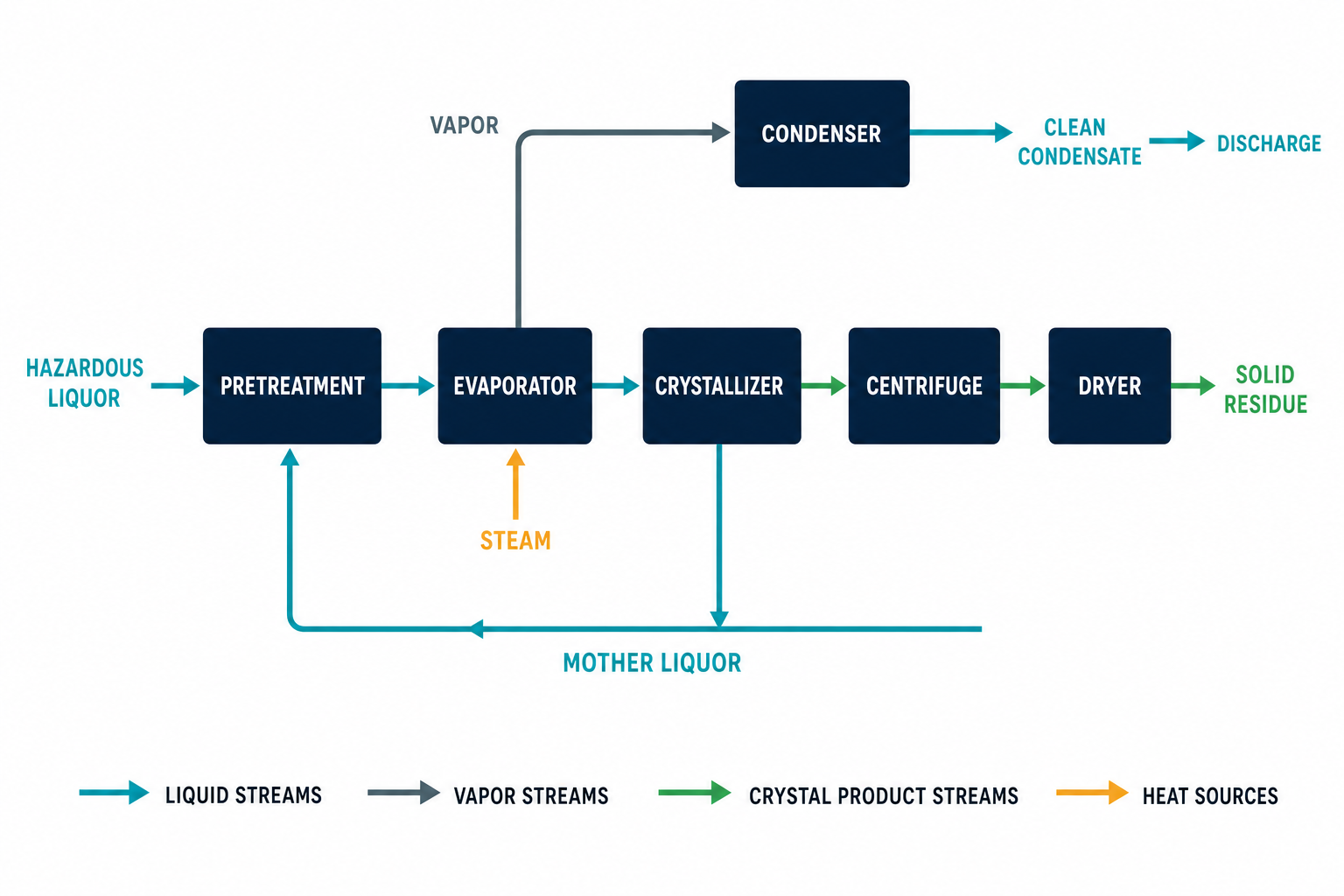
Stage two is class-specific pretreatment per the table above. Stage three is evaporation-crystallization, specified as either an MVR train (lower operating energy, higher capital, continuous duty) or a multi-effect train (cheaper entry, needs steam, suited to facilities whose incinerators raise waste heat). Selection principles from established practice: prefer high-efficiency low-consumption processes; demand adaptability and compatibility to quality swings; keep operation simple with stable, compliant effluent; and minimize investment, electricity and operating cost within those constraints. Stage four is residue routing — crystallized salt, stabilized solids and concentrated organics each leave by their qualified channel, defined by the operating permit before design begins.
Where biological treatment plays a role, membrane bioreactors combine degradation with membrane separation in a compact footprint — but membranes in hazardous service foul predictably: organics from oils, resins, solvents and surfactants; inorganic scaling from calcium, magnesium, sulfate and chloride; colloidal blocking even in visually clear feeds; and accelerated fouling when COD, salinity or pH swing. The response is pretreatment to shave peaks and equalization to stabilize influent — not heroic cleaning regimes. Failure symptoms are rising differential pressure, falling permeate, more frequent cleaning, climbing energy per cubic meter, and shortening membrane life; a plant showing two is spending its membrane budget compensating for a missing equalization tank.
Read by module, the train decomposes as follows:
| Process module | Equipment candidates | Selection basis | Indicative envelope |
|---|---|---|---|
| Characterization & equalization | Sampling program, equalization tanks | Feed shifts with every waste contract | Worst-case compositions, not averages |
| Class-specific pretreatment | Demulsification, neutralization, metal stabilization | Each waste class has its prerequisite | Per the waste-class table above |
| Evaporation-crystallization | MVR or multi-effect forced-circulation train | Fouling, salt-bearing liquor by definition | Energy 20–50% below traditional (supplier-published) |
| Membrane-biological stage | MBR for organic fractions | Compact degradation plus separation | Fouling managed by equalization |
| Residue routing | Centrifuge, secure disposal channels | Salt classification is a waste determination | Audit trail per permit |
Configuration, materials, and operating ranges depend on the actual waste mix, corrosion review, fouling behavior, utilities, and project capacity.
The Six Underestimated Risks — and What Each Costs
Post-mortems of troubled projects converge on six underestimated risks, each cheap to respect and expensive to ignore:
- Composition complexity: design around “main pollutants” (high salinity, high COD) while trace reactive or scale-forming species concentrate and take over the system at operating temperature.
- Long-term variability: a system verified at design conditions that cannot absorb periodic concentration swings, intermittent flow, shock loads or seasonal temperature change is fragile at exactly the moments disposal contracts change.
- Chronic scaling and corrosion: both accumulate invisibly — stable early operation degrades as heat transfer surfaces foul and energy consumption climbs; corrosive ions amplify at high temperature and concentration, and short-term acceptance passes while long-term lifespan fails.
- Safety margin: systems pushed near design limits for capacity or capex savings lose the buffer to absorb any abnormal influent; hazardous service demands predictable, recoverable operation rather than peak efficiency.
- Life-cycle cost: purchase-price focus hides energy, maintenance, spare parts and compliance-loss costs that dominate the total; the cheap evaporator is rarely the cheap system.
- System engineering capability: the process, materials, automation and operating strategy must be designed as one — which is why experienced buyers procure complete solutions rather than individual equipment.
Business Models and Delivery Formats
The delivery model is part of the solution. Build-operate-transfer (BOT) projects are now established: the supplier builds and operates the evaporation train inside a waste management center, sells reduction by the ton, and transfers the asset after the term. For generators, BOT converts a capital project into volume-aligned operating expense; for the operator it aligns incentives toward efficiency and uptime. Skid-mounted modular MVR units extend the same economics to modest volumes and compress schedule and site work.
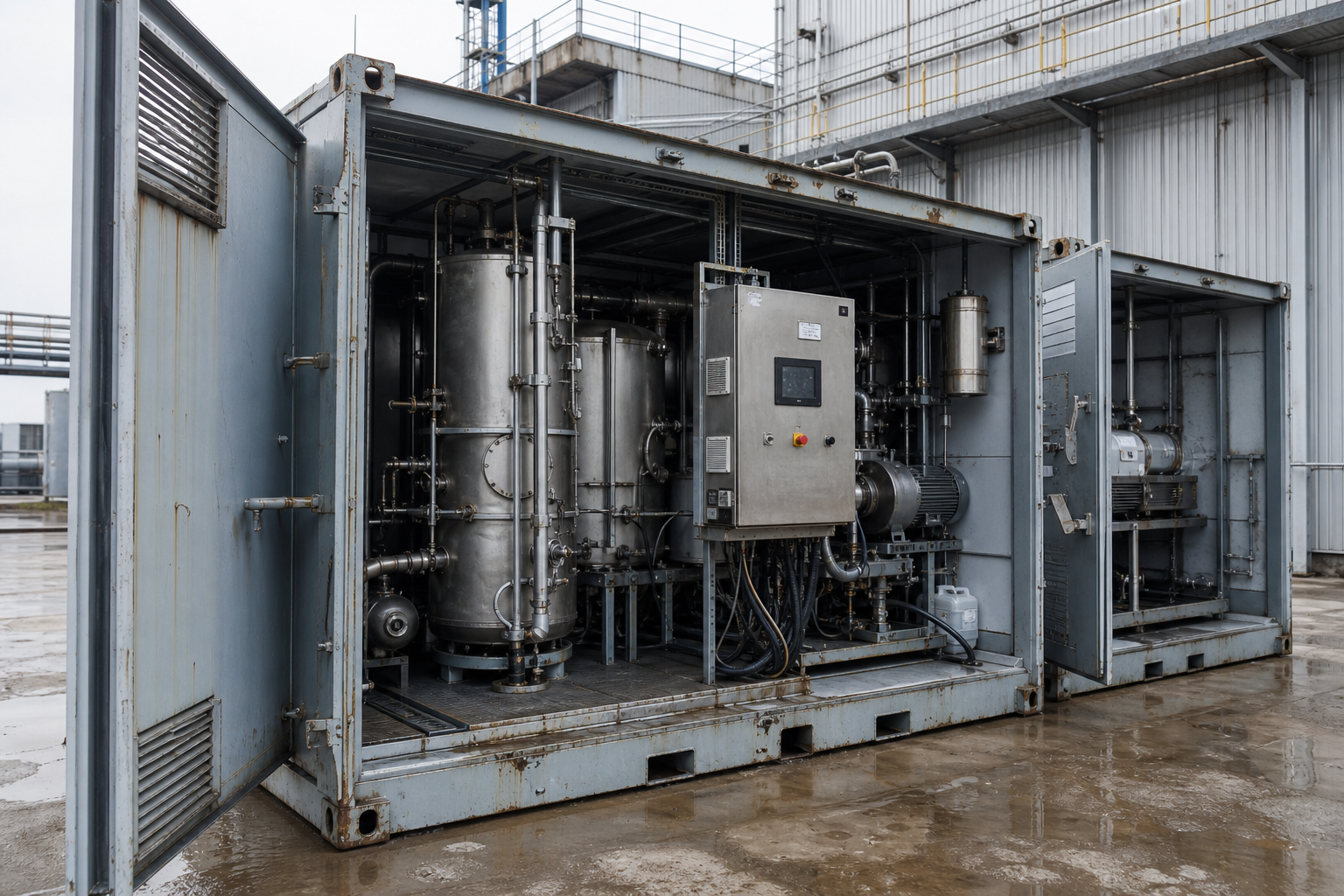
Automation is not optional in this service. Hazardous trains run under PLC control with continuous monitoring of the parameters that govern compliance and stability — concentration, pH, temperature, vacuum — and automatic adjustment when feed quality shifts, because the one constant of hazardous waste feed is change. Remote support and spare-parts programs belong in the procurement package for the same reason: the cost of an outage is not the evaporator’s downtime but the waste tanks filling behind it.
Salt and Residue: The Compliance Detail That Decides Permitting
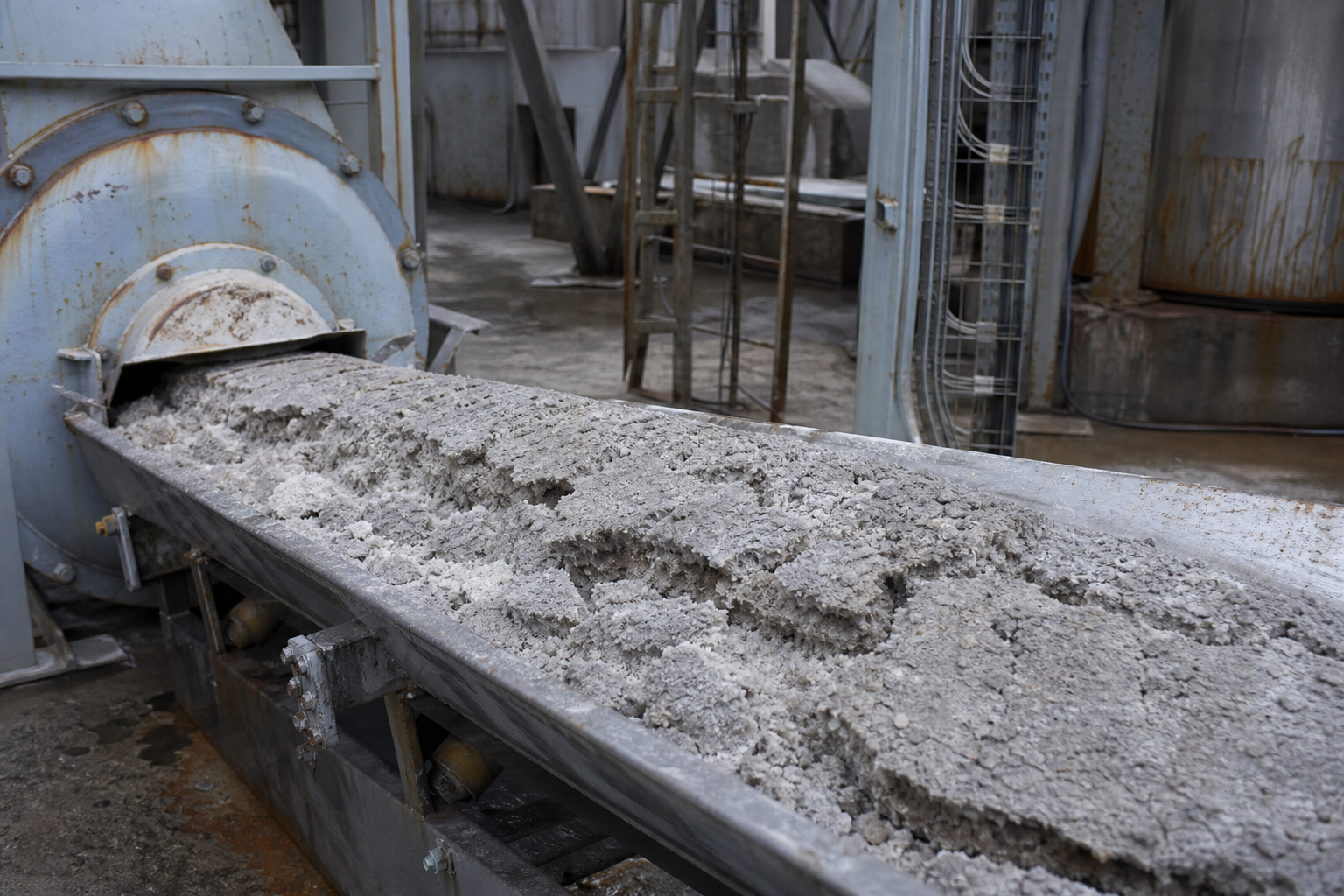
The crystallized salt leaving the train is the item most likely to stall a project’s permitting, because its classification is not a process output — it is a waste determination. Mixed salts from neutralized hazardous liquors usually remain hazardous by derivation (the “derived from” rule in most regulatory regimes) and must exit to qualified disposal even when visually clean; single-origin brines, such as a segregated sodium sulfate stream, can sometimes be recovered as product salt if the waste contract and analysis chain supports it. Designing salt handling therefore means designing the audit trail: batch provenance, wash water quality, mother liquor carryover and metal carryover all appear in the disposal or acceptance agreement. Plants that treat the centrifuge discharge as “just salt” discover at commissioning that no landfill will take it without documentation no one kept.
This is also why integrated membrane-plus-evaporation trains have become the reference architecture for larger resource-recovery campuses — membrane sections pre-concentrate dilute feeds cheaply and catch organics before they load the evaporator, while the evaporator-crystallizer handles the membrane concentrate that no membrane can. Integrated suppliers now operate facilities at the 100,000-ton annual throughput scale for resource recovery (externally published industry references, not EvapCryst project records) — achievable only when salt and residue routes were engineered in from the first flowchart revision.
Related Solutions and Further Reading
The evaporation-crystallization core of this solution shares its equipment logic with concentration and crystallization systems; the water-closure objective is the high-risk end of zero liquid discharge; the energy selection between MVR and multi-effect follows the same calculus documented under MVR evaporation and multi-effect evaporation. Segregated industrial streams from the same parks — plating rinses, PCB etchants, solvent washes — are covered in electroplating and PCB wastewater recovery and DMAC/DMF solvent recovery, with sector context at complex wastewater industries.
When This Route May Not Fit
Evaporation-based reduction is the wrong purchase for several situations. Single-batch or one-off waste lots are cheaper to hand to a mobile treatment service than to amortize a train against. Streams whose value is a recoverable solvent belong on a distillation recovery line, not a mixed-salt evaporator. Projects without a written, confirmed disposal channel for the crystallized salt should not be built — the salt determination, not the evaporator, decides permitting. And generators whose volumes are modest gain more from regional take-back contracts than from owning hazardous-service equipment.
What Must Be Verified
Verification starts with waste characterization per contract: documented worst-case compositions and batch-to-batch swing, not averages. Second, the concentration factor applied to trace species — what scales, corrodes, or phase-separates at 10–50× must be predicted before it is discovered. Third, pretreatment sequencing confirmed by bench tests on the real classes. Fourth, the salt and residue determination in writing: hazardous by derivation or recoverable product, with the receiving facility named. Fifth, condensate quality against its reuse or discharge standard. Sixth, the safety review of reactive and incompatible wastes, and the BOT-versus-own economics per ton treated.
FAQ
What are the four main categories of hazardous waste liquor?
Waste emulsion, waste acid and alkali, heavy-metal waste liquid (chromium-, arsenic- and mercury-bearing classes in particular), and high-concentration organic waste liquid. Each requires its own pretreatment — demulsification, neutralization, class-specific metal stabilization, and recovery-vs-incineration routing respectively — before evaporation.
MVR or multi-effect evaporation for hazardous waste liquor?
MVR suits continuous duty where electricity is available, cutting energy 20–50% against traditional trains; multi-effect suits sites with cheap or waste steam, such as disposal facilities whose incinerators raise recoverable heat. Both are specified with forced circulation and crystallization bodies because hazardous liquors are fouling and salt-bearing by definition.
How much can hazardous waste liquor volume actually be reduced?
Most hazardous liquors are majority water, and evaporation removes that water into a reusable condensate — leaving salts and concentrate as a small residual stream for qualified disposal or recovery. The exact factor is feed-specific and must be established by characterization and bench evaporation, not assumed; concentrated organics are often taken only to incineration feed strength rather than to dryness.
Why do membrane systems fail so often in hazardous wastewater service?
Four fouling mechanisms stack up: organic accumulation (oils, resins, solvents, surfactants), inorganic scaling (calcium, magnesium, sulfate, chloride), colloidal pore blocking, and fouling accelerated by feed quality fluctuation. The durable fix is pretreatment that shaves peak loads plus equalization that stabilizes influent — treating the membrane as the protected final step, not the shock absorber.
What is a BOT hazardous waste evaporation project?
Build-operate-transfer: the technology supplier builds and operates the evaporation-concentration train inside a waste management facility, sells reduction as a per-ton service, and transfers the asset after the contract term. It converts a generator’s capital project into volume-aligned operating expense and is now an established delivery format for hazardous waste evaporation and concentration.
To screen this route, share the waste-class breakdown, representative analyses with worst cases, the throughput, and the intended residue outlets — enough for an initial train-configuration assessment.