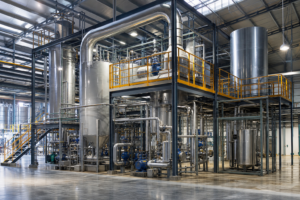
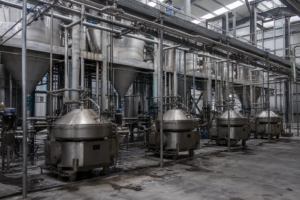
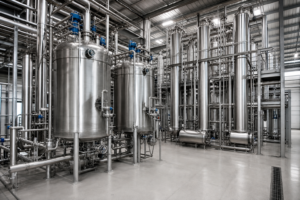
Evaporation in food and beverage plants is a three-part engineering problem, thermal, microbiological, and economic, and it is often the single most energy-intensive step in the factory: in milk powder production, the evaporator account for more than half of total line energy consumption. The near-universal answer for the thermal part is the falling film evaporator operating under vacuum at 40–70 °C with seconds-scale residence time, which concentrates milk, juice, coffee and tea extracts, and protein liquors without cooking them; the economic part is increasingly answered by MVR recompression, which in externally reported dairy conversions cuts carbon emissions by around 65% versus legacy five-effect steam trains (industry reference, indicative not a guarantee). Between those two decisions sits a set of product-specific boundaries, the 50–55% total-solids threshold in dairy, the 62.5–64.5% sugar specification in sweetened condensed milk, the viscosity cliff above roughly 100 cP, that determine whether a plant runs a clean campaign or fights fouling for it.
What Heat Sensitivity Means in Engineering Terms
A liquid is heat-sensitive when its valuable components degrade faster than evaporation completes. Food and beverage streams suffer three damage classes, each with a known temperature signature:
- Nutritional degradation: vitamin C and B-group vitamins in fruit juices break down above about 60 °C; milk proteins denature and aggregate above 70 °C, changing texture and digestibility.
- Sensory deterioration: Maillard reactions between sugars and amino compounds accelerate with temperature, browning dairy concentrates, coffee extracts, and glucose syrups and generating cooked off-flavors.
- Functional loss: enzymes, probiotics, and active ingredients in nutraceutical and pharmaceutical-adjacent liquors have narrow stability windows, and brief excursions above them are irreversible.
Two variables control all three: operating temperature and residence time. Falling film minimizes both — why it, not forced circulation or scraped surface, carries most food and beverage concentration duty worldwide.
Why Falling Film Is the Food Industry’s Default Evaporator
In a falling film evaporator, liquor is distributed at the top of a vertical tube bundle and flows down as a film a few millimeters thick, boiling under vacuum at only 3–5 °C temperature difference versus 15–25 °C in forced circulation service. Hot-zone residence is 5–30 seconds in standard designs, 20–40 in dairy trains. Clean-surface heat transfer coefficients run 2,000–4,000 W/(m²·K), two to four times what forced circulation achieves on the same fluid, so less area is installed for the same duty. Operating pressure of 5–20 kPa absolute puts water boiling at 40–60 °C, cold enough for juice aromatics and milk proteins alike.
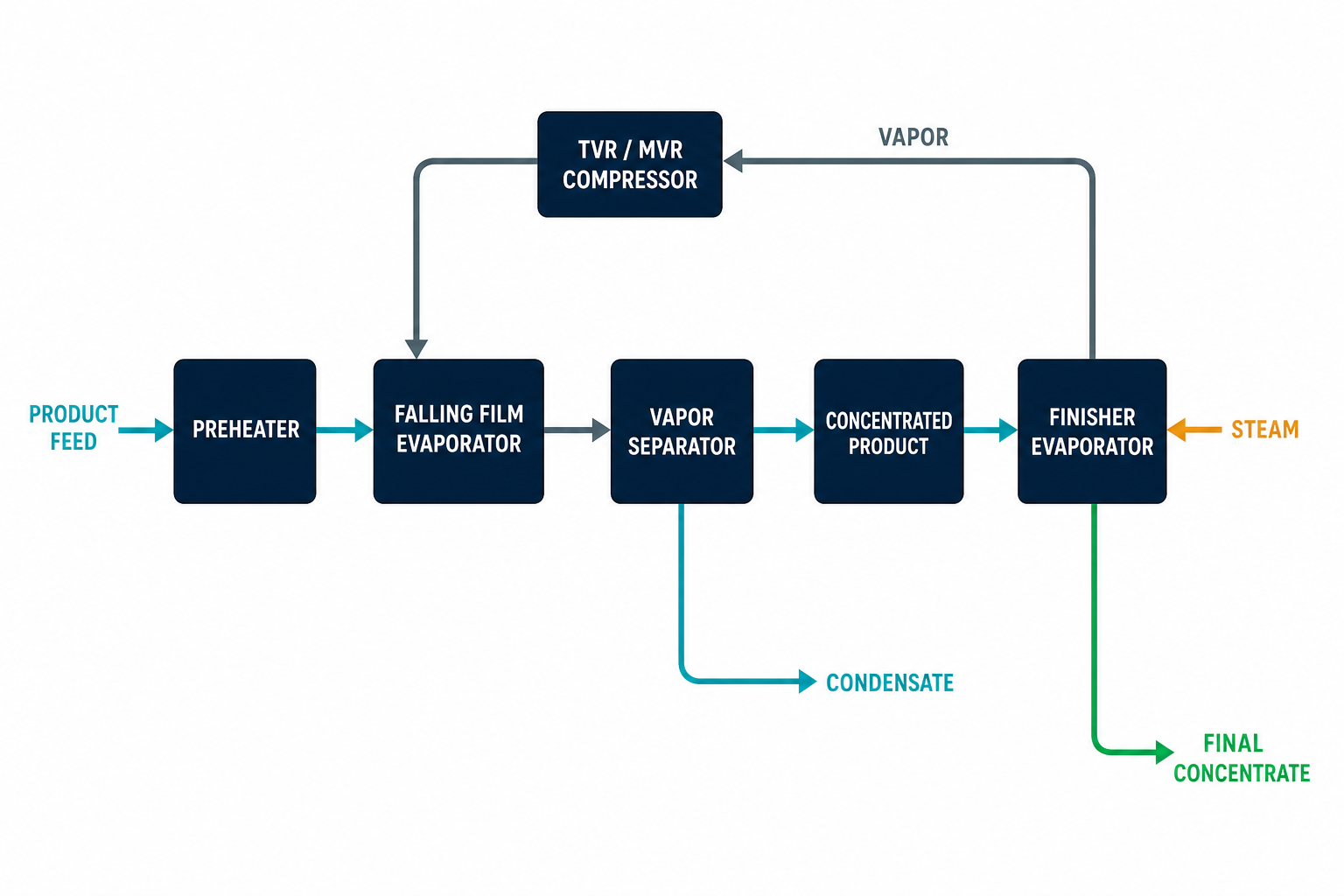
Two scale-up numbers deserve repeating here: wetting rate (liquid load per meter of tube circumference) should stay within roughly 0.25–1.0 kg/(m·s) for water-like feeds — under-wetting creates the dry spots that burn product onto tubes — and tube length-to-diameter ratios of roughly 200:1 to 400:1 balance wetted height against building headroom. Design margins are covered in depth on our falling film evaporation page.
Product Categories Set the Duty
| Category | Indicative concentration duty | Dominant risk | Equipment response |
|---|---|---|---|
| Milk and whey for powder | From ~10% to 45–55% TS ahead of the spray dryer | Protein denaturation, fouling at high solids | Multi-effect falling film, TVR or MVR; forced-circulation finisher where viscosity demands |
| Sweetened condensed milk | To ≥28% milk solids with 62.5–64.5% sugar in product | Viscosity, Maillard browning, lactose crystal size | Low-temperature vacuum effects; rapid seeded cooling after evaporation |
| Fruit juice (apple, orange, pineapple) | To 60–70% concentrate | Aroma loss, vitamin degradation | Falling film under deep vacuum; aroma recovery on stripped volatiles |
| Coffee and tea extracts | To concentrate for spray drying or freeze drying | Flavor and color drift | Short-residence falling film; low ΔT per effect |
| Plant protein (soy, pea) | To protein concentrate specification | Foaming, non-Newtonian viscosity | Multi-stage falling film plus forced circulation on the viscous tail |
| Starch sweeteners and sugar alcohols | From below 20% to 70–77% DS | Color formation, viscosity rise | Five-effect TVR or MVR trains; staged targets around chromatography |
Note: an illustrative envelope of duties from published food-engineering literature, not a project datasheet.
The starch sweetener and sugar alcohol duties have dedicated pages on starch syrup evaporation and sugar alcohol production.
The 50–55% Solids Threshold and the Finisher Decision
Dairy evaporation has a well-defined operating cliff: below roughly 50% total solids, falling film trains concentrate milk and whey cleanly; approaching 50–55%, viscosity rises steeply, tubes wet unevenly, protein burn-on begins, and black speck contamination becomes a food safety issue, not just a quality one. Two responses are standard: tight ΔT discipline in the high-viscosity stages, holding the driving force at 4–6 K so the film never sees local overheating; and a hybrid flowsheet — the falling film train removes bulk water at low viscosity while a forced-circulation finisher, or in extreme duties a scraped-surface unit, takes the final concentration where product behaves non-Newtonian. Whey protein concentrate is the classic hybrid case; sweetened condensed milk, whose sugar content multiplies viscosity, is sized the same way.
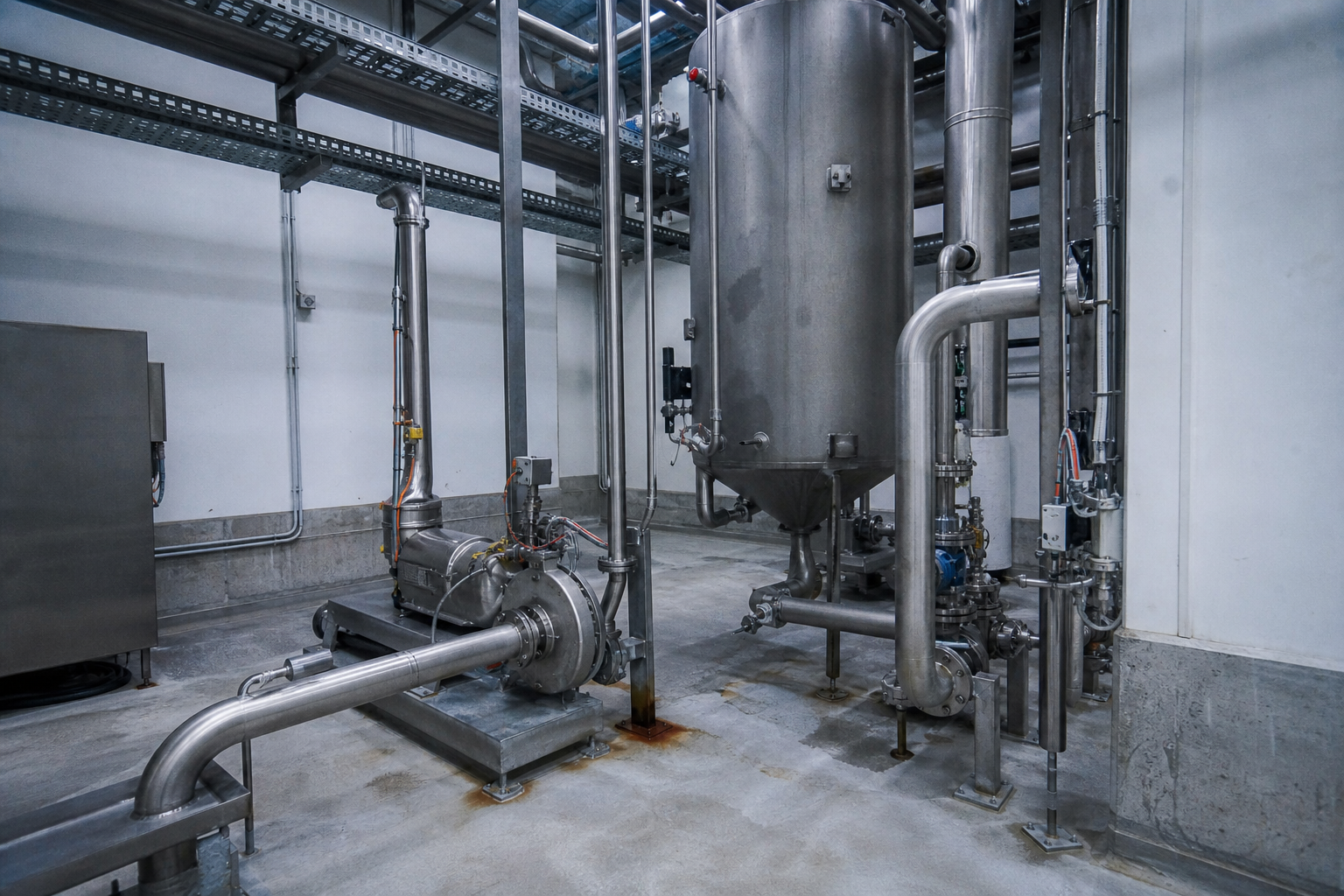
Upstream, condensed milk plants stabilize the milk itself: holding at 80–95 °C for 10–30 minutes, or 100–120 °C for 1–3 minutes, denatures whey proteins and precipitates calcium so the concentrate survives sterilization. Skipping this step is a common integration error.
Energy: The Other Half of the Problem
Because evaporation dominates plant energy, configuration choices ripple through the cost structure. Benchmark figures for a dairy-scale train:
| Configuration | Specific energy | Live steam per kg water | Typical payback context |
|---|---|---|---|
| Four-effect TVR train | Steam-driven | ~0.25 kg/kg | Standard where steam is cheap and steady |
| Six-effect + TVR | Steam-driven | 0.08–0.12 kg/kg (up to 12 kg water per kg steam) | High-volume sites with low-cost steam |
| MVR falling film | 8–12 kWh per tonne evaporated | Start-up only | ROI typically 1.5–2.5 years where electricity is competitive; ~65% carbon reduction versus five-effect steam trains in reported conversions |
Note: figures are industry-reported indicative ranges from published sources, not project guarantees; site results depend on energy prices, duty, and campaign pattern.
The economics are not subtle. Industry tracking across dairy projects (external reference) puts the value of one percentage point of thermal efficiency at roughly USD 150,000 per year for a 10,000-tonne-per-annum milk powder plant, which is why energy audits of existing trains, insulation, preheater recovery, condensate routing, frequently outperform new-equipment proposals. For plants with legacy steam trains, staged MVR retrofit strategies are covered on our energy retrofit and decarbonization page, and the MVR cycle itself on the MVR technology page.
Process Modules and Selection Basis
| Process Module | Candidate Equipment | Selection Basis |
|---|---|---|
| Milk stabilization | Holding tubes, 80–95 °C for 10–30 min or 100–120 °C for 1–3 min | Whey denaturation and calcium control ahead of sterilization |
| Bulk concentration | Multi-effect falling film, TVR or MVR | Heat sensitivity; 3–5 °C ΔT; energy economics |
| Final concentration | Forced-circulation or scraped-surface finisher | Viscosity cliff above ~50–55% TS; non-Newtonian behavior |
| Aroma recovery | Volatile condensation and return | Juice and tea flavor retention requirements |
| Cleaning | Condition-based local CIP; alkaline/acid cycles | Protein soil versus mineral scale; uptime targets |
Note: configurations are indicative; selection depends on actual product, sanitary standard, utilities, and capacity.
Fouling Management: Monitor, Don’t Calendar
Modern food evaporators increasingly replace calendar-based cleaning with condition-based cleaning. The plant tracks each effect’s overall heat-transfer coefficient continuously; a fall of about 15% triggers raised flow and targeted local CIP on that effect instead of a whole-train wash. This extends continuous run time by roughly a quarter and changes maintenance economics: CIP chemicals, lost production, and thermal cycles all scale with full cleans avoided. Full CIP cycles alternate alkaline detergent for protein soil, acid for mineral scale, and hot water rinse, through bodies with self-draining surfaces and CIP velocity guaranteed at the distributor plates.
Sanitary Design and Materials
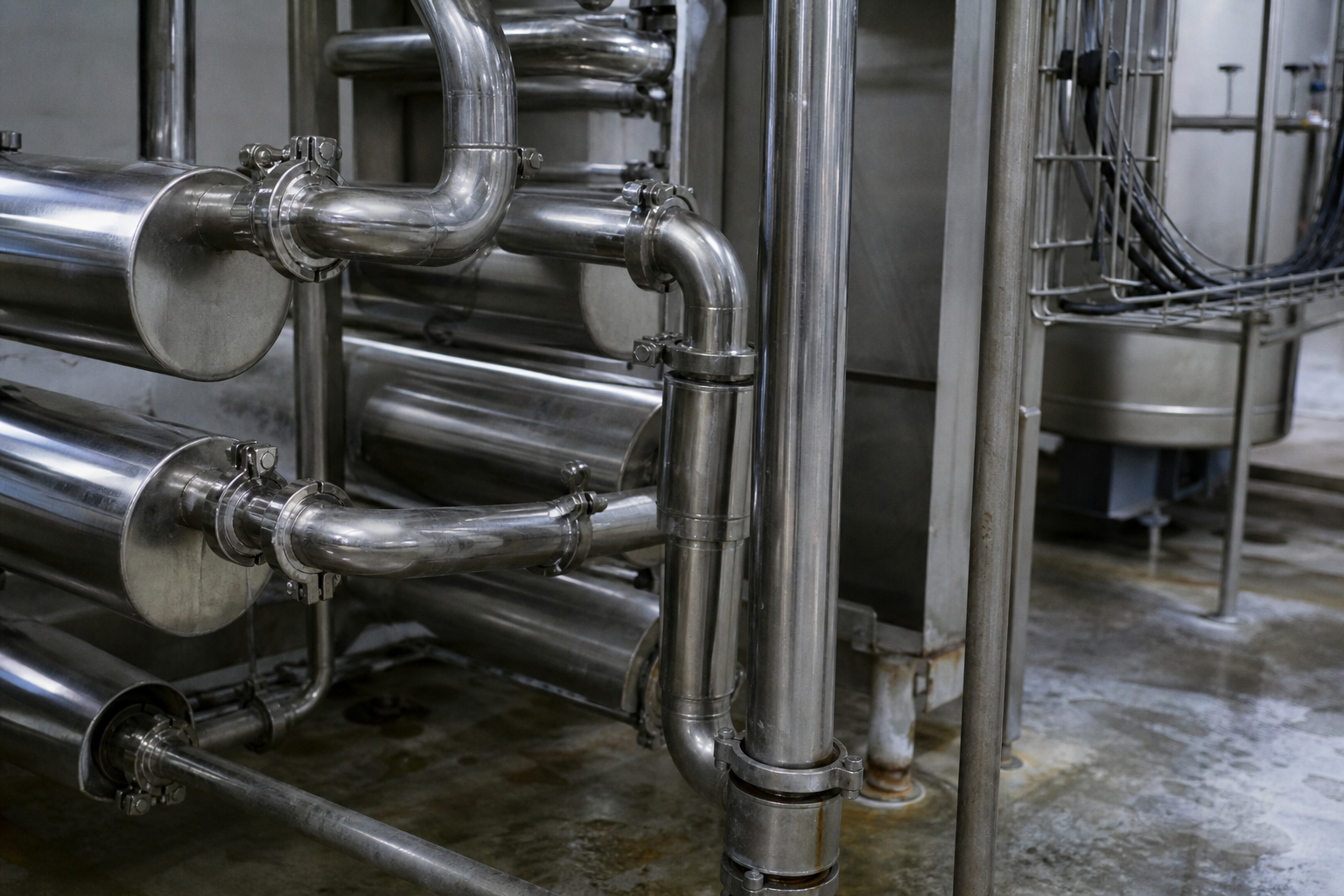
Food and pharmaceutical-adjacent evaporation is delivered under 3-A, EHEDG, or GMP frameworks by destination market: product-contact surfaces polished to Ra ≤ 0.8 µm where required, no dead legs, full drainability, Tri-Clamp or DIN connections, documented traceability. Standard metallurgy is 304 or 316L; the frontier has moved for cause — acidic whey and residual cleaning chemicals justify duplex 2205 on critical surfaces, with externally reported life extension above 40% versus standard austenitics on those duties. Condensate management closes the hygiene loop: condensate from clean product service is usable for boiler makeup or first rinse when demister and entrainment design keep it that way.
Integration With the Rest of the Plant
An evaporator is never a standalone machine in a food plant. It must tie into upstream heat treatment and feed stability, downstream homogenization or spray drying, sugar dosing, and the utility block — steam at first-effect pressure, cooling water at condenser temperature, vacuum sized for non-condensables, not just vapor load. Integration failures — undersized stabilization, mismatched utilities, CIP blocked by layout — cause poor performance more often than the evaporator itself, and the plant-wide view is what we apply across the food and fermentation industry practice and the concentration and crystallization solutions portfolio.
When This Route May Not Fit
Not every food plant should buy a thermal evaporator. Very small outputs — a few hundred liters per hour — are often served better by renting concentration capacity or by freeze concentration for high-value aromatics. Where the product is already near its target solids and the remaining duty is small, membrane concentration may finish the job at lower temperature and lower capital. Where energy is the binding constraint and electricity is expensive while waste heat is abundant, a TVR or multi-effect steam train can beat MVR outright. And products whose damage mechanism is oxidation rather than heat — some enzymes and pigments — need oxygen exclusion and antioxidant strategy, not just a lower boiling temperature, and no evaporator choice fixes that alone.
What Must Be Verified
No external case data is embedded in this article, so validation before any capital commitment must cover the following on real product: product-specific heat-stability testing — the actual degradation signature of the liquor across the intended 40–70 °C window — because published literature thresholds are indicative only, not product datasheets; viscosity-versus-solids measurement up to the finish point to place the falling-film-to-finisher handoff; a utility audit confirming steam or power availability at the full duty required, including vacuum and cooling capacity for the peak campaign; a fouling-rate estimate from pilot or reference duty that sets expected CIP frequency and plant availability; and sanitary compliance mapping — 3-A, EHEDG, or GMP per destination market — fixed before the materials and surface-finishing specifications are frozen for order.
Required inputs for screening: product and target solids, throughput, heat-sensitivity data if available, and site energy prices — enough to outline the train and the MVR-versus-steam call.
Frequently Asked Questions
Why do food plants use falling film evaporators rather than other types?
Falling film combines 5–30 second residence, 40–60 °C vacuum operation, 3–5 °C ΔT, and coefficients of 2,000–4,000 W/(m²·K) — protecting vitamins, proteins, and aroma while keeping area and energy low. Forced circulation and scraped-surface units serve the viscous, high-solids tails where film stability fails.
What is the 50–55% total solids threshold in dairy evaporation?
Above roughly 50% total solids, milk and whey viscosity rises steeply, wetting becomes uneven, and burn-on accelerates — so plants hold the falling film train at or below that band and either apply tight 4–6 K ΔT control or hand final concentration to a forced-circulation finisher built for non-Newtonian liquor.
Is MVR worth it for a mid-size food plant?
Where electricity is price-competitive, MVR pays back in 1.5–2.5 years versus 3–4 for TVR steam systems, consumes 8–12 kWh per tonne instead of live steam, and cuts carbon about 65% in reported five-effect conversions. Extremely cheap gas with expensive power remains the exception — though decade-scale total cost often still favors MVR once carbon pricing counts.
How is fouling controlled without stopping production?
Condition-based cleaning tracks the heat-transfer coefficient per effect; a ~15% fall triggers flow adjustment and local CIP instead of whole-train shutdown, extending continuous operation ~25% and cutting chemical and downtime cost.
What sanitary standards apply to food evaporators?
Depending on market: 3-A in the United States, EHEDG in Europe, GMP for pharmaceutical and infant-formula duty — executed via polished drainable surfaces (Ra ≤ 0.8 µm where specified), crevice-free welds, no dead legs, and CIP sized to the distributor geometry.