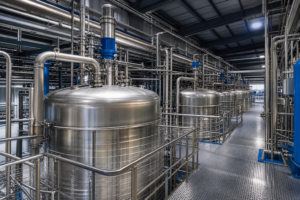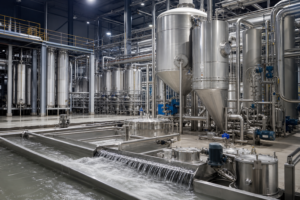
Ammonium sulfate ((NH₄)₂SO₄) recovery by evaporation crystallization turns three problems — chemical wastewater COD and nitrogen load, disposal cost, and fertilizer feedstock demand — into one loop: the wastewater is concentrated in an MVR or multi-effect evaporator, the salt crystallizes out as sellable product, and the condensate returns to the plant as process water. Industrial routes differ by feedstock: neutralization of ammonia with sulfuric acid in a saturated crystallizer for on-purpose production, and evaporation crystallization for sulfate-ammonia waste liquors from caprolactam, coke-oven gas scrubbing, titanium dioxide, and dye manufacture. This article lays out the process options with their operating characteristics, the crystal-size engineering that separates commodity salt from premium large-particle product (1.6–2 mm), and what the drying and materials sections must get right.
Where Ammonium Sulfate Streams Come From
Most ammonium sulfate entering the market is not made on purpose — it is recovered from industrial by-product and waste streams. The principal sources are:
- Coke-oven and coal gas scrubbing — sulfuric acid absorbs ammonia from coke-oven gas; the resulting sulfate liquor is crystallized.
- Smelter flue gas — ammonia water absorbs sulfur dioxide from smeltery flue gas, again producing an ammonium sulfate liquor.
- Caprolactam production — ammonia in the process loop is recovered as ammonium sulfate, typically in large tonnage.
- Titanium dioxide (sulfate process) — sulfuric acid waste liquor is neutralized with ammonia to yield sulfate salt.
- Gypsum route — natural gypsum or phosphogypsum reacts with ammonia (and carbon dioxide), converting a solid waste into ammonium sulfate.
- General chemical wastewater — dye, pharma, and agrochemical plants discharge liquors rich in ammonium sulfate, frequently mixed with ammonium chloride.
The engineering consequence: feed composition is never clean. Organics, heavy metals, and free acid ride along with the salt, and the evaporation-crystallization train must be designed for the actual liquor, not the textbook binary.
On-Purpose Production: The Neutralization Route
In neutralization production, ammonia and sulfuric acid react directly in a saturated crystallizer — operated under vacuum or at atmospheric pressure — generating ammonium sulfate crystals in situ. The slurry is centrifuged, the crystals are dried, and the mother liquor returns to the saturator. The reaction itself is strongly exothermic, and well-designed plants put that heat to work: reaction heat evaporates the water brought in with the sulfuric acid, or water deliberately added for temperature control. In atmospheric saturators, a large airflow through the reaction mass carries away excess heat.
The neutralization method’s documented advantages explain its dominance: the process is mature, raw materials are readily available, product purity is high, and energy consumption is comparatively low because the reaction heat offsets part of the evaporation duty. Coke-oven gas ammonia recovery by sulfuric acid washing is chemically the same neutralization, just with the ammonia sourced from gas.
Evaporation Crystallization for Waste Liquors
When the ammonium sulfate is already dissolved in wastewater — dye-plant effluent, caprolactam mother liquor, desulfurization blowdown — the recovery path is evaporation crystallization. The liquor is concentrated in a forced-circulation or falling-film evaporator; as the solution approaches saturation, crystals nucleate and grow in a crystallizer operating under controlled supersaturation; the slurry is centrifuged; mother liquor recycles to the evaporator with a controlled purge to stop impurity build-up.
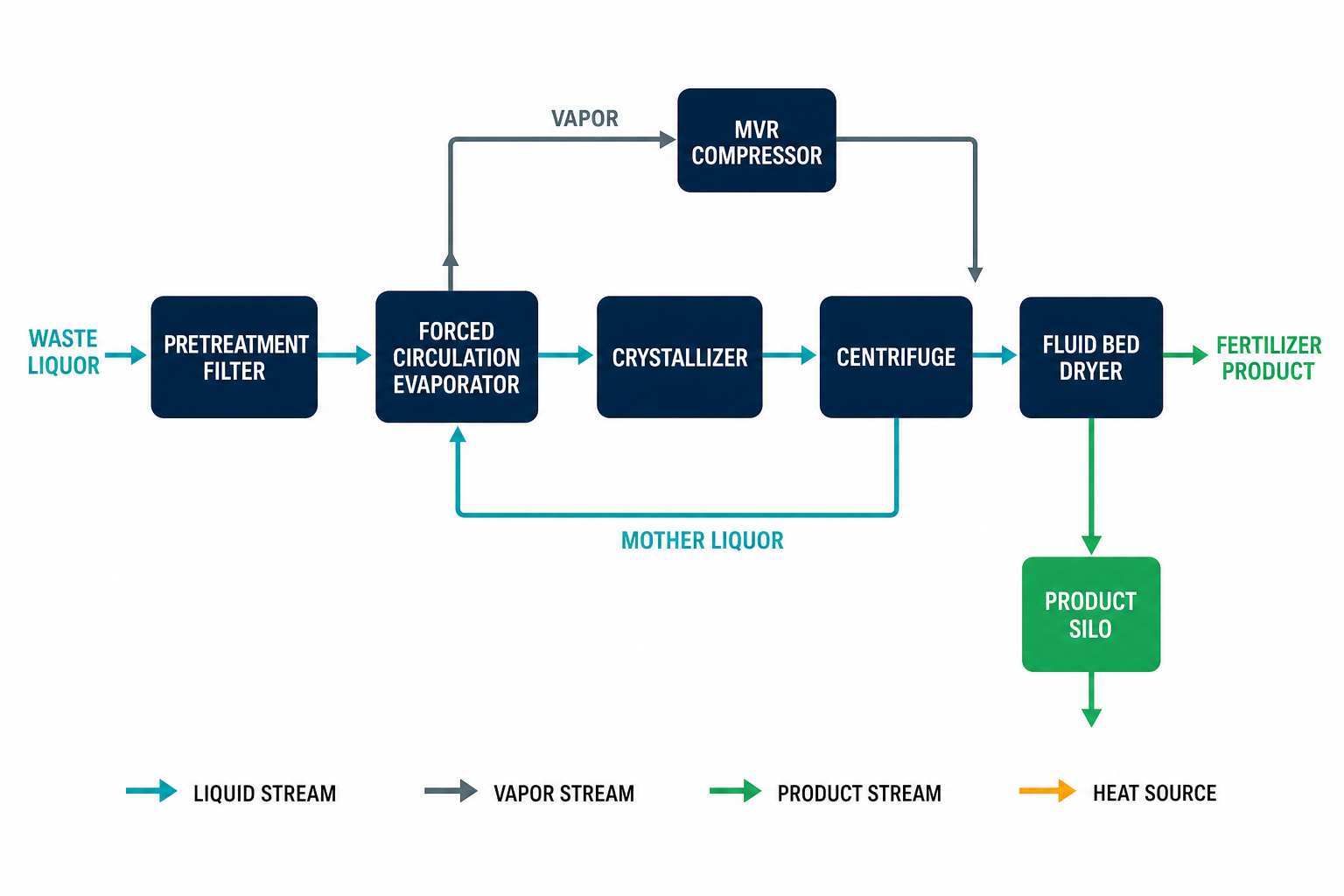
How effective the treatment is depends mainly on two variables, as published dye-factory MVR references indicate (external industry reference, vendor-published — not EvapCryst deliveries): the volume of wastewater to be processed (which sets evaporator capacity and residence time) and the wastewater’s composition (co-contaminants beyond ammonium sulfate — organics, ammonium chloride, metals — add separation steps before or after the crystallizer). MVR recompression is the standard driver for these trains because the liquor is close to boiling most of the cycle and the electricity-for-steam substitution is what makes recovery cheaper than disposal; the underlying cycle is covered in our MVR evaporation technology overview.
For streams where ammonium sulfate coexists with other salts — mixed sulfate/chloride/nitrate liquors — fractional crystallization separates them into individual products instead of a mixed waste salt. The sequencing logic (which salt crystallizes first at what temperature and concentration) is detailed on the salt separation technology page.
Crystal Size: Commodity Powder vs Large-Particle Product
Conventional crystallization delivers ammonium sulfate below 1 mm — a dusty powder that cakes, generates explosion-class dust in handling, and fetches commodity pricing. Export fertilizer markets pay a premium for large particles of 1.6–2 mm: uniform, complete crystal form, no crusts, lumps, or fines. The production route is multi-stage continuous cooling (or evaporation) crystallization, in which the liquor passes through three crystallizer stages in series, each with its own condenser, plus feed, transfer and discharge pumps and a vacuum system.
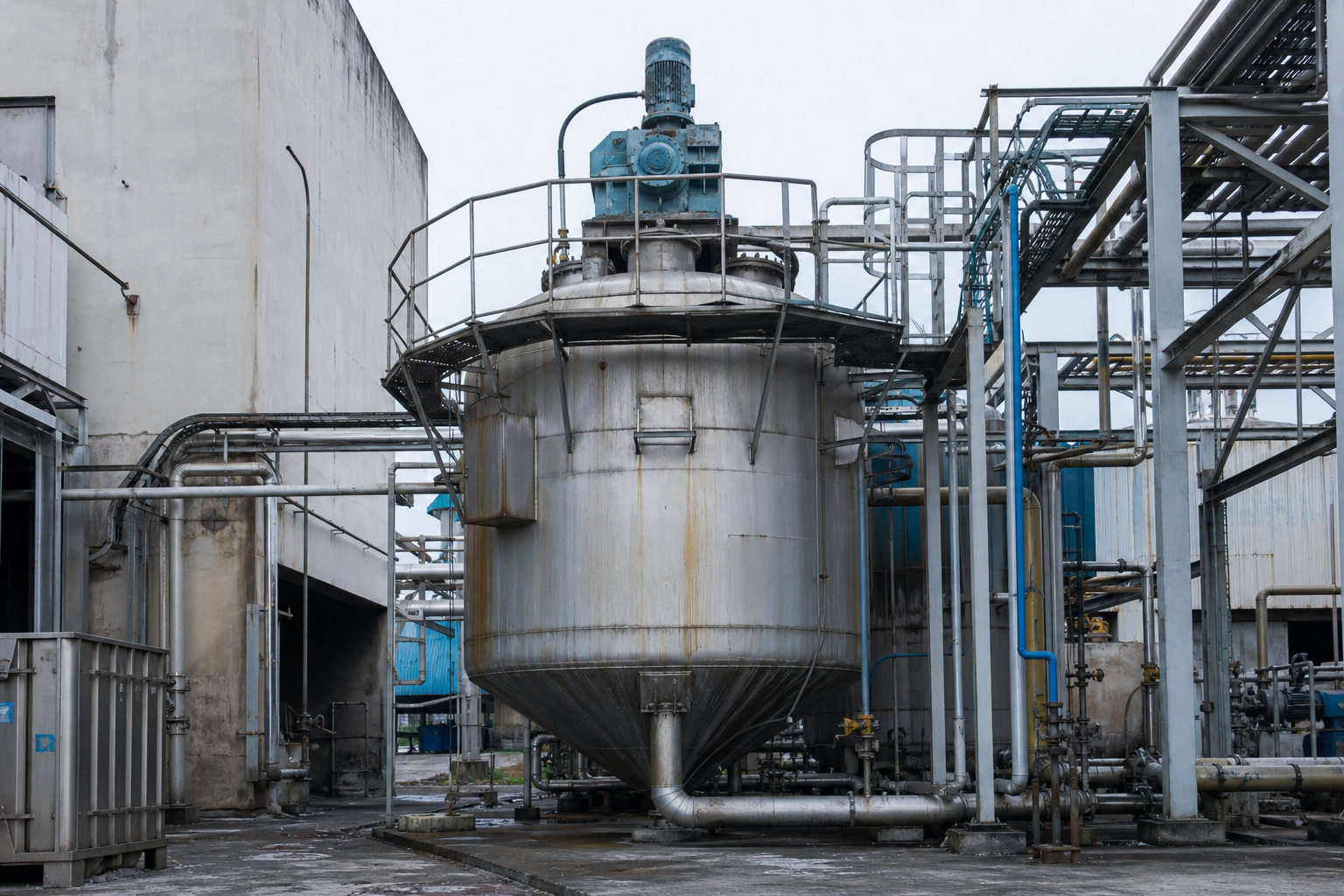
Supplier-published data for continuous large-particle units (10,000–200,000 t/y capacity range; indicative figures, not a project guarantee) shows the utility footprint directly:
| Unit size class | Electricity draw (kW at rated duty, supplier-published) | Cooling water (m³/h at rated duty) |
|---|---|---|
| 15,000 t/y class | 115 kW | 50 m³/h |
| 25,000 t/y class | 145 kW | 85 m³/h |
| 35,000 t/y class | 185 kW | 110 m³/h |
Three operating advantages quoted from suppliers’ reference lists (external industry reference — vendor-published, not EvapCryst deliveries; indicative, not a project guarantee) mark continuous crystallization against batch tanks: footprint — a 100,000 t/y oxalic acid continuous crystallizer occupies roughly 500 m² versus about 10,000 m² for the equivalent batch tank farm, on the order of one-twentieth the land; labor — one operator after smooth start-up under automated computer control; and safety — eliminating crystal scars, lumps, and fines removes the clogging and dust-explosion hazards associated with powder product. The same equipment family serves adipic acid (crystals above 1 mm), succinic acid (about 1.5 mm), caprolactam, tartaric acid, and sodium hypophosphite duties, confirming that the crystal-size engineering transfers across products.
Route Selection: Evaporative vs Cooling Crystallization
| Criterion | Evaporation crystallization (MVR / multi-effect) | Cooling crystallization (multi-stage continuous) |
|---|---|---|
| Driving force | Water removal raises concentration above saturation | Temperature reduction exploits the solubility-temperature slope |
| Best fit | Dilute-to-moderate waste liquors; wastewater recovery where volume reduction is itself the goal | Concentrated, hot, clean liquors; on-purpose production after neutralization |
| Energy carrier | Electricity (MVR compressor) or steam (MEE) | Cooling water / chilled water; lowest electrical load |
| By-product | Distillate water recovered as condensate for reuse | No water removed; mother liquor volume unchanged |
| Typical crystal size | Small-to-medium unless OSLO-type growth zone added | Large particles achievable (1.6–2 mm demonstrated) |
In wastewater projects the evaporative route usually wins on system grounds — the plant needs the water removed regardless — while cooling crystallization is the upgrade path when the salt is destined for fertilizer markets and particle size carries price. Hybrid trains (evaporative concentration followed by a polishing cooling stage for crystal size) are common at large scale.
Drying: The Last Mile of Fertilizer Quality
Centrifuged ammonium sulfate carries surface moisture that must come off before storage and bagging, and fluid-bed drying is the industry-standard answer — well-suited to the crystal’s free-flowing form and compatible with the large-particle product grades. Two design points deserve attention. First, temperature control: ammonium sulfate begins to decompose if over-dried at excessive temperature, so drying air temperature and residence time are product-quality variables, not just utility settings. Second, dust management: fine ammonium sulfate is a combustible dust, and the elimination of fines at the crystallizer stage is precisely what keeps the dryer’s explosion risk class manageable — one more reason the 1.6–2 mm product is safer to handle end-to-end. Dryer selection and the drying-packing line are covered on the drying and packing technology page.
Wastewater Recovery Economics and ZLD Position
Ammonium sulfate crystallization sits in the zero-liquid-discharge train as the salt-recovery step that converts the brine concentrate into a monetizable stream. The economics rest on three legs: avoided disposal cost (per-ton effluent treatment or hazardous-waste fees), condensate returned as process water, and fertilizer-grade salt revenue. The salt’s market value fluctuates with fertilizer cycles, so the robust projects are those where disposal avoidance alone nearly pays the operating cost and salt sales are margin, not lifeline. Where ammonia recovery rather than salt recovery is the goal, upstream stripping changes the problem; the ZLD solutions page shows where the crystallizer island fits relative to membranes, strippers, and final solids handling.
Materials selection is the quiet cost driver: ammonium sulfate liquors are mildly acidic and corrosive toward plain stainless. SS316L is the baseline for evaporator and crystallizer bodies in neutral service; higher-alloy grades enter the discussion when free sulfuric acid or chlorides are present in the waste liquor — common in titanium dioxide and caprolactam feeds.
| Process module | Equipment candidates | Selection basis | Indicative envelope |
|---|---|---|---|
| Feed pretreatment | Equalization, polishing filtration, metals and organics removal | Impurity control for crystal purity | Clarified liquor at fertilizer-grade feed quality |
| Evaporation concentration | Forced-circulation or falling-film MVR / multi-effect | Sulfate liquor near boiling most of the cycle | To (NH₄)₂SO₄ saturation |
| Crystallization | FC / DTB / Oslo; evaporative or multi-stage cooling | Crystal-size target sets the route | Commodity powder to 1.6–2 mm product |
| Centrifuging and drying | Centrifuge, fluid-bed dryer | Fertilizer moisture and dust specification | Baggable, free-flowing product |
| Mother liquor and condensate | Controlled purge; condensate polish | Impurity ceiling, water reuse | Small purge, reusable condensate |
Configuration, materials and operating envelopes depend on the actual liquor analysis, impurity profile, corrosion review, utilities and project capacity.
Related Salt Recovery Lines
The same platform handles adjacent ammonium chemistry: ammonium chloride evaporation crystallization and drying for soda-ash coupled production and rare-earth wastewater, and sodium chloride MVR production for the chloride-side counterpart. Mixed ammonium streams that must be split are addressed under salt separation. For the dyeing-industry application of exactly this chemistry, see the dedicated dyeing wastewater ammonium sulfate recovery page — this page covers the chemical’s general evaporation-crystallization platform, while that page deepens the dye-house scenario (bath chemistry, dye-factory case, recovery economics).
When This Route May Not Fit
This route assumes a sulfate-ammonia liquor worth concentrating and a salt outlet that pays. It may not fit very dilute streams — evaporating hundreds of tons of water to recover a few tons of salt can cost more than the product is worth; biological or stripping recovery handles weak ammonia streams better. It may not fit liquors whose organics, heavy metals or dyes contaminate the crystal beyond fertilizer tolerance and cannot be cleaned upstream. It may not fit sites with no fertilizer-market access, where commodity ammonium sulfate prices swing low enough that disposal avoidance alone cannot carry the plant. And where chlorides run high, corrosion allowances may push capital beyond what salt revenue justifies; large-particle premium product adds staging capital that only a confirmed buyer repays.
What Must Be Verified
Before this route is fixed, the validation focus is: a full liquor analysis — ammonium sulfate strength, free sulfuric acid, chlorides, organics, heavy metals — because impurity and chloride levels fix both the pretreatment train and the metallurgy budget. Then crystal-quality proof: bench crystallization on the real liquor, checked against the target fertilizer specification, not the textbook binary. Then the salt outlet — a fertilizer buyer, a blending contract or a confirmed disposal grade — because economics that depend on peak fertilizer prices are fragile. Then the water balance: where the condensate goes and what polishing it needs. Finally, for large-particle product, the cooling-staging utility check, and electricity-versus-steam pricing closes the MVR-or-MEE question. Verified liquor data and bench crystallization are the evidence base.
Required inputs: the liquor analysis (salt strength, free acid, chlorides, organics, metals), feed rate and the intended product outlet — in exchange, an initial direction on route selection, crystallizer staging and crystal-size target.
FAQ
What are the main sources of ammonium sulfate for recovery?
Coke-oven gas ammonia absorbed by sulfuric acid, smelter flue-gas SO₂ absorbed by ammonia water, caprolactam plant ammonia, titanium dioxide sulfuric-acid waste liquor neutralized with ammonia, and the gypsum route using natural gypsum or phosphogypsum.
How does the neutralization method produce ammonium sulfate?
Ammonia and sulfuric acid react in a saturated crystallizer under vacuum or atmospheric pressure. The strongly exothermic reaction heat evaporates incoming water, crystals form in situ, the slurry is centrifuged and dried, and mother liquor returns to the saturator.
Can ammonium sulfate wastewater be treated effectively with an evaporator?
Yes — effectiveness depends chiefly on wastewater volume (evaporator sizing) and composition (co-contaminants such as organics, ammonium chloride, or metals, which may require pre-treatment or additional separation steps). Published dye-factory MVR crystallization references — external industry reference, vendor-published, not EvapCryst deliveries — support the route’s effectiveness.
Why produce large-particle ammonium sulfate of 1.6–2 mm?
Conventional product below 1 mm dusts, cakes, and carries dust-explosion handling risk. Large, uniform particles command export fertilizer premiums, avoid caking, and improve spreading behavior in fertilizer application.
Which crystallization route should I choose: evaporative or cooling?
Choose evaporative (MVR/multi-effect) when the feed is dilute wastewater and water removal is required anyway. Choose multi-stage continuous cooling for hot, concentrated, clean liquors where large crystal size is the objective; hybrid trains combine both.