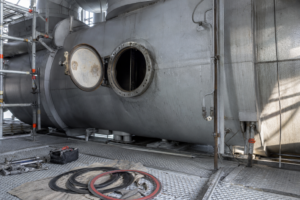
Industrial evaporators divide into four main types — natural circulation, forced circulation, rising/falling film, and multi-effect/MVR — and each earns its place by fluid behavior: heat-sensitive clean fluids go to falling-film evaporators (seconds-scale residence time; energy set by effect count, or 15–40 kWh/t electricity with MVR), viscous, scaling, or crystallizing fluids go to forced-circulation evaporators (robust at high velocity, but pump power dominates), low-viscosity easy fluids can run natural circulation (the cheapest architecture, roughly 60% of forced-circulation capital), and large continuous duties justify multi-effect or MVR energy recovery (MVR down to 15–40 kWh/t of electricity). At 16 t/h evaporation duty, a triple-effect MEE consumes about 6.6 t/h of steam against MVR’s 0.9 t/h — but MVR draws roughly 923 kWh versus 240 kWh and occupies half the footprint. This article compares all four types on the numbers that decide projects: heat-transfer coefficient, energy, capital, maintenance, and duty fit.
The Four Main Types at a Glance
| Type | Driving principle | Specific energy (t steam/t water for steam-driven types; kWh/t electricity for MVR) | Typical CAPEX (indicative) | Annual maintenance (indicative) | Best-fit fluids |
|---|---|---|---|---|---|
| Natural circulation | Density difference, no pump | ~1.0 t steam/t water (single-effect) | USD 50k–100k | USD 500–1,000 | Low viscosity, non-scaling, non-crystallizing |
| Forced circulation (FC) | Axial-pump velocity through heater | Steam by effect count; high circulation-pump power | USD 100k–200k | USD 1,500–3,000 | Viscous (>200 cP), scaling, crystallizing |
| Rising / falling film | Thin film, gravity or vapor shear | Steam by effect count; with MVR 15–40 kWh/t electricity | USD 80k–150k | USD 1,000–2,000 | Heat-sensitive, clean, low-viscosity |
| Multi-effect + MVR | Vapor reuse / recompression | MVR 15–40 kWh/t electricity (higher on high-BPE duties); triple-effect ~0.3–0.4 t steam/t water | USD 150k–300k | USD 2,000–5,000 | Large continuous duties, energy-sensitive sites |
These are indicative planning figures for comparative scale — actual pricing follows capacity, materials, and duty, but the relative ranking is stable and is the point.
Natural Circulation Evaporators: Simplicity as a Feature
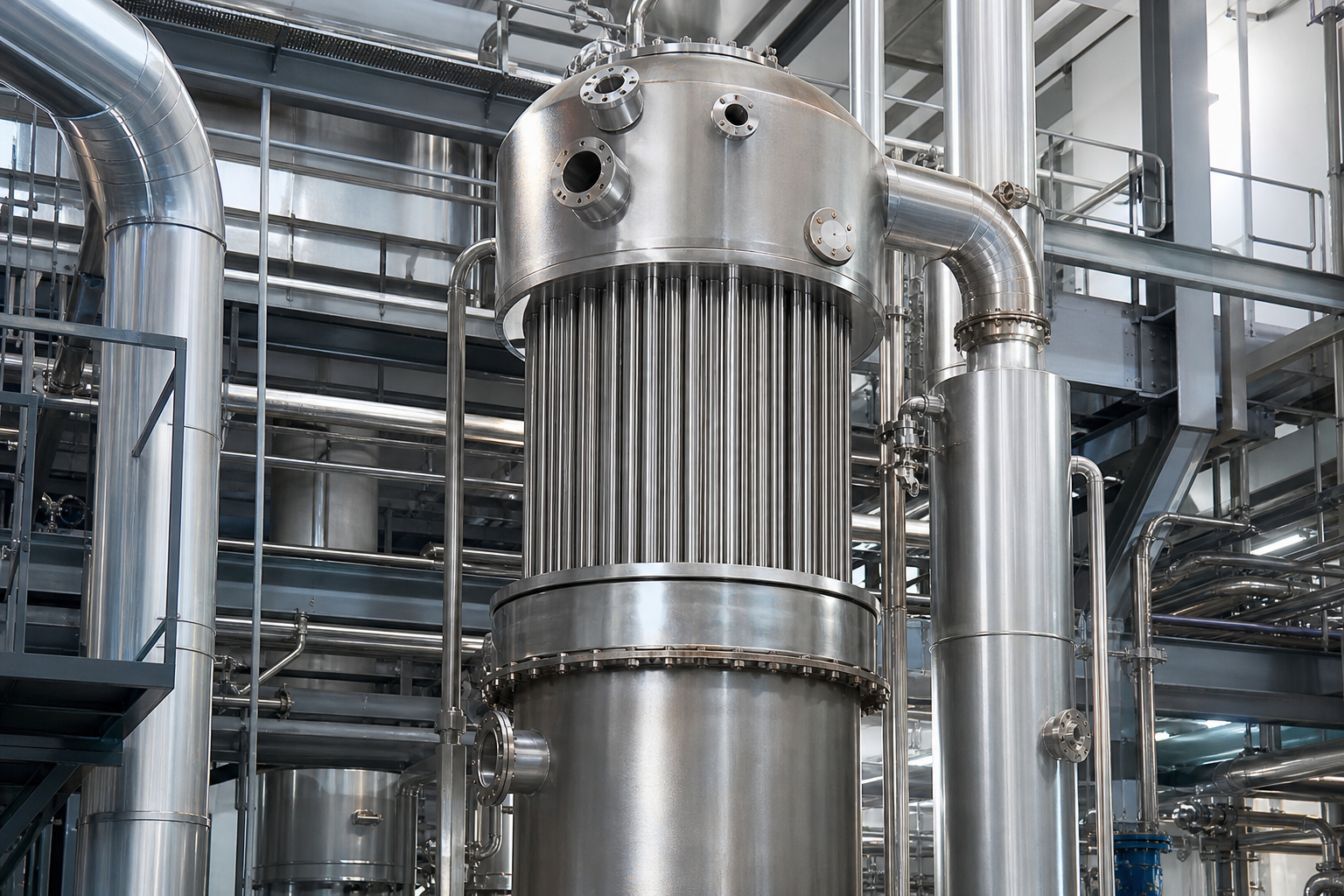
Natural circulation relies on the density difference between heated and cooled liquid to drive flow through the heating element — no circulation pump, fewer wear parts, lower energy draw. The trade-off is limited velocity and limited heat transfer, which confines it to low-viscosity fluids that neither scale nor crystallize aggressively. Its capital cost runs roughly 60% of an equivalent forced-circulation installation. Typical service: straightforward concentration duty such as fruit-juice plants (illustrative application) — one installation running 5,000 L/h at 70% concentration (external industry reference) illustrates the class. If your fluid is easy and your budget tight, this is the honest answer; if the fluid might scale, it is a trap.
Forced Circulation Evaporators: Built for the Difficult Cases
An axial pump pushes liquid through the heater at roughly 1.5–4 m/s, suppressing boiling inside the tubes — the fluid flashes in the separator instead, so solids never get the chance to bake onto heat-transfer surfaces. Heat-transfer coefficients run high (typically in the 1,800–4,500 W/m²K band), and the configuration tolerates high solids: designs sustain continuous operation above 20% solids content for 500+ hours on ZLD brine service at around 3 m/s (reported in external industry documentation). The price is the pump: on a 10 t/h MVR forced-circulation plant, circulation-pump power typically lands between 90 and 160 kW, which dominates the maintenance budget and part of the energy bill. One reported case (external industry reference): a monosodium-glutamate plant running a 10 t/h FC crystallizer gained 20% crystallization-rate improvement with 8,000 hours of annual runtime. For crystallizing duty, the forced-circulation evaporator is the default; its pairing with crystallizers is covered under our crystallization technology pages.
Falling Film vs. Rising Film: The Thin-Film Pair
Both types spread liquid into a thin film for high heat transfer and short residence time, but they differ in mechanics and tolerance:
- Heat-transfer coefficient — rising film reaches roughly 1,500–2,500 W/m²K; falling film 2,000–3,000 W/m²K, with design values up to ~3,500 in favorable service;
- Specific energy — film types are steam-driven with economy set by effect count; falling film typically runs 10–20% below forced circulation on total energy thanks to higher heat-transfer coefficients;
- Film and residence — falling film forms a 0.1–0.6 mm gravity-driven film with 20–120 s residence (seconds-scale in the heated zone), preserving quality on heat-sensitive products;
- Fluid limits — falling film dislikes viscosity above ~200 cP and fouling feeds (film breakup causes dry patches); rising film needs sufficient vapor velocity to drag the film up, suiting low-foaming, self-circulating duties;
- Fouling tolerance — neither matches forced circulation; clean feed discipline is the entry ticket;
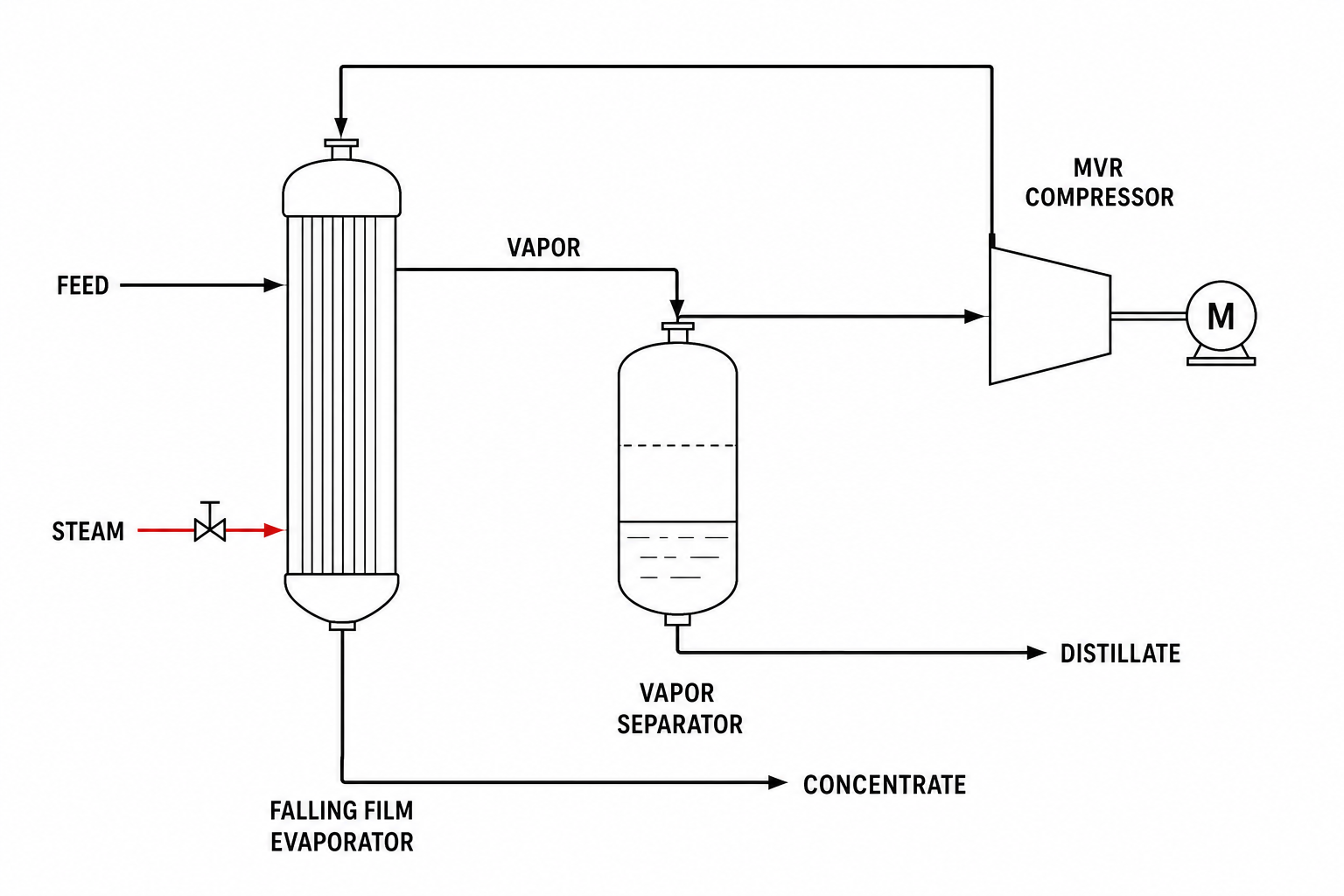
- MVR compatibility — falling film’s high coefficient at low temperature difference (below ~8°C) makes it the natural partner for MVR compressors, which deliver exactly that profile.
For the food-and-pharma heat-sensitive end of this spectrum, the falling-film evaporator page details the design choices.
Multi-Effect and MVR: The Energy-Recovery Types
Where throughput is large and hours are long, the architecture itself must recover energy. Multi-effect evaporation reuses each effect’s vapor in the next — a triple-effect plant evaporates water on roughly 0.3–0.4 kg of steam per kg of water, a 30–50% saving against single effect, with more effects improving further until temperature-difference losses bind. MVR goes further: an electric compressor recycles essentially all the vapor, bringing net specific electricity consumption to 15–40 kWh/t on a site-consistent basis (higher on high-BPE duties; see the worked comparison below) — one chemical plant treating 500,000 t/y of wastewater (external industry reference) reported 60% energy savings worth USD 200,000 per year. The theory and equipment are covered on our multi-effect and MVR technology pages.
MVR vs. Triple-Effect MEE at 16 t/h: A Worked Comparison
Side-by-side utility consumption at 16 t/h evaporation capacity:
| Utility / metric | Triple-effect MEE | MVR |
|---|---|---|
| Steam consumption | 6.6 t/h | 0.9 t/h (start-up + trim) |
| Electricity | ~240 kWh | ~923 kWh (incl. compressor and auxiliaries) |
| Circulating cooling water | 600 m³/h | 100 m³/h |
| Plot area | 12 × 18 m | 6 × 12 m |
Read the table as a trade, not a verdict: MVR nearly eliminates steam and cooling water at the cost of compressor electricity, while halving footprint. The winner is set by your utility prices and runtime — high steam price and continuous duty favor MVR strongly; cheap CHP steam and batch operation keep MEE defensible. The two are not always substitutes either: streams with high BPE, severe fouling, or specific purity demands may force one architecture regardless of energy math. The broader decision framework is in our evaporator selection guide.
Capacity Bands and the Batch Question
Energy performance and duty fit pull the MVR-versus-triple-effect choice in complementary directions. On energy recovery, MVR systems recycle roughly 85–90% of process energy while a triple-effect plant achieves 55–60% savings relative to single effect — both strong, separated by capital intensity. On capacity fit, MVR designs are most at home between roughly 5 and 100 t/h of evaporation, whereas triple-effect plants serve the 1–20 t/h band economically. Beyond the numbers, three situational tests pick the winner:
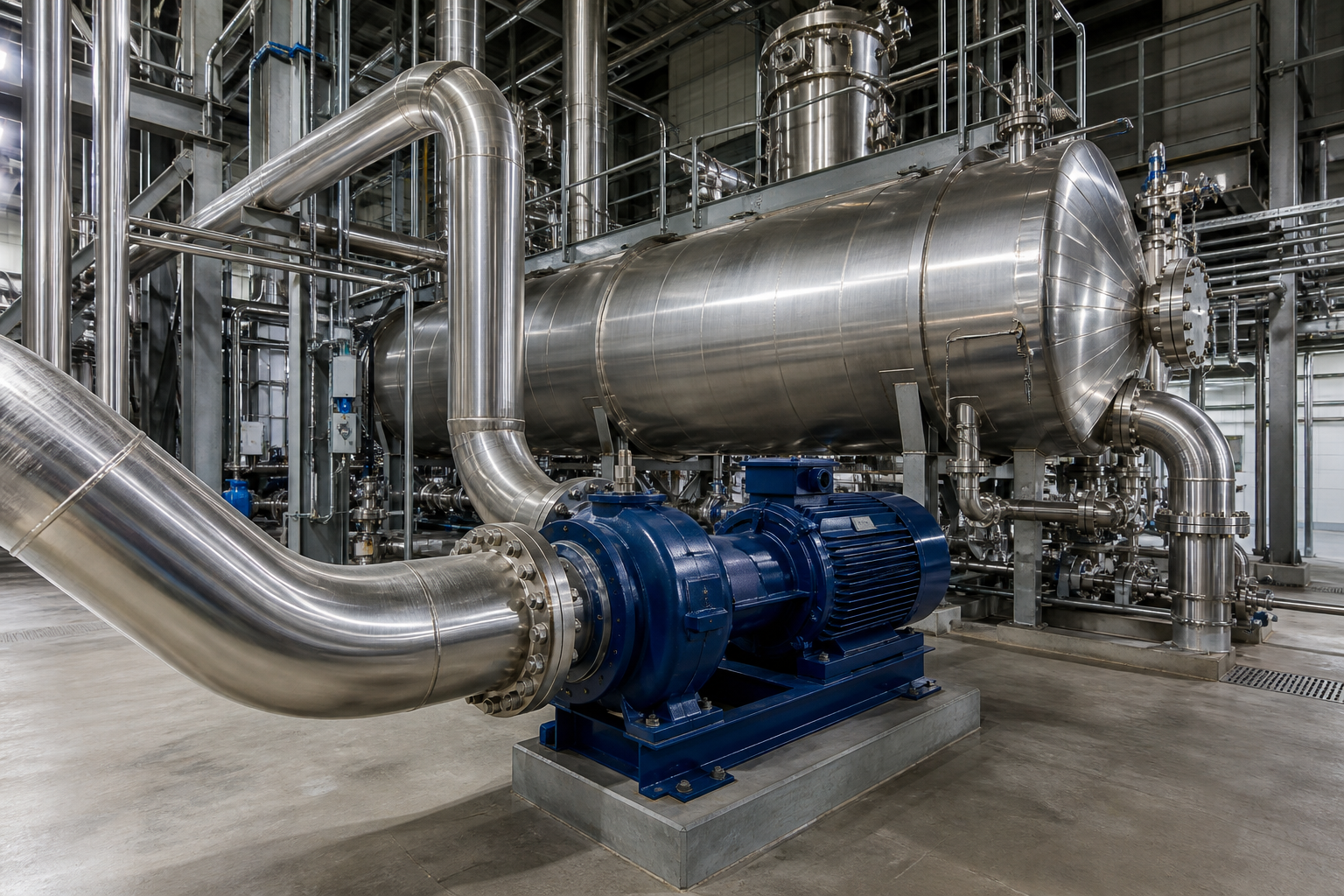
- Choose MVR when the plant runs continuous 24/7 duty, electricity is favorably priced against steam, or site space is constrained (recall the 6×12 m versus 12×18 m footprint);
- Choose triple-effect when operation is batch or campaign-based, the product is thermally sensitive and needs a gentler thermal profile, or the application demands high-purity crystallization — pharmaceutical crystallization and food-grade salt are the classic cases where the multi-effect’s milder heat treatment and superior crystal purity output outweigh MVR’s efficiency;
- Choose the hybrid when both efficiency and purity matter: MVR–triple-effect combined flowsheets add MVR’s energy performance to the multi-effect’s product quality, cutting energy cost a further 30–40% while preserving flexible operating modes.
Which Type for Which Duty? The Decision Logic
- Heat-sensitive product + clean feed → falling film, ideally under vacuum; pair with MVR for efficiency;
- High viscosity, scaling, or crystallizing feed → forced circulation; accept pump energy and maintenance;
- Easy fluid + modest budget → natural circulation where duty allows;
- Large continuous duty + energy-sensitive site → multi-effect or MVR, chosen by steam-to-power ratio;
- Mixed duty (medium viscosity, mild scaling) → hybrid: multi-effect falling-film effects up front, forced-circulation finisher at the concentrated end — often the optimum, since each section handles the regime it tolerates best.
Cleaning, Maintenance, and Runtime Reality
Between cleanings, service factors follow fluid character: clean liquids support 3–6 month cleaning intervals, while scaling-prone feeds push CIP cycles to every 7–15 days (typical reported practice). Falling-film plants foul fast when feed discipline slips (dry-patch risk); forced-circulation plants trade that risk for pump overhaul schedules. Budget maintenance against the indicative annual figures in the first table, and verify vendor claims of runtime between cleanings against references on genuinely comparable fluid — not just comparable capacity.
Validate with Pilot Testing Before Committing
Heat-transfer coefficients, scaling rates, and product quality are fluid-specific; literature values bracket them but cannot guarantee them. For any unfamiliar feed or quality-critical product, pilot evaporation — even bench scale — converts assumptions into measured data: actual K values, observed fouling velocity, distillate quality, and crystal habits where applicable. Feed those numbers into an ROI model across your utility prices and runtime, and the type comparison in this article collapses into one defensible project decision.
FAQ
Which evaporator type is best for heat-sensitive products?
Falling-film evaporators: the 0.1–0.6 mm film and seconds-scale residence in the heated zone minimize thermal exposure, and vacuum operation lowers product temperature further. Pairing with MVR adds energy efficiency at the low temperature difference falling film naturally accepts (below ~8°C).
When should I choose forced circulation over falling film?
When the fluid is viscous (above roughly 200 cP), scaling, or crystallizing. Forced circulation’s 1.5–4 m/s pump velocity suppresses tube-side boiling and wall deposition, sustaining operation at solids contents above 20% — performance a falling-film design cannot hold on those fluids.
How much energy does MVR really save compared with triple-effect evaporation?
At 16 t/h duty: steam falls from 6.6 t/h to 0.9 t/h and cooling water from 600 to 100 m³/h, in exchange for electricity rising from roughly 240 to 923 kWh (the 923 kWh at 16 t/h is ≈58 kWh/t — above the 15–40 kWh/t clean-water band because this duty carries high boiling-point rise and auxiliary loads). Net savings depend on your steam-versus-power prices; on continuous duty with priced steam, MVR’s specific electricity consumption of roughly 15–40 kWh/t typically wins decisively.
Can different evaporator types be combined in one plant?
Yes, and it is often optimal: multi-effect falling-film effects handle the dilute, well-behaved front end at high efficiency, while a forced-circulation finisher manages the concentrated, crystallizing tail. MEE–MVR hybrids similarly trade capital against operating cost on mid-size duties.
How often do industrial evaporators need cleaning?
By fluid character: clean services run 3–6 months between CIP cycles; scaling-prone feeds require cleaning every 7–15 days. Cleaning frequency is a first-order operating cost — verify it against references on comparable fluid before accepting any vendor’s runtime claims.