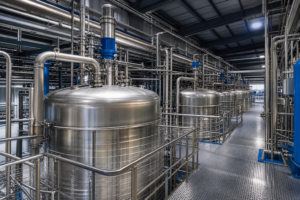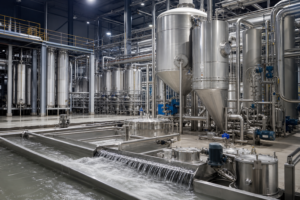
Zinc sulfate is sold in two hydrates with two different markets, and the right crystallization plant makes both in one line. A draft-tube-baffle (DTB) crystallizer running in evaporation mode produces zinc sulfate monohydrate (ZnSO4·H2O) for feed, fertilizer and dry-blend applications; the same vessel switched to cooling mode produces heptahydrate (ZnSO4·7H2O) for water-soluble fertilizer, electroplating and water treatment. Behind the crystallizer, an integrated train of automatic-discharge centrifuge, fluidized-bed dryer and packing machine – all under PLC control – turns liquor into bagged product continuously. This page explains the hydrate choice, why DTB geometry dominates zinc sulfate duty, how the energy side is configured, and what an integrated reference design looks like. Specifications quoted here form an illustrative envelope from published industry practice, not a project datasheet.
Two Products, One Plant: Monohydrate versus Heptahydrate
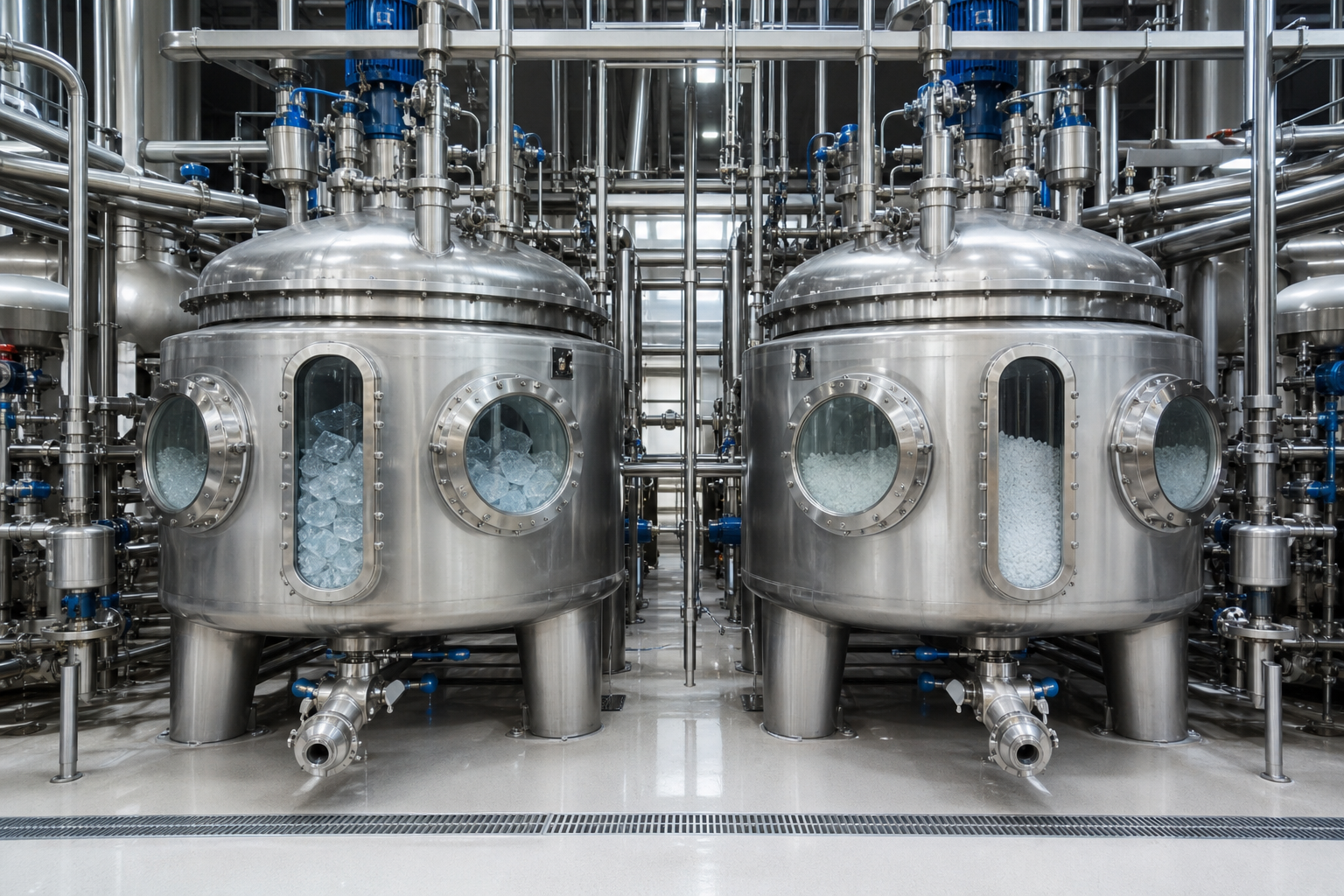
The commercial distinction between the two hydrates is not cosmetic – it dictates the crystallization mode, the energy demand, and even the storage behavior of the finished product:
| Aspect | Monohydrate (ZnSO4·H2O) | Heptahydrate (ZnSO4·7H2O) |
|---|---|---|
| Crystallization mode | Evaporation crystallization (water driven off to reach supersaturation) | Cooling crystallization (solubility falls as liquor cools) |
| Energy emphasis | Latent heat of evaporation – multi-effect or MVR supply | Heat removal – chilling duty rather than vaporization |
| Typical markets | Feed premixes, dry-blend fertilizers, compound zinc chemicals | Water-soluble fertilizers, electroplating baths, water treatment |
| Handling character | Low water of crystallization, better storage stability | Higher water content; caking control matters |
| Switch requirement | One DTB crystallizer covers both modes by switching operating recipe – no additional vessel required | |
That last row is the commercially decisive one. Feed-grade and fertilizer-grade demand move independently through the year, and producers who must answer both markets value a crystallizer that follows the order book instead of standing idle.
Why a DTB Crystallizer for Zinc Sulfate
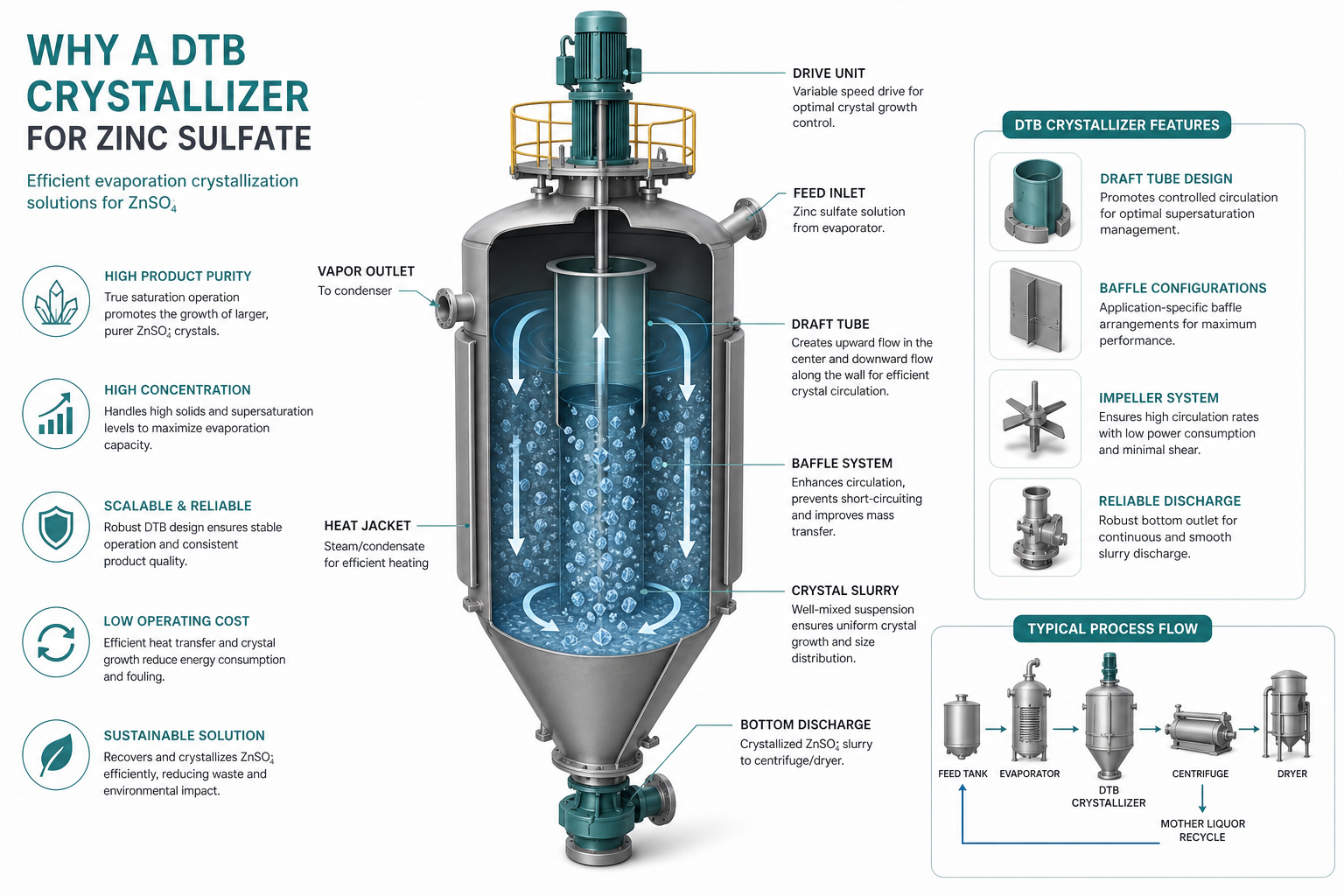
The draft-tube-baffle design occupies the middle ground of crystal-size engineering: coarser and more uniform than simple forced-circulation vessels, more compact and less capital-hungry than Oslo fluidized-bed units. In zinc sulfate service it delivers five concrete advantages:
- High purity and uniform crystal size. The internal classification zone holds fine crystals back for further growth while coarse product discharges, giving a narrow size distribution and consistent assay from lot to lot.
- Efficient cooling crystallization. For heptahydrate mode, the DTB’s controlled cooling profile converts heat removal into crystal growth rather than a shower of fines.
- Reduced scaling and maintenance. The internal flow pattern keeps supersaturation off the heat-exchange surfaces, extending runs between cleanings and cutting maintenance cost.
- Continuous automated operation. Under PLC control the vessel runs continuously with minimal operator intervention, which is what makes the product switch a recipe change rather than a rebuild.
- Gentle hydraulics protect the crystal. The draft tube’s low-shear circulation prevents excessive nucleation and crystal breakage, so the product you grew is the product you bag – not a fines fraction that dusts and cakes.
The Reference Integrated Design: 720 L/h, Dual-Product
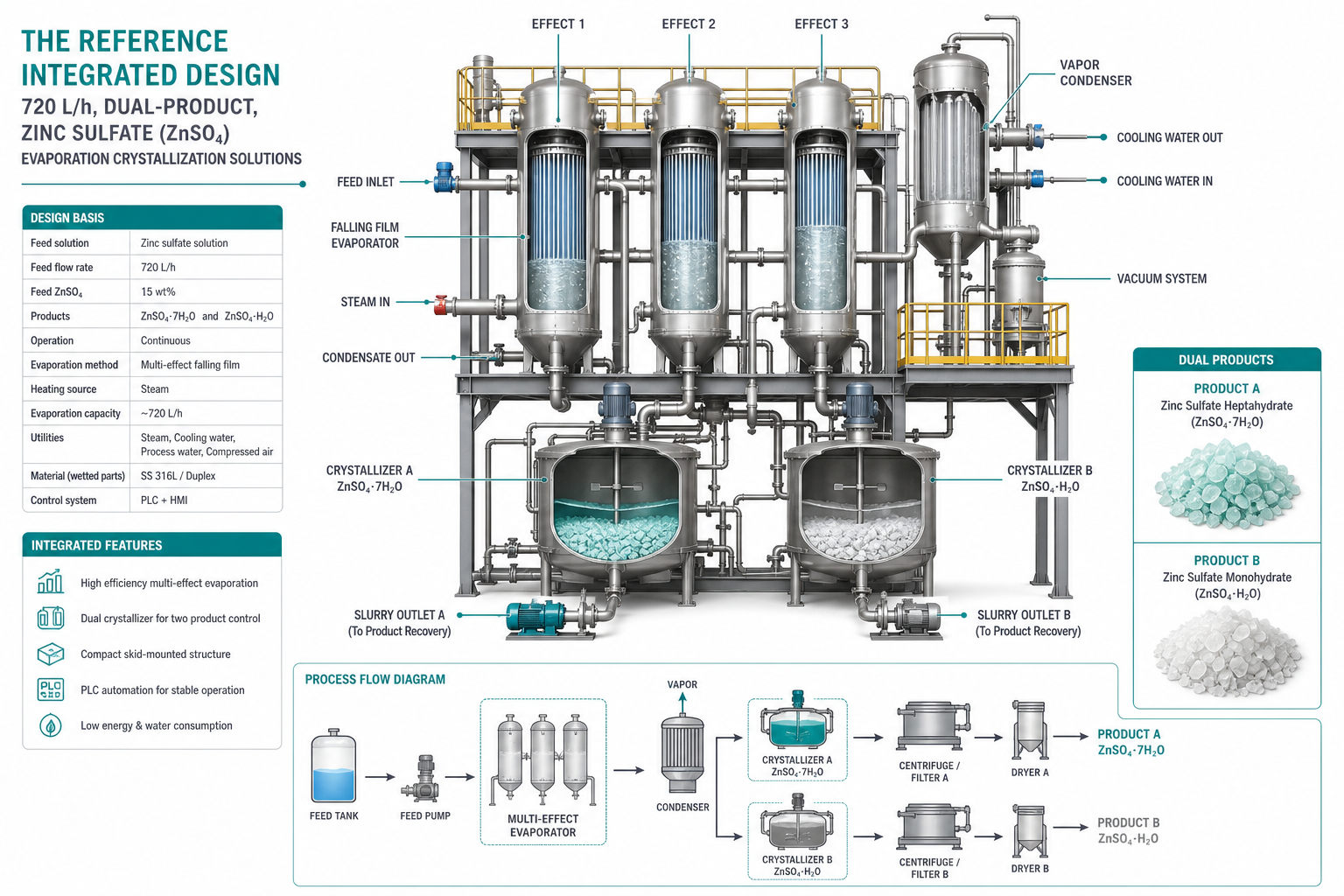
A vendor-published reference design for zinc sulfate duty shows the arrangement in concrete terms — an external industry reference, not an EvapCryst delivery, and indicative rather than a project guarantee. The DTB crystallizer is fed at a published reference rate of 720 liters per hour. When the campaign target is monohydrate, the system operates in evaporation-crystallization mode – energy supplied by the evaporation section, water driven off until the monohydrate crystallizes. When the campaign switches to heptahydrate, the same vessel shifts to cooling-crystallization mode. No additional crystallizer is purchased; the change is one of operating conditions under the same head and body.
The complete system downstream is equally integrated:
- Automatic-discharge centrifuge for continuous crystal dewatering
- Fluidized-bed dryer for uniform, gentle drying to product moisture
- Packing machine closing the line into bagged product
- PLC control across the whole train for continuous production
- SS316L construction throughout, appropriate for sulfate media and standard for agrochemical-grade product contact
The value of this integration is operational: one control system, one operating team, and a single quality chain from liquor to bag. Drying and packing integration is covered in more depth on our drying and packing capability page.
Supplying the Energy: Triple-Effect or MVR
Whichever hydrate is in production, the evaporation side needs a heat strategy, and there are two proven options.
Triple-effect forced circulation
A triple-effect forced-circulation system reuses vapor across three stages in cascade: the first effect is heated by live steam, and each subsequent effect is heated by the previous effect’s vapor. Reusing vapor across three stages reduces steam consumption by an industry-reported up to 70% compared with single-effect operation. Forced circulation inside each effect keeps high velocities over the heat-transfer surfaces, preventing scaling and sustaining heat-transfer coefficients on concentrating sulfate liquor. This is the classical configuration where the site has reliable boiler capacity.
MVR
Mechanical vapor recompression replaces the boiler with a compressor: secondary vapor is recompressed and returned as heating steam, and the plant’s ongoing energy input becomes electricity. For high-utilization plants the MVR route usually wins on operating cost, and it eliminates the boiler dependency entirely. The trade-off and selection logic between the two are developed in our MVR technology overview.
One materials note carries over from project experience: when the sulfate liquor is accompanied by a high chloride load – as in fertilizer-plant ammonium chloride wastewater co-processing, or ammonium zinc sulfate production – the chloride side dictates materials, and titanium is selected for the chloride-contacting sections. Sulfate-only duty stays in stainless; chloride-bearing duty does not.
At procurement level the integrated train resolves into four core modules:
| Module | Candidate Equipment Types | Selection Rationale | Indicative Operating Envelope |
|---|---|---|---|
| Evaporation concentration | Triple-effect forced-circulation or MVR train | Steam economics versus electricity decides the drive | Sulfate liquor to crystallizer feed concentration |
| DTB crystallization | Draft-tube-baffle body, dual-recipe | Classified growth; switches monohydrate and heptahydrate modes | Evaporation mode or cooling mode under one head |
| Dewatering | Automatic-discharge centrifuge | Continuous dewatering protects dryer duty | Wet crystal with mother liquor returned |
| Drying and packing | Fluidized-bed dryer; packing machine | Gentle uniform drying; single PLC chain to bag | Product moisture to specification, bagged |
Configuration, materials, and ranges depend on actual feed, corrosion review, fouling behavior, utilities, and project capacity.
Process Flow Beyond the Evaporator
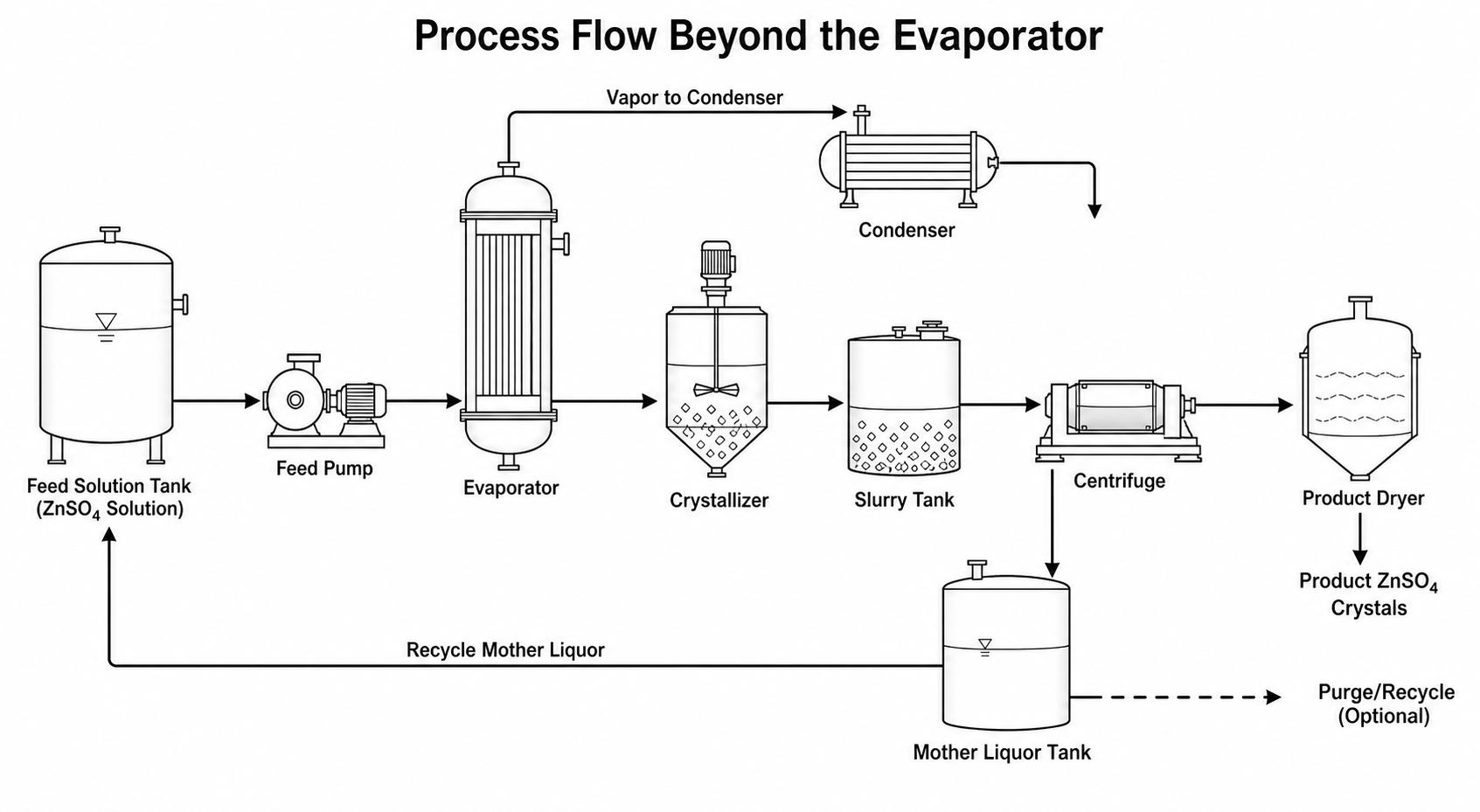
A full triple-effect reference flowsheet for ammonium zinc sulfate and ammonium potassium sulfate production illustrates the standard sequence: feed enters a triple-effect co-current forced-circulation evaporation system; the concentrated liquor passes to a thickener for further densification; the thickened slurry proceeds to a DTB crystallizer for crystal formation; and the crystallized material is conveyed to drying and packaging. Equipment selection across that sequence is governed by five factors – the characteristics of the liquor, the processing capacity, the client’s technical objectives, the investment budget, and the operational costs – and a serious proposal should show how each factor moved the design.
Ammonium zinc sulfate and ammonium potassium sulfate themselves are adjacent products on the same architecture: micronutrient and specialty-fertilizer salts produced by the same forced-circulation evaporation plus DTB crystallization logic, with co-current triple-effect supply where steam economics favor it.
Where Zinc Sulfate Sits in the Sulfate Family
Zinc sulfate is the zinc member of a family of evaporation-crystallization duties that share architecture but differ in solubility personality and impurity management. Producers and EPC buyers usually specify one member and extend to others within a year or two:
- Copper sulfate solutions – pentahydrate production and etch-solution copper recovery
- Manganese sulfate solutions – inverse-solubility design for feed and battery-material chains
- Mixed ammonium-potassium and ammonium-zinc sulfate fertilizers – multi-salt duties where fractional crystallization governs product split
Where several salts must leave a wastewater circuit as separate products, the same plant logic extends into salt separation and fractional crystallization and full zero liquid discharge trains.
Mother Liquor and Yield Management
Between crystallization campaigns, the mother liquor is where both the yield and the impurity story plays out. After centrifuging, the filtrate still carries zinc values, so it returns to the crystallizer feed rather than leaving the plant; steady-state purge is set to balance impurity accumulation against zinc loss. In fertilizer-grade duty the purge can often be worked back into a downstream salt product; in battery and feed chains, where iron, cadmium and lead limits bite, the purge is smaller and more closely monitored. A well-engineered zinc sulfate design states explicitly how mother liquor is recirculated, how the purge is sized, and what happens to it – because a crystallizer that ignores mother-liquor management quietly converts yield into effluent.
Specification Checklist for a Zinc Sulfate Plant
When comparing proposals for a zinc sulfate crystallization line, six questions separate engineered systems from catalogue equipment:
- Which hydrate(s) are in the sales plan, and does the proposed crystallizer switch between them by recipe rather than by rebuild?
- Is the crystallizer geometry matched to the target crystal size – DTB for medium, uniform product; Oslo where coarse crystal commands a premium?
- What energy supply fits the site: boiler steam for triple-effect, or electricity for MVR?
- Does the quote include the full train – thickening, centrifuge, dryer, packing – or stop at the crystallizer nozzles?
- What materials zoning is proposed, and is titanium included where chlorides are present?
- What is the automation scope: continuous PLC operation, recipe management, and remote monitoring?
When This Route May Not Fit
Zinc sulfate crystallization earns its keep only against a real product market. A site producing liquor as waste, with no feed, fertilizer, or plating outlet for either hydrate, should treat the stream rather than crystallize it — selling zinc chemicals is a market position, not a wastewater decision. The dual-product DTB logic also loses value where the order book is mono-hydrate only: a simpler evaporation crystallizer will do, and paying for switchability that never switches is capital misallocation. Very small campaign duties favor batch equipment over a continuous integrated train, and sites without steady liquor flow starve the centrifuge and dryer that assume it. And where the liquor carries heavy chloride or heavy-metal loads beyond what zoning and purge can manage, the honest flowsheet is impurity removal first, crystallization second.
What Must Be Verified
Before a zinc sulfate line is committed, the following must be verified against site data rather than the illustrative envelope above. A full liquor analysis — zinc strength, free acid, chloride, and iron, cadmium, lead where feed or food grades are targeted — because impurity ceilings set both the purge ratio and the alloy plan. Solubility and viscosity behavior at the intended endpoint of each hydrate mode, since the DTB recipe depends on them. The chloride question answered definitively, because it decides stainless versus titanium zoning. A confirmed market specification for each hydrate in the sales plan, including caking and moisture limits for heptahydrate storage. And a utilities review fixing triple-effect steam against MVR electricity before the energy system is frozen into the layout.
Frequently Asked Questions
Can one crystallizer really produce both zinc sulfate monohydrate and heptahydrate?
Yes. A DTB crystallizer switches between evaporation-crystallization mode (monohydrate) and cooling-crystallization mode (heptahydrate) by changing operating conditions – no additional equipment is needed. Vendor-published reference designs run this dual-product duty at feed rates such as 720 L/h with PLC-managed changeovers.
Which is more energy-intensive: monohydrate or heptahydrate production?
Monohydrate, because water must be evaporated to reach supersaturation. Heptahydrate crystallizes on cooling, so its energy cost is heat removal rather than vaporization – often the cheaper mode when chilled water or ambient heat rejection is available.
How much steam does triple-effect evaporation save?
Reusing vapor across three stages cuts steam consumption by an industry-reported up to 70% versus single-effect operation. MVR goes further by replacing live steam with recompressed vapor and electricity.
What construction materials are standard?
SS316L for sulfate-only duty, including all product-contact parts in the reference integrated design. Where the liquor carries significant chloride – ammonium chloride wastewater, chloride etchants – titanium sections are specified.
Is the dryer part of the crystallizer supply?
In an integrated line, yes: an automatic-discharge centrifuge, fluidized-bed dryer and packing machine complete the train under one PLC. Buying them as one package avoids the interface gaps – moisture carryover, dusting, mismatched throughput – that appear when the crystallizer and dryer come from separate suppliers.
The essence of a good zinc sulfate plant is architectural: one DTB crystallizer covering both hydrate markets, an energy supply chosen honestly between steam and electricity, materials zoned to the chloride reality of the feed, and a single PLC chain running from liquor to packed product. Specified that way, the line follows the order book instead of fighting it – and the same architecture extends naturally across the sulfate family as the product portfolio grows.
Next step: send your liquor analysis, target hydrates, and capacity, and receive a first-pass screening of the process direction and boundary conditions — inputs exchanged for engineering direction.