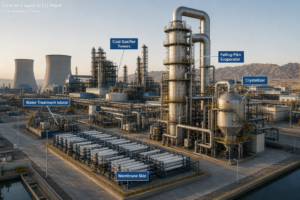
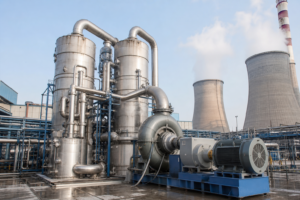
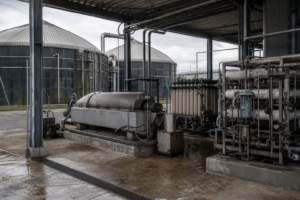
Ammonium chloride (NH₄Cl) recovery by MVR evaporation crystallization is a corrosivity-first engineering problem: the salt sells as fertilizer and chemical feedstock, but its solutions are aggressively corrosive toward ordinary stainless steel, and the drying stage emits ammonia if mishandled. The proven configuration for waste-liquid duty is an MVR forced-circulation evaporator paired with a cooling crystallizer, which runs at low temperature, needs no live steam in steady state, and closes the loop to zero wastewater discharge. On the drying side, steam rotary dryers have displaced fluid beds in the largest installations — an external industry reference: published reporting describes the first domestic 300,000 t/y rotary unit delivered to a Jiangsu soda plant, with savings of roughly $15.57 per ton of product and an order-of-magnitude cut in free-ammonia emissions, supplier-reported figures that are indicative – not a project guarantee. This article walks through the full NH₄Cl train: sources, materials of construction, evaporation-crystallization design, scaling management, and the dryer choice that decides the plant’s economics.
Where Ammonium Chloride Streams Come From
Three feed classes dominate:
- Soda ash coupling (Hou process) — the coupled production of soda ash and ammonium chloride generates NH₄Cl mother liquor as an intrinsic part of the flowsheet; the salt is a co-product, not a waste, and tonnages reach hundreds of thousands of tons per year per site.
- Rare-earth separation wastewater — rare-earth refining uses ammonium chloride (and ammonium sulfate/nitrate) in extraction and precipitation circuits, leaving liquors where NH₄Cl is the recoverable value and the environmental liability at once.
- General chemical and metallurgical effluents — dye, pharma, and metal-processing streams rich in ammonium chloride, frequently mixed with other ammonium salts.
The design consequence is that there is no universal flowsheet: equipment selection has to be made by analyzing the specific origin of the ammonium chloride and its impurity load — chlor-alkali traces, heavy metals, organics — because impurity chemistry drives both crystallizer selection and materials of construction. Mixed ammonium salt streams that need splitting into individual products follow the fractional-crystallization logic on our salt separation technology page.
Corrosion Sets the Materials Budget
Ammonium chloride solutions are among the more corrosive common salt liquors: they are acidic in service, chloride-rich, and corrosive toward the evaporator’s wetted surfaces. Two practical rules follow. First, materials selection is a first-line design decision, not a procurement detail — standard austenitic stainless is often insufficient over a plant’s design life for hot concentrated NH₄Cl, and duplex alloys and titanium enter the specification for heating surfaces, vapor bodies, and pumps. Second, low-temperature operation is not only an energy choice but a corrosion mitigation: every 10–20 °C reduction in process temperature meaningfully slows chloride attack, which is one reason vacuum-driven low-temperature evaporation is preferred for this salt.
The MVR Train: Forced Circulation Evaporator Plus Cooling Crystallizer
The recommended architecture for ammonium chloride waste liquid is a two-stage train: an MVR forced-circulation evaporator concentrates the liquor, and a cooling crystallizer precipitates the salt from the hot concentrate, exploiting NH₄Cl’s steep solubility-temperature curve (solubility roughly doubles between ambient and boiling). Forced circulation is the right evaporator type here because it suppresses wall boiling — slurry flows through the tubes at high velocity under sufficient static head, so nucleation and crystal growth happen in the bulk liquid rather than on the heat-transfer surface, protecting both heat transfer and crystal quality.
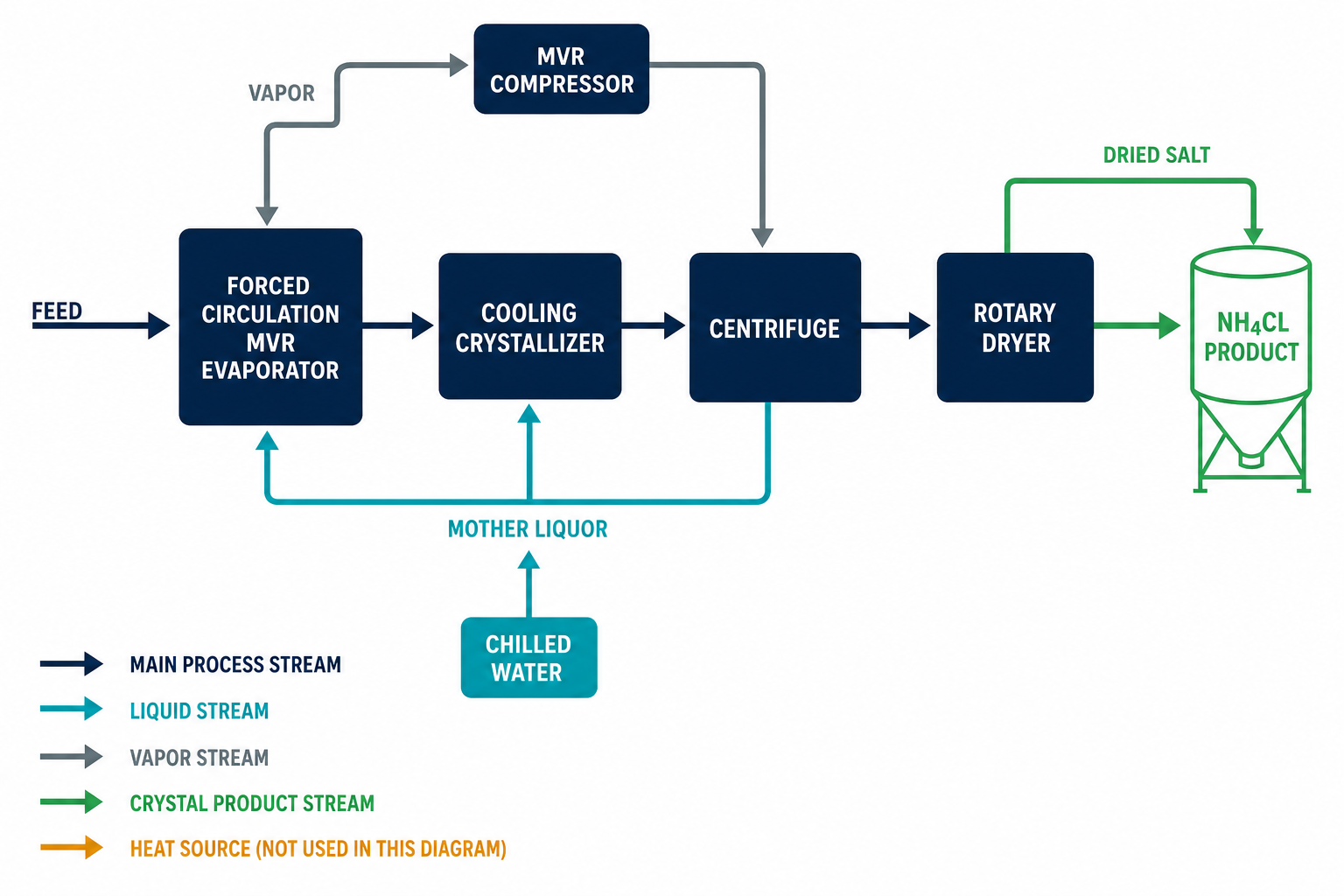
A complete system comprises eight functional blocks, each with NH₄Cl-specific requirements:
| Process module | Function and NH₄Cl-specific notes |
|---|---|
| Preheater | Brings feed to near-boiling before the evaporator, recovering heat from condensate and product streams |
| Forced-circulation evaporator | Concentrates the liquor under vacuum; type selected for corrosive, crystallizing service |
| Vapor-liquid separator | Centrifugal, gravity, or special-design variants matched to entrainment behavior |
| MVR compressor | Raises secondary-vapor enthalpy to serve as the heating source; multi-stage compressors in series where higher pressure lift is required |
| Cooling crystallizer | Recovers NH₄Cl from hot concentrate on the solubility slope; crystal size controlled by circulation and seeding |
| Vacuum system | Holds system vacuum, removes non-condensables, maintains stable evaporation |
| Control system | PLC automation of feed/discharge, speed, valves, temperature and pressure; automatic alarms and protection sequences |
| Cleaning system (CIP) | In-situ chemical cleaning or dismantled cleaning — more than 99% of scaling is removed by chemical solvent addition |
Indicative envelopes above are qualitative only; configuration, materials, and operating ranges for each module depend on the actual feed, temperature, pressure, corrosion review, fouling behavior, utilities, and project capacity.
The operating profile this configuration delivers, per system supplier documentation: no steam consumption in steady state, no cooling-water requirement for the evaporation circuit (the MVR loop recycles its heat rather than rejecting it), low-temperature evaporation gentle enough for heat-sensitive loads, large concentration ratio with short residence time, compact footprint, and continuous feed/discharge under PLC control with reduced operator attention. The underlying MVR cycle — compressor selection, compression ratio, and thermal economy — is covered in the MVR evaporation technology overview.
Scaling Management: Design for Cleaning, Not Against It
Any solution will scale an evaporator given operating time; the design question is how the scale comes off. For NH₄Cl systems the standard answer is chemical: more than 99% of deposits are removed by adding cleaning solvents to the circuit, executed either as clean-in-place (circulating solvent through the same loops) or by dismantling the affected sections during planned outages. The planning discipline that matters is frequency: scale growth is gradual, heat-transfer coefficients decay slowly, and plants that wait for throughput to fall before cleaning pay for it in longer cleaning campaigns and harder deposits than plants that clean on a fixed schedule tied to measured heat-transfer degradation. Mother-liquor purge management matters equally — impurities that are not purged accumulate until they contaminate the crystal product.
Crystal Size Control in the Cooling Crystallizer
Because NH₄Cl crystallizes on a steep solubility curve, the cooling crystallizer’s controllable variables map directly onto product quality. The four that matter in practice:
- Cooling rate — the supersaturation generator. Fast cooling produces fines; slow, staged cooling grows the existing population. Multi-stage crystallizers in series (each stage with its own condenser and pumps, as used in large-particle ammonium sulfate service) stage the supersaturation so the crystal population never sees a nucleation spike.
- Slurry density and residence time — held by classified-product removal and circulation rate; stable density keeps growth rate and attrition in balance.
- Seeding — deliberate seed addition at start-up and after CIP campaigns prevents the induction period that otherwise ends in an uncontrolled nucleation event.
- Agitation and circulation velocity — enough to keep crystals suspended and heat evenly distributed, not so much that attrition regenerates fines; the same constraint that governs forced-circulation evaporator design applies to the crystallizer body.
Why crystal size is worth the control effort shows up in every downstream step: coarser crystals centrifuge drier, flow without caking, dry more uniformly, and — as the rotary-dryer comparisons below make explicit — keep the drying workshop cleaner because they generate less dust and less ammonia carryover. Fertilizer and industrial buyers alike specify particle-size distribution, and the specification is won or lost in the crystallizer, not in the solids-handling building.
Drying: Steam Rotary Versus Fluid Bed
Centrifuged ammonium chloride still carries surface moisture, and how it is dried shapes both operating cost and the workshop environment. The industry’s reference case for scale, cited as an external industry reference from published vendor reporting rather than EvapCryst delivery experience: in the soda-ash sector, the first domestic 300,000 t/y new-generation NH₄Cl rotary drying unit was delivered to a Jiangsu soda plant — drying is where the tonnage is. Steam rotary drying technology, measured against the traditional fluid-bed approach, documents six advantages:
- Energy saving — product cost reduced by $15.57 per ton (benchmarked at steam $130/t, electricity $0.5/kWh).
- Emissions — tail-gas volume reduced by an order of magnitude; free-ammonia emission reduced by 14.4 t/a (calculated at 50 mg/m³ free ammonia in dry tail gas); lower water consumption for dust removal.
- Operating environment — negative-pressure operation with less ammonia smell and a cleaner drying workshop; no high-power fans, so less on-site noise.
- Stability — no need for block-discharge devices; no fluid-bed clogging; higher automation level.
- Flexibility — unit energy consumption essentially unchanged across different load rates, which matters for plants whose crystallizer output follows mother-liquor availability.
- Maintenance — detachable structure convenient for overhaul.
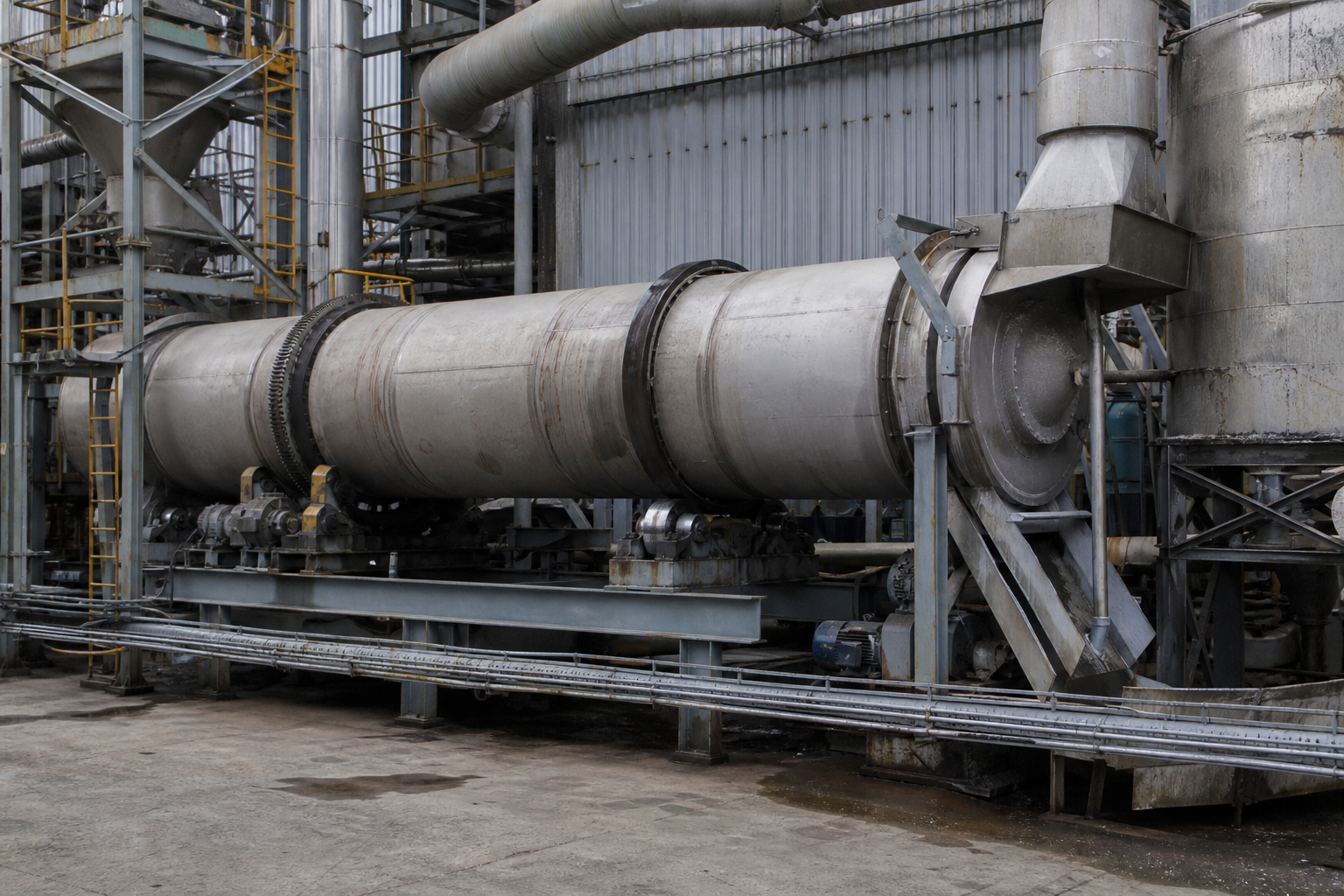
The ammonia point deserves emphasis: ammonium chloride is thermally sensitive — overheat it and it releases ammonia gas, which is simultaneously a product loss, an odor problem, and a regulated emission. Dryer selection and temperature control therefore sit on the product-quality axis as much as the utility axis; the trade space between rotary, fluid-bed, and other dryer families is laid out on the drying and packing technology page.
Where the Salt Goes: Product and Compliance
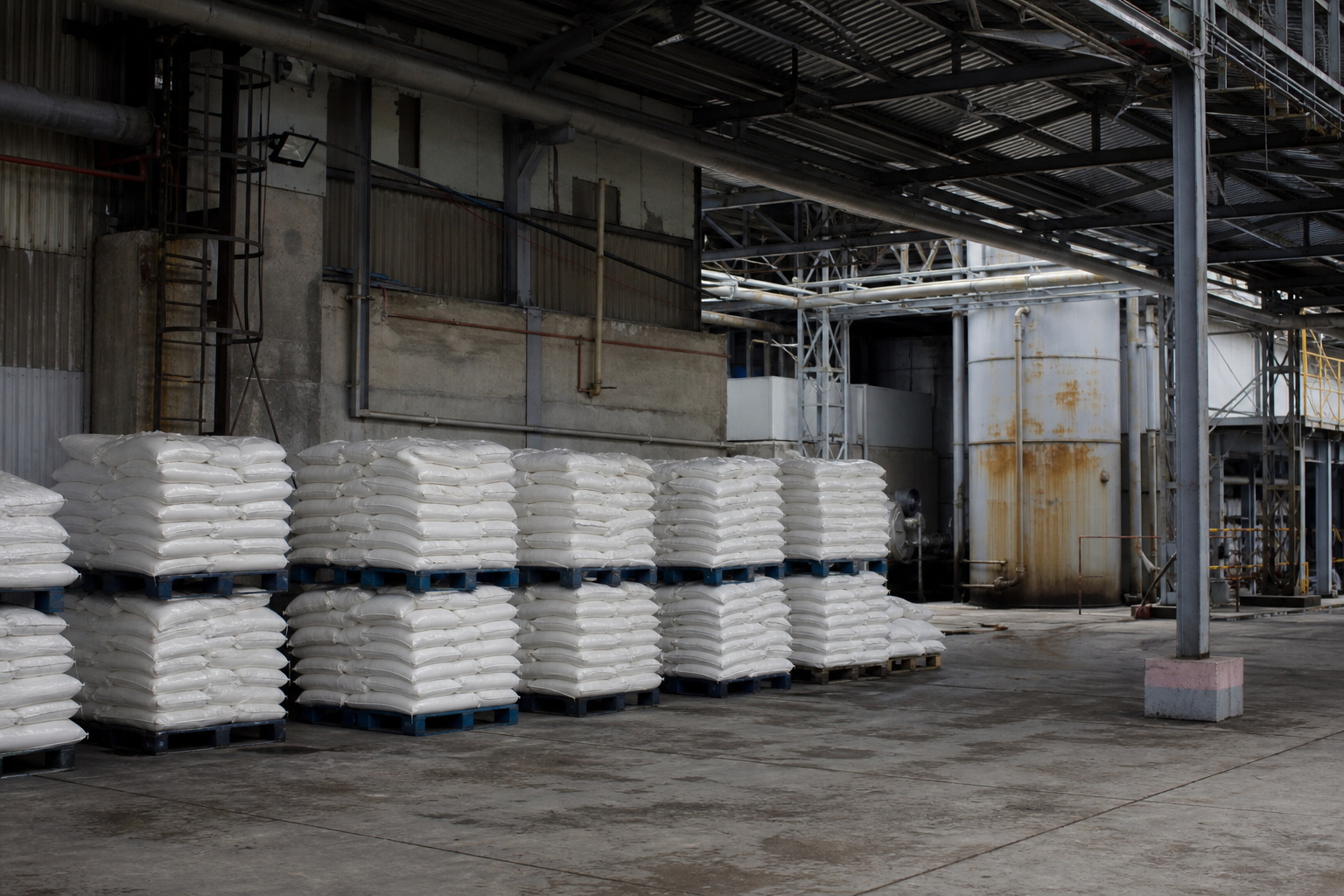
Recovered NH₄Cl has two established outlets: agricultural-grade fertilizer (directly or blended) and industrial-grade sales into electroplating, battery electrolyte, and chemical synthesis markets that pay for purity. On the compliance side, the MVR crystallization train is the closing step that makes zero wastewater discharge achievable for NH₄Cl-bearing effluents — condensate returns as process water, and the salt leaves as product rather than brine. In rare-earth regions where effluent ammonium loads have become the binding environmental constraint, salt recovery is shifting from cost center to license-to-operate. The position of the crystallization island within a full zero-liquid-discharge train is diagrammed on the ZLD solutions page.
Related Salt Recovery Lines
The sibling ammonium salt is covered separately: ammonium sulfate evaporation crystallization and wastewater recovery shares the corrosivity-first design logic but differs in crystallization route (cooling-driven large-particle production is more developed for the sulfate). For the neutral chloride counterpart, see sodium chloride MVR production.
When This Route May Not Fit
Where electricity is expensive and cheap live steam is already on site, the MVR advantage narrows to nothing and a steam-driven multi-effect train is the honest recommendation. Very small NH₄Cl streams – a few cubic meters per day – do not clear the capital threshold of a corrosion-rated train and are better outsourced. Streams whose ammonium value is split across several salts need the fractional-crystallization logic of salt separation rather than a single-salt recovery line. Heavy organic loading changes the duty fundamentally: condensate quality, foaming, and crystal contamination then set the design, and a biological or oxidation pretreatment step must come first. And where the recovered salt has no market within economic hauling distance, recovery for disposal alone rarely pays.
What Must Be Verified
Four inputs gate this route before any commitment. First, a full liquor analysis: NH₄Cl concentration, companion ammonium salts, heavy metals, organics, and pH, because impurity chemistry drives crystallizer selection and the mother-liquor purge rate. Second, corrosion data at the actual temperature band – supplier alloy curves or coupon tests – since the materials budget can swing the capital estimate widely. Third, the target crystal size distribution and salt grade the market will pay for, which fixes crystallizer staging and the dryer choice. Fourth, the site energy pair and its annual hours, plus the condensate-reuse specification and the ammonia emission limit the permit imposes. A bench concentration-and-crystallization test on the real liquor confirms cleaning intervals and crystal quality before the capital is committed.
FAQ
What is the best evaporator configuration for ammonium chloride waste liquid?
An MVR forced-circulation evaporator followed by a cooling crystallizer is the recommended configuration — low-temperature, steam-free in steady state, and able to close the loop to zero wastewater discharge, with the exact flowsheet set by the NH₄Cl source and impurity load.
Why is ammonium chloride equipment more expensive in materials?
NH₄Cl solutions are acidic and chloride-rich, making them strongly corrosive toward ordinary stainless steel. Hot concentrated service typically requires upgraded alloys (duplex, titanium) for heating surfaces, vapor bodies, and pumps; low-temperature vacuum operation slows the attack.
How is scaling handled in NH₄Cl evaporators?
Chemically — more than 99% of scale is removed by adding cleaning solvents, applied as in-situ CIP circulation or dismantled cleaning. The operational discipline is fixed-schedule cleaning triggered by heat-transfer decay, plus mother-liquor purge to stop impurity build-up.
Steam rotary or fluid-bed dryer for ammonium chloride?
Steam rotary drying is documented to cut product cost by about $15.57/t versus fluid bed, reduce tail gas by an order of magnitude and free-ammonia emission by 14.4 t/a, run under negative pressure with less ammonia odor, avoid fluid-bed clogging, hold unit energy consumption across loads, and ease maintenance through detachable construction.
Can recovered ammonium chloride be sold?
Yes — into agricultural fertilizer markets and industrial applications such as electroplating, batteries, and chemical synthesis, with price tied to achieved purity. In soda-ash coupling it is a designed co-product at up to 300,000 t/y scale per train.
To screen this route for a specific stream, share the feed analysis with NH₄Cl concentration and impurity load, the site energy prices, and the target salt grade – enough for an initial process-direction assessment.