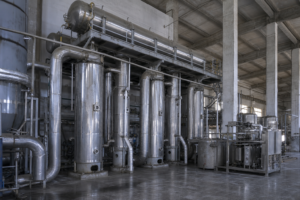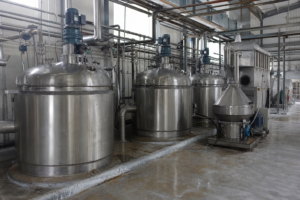
Vanillin production lives or dies on two downstream operations: concentration of the reaction liquor and drying of the wet crystalline product. Because vanillin melts at 81-83°C, oxidizes and discolors on overheating, and evolves flammable solvent vapor and combustible dust during drying, the evaporation-crystallization-drying train must be engineered as one integrated system – typically with low-temperature vacuum or falling-film concentration, controlled cooling crystallization, and a closed-loop nitrogen drying circuit that recovers solvent instead of venting it. Industry-reported estimates put the cost of treating these units as isolated equipment purchases at 2-5% of product value lost to sublimation loss, off-color lots, and solvent emissions.
Where Concentration and Drying Sit in the Vanillin Process

Vanillin (4-hydroxy-3-methoxybenzaldehyde) is produced commercially through the guaiacol-formaldehyde route (glyoxylic acid condensation and oxidation) in most large plants, with lignin-derived and bio-based ferulic acid routes growing at smaller scale. Every route ends with the same problem: a dilute liquor containing crude vanillin, dissolved salts or caustic residues, and solvent (methanol, water, or aromatics depending on the purification scheme) that must be concentrated, crystallized, and dried to meet food- and pharma-grade specifications.
The downstream train below is presented as an illustrative envelope for screening – assembled from published vanillin process practice and the vendor-published case cited on this page, not from customer or project data. Feed composition, solvent system and cake moisture must be confirmed for the specific line before equipment selection:
| Process Module | Candidate Equipment Types | Selection Basis | Module Function |
|---|---|---|---|
| Reaction liquor clarification | Filter, decanter, acidification stage | Solids and catalyst residue load in the liquor | Removes catalyst residues, salts and tars; protects the evaporator (indicative target: suspended solids below ~50 ppm) |
| Solvent stripping & concentration | Falling-film evaporator or vacuum forced-circulation unit | Solvent recovery value, thermal sensitivity of the liquor | Recovers methanol/solvent and drives liquor toward supersaturation (indicative product-side envelope: ~55-75°C under vacuum) |
| Crystallization | Cooled agitated crystallizer | Crystal size and color-rejection specification | Forms uniform crystals and rejects colored impurities (indicative cooling envelope: ~70-80°C down to 20-30°C) |
| Solid-liquid separation | Centrifuge or basket filter | Cake moisture consistency, throughput | Deliquors crystals (indicative wet-cake moisture envelope: 5-15%) |
| Drying | Closed-loop nitrogen fluid bed dryer | ATEX duty, solvent-wet cake, melting-point margin | Delivers final moisture below ~0.5% while preserving whiteness; oxygen held below ~8 vol% (indicative, not a project guarantee) |
| Packaging | Low-humidity bagging with dehumidified air | Hygroscopic, odor-sensitive product handling | Protects product in PE-lined bags under controlled ambient RH |
Configuration, materials and operating ranges above are indicative envelopes and potential considerations; actual selections depend on feed composition, temperature, pressure, corrosion review, fouling behavior, utilities and project capacity.
Why Vanillin Is a Difficult Drying Duty

Three material properties dominate the engineering:
1. A melting point of 81-83°C sits inside the normal drying temperature window
Most organic crystals are dried at temperatures far below their melting points. Vanillin’s melting range of 81-83°C is unusually low for an industrial aroma chemical, and the effective softening point is lower still in the presence of residual moisture. If the wet cake reaches its melting range inside the dryer, particles agglomerate into dense lumps, the bed defluidizes, and the batch is lost to melting and caking. Practical designs therefore keep the solids temperature typically 10-25°C below the melting onset (an indicative margin drawn from published drying practice) – which means inlet gas temperature, residence time, and evaporative cooling must be balanced so the wet-bulb depression does not push the product past its limit.
2. Sublimation and volatility quietly eat yield
Vanillin has an appreciable vapor pressure well below its melting point, and it sublimes measurably in a hot, dry gas stream. In an open drying circuit every gram that sublimes leaves with the exhaust – it is not lost to decomposition, simply carried away. Fine crystals increase the exposed surface area and accelerate this loss. A closed-loop circuit with a condenser in the gas return line captures most of this material, and recovered vanillin-rich condensate can be routed back to the crystallizer feed.
3. Organic dust plus solvent vapor is a genuine explosion hazard
Vanillin dust is a combustible organic powder. Drying immediately after solvent-bearing crystallization means the dryer atmosphere can contain both flammable vapor and ignitable dust – the worst combination for ignition risk assessment. This is precisely why a vendor-published 5,000 TPA vanillin drying system for a Jiangxi producer – an external industry reference, not an EvapCryst delivery – adopted a nitrogen closed-circuit circulation process: operating the dryer under nitrogen with a controlled oxygen ceiling removes the oxidizer leg of the fire triangle, greatly improves system safety, and significantly cuts exhaust emissions compared with an open-loop hot-air design.
Closed-Loop Nitrogen Drying: How the Circuit Works
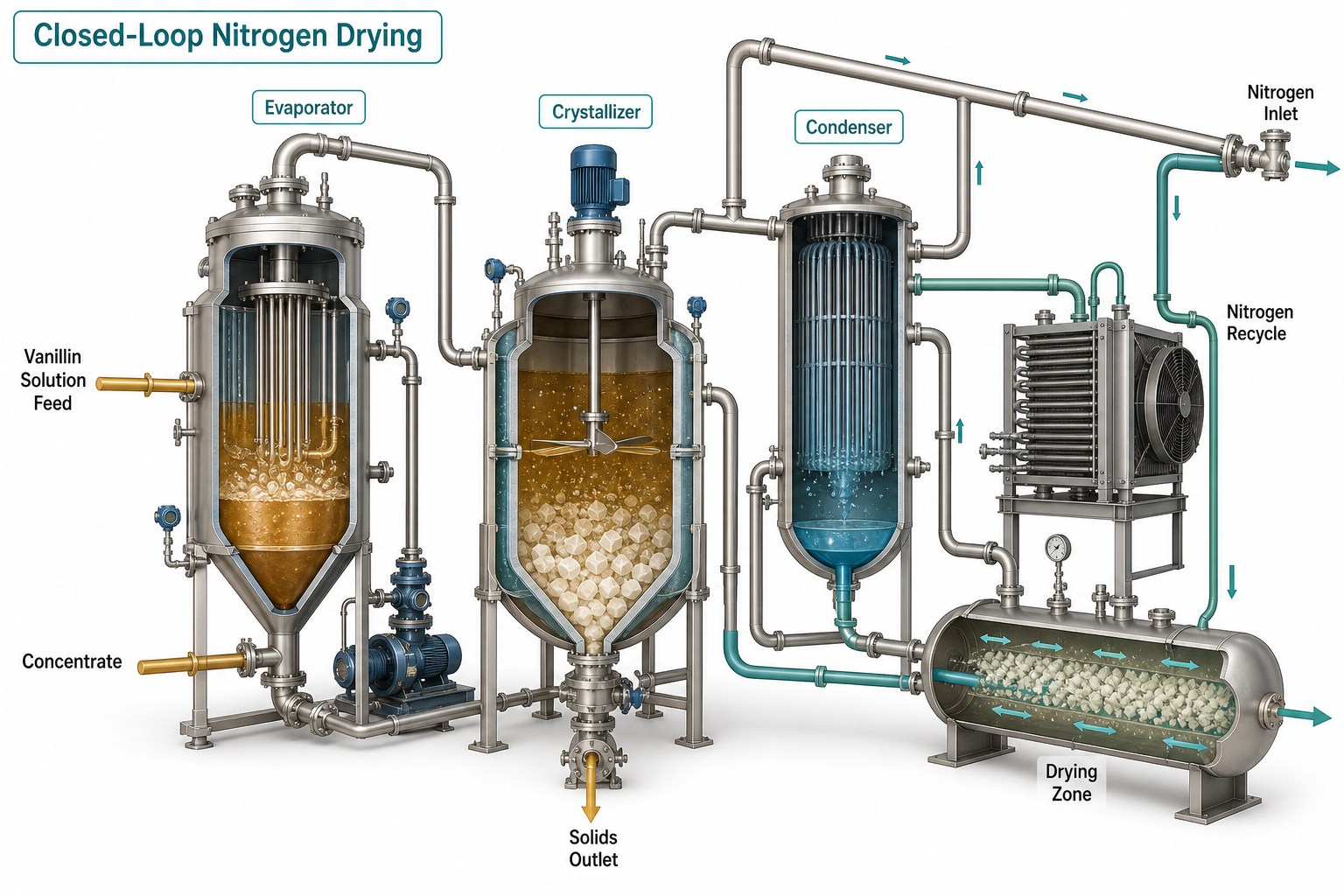
A nitrogen circulation drying system is a gas loop, not a once-through dryer:
- Blower and heater: nitrogen is heated indirectly (no combustion products in the loop) and passes through the fluid bed containing the vanillin wet cake.
- Fluid bed drying: evaporated solvent (and water, if aqueous) transfers to the gas; the solids stay cool through evaporative cooling even with a warm inlet.
- Cyclone and filter: entrained fines are captured and returned to the bed rather than lost to a stack.
- Condenser: solvent and sublimed vanillin condense out of the gas; solvent is collected for distillation and reuse, and vanillin-rich fractions return to the process.
- Gas return and makeup: dehumidified nitrogen re-enters the blower; a small instrument-controlled nitrogen makeup stream compensates for leakage and keeps oxygen below the set ceiling, typically in the low single digits to below 8 vol% depending on the solvent and the hazardous-area study.
The economic logic is straightforward: the nitrogen is recycled, the solvent is recovered rather than emitted, and the recovered solvent re-enters the front of the process. In a 5,000 TPA plant, even small percentage improvements in solvent recovery and product yield compound into significant annual value – which is why supplier-published capability statements from EPC contractors in this industry (indicative, not a project guarantee) describe integrated scopes covering a substantial share of global vanillin capacity.
Choosing the Dryer Configuration
| Option | Best For | Limitations for Vanillin |
|---|---|---|
| Closed-loop nitrogen fluid bed | Solvent-wet cakes, ATEX duties, continuous large-scale lines | Higher capex; requires inert-gas management and leak-tight construction |
| Vacuum paddle/plough dryer (batch) | Small batches, thermally sensitive lots, frequent product changes | Batch logistics; longer cycles; scale-limited beyond mid-size plants |
| Open-loop hot air fluid bed | Aqueous, non-flammable wet cakes at commodity scale | Not suitable with solvent-wet vanillin; sublimation loss; emissions |
| Spray drying | Products sold as powder directly from liquor | Vanillin heat exposure at the droplet stage; melt-stickiness risk near 81-83°C |
For solvent-bearing vanillin cake at industrial scale, the closed-loop fluid bed is the reference solution; vacuum paddle dryers remain common for campaign-based fine-chemical producers running many products on one line.
Concentration and Solvent Recovery Upstream of the Dryer
The dryer is only as stable as the feed it receives. Two upstream measures matter most:
Steady wet-cake moisture. A crystallizer and centrifuge delivering a consistent 8-12% moisture cake let the dryer run at fixed inlet temperature and residence time. Swinging cake moistures force operators to run hot “to be safe,” which is exactly how melting and discoloration incidents start.
Integrated solvent distillation. Methanol recovered in the evaporation and drying steps carries water and trace organics. A small distillation column polishes the recovered methanol back to reaction-grade quality, closing the solvent loop. Combined with MVR or multi-effect evaporation on the concentration step, plants cut the steam demand of the liquor concentration duty substantially – mechanical vapor recompression is particularly attractive where the evaporated solvent is recovered at near-atmospheric condensation temperatures and electricity is cheaper than steam.
Quality and Compliance Checkpoints
- Color (whiteness): oxidation and overheating both drive yellowing; nitrogen atmosphere and temperature ceilings are the primary defenses.
- Moisture: final product typically specified below 0.5% for free moisture.
- Particle size: set mainly by crystallization cooling profile and fines management, not by the dryer.
- Residual solvent: limits in the low hundreds of ppm or tighter depending on food/pharma use, achievable with adequate residence time and purge design.
- Emissions: closed-loop operation reduces VOC exhaust to the purge stream only, simplifying permitting.
Integration Matters More Than Individual Machines
Vanillin projects at the 5,000-10,000 TPA scale are, in industry-reported practice, typically delivered as an integrated concentration-crystallization-drying-packaging package, with the solvent loop, nitrogen loop, and heat recovery designed together. Retrofitting a closed-loop dryer onto an open-loop plant is possible but rarely recovers the full benefit, because the condensate and off-gas handling that make the loop economical must have somewhere useful to go. Buyers evaluating suppliers should therefore ask for the heat and mass balance of the whole train – not just the dryer datasheet – including nitrogen makeup rate, solvent recovery quality, and expected sublimation losses.
Explore our related capabilities: drying and packing systems for closed-loop and inert-gas drying, solvent recovery and distillation for methanol loop closure, and MVR evaporation for low-steam concentration duties. For integrated chemical production scopes, see our POM production integration and dimethyl carbonate production integration overviews, or our zero liquid discharge solutions for the wastewater side of fine-chemical plants.
When This Route May Not Fit

The closed-loop nitrogen route assumes solvent-wet cake, continuous scale, and product sold as crystalline material. It may not fit when: production is campaign-based fine-chemical manufacturing with many small-lot products, where a batch vacuum paddle or plough dryer is simpler and more flexible; the cake is genuinely aqueous and non-flammable, making an open-loop hot-air dryer the cheaper adequate choice; the product is deliberately sold as powder direct from liquor, pointing to spray drying despite the thermal-exposure trade-offs; or the existing plant lacks distillation capacity and condensate routing, so a closed-loop retrofit cannot monetize its recovered streams. In such cases the added capex of inert-gas circulation buys safety margin it cannot fully amortize.
What Must Be Verified
Before committing to this train, verify against your own case: dust explosion characteristics of your vanillin fraction (Kst, MIE, Pmax) and the solvent system’s limiting oxygen concentration, which set the nitrogen ceiling and ATEX zoning; measured melting and softening behavior of the actual wet cake, not literature values alone; wet-cake moisture and its swing from the existing centrifuge, because dryer stability depends on it; residual-solvent specification for the target food or pharma market; nitrogen supply, utility capacity and leak-tightness feasibility at the installation site; and a heat-and-mass balance across the whole train, including expected sublimation losses. The vendor-published case cited on this page is an external industry reference – indicative, not a project guarantee.
Frequently Asked Questions
Why is nitrogen used to dry vanillin instead of hot air?
Vanillin wet cake carries flammable solvent, and vanillin dust itself is combustible. An oxygen-lean nitrogen loop removes the oxidizer from the fire triangle while also allowing solvent recovery; an open hot-air circuit would vent solvent vapor and lose sublimed product. A vendor-published 5,000 TPA system in China (external industry reference, not an EvapCryst delivery) demonstrated that this approach greatly improves safety and significantly reduces exhaust emissions.
What temperature should vanillin be dried at?
Because vanillin melts at 81-83°C, the solids temperature should stay typically 10-25°C below that range – in practice a bed temperature of roughly 55-70°C, with the exact figure set by cake moisture, residence time, and the allowable residual solvent. Inlet gas can be warmer because evaporative cooling protects the wet particles, but the margin must be engineered, not assumed.
How is solvent recovered from the drying step?
The nitrogen leaving the fluid bed passes through a cyclone and filter for fines, then a condenser that knocks out solvent and sublimed vanillin. The recovered solvent is collected for re-distillation to reaction grade, and vanillin-rich condensate is returned to the crystallizer feed. Only a small nitrogen purge leaves the system.
Can an existing open-loop dryer be converted to closed-loop?
Partially. Sealing the machine, adding a blower-loop and condenser, and nitrogen purging are routine modifications, but the full economics depend on having distillation capacity to reuse the recovered solvent and condensate routing to absorb the captured product. A feasibility study on the heat and mass balance should precede any commitment.
What causes yellow or off-color vanillin after drying?
The usual causes are excessive product temperature (thermal degradation), oxygen exposure during hot handling (oxidation), and impure feed liquor carrying colored by-products into the crystals. Nitrogen atmosphere, conservative bed temperature, and upstream purification discipline address the three causes respectively.
To move from this screening overview to a grounded process direction, share your feed and wet-cake state (solvent system, moisture), throughput target and product specification – EvapCryst returns a first-pass process-direction screening for your case.