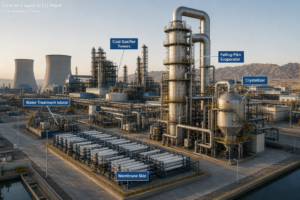
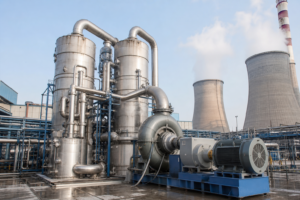
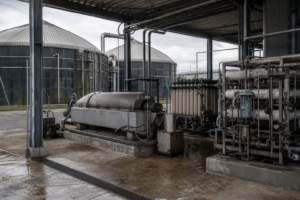
Battery-grade lithium carbonate (Li2CO3) is won almost entirely by evaporation and crystallization engineering: the ore or brine contributes lithium to a dilute sulfate or chloride liquor, and everything between that liquor and a 99.5% battery-grade powder is concentration, impurity rejection, precipitation crystallization, and drying. The counterintuitive core of the flowsheet is that lithium carbonate’s solubility falls as temperature rises – so precipitation happens hot, and mothers are recovered cold. Plants that master this inverted solubility, pair MVR evaporation with disciplined sodium sulfate by-product recovery, and finish with rotary drying plus magnetic control, ship battery-grade product; plants that don’t, ship industrial-grade at battery-grade prices. Published reference projects — external industry references, not EvapCryst project records — now run at 30,000 TPA with core evaporation-drying trains in full zero-liquid-discharge configuration.
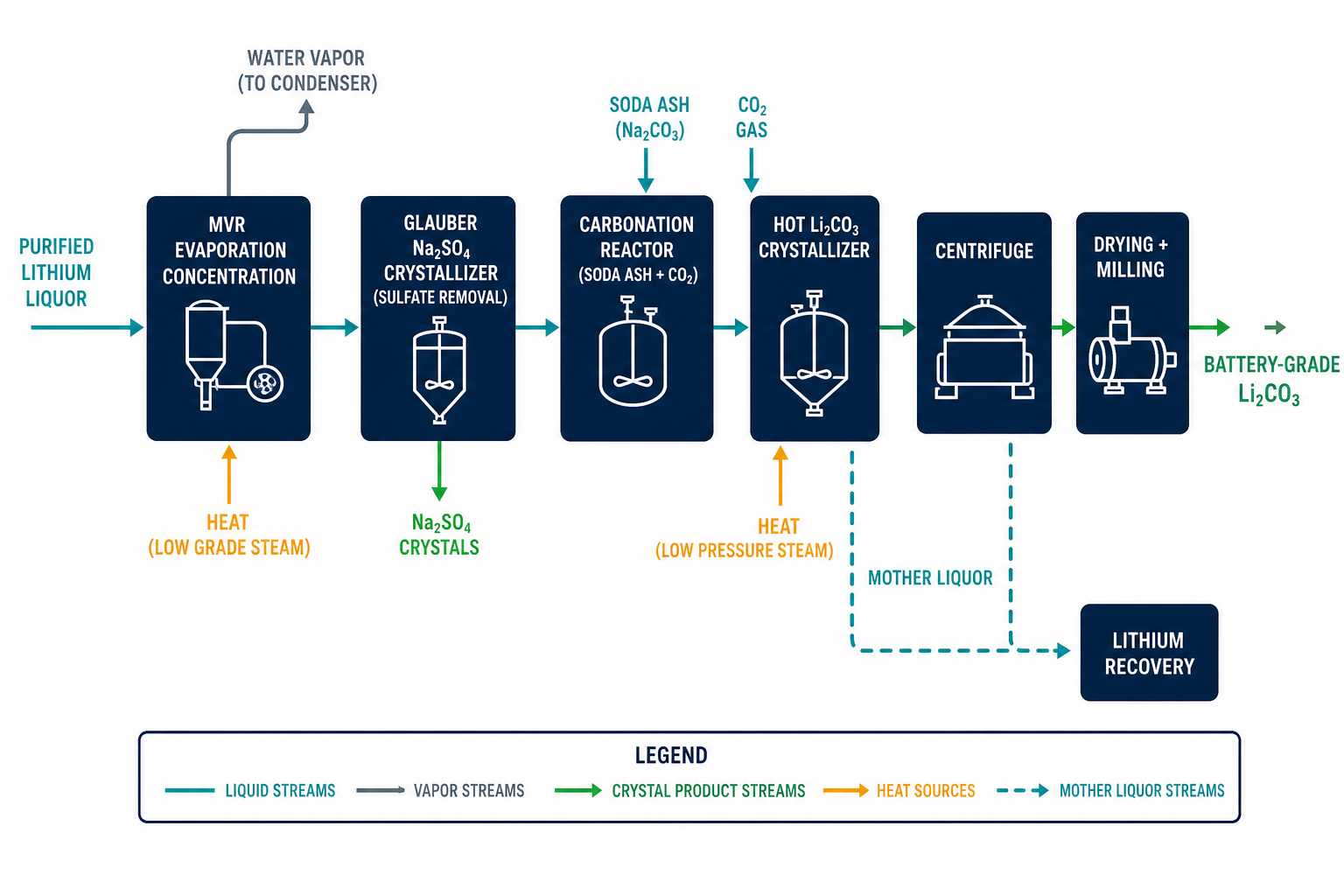
The Process Chain from Liquor to Battery Grade
Whether the lithium arrives from spodumene (sulfuric acid route), salt-lake brine, or battery recycling, the back end of the plant looks broadly similar:
| Process module | Equipment candidates | Selection basis | Indicative envelope |
|---|---|---|---|
| Purification | Precipitation, ion-exchange polish | Remove Ca, Mg, Fe, Al, heavy metals first | Mg and Ca to low ppm before concentration; each ppm saved here is purity gained later |
| Evaporative concentration | MVR forced-circulation evaporator/crystallizer | Lift dilute liquor to precipitation strength | Scaling and lithium loss to purge; compressor reliability |
| Precipitation (hot) | Agitated precipitation crystallizers | React Li+ with soda ash; inverted solubility favors hot operation | 80-95°C high end; Na2CO3 stoichiometry sets yield and particle size |
| Separation and washing | Centrifuge or pressure filter with wash | Deliquor and wash crystals | Wash discipline; mother-liquor carryover carries sodium |
| Drying | Rotary dryer (published 30,000 TPA practice) or indirect/convection unit | Free and surface moisture to spec | Product temperature 120-250°C; avoid contamination |
| Communition and magnetic polish | Air-classifying mill, multi-stage electromagnetic separators | Set particle size; strip magnetic foreign matter | Magnetic foreign matter down to tens of ppb |
| Mother liquor treatment | Freezing crystallizer (Glauber’s salt) and/or evaporation to anhydrous Na2SO4 | Recover lithium; discharge sodium as by-product | ZLD closure; by-product salt purity |
The Inverted Solubility of Lithium Carbonate
Almost every other industrial crystallization works the other way, which is why lithium carbonate confuses engineers arriving from sodium salts or organics: handbook solubility falls from about 1.5 g per 100 mL near 0°C to roughly half that at 100°C. The consequences run through the whole plant:
- Precipitation runs hot. Soda ash is charged at the upper end of the 80-95°C window, where Li2CO3 is least soluble – pushing yield up and crystal growth favorable.
- Mother cooling recovers more lithium. Cooling the spent mother toward 20-30°C re-saturates the liquor and recovers a second crop, cutting the lithium load passed to the sulfate side.
- Hot washing is deliberate. Wash water is heated so it dissolves less product per tonne of wash – cold wash on Li2CO3 cake quietly eats yield.
Single-pass precipitation yields typically land in the 70-85% range depending on stoichiometry and temperature; with mother recycle and cooling recovery, overall lithium recovery above 90% is the standard design target.
Battery Grade Is a Purity-and-Physics Specification
| Parameter | Typical Battery-Grade Requirement | Where It Is Won |
|---|---|---|
| Li2CO3 purity | ≥99.5% | Purification and wash discipline; mother liquor sodium control |
| Magnetic foreign matter (Fe/Cr/Ni/Zn) | Tens of ppb total | Stainless contact surfaces, wear management, multi-stage magnetic separators after milling |
| Particle size D50 | Roughly 3-10 μm depending on customer | Precipitation supersaturation control and post-drying milling |
| Moisture | Typically ≤0.25% | Final drying stage |
| Impurities (Na, K, Ca, Mg, SO4) | Individual limits at tens-to-hundreds of ppm | Upstream purification and soda ash quality |
The magnetic-foreign-matter limit is met by the whole plant, not one machine: every wetted part is stainless or lined, wear points are monitored, and product passes multiple electromagnetic stages between milling and packaging. A single carbon-steel tool dropped into a hopper can scrap a batch worth six figures.
MVR Evaporation: The Engine of the Concentration Step
Lithium liquors arrive dilute – spodumene sulfate liquors carry lithium in the grams-per-liter range (an illustrative envelope; brine concentrates vary by deposit). Reaching precipitation strength means evaporating large water volumes, and MVR has become the industry default: the duty is continuous, the liquor tolerates forced-circulation heat transfer, and electricity-driven evaporation beats live steam wherever grid power is reasonable. Externally published installations speak to scale: a 30,000 TPA battery-grade project in Xinjiang reports its core evaporation and drying train in full operation (vendor-published; indicative), and MVR crystallization units of 16 TPH evaporation capacity per set — two sets reported at a single battery-grade producer planning 10,000 TPA — demonstrate the unit scale now standard in this industry.
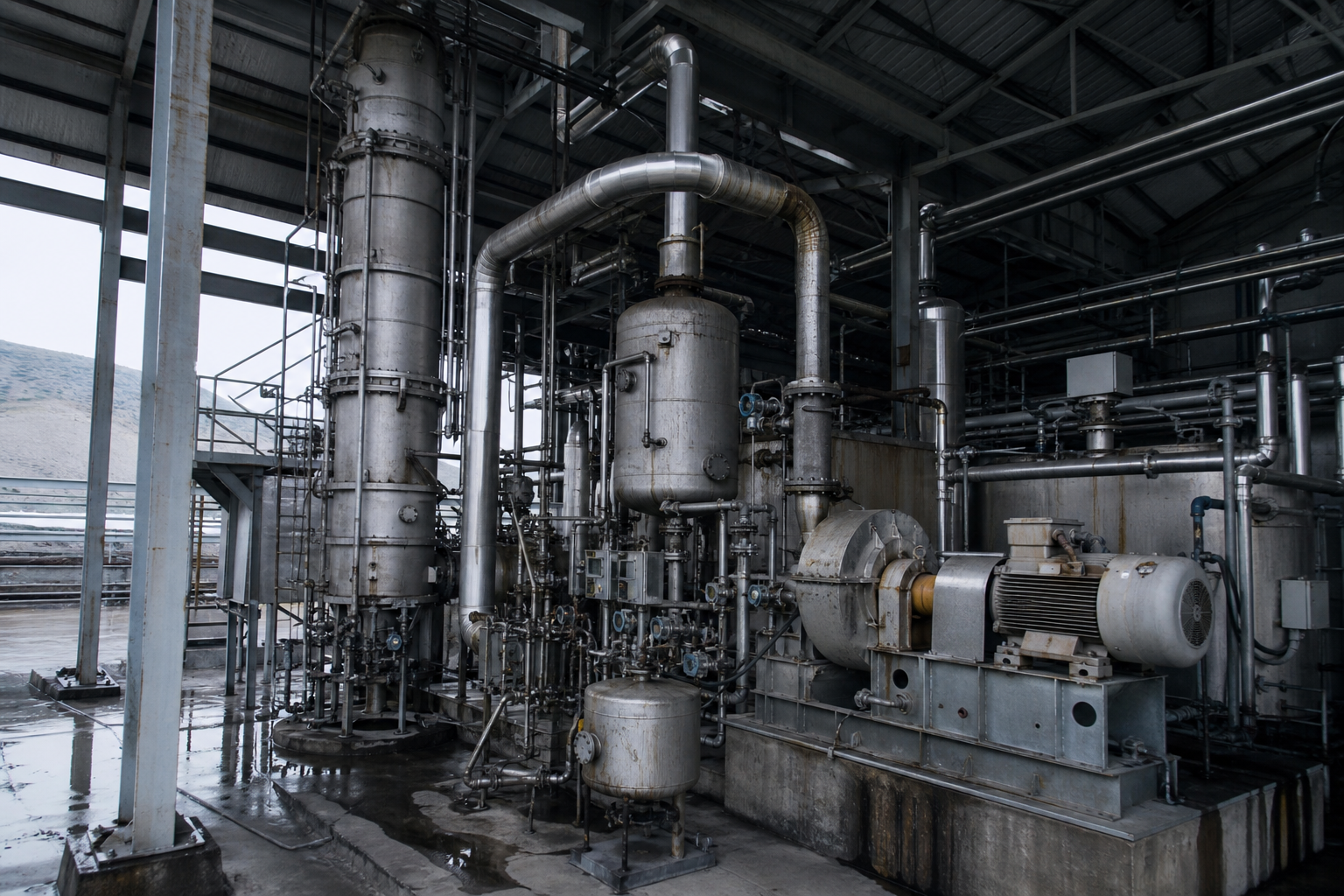
Two engineering watch-outs dominate MVR lithium service: sulfate scaling in the heater (managed by circulation velocity and by keeping the liquor undersaturated with respect to sodium salts passing to the salt section) and compressor availability – a single compressor trip on a plant with no steam backup stops the entire front end.
Sodium Sulfate: The By-Product That Decides the Water Balance
Every mole of lithium precipitated with soda ash leaves a mole of sodium behind, and in the sulfate route the sodium exits as sodium sulfate. The plant’s water balance and its zero-liquid-discharge status hinge on how this stream is handled:
- Freezing crystallization of cooled mother liquor precipitates Glauber’s salt (Na2SO4·10H2O) at low temperature, recovering process water and de-sodiating the liquor before lithium recycle.
- Evaporative crystallization takes the salt to anhydrous Na2SO4 directly – the published 30,000 TPA project closes its water loop this way, with zero-discharge by-product sodium sulfate dried on fluid bed equipment before sale.
- By-product credit: anhydrous sodium sulfate sold into detergent, glass, and textile markets partially offsets soda ash purchases – at tens of thousands of tonnes per year for a 30,000 TPA lithium plant, this is not a rounding error.
Drying, Milling, and the Last 100 Meters
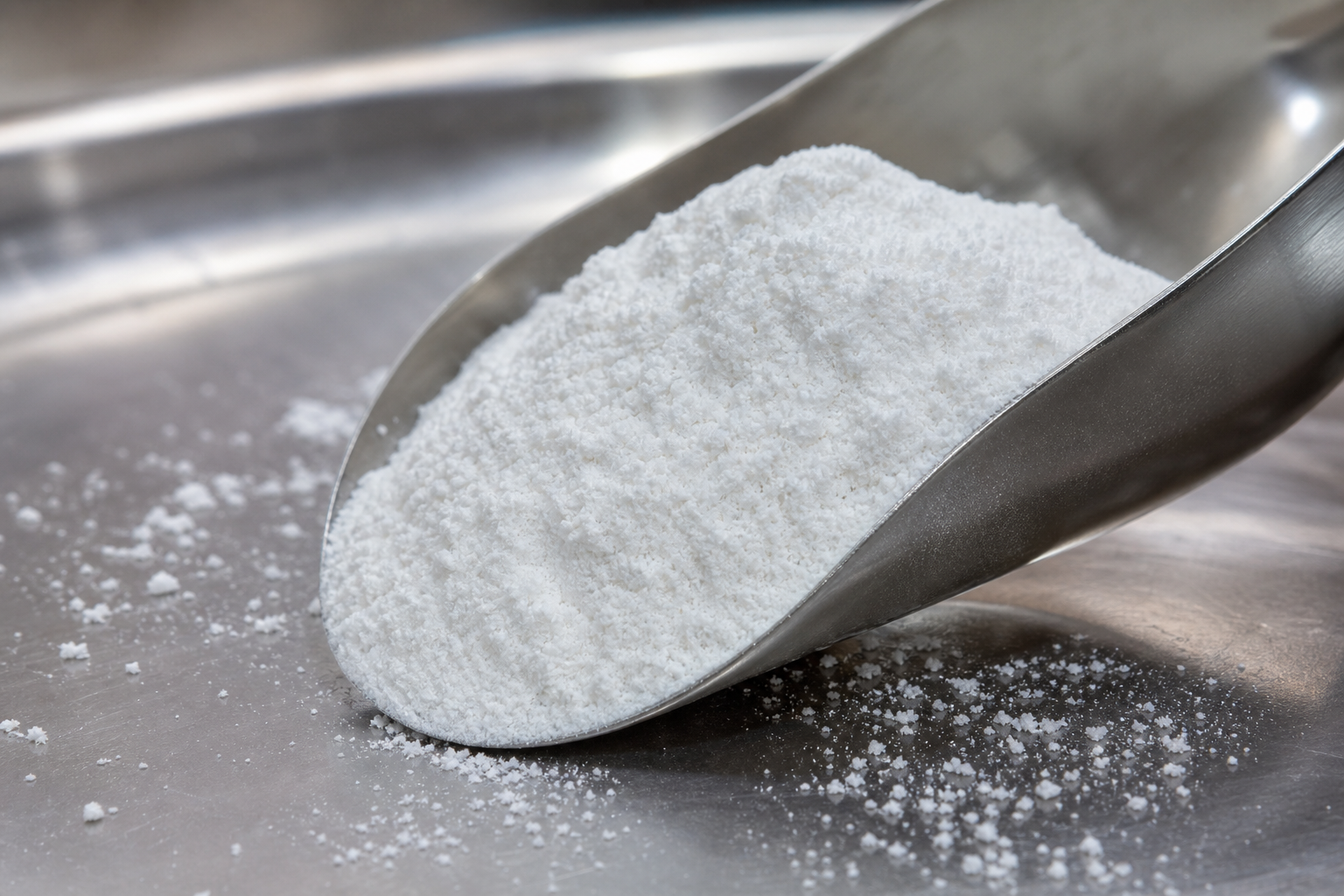
Lithium carbonate cake after centrifugation carries single-digit free moisture that must come down below ~0.25% without introducing forbidden contaminants. Rotary drying – the configuration reported at the 30,000 TPA Xinjiang project – handles the duty with direct or indirect hot-gas contact in the 120-250°C product-temperature window; the dried cake passes air-classifying milling to set particle size, then magnetic separation to strip tramp metal, before moisture-barrier packaging (25 kg PE-lined bags or 500-1000 kg bulk bags) in humidity-controlled conditions.
Related capabilities: MVR evaporation systems for lithium liquor concentration, salt separation and crystallization for sodium sulfate management, drying and packing systems for rotary and fluid bed finishing, and zero liquid discharge for full water-loop closure. For the adjacent link in the battery supply chain, see dimethyl carbonate production – the electrolyte solvent that meets this salt in the cell – and our other inorganic salt integration cases such as calcium chloride concentration and granulation.
Where Lithium Is Lost, and How Plants Close the Gaps
In a battery-grade lithium carbonate plant, profitability tracks the lithium balance sheet more closely than the energy balance sheet. The recognized loss points, in rough order of the money involved:
- Precipitation mother liquor. The hot mother still carries several grams per liter of lithium (set by inverted solubility and carbonate residual); cooling recovery and recycle return most of it, and the remainder must be chased into the sodium sulfate side.
- Cake washing. Every tonne of wash water dissolves product (less when hot, per the solubility curve) while carrying sodium back if under-washed. Plants tune wash ratio and temperature against the sodium spec – and recycle the wash filtrate to concentration rather than draining it.
- Sodium sulfate entrainment. Salt crystals mechanically trap mother liquor; without adequate deliquoring and washing on the salt filter, lithium leaves inside a low-value by-product. Freezing-crystallization routing keeps lithium in the recycled liquor and is preferred for this reason.
- Drying and milling fines. Air-classifying mills send a fines stream to collection; without cyclone and filter recovery tied back into packaging (or the crystallizer), this dust is a quiet percentage-point loss and a housekeeping problem.
- Purge streams. Every purge taken for impurity control (boron, magnesium accumulations) contains lithium; well-designed plants neutralize and re-dissolve purge solids back into the front of the process.
A disciplined quarterly lithium audit – feed in, product out, every stream in between – is the mark of a well-run plant; operations that skip it routinely discover a mid-single-digit percentage of lithium production has been financing someone else’s salt stack.
When This Route May Not Fit
Not every lithium liquor deserves this train. Very small carbonate producers — toll converters and pilot plants — cannot amortize MVR concentration plus magnetic-polish finishing. Direct brine producers with cheap solar evaporation already reach concentration without fuel or power, and adding mechanical evaporation there must beat free sun. Projects whose sodium sulfate by-product has no outlet carry a disposal liability that can consume the by-product credit. And producers serving only technical-grade markets skip the ppb-level magnetic and purity disciplines that define battery-grade cost structure.
What Must Be Verified
Verification starts with the liquor assay: lithium concentration envelope, and the Ca, Mg, boron, sodium and sulfate background across feed batches, because purification depth and mother-liquor routing hang on it. Second, the inverted-solubility behavior of the actual liquor — precipitation yield and particle size confirmed in bench precipitation at temperature. Third, soda ash quality against the sodium specification, since ash impurities report directly to product. Fourth, sulfate-scaling tendency in the evaporator, ideally from concentration tests. Fifth, the magnetic-contamination audit of every candidate wetted component. Sixth, the water balance including freezing-crystallization or evaporative closure of the sulfate side.
Frequently Asked Questions
Why is lithium carbonate precipitated hot instead of cold?
Lithium carbonate’s solubility decreases as temperature rises – roughly half as soluble at 100°C as near 0°C. Precipitating at the top of the 80-95°C window with soda ash therefore maximizes yield, while cooling the mother afterward recovers an additional crop. This is the reverse of most industrial crystallizations.
What does battery-grade lithium carbonate require?
Typically ≥99.5% Li2CO3 purity, total magnetic foreign matter (Fe, Cr, Ni, Zn) in the tens-of-ppb range, particle size D50 around 3-10 μm depending on the cathode customer, moisture below about 0.25%, and individual impurity limits for Na, K, Ca, Mg, and sulfate in the tens-to-hundreds of ppm.
What recovery can a lithium carbonate plant achieve?
Single-pass precipitation yield is typically 70-85%, set by temperature and soda ash stoichiometry. With mother-liquor recycle, cooling recovery, and lithium bleed-back from the sulfate side, overall lithium recovery above 90% is the standard design target.
How is sodium sulfate handled in a lithium plant?
Sodium enters with soda ash and exits the mother liquor. Plants either freeze-crystallize it as Glauber’s salt at low temperature (recovering water and regenerating liquor for lithium recycle) or crystallize it directly to anhydrous Na2SO4. The 30,000 TPA reference project dries its zero-discharge by-product sodium sulfate on fluid bed equipment for sale.
Why is MVR preferred for lithium liquor concentration?
The duty is continuous and large – lifting dilute sulfate or brine liquors to precipitation strength evaporates multiple tonnes of water per tonne of product. Mechanical vapor recompression drives that evaporation with electricity at lower operating cost than live steam, and 16 TPH-per-set MVR crystallization units at battery-grade producers demonstrate the maturity of the configuration at commercial scale.
To screen this route, share the lithium liquor assay, the target product grade, and the throughput — enough for an initial process-configuration assessment.