Ferrous phosphate (FePO4, the LFP precursor) plants generate two distinct wastewater streams — ammonium sulfate mother liquor from the ammonium route and sodium sulfate wash water from the sodium route — and the proven treatment architecture treats them separately: segregation at source, pretreatment and multi-stage membrane concentration, then twin MVR evaporation crystallization systems. In an external industry reference (vendor-published, not an EvapCryst delivery; indicative, not a project guarantee), a 70 t/h train converts the ammonium sulfate liquor to crystal product while a 60 t/h train handles the sodium sulfate stream, and the integrated plant recycles permeate at pH 6–8 with conductivity at or below 10 μS/cm. The scale is not small: a 50,000 t/y iron phosphate plant produces roughly 84 t/h of mother liquor against 450 t/h of wash water, which is why energy-efficient evaporation decides the plant’s water economics. Figures here form an illustrative envelope from published external references, not a project datasheet.
Iron Phosphate Production and Where the Wastewater Comes From
Battery-grade iron phosphate is made by three competing routes, and each defines a different wastewater problem. The two mainstream processes differ in the pH regulator they use — ammonia in the ammonium process, sodium hydroxide in the sodium (phosphoric acid) process:
- Ammonium process: a ferrous sulfate solution reacts with monoammonium phosphate; after precipitation and filtration, excess acid is neutralized with ammonia water to yield iron phosphate. The by-product is ammonium sulfate in the mother liquor.
- Sodium process (phosphoric acid process): ferrous sulfate is acidified with phosphoric acid, oxidized with hydrogen peroxide to ferric dihydrogen phosphate, then pH is adjusted to about 2 with sodium hydroxide to precipitate iron(III) phosphate. The by-product is sodium sulfate.
- Phosphoric acid + iron powder process: a newer route whose raw material is more expensive, but which discharges little wastewater (the main emission is hydrogen), giving it the lowest environmental burden of the three at the cost of poorer product stability today.
| Factor | Ammonium process | Sodium (phosphoric acid) process | Phosphoric acid + iron powder |
|---|---|---|---|
| pH regulator | Ammonia / monoammonium phosphate | Sodium hydroxide (final pH ≈2) | — |
| By-product in wastewater | Ammonium sulfate mother liquor | Sodium sulfate wash water | Minimal (mainly hydrogen off-gas) |
| Production cost | Lowest of the mainstream routes — industry-reported roughly CNY 6,000–7,000 per tonne cheaper than the sodium route | Higher | Highest raw-material cost |
| Product stability | Good | Good | Relatively poor at present |
| Wastewater treatment value | Ammonium sulfate is recoverable and saleable | Sodium sulfate is recoverable | Little wastewater to treat |
The economics compound downstream of the reactor: a published cost breakdown puts phosphorus above 53% of iron phosphate production cost, so integrated phosphorus-chemical producers hold a raw-material advantage — and every tonne of by-product salt recovered from the wastewater loop adds margin back to the same balance sheet.
Stream Characterization: Mother Liquor versus Wash Water
The defining feature of iron phosphate effluent is the volume asymmetry between the two streams. For a published 50,000-tonne-per-year reference plant, the mother liquor amounts to about 84 t/h while washing water reaches roughly 450 t/h. The mother liquor is salt-rich; the wash water is large in volume but dilute, carrying residual sulfate and traces of iron and phosphate from cake washing. Treating them as one mixed stream would force the evaporation plant to boil hundreds of tonnes per hour of near-clean water; segregating them lets membrane concentration do the cheap first lift on the dilute stream and reserves thermal energy for the concentrated one.
The Treatment Architecture, Stage by Stage
1. Segregated collection
Mother liquor and wash water are collected in separate buffer systems. This single decision splits a mixed 534 t/h problem into an 84 t/h salt-recovery problem and a 450 t/h water-recovery problem, each addressed by the technology that does it cheapest.
2. Pretreatment
Both streams pass through pretreatment to remove suspended iron phosphate fines and to condition scalants (adjusting pH as required to keep calcium, magnesium, and iron from fouling downstream membranes and heat exchangers). Protecting the membrane stage is the priority, because membrane flux loss propagates directly into evaporation load.
3. Multi-stage membrane concentration
The wash water is concentrated through multi-stage membrane trains. Permeate from the early stages is already process-quality water; retentate is progressively enriched until the salt concentration justifies thermal treatment. Membrane stages move water at a fraction of the energy of evaporation, so the design goal is to push as much volume as possible across the membrane before the first MVR effect.
4. Twin MVR evaporation crystallization systems
The concentrated salt streams enter two dedicated MVR systems:
- Ammonium sulfate circuit (70 t/h in the reference project): falling-film evaporation concentrates the ammonium sulfate solution, followed by MVR forced-circulation crystallization that produces ammonium sulfate crystal. The crystal is a saleable by-product — evaporating concentration, evaporation crystallization, and flash separation recover the ammonium-route by-product and add value back to the ammonium process.
- Sodium sulfate circuit (60 t/h in the reference project): the same falling-film-plus-forced-circulation arrangement, crystallizing sodium sulfate for by-product sale or internal reuse.
In both circuits, secondary vapor is recompressed by an electrically driven machine and reused as the heating source, so the plant’s steam infrastructure shrinks to startup and trim duty.
5. Product and water outputs
The plant exits with three products: ammonium sulfate crystal, sodium sulfate crystal, and recycled purified water. Reference water quality after the treatment train is pH 6–8 with conductivity at or below 10 μS/cm — suitable for return to the washing loop, closing the water balance toward zero liquid discharge.
At procurement level the architecture resolves into four core modules:
| Module | Candidate Equipment Types | Selection Rationale | Indicative Operating Envelope |
|---|---|---|---|
| Segregated collection and pretreatment | Separate buffer systems; fines removal and pH conditioning | Volume asymmetry is the economic foundation | Liquor and wash water kept apart (reference split) |
| Membrane concentration | Multi-stage membrane trains | Moves dilute water at membrane energy, not thermal | Permeate at process quality; retentate enriched |
| Ammonium sulfate circuit | Falling-film body plus MVR forced-circulation crystallizer | Recovers saleable fertilizer by-product | 70 t/h reference capacity |
| Sodium sulfate circuit | Falling-film body plus MVR forced-circulation crystallizer | Recovers detergent-or-glass-grade salt | 60 t/h reference capacity |
Configuration, materials, and ranges depend on actual feed, corrosion review, fouling behavior, utilities, and project capacity.
Reference Project Configuration
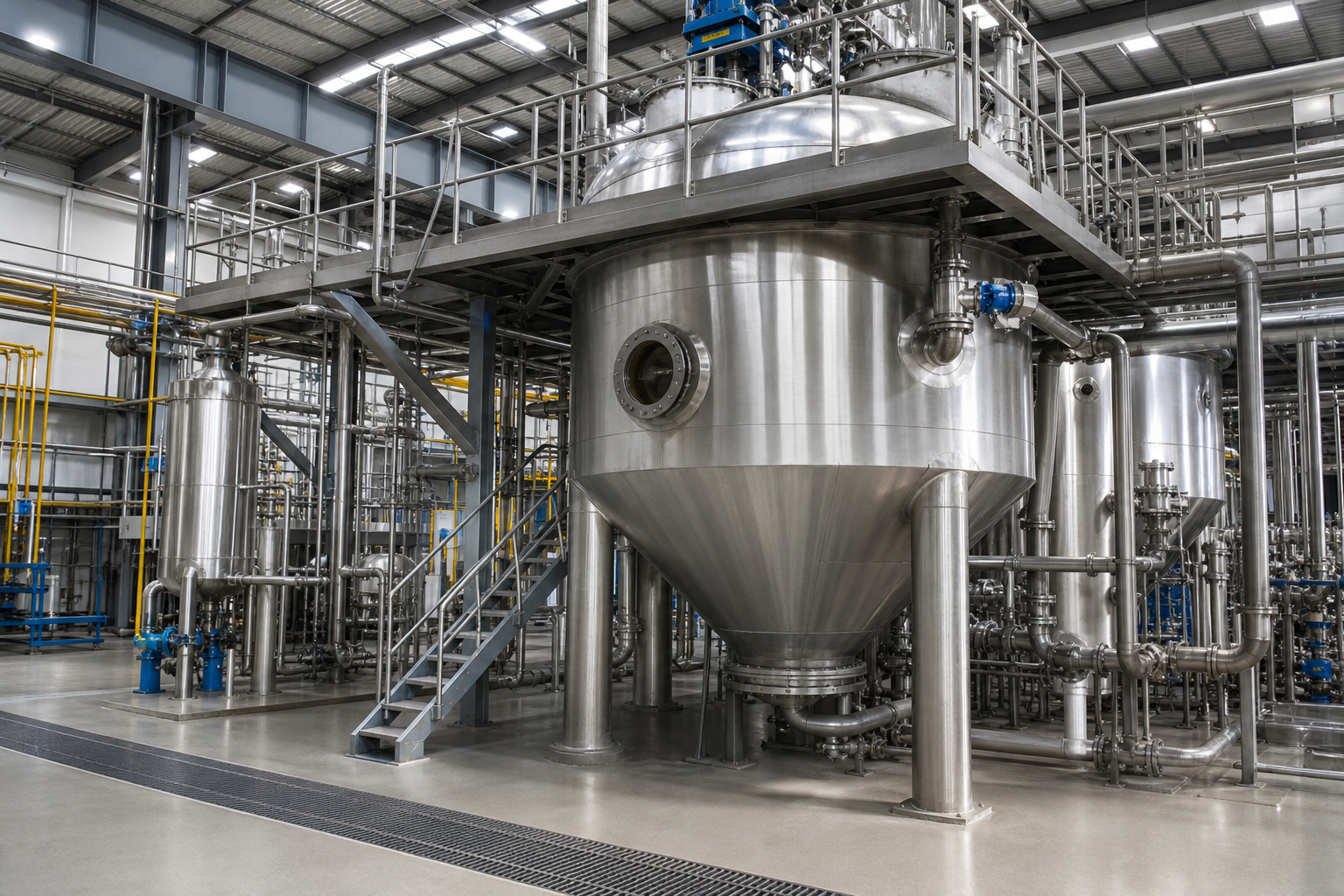
The configuration below is an external industry reference from vendor-published project descriptions — not an EvapCryst delivery, and indicative rather than a project guarantee.
| Item | Ammonium sulfate system | Sodium sulfate system |
|---|---|---|
| Evaporation capacity | 70 t/h | 60 t/h |
| Process arrangement | Falling-film evaporation + MVR forced-circulation crystallization | Falling-film evaporation + MVR forced-circulation crystallization |
| Feed | Ammonium sulfate solution (mother liquor after membrane stage) | Sodium sulfate solution (wash water after membrane stage) |
| Product | Ammonium sulfate crystal | Sodium sulfate crystal |
| Design standard | GB (Chinese national standard) | GB |
Upstream of these trains, the same plant processes 84 t/h of mother liquor and 450 t/h of wash water from 50,000 t/y of iron phosphate production through pretreatment and multi-stage membrane concentration — the evaporators see only the concentrated fraction, which is what keeps the thermal energy bill tractable.
Design Considerations That Decide Success
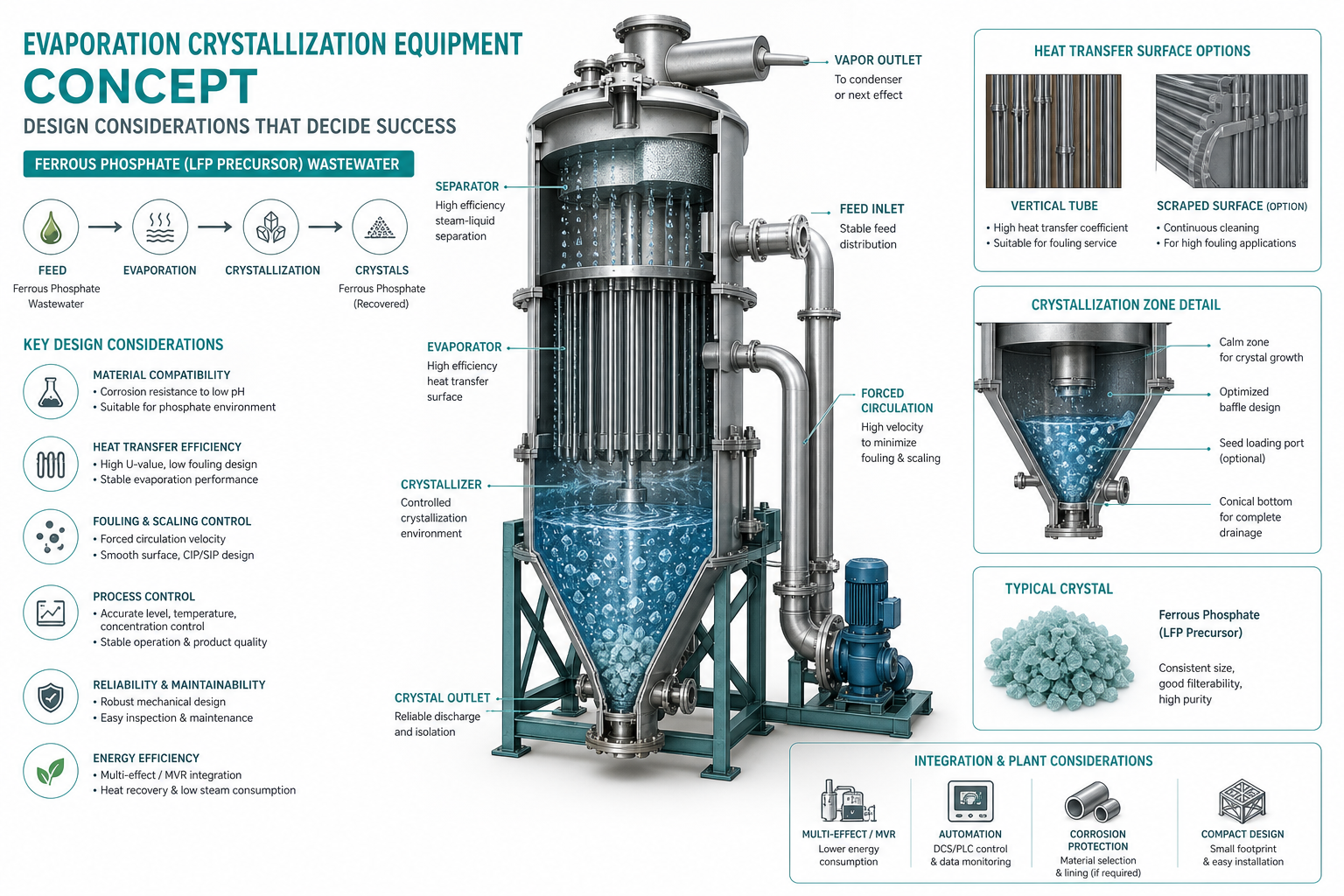
- Stream segregation discipline. The economics collapse if ammonium and sodium circuits cross-contaminate; a mixed sulfate stream has no fertilizer market and no clean by-product outlet. Collection piping and buffering must be engineered as deliberately as the evaporators.
- Scaling control in the sulfate service. Sulfate streams with residual calcium, magnesium, and iron scale heat-transfer surfaces. Forced-circulation crystallizers with controlled circulation flow rates are the standard answer; falling-film concentrators ahead of them are kept in the concentration range where tube wetting is reliable.
- Ammonia management. Ammonium-route streams can carry free ammonia that strips with the vapor; condensate routing and pH management keep ammonia out of the recycled water pool.
- Product market linkage. Ammonium sulfate crystal moves into fertilizer markets; sodium sulfate moves into detergent, glass, and textile-chemical markets. Plant siting should verify offtake for both before the flowsheet is frozen.
Cost and Energy Context
Two numbers frame the business case. First, process-route economics: the ammonium route is already roughly CNY 6,000–7,000 per tonne cheaper than the sodium route before wastewater is considered, and ammonium sulfate recovery converts its main liability into a saleable by-product — effectively widening the cost gap in the ammonium route’s favor. Second, energy: at 450 t/h of wash water for a 50,000 t/y plant, even a modest specific-energy gap between multi-effect and MVR evaporation compounds into a large annual line item, which is why the membrane-first, MVR-second architecture is standard on new iron phosphate projects. Where grid electricity is expensive or unstable, hybrid arrangements (MVR for the base load, trim steam for peaks) keep operating cost predictable without giving up the condensate-quality benefits of mechanical recompression.
From Precursor Plant to Battery-Scale Water Balance
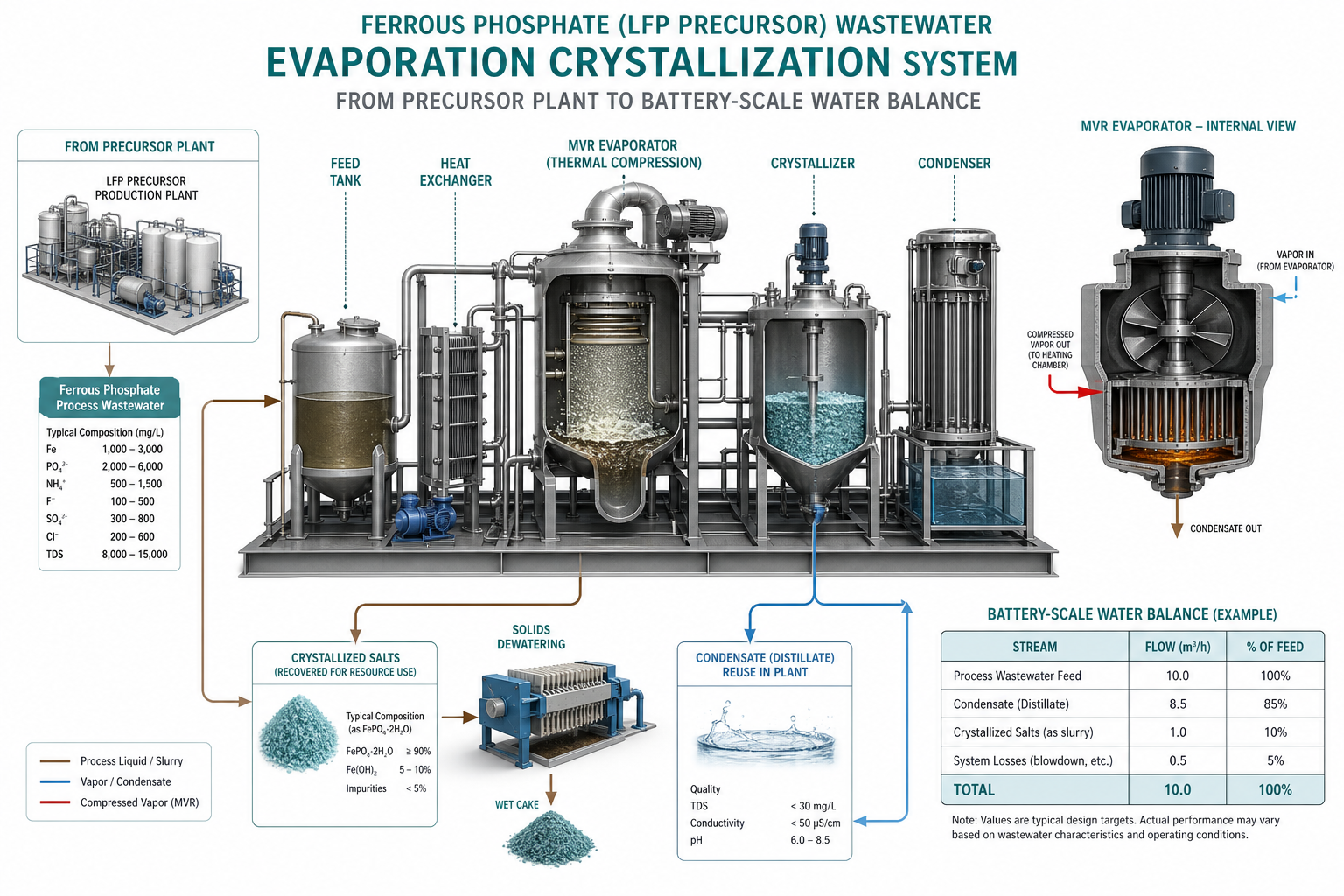
Iron phosphate is one node in the LFP battery water system. The sodium-route salt problem widens at the cathode-material stage, where sodium sulfate wastewater from cathode production is one of the largest single salt streams in the battery supply chain; the LFP-specific ammonium sulfate recovery also reappears in mixed battery-material plants that run both chemistries. For black-mass recycling plants, sulfate streams of nickel, cobalt, and sodium coexist with lithium recovery — a broader resource-recovery problem with the same MVR crystallization backbone.
When This Route May Not Fit
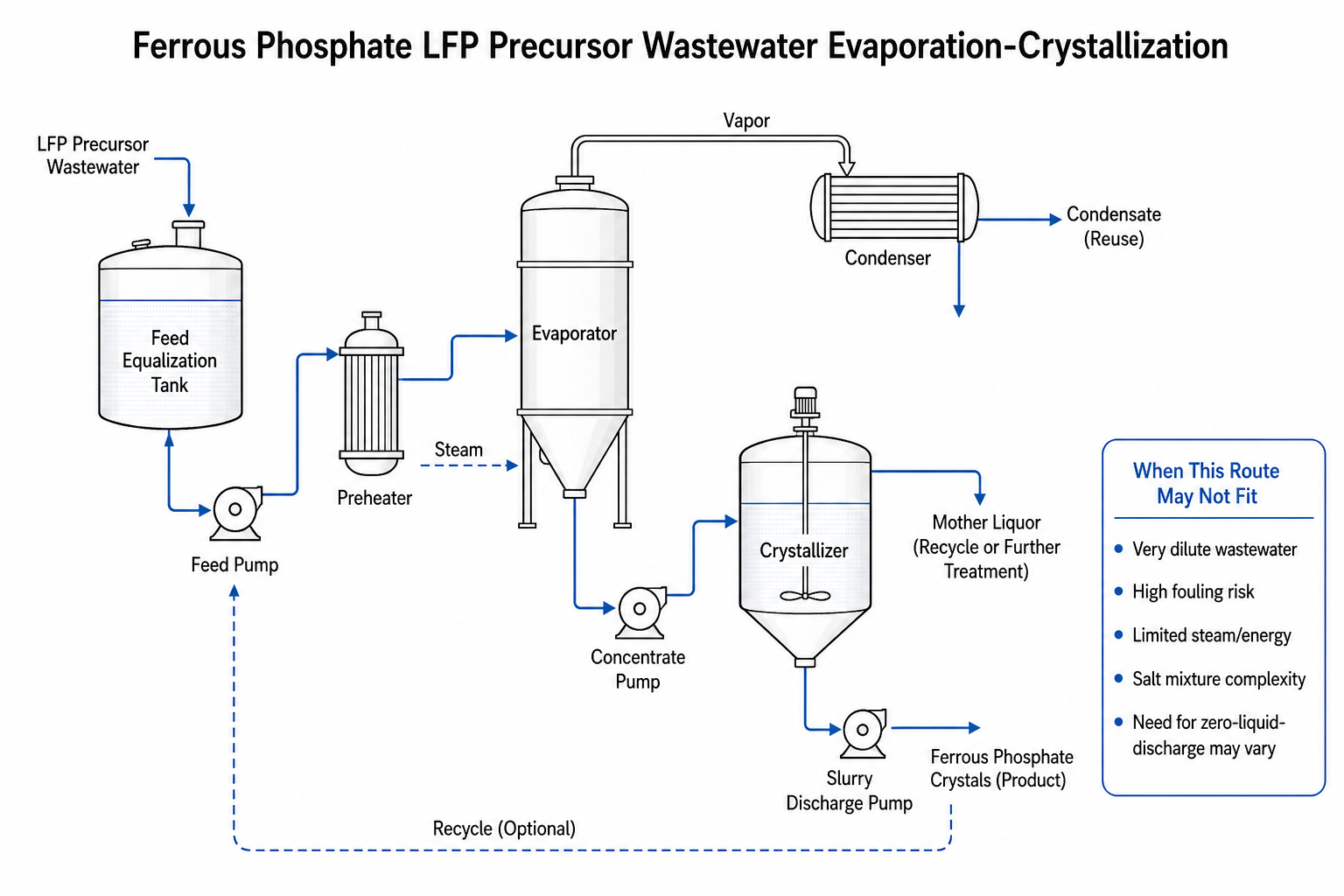
This architecture assumes an iron phosphate plant whose two salt streams are worth recovering. The phosphoric-acid-plus-iron-powder route discharges little wastewater at all, and bolting a twin-MVR salt-recovery plant onto it solves a problem that does not exist. The route also misfits small or single-route producers: a plant running only the sodium process at modest scale may find one crystallizer and outsourced disposal of the salt cheaper than two parallel circuits with membrane fronts. Where ammonium and sodium circuits cannot be kept reliably segregated — old collection networks, shared sumps — cross-contamination destroys both by-product markets and the economics with them. And sites lacking any fertilizer or detergent offtake within hauling distance should check whether crystal-for-landfill genuinely beats liquid disposal before the flowsheet is frozen.
What Must Be Verified
Before an iron phosphate wastewater project is committed, the following must be verified against site data rather than the vendor-published reference above. The actual stream survey — mother liquor and wash water volumes, salt strengths, and the process route actually run — because the whole architecture hangs on the volume asymmetry. Membrane concentration trials on the real wash water, confirming flux stability against iron, calcium, and magnesium fouling. Scaling tendency of both sulfate concentrates on forced-circulation duty. Free-ammonia levels in the ammonium circuit, fixing condensate routing and pH management. Confirmed offtake agreements for both crystals — fertilizer-grade ammonium sulfate and detergent-or-glass-grade sodium sulfate — and a water-reuse specification the recycled permeate must meet before it returns to cake washing. Utilities pricing for the MVR duty, and winter cooling-water behavior.
Frequently Asked Questions
What salts are in iron phosphate wastewater?
It depends on the process route. The ammonium process produces ammonium sulfate mother liquor; the sodium (phosphoric acid) process produces sodium sulfate wash water; the phosphoric acid + iron powder route produces very little wastewater at all. A plant’s wastewater treatment design follows directly from which route it runs.
How much wastewater does an iron phosphate plant generate?
At the 50,000 t/y iron phosphate scale, vendor-published reference projects report roughly 84 t/h of mother liquor and about 450 t/h of washing water. The wash water dominates by volume but is dilute, which is why membrane concentration precedes evaporation.
Can the treated water be reused in production?
Yes. With pretreatment, multi-stage membrane concentration, and MVR crystallization in series, recycled water quality of pH 6–8 and conductivity ≤10 μS/cm is reported in published full-scale operation — clean enough to return to washing duty and close the water loop toward zero liquid discharge.
Is ammonium sulfate from LFP precursor wastewater saleable?
Yes. Recovered by evaporation concentration, evaporation crystallization, and flash separation, the ammonium-route by-product re-enters the fertilizer value chain. Since the ammonium route is already the lower-cost iron phosphate route (roughly CNY 6,000–7,000 per tonne cheaper than the sodium route), by-product monetization widens that advantage further.
Why two separate MVR systems instead of one?
Because the two salts have different crystallization behavior, different product markets, and must not cross-contaminate. The vendor-published reference configuration runs a 70 t/h ammonium sulfate train and a 60 t/h sodium sulfate train in parallel, each with falling-film concentration ahead of MVR forced-circulation crystallization.