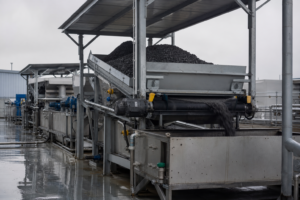
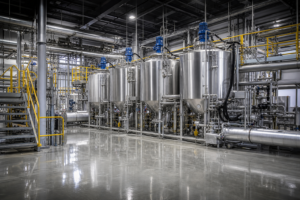
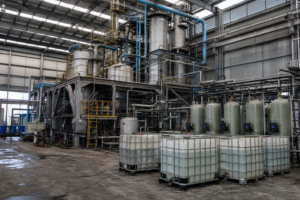
In the spodumene route to battery-grade lithium, lithium sulfate (Li2SO4) is the currency of the middle of the flowsheet — and evaporation is where that currency is minted. The purified leach liquor leaving acid roasting and purification typically carries lithium at around 100 g/L counted as Li2SO4 (about 13 g/L as lithium metal), too dilute for efficient precipitation; concentration to roughly 200-220 g/L counted as Li2SO4 (Li2O about 55-60 g/L) is the prerequisite for economic lithium carbonate or hydroxide production downstream. MVR (mechanical vapor recompression) evaporators have become the default machine for this duty — an externally documented, vendor-published installation reference concentrates lithium sulfate liquor at 20,000 kg/h water evaporation with titanium wetted parts — an external industry reference, not an EvapCryst delivery, and indicative rather than a project guarantee — while crystallization of Li2SO4 itself, or of the sulfate salts around it, becomes the tool for lithium recovery from plant wastewater. This page covers the concentration duty, the equipment, the lithium-loss points, and the design decisions specific to lithium sulfate service.
Where Lithium Sulfate Sits in the Flowsheet
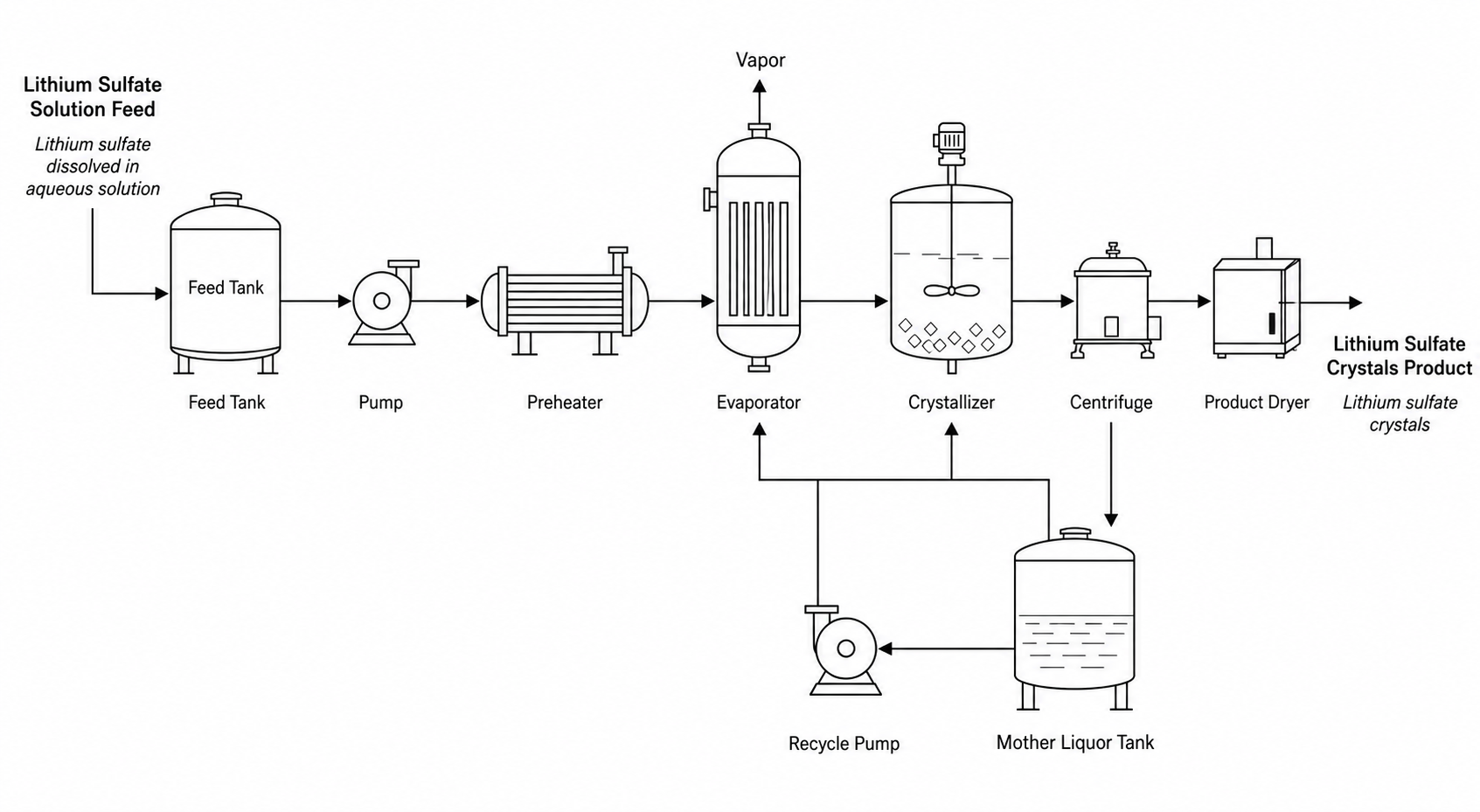
Hard-rock spodumene supplies the majority of the world’s lithium — an industry-reported majority share of global production — with most ore mined in Australia and processed in China. The conversion of that ore into battery chemicals runs through lithium sulfate without exception:
- Concentration and roasting. Crushed, beneficiated spodumene concentrate is roasted at high temperature (around 1,050 °C) to convert the crystal structure, then mixed with sulfuric acid and re-roasted at roughly 200 °C to form water-soluble Li2SO4.
- Leaching and purification. Water leaching dissolves the lithium sulfate; hardness and metal impurities (calcium, magnesium, iron, aluminum, sodium, potassium) are removed through chemical precipitation, ion exchange and polishing steps. The product of this stage is a clarified, slightly acidic liquor at around 100 g/L counted as Li2SO4.
- Concentration. This is the evaporation duty — lift the liquor to roughly 200 g/L Li2SO4 without losing lithium, contaminating it, or scaling the heater.
- Conversion. The concentrated liquor meets sodium carbonate (to precipitate battery-grade Li2CO3, typically for LFP supply chains) or sodium hydroxide (en route to LiOH·H2O, typically for NMC supply chains), with the sodium sulfate byproduct separated by crystallization along the way.
Every kilogram of lithium that passes step 3 cleanly is lithium that does not have to be mined again — which is why the evaporator, unglamorous as it looks, carries direct leverage over plant yield.
Why Concentration — Not Crystallization — Is Usually the Goal
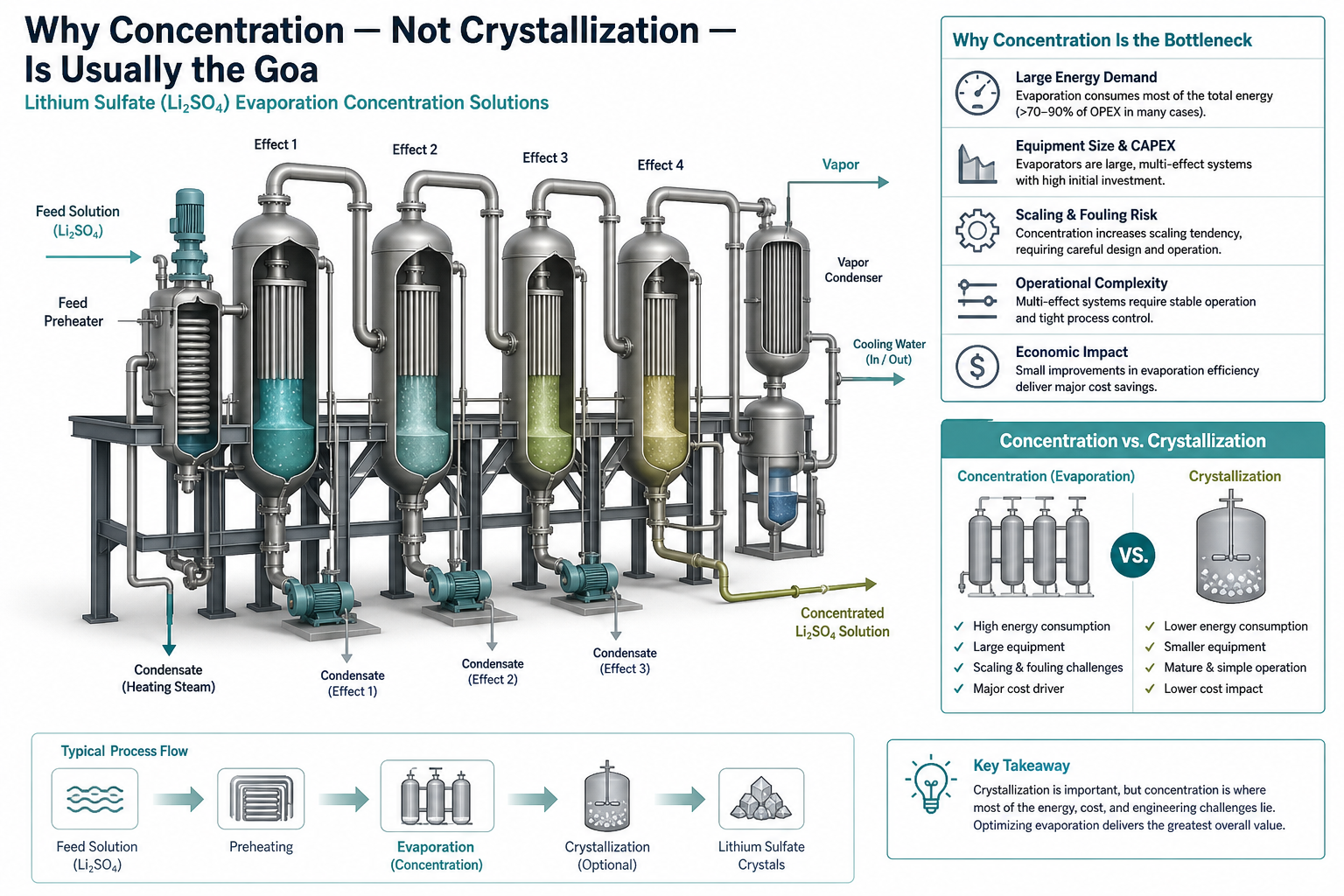
Lithium sulfate is exceptionally soluble, so crystallizing it directly from liquor is neither necessary nor attractive: the cheap route to solid lithium chemicals is precipitation as carbonate or hydroxide after concentration. The evaporation duty is therefore a pure concentration service with three hard requirements:
- Hit the concentration target precisely. Under-concentrated liquor wastes precipitation-chemical efficiency; over-concentrated liquor risks sodium sulfate co-precipitation and scaling. The design point — roughly doubling from ~100 to ~200-220 g/L counted as Li2SO4, Li2O about 55-60 g/L — comes from the downstream stoichiometry.
- Do not lose lithium. Lithium follows water everywhere: entrainment droplets in the vapor, boil-out liquors, purge streams. A well-designed system keeps vapor scrubbing and condensate quality under surveillance because dissolved lithium in the wrong stream is money in the sewer.
- Do not foul the heat surface. The liquor is slightly acidic and carries dissolved sodium, potassium and residual hardness even after purification. Forced-circulation heaters with small temperature differences and scouring velocities keep the tubes clean; scaling here is a capacity outage waiting to happen.
The MVR Evaporator for Lithium Sulfate Concentration
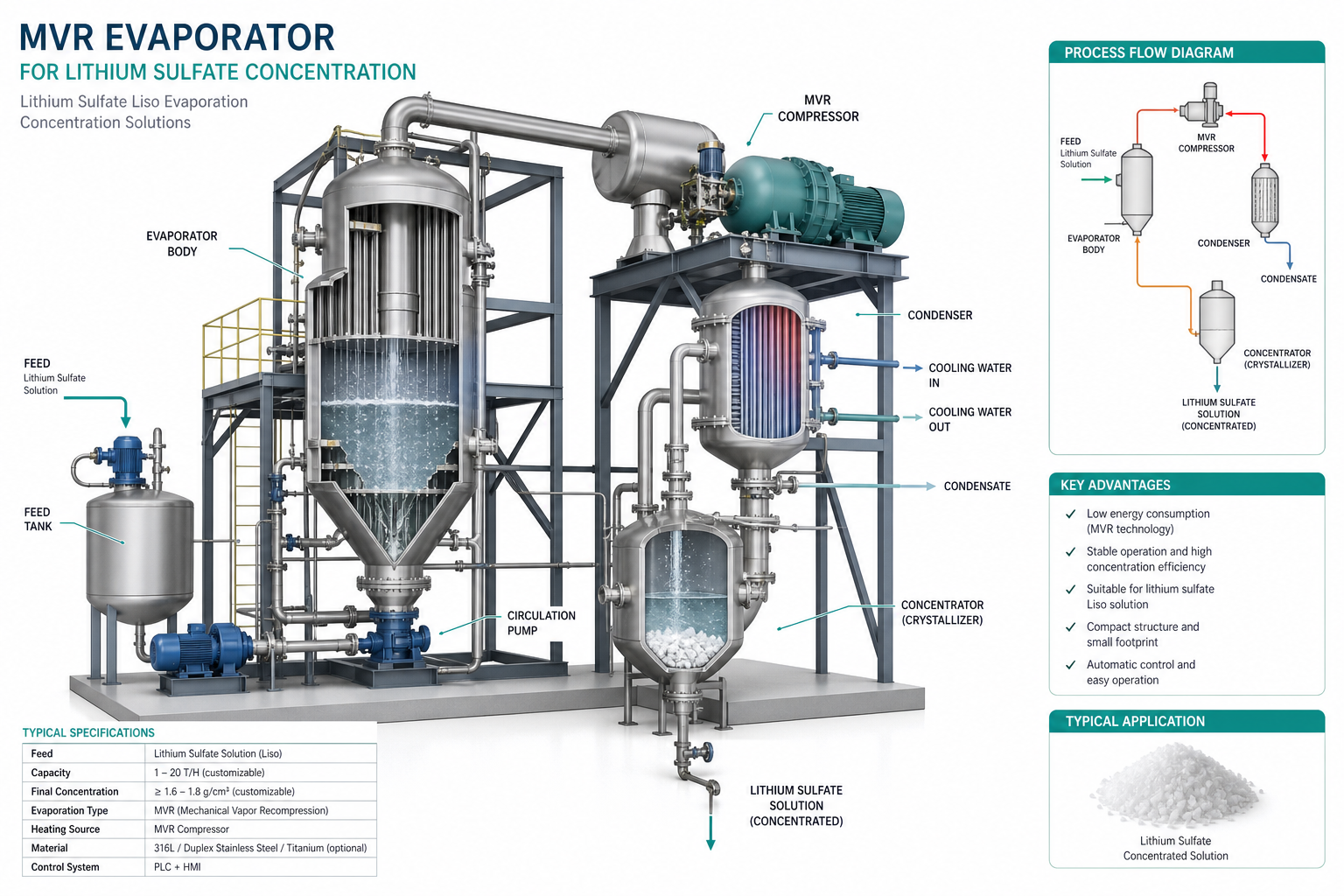
MVR is the standard choice for this duty for a straightforward reason: the duty is large, continuous, and steam-optional. A mechanical compressor takes the secondary vapor from the separator, compresses it to a higher pressure and temperature, and returns it to the heater as the heating medium. After startup, the system needs almost no live steam — energy arrives as electricity instead.
The advantages compound in lithium service:
- Low operating cost at large duty. The vendor-published 20,000 kg/h evaporation capacity class would consume substantial continuous steam with conventional evaporation; MVR trades it for compressor electricity.
- Gentle temperature difference. The temperature lift the compressor provides is small, so the heater operates with a narrow temperature approach — mild evaporation that protects product quality and reduces scaling.
- Simple, continuous, automatic. MVR trains run fully automated with continuous operation; production systems come equipped with CIP (clean-in-place) piping for on-line cleaning without disassembly.
- Sits anywhere in the energy landscape. Where single-effect or multi-effect evaporators work, MVR is technically substitutable with better energy and environmental performance — the constraint is local electricity price versus steam cost.
Reference system configuration
| Component | Function in Li2SO4 concentration |
|---|---|
| Condensate preheater | Recovers heat from clean condensate into the feed |
| Exhaust vapor preheater | Recovers vent-stream heat before it leaves the system |
| Exhaust condenser | Condenses residual vapor, protects vacuum equipment |
| Forced-circulation heater | Concentrates liquor; high velocity keeps tubes scoured |
| Liquid-vapor separator | Disengages droplet carry-over; protects condensate quality |
| Vapor scrubber | Washes entrained liquor out of the vapor — the lithium-loss guard |
| Steam compressor (MVR) | Upgrades secondary vapor to heating duty |
| Pump group, piping, electrical control | Continuous automated operation |
Vendor-published reference design data for this service (an illustrative envelope, not a project datasheet): lithium sulfate feed liquor, slightly acidic pH, 20,000 kg/h evaporation capacity, titanium (TA2) for product-wetted parts with SS304 or carbon steel for non-wetted sections.
At procurement level the concentration island resolves into four core modules:
| Module | Candidate Equipment Types | Selection Rationale | Indicative Operating Envelope |
|---|---|---|---|
| Feed preheating | Condensate preheater; exhaust-vapor preheater | Recovers heat already inside the system | Feed warmed by clean condensate and vents |
| MVR concentration | Forced-circulation heater with steam compressor | Narrow temperature approach limits scaling | ~100 to ~200 g/L Li2SO4 lift (published range) |
| Separation and scrubbing | Liquid-vapor separator; vapor scrubber | Entrainment control is the lithium-loss guard | Condensate conductivity trended continuously |
| Heat rejection and vacuum | Exhaust condenser; vacuum group | Protects vacuum equipment, closes water balance | Residual vapor condensed before the ejector |
Configuration, materials, and ranges depend on actual feed, corrosion review, fouling behavior, utilities, and project capacity.
Materials of Construction
Lithium sulfate liquor after purification is only mildly aggressive — but it is hot, acidic and continuous, and the lithium price makes even small corrosion product problems expensive. Established practice in battery-material evaporators (lithium, cobalt, nickel sulfate alike) is titanium (TA2) for wetted parts — separator, heater tubes, crystallizer internals — with 304 stainless or carbon steel for non-wetted structures. Two specific cautions:
- Chloride traces change the answer. If recycle streams or wash water bring chloride into the liquor, 316L loses margin fast; titanium keeps it. Run the feed scan before the material specification is frozen.
- Condensate-side corrosion. Acidic carry-over into the condensate attacks carbon steel condensate piping and the preheaters; the vapor scrubber and condensate pH monitoring are your defense.
The Lithium-Loss Map: Where Yield Bleeds
Published flowsheet analysis of spodumene plants puts high-salinity wastewater at roughly 4–5% of total plant lithium load — a number worth chasing because upstream processing is so expensive that recovering lithium while treating wastewater pays double. The specific bleed points:
| Stream | Character | Recovery Route |
|---|---|---|
| Carbonation reactor blowdown (Li2CO3 route) | Nearly saturated in sodium sulfate with roughly 1,500–2,000 mg/L lithium | Concentrate and crystallize; recover lithium as carbonate or phosphate |
| Evaporative crystallizer boil-out (LiOH route) | Small volume, highly concentrated in lithium and impurities | Lithium recovery before disposal |
| General saline wastewater | Sodium-rich, dilute lithium | ZLD crystallization with lithium recovery; in many jurisdictions treatment before discharge is mandatory anyway |
An external vendor-published case in this space: a 5 m³/h MVR evaporation-crystallization system (EPC including process design, controls, installation and commissioning) vaporizes and crystallizes lithium-containing concentrate water into a lithium sulfate product — wastewater duty converted into product revenue.
Operating Watchpoints
- Boiling point elevation. At 200 g/L the liquor’s BPE erodes your temperature driving force; the MVR compressor lift must be matched to it at end-of-concentration conditions, not at start-up conditions.
- Entrainment control. Separator level excursions push liquor droplets into the vapor; the scrubber and condensate conductivity trend catch it early. Condensate that suddenly conducts is lithium leaving.
- Sodium sulfate surprise. As liquor concentrates, sodium sulfate approaches its own saturation. If it precipitates where you did not plan for it, you have scale and a lithium-bearing solids handling problem; if you plan for it, you have a byproduct stream.
- CIP discipline. The CIP system exists so cleaning is routine, not an event. Trend heat-transfer coefficient and condensate quality; clean on the schedule the data sets, not the calendar quarter.
- Startup and shutdown lithium hygiene. Dilution and flush water at startup/shutdown carries lithium if it is dumped — route wash water to a capture tank, not the drain.
When This Route May Not Fit
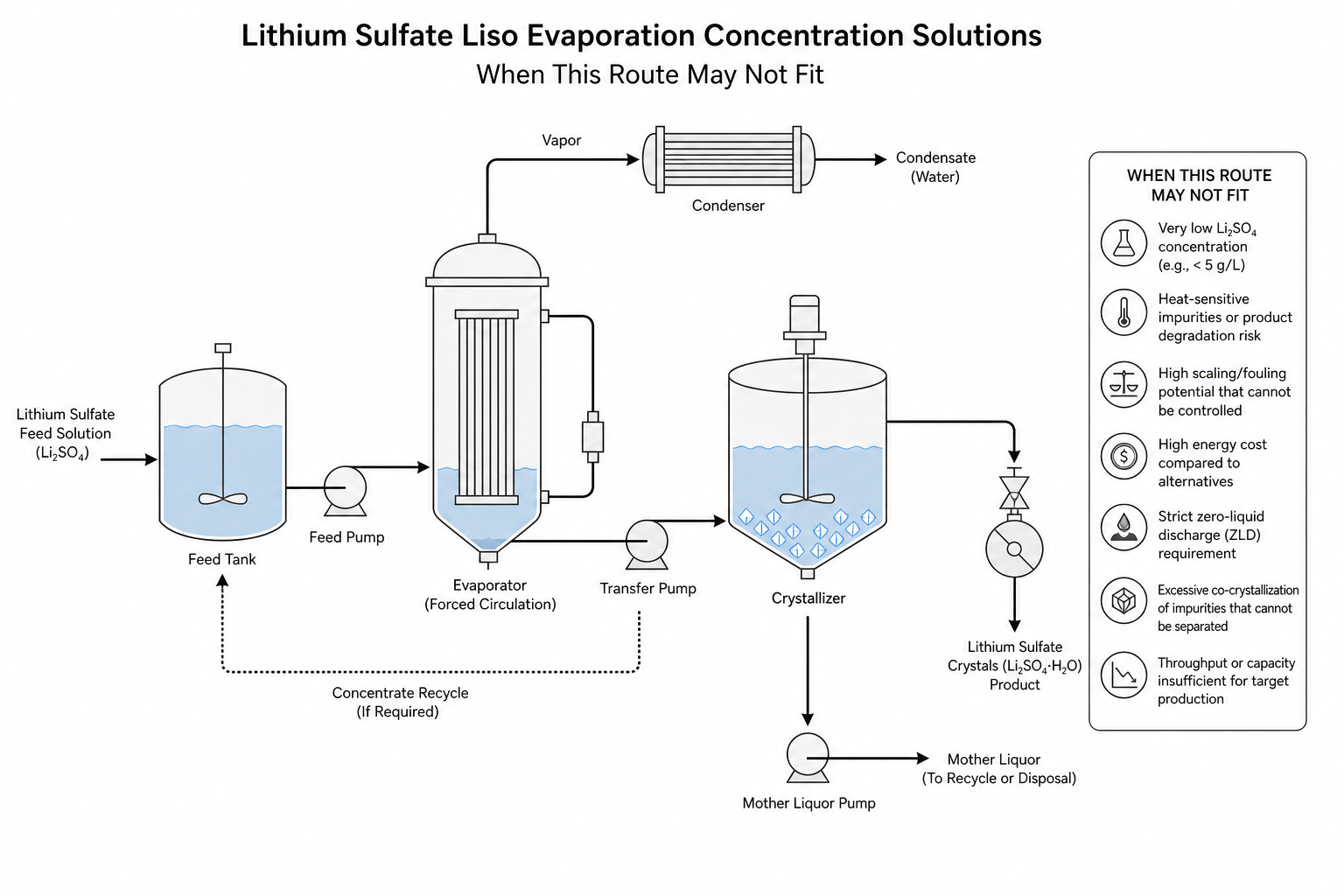
This page’s logic assumes a spodumene-style refinery whose middle flowsheet runs through lithium sulfate liquor. Plants on brine or clay routes, or recyclers whose lithium already arrives as carbonate or hydroxide, have no equivalent concentration duty, and importing this train there buys stainless solutions to non-existent problems. MVR specifically misfits sites where electricity is expensive and steam is a by-product of the roast: the multi-effect alternative uses what the site already flares. Very small or campaign-based duties also favor simpler single-effect equipment, because compressor capital only amortizes across continuous running. And where purification upstream cannot deliver a clean, stable liquor — hardness and sodium still swinging — the evaporator will convert that instability into scaling and lithium losses no vendor can warrant away.
What Must Be Verified
Before a lithium sulfate concentration project is committed, the following must be verified against site data rather than the illustrative envelope above. A full purified-liquor analysis — Li2SO4 strength, pH, and residual sodium, potassium, calcium, magnesium, iron, aluminum, chloride — because the concentration endpoint, scaling risk, and alloy plan all follow from it. The exact target concentration fixed by downstream stoichiometry, with the sodium sulfate saturation margin calculated at end-of-concentration conditions. Boiling point elevation at target strength, checked against available compressor lift. Entrainment and scrubber performance criteria tied to condensate lithium limits. Utilities pricing that fixes the MVR-versus-multi-effect decision on numbers, not preference. And a lithium water-balance audit across startup, shutdown, and CIP events, because wash water dumped at transitions is lithium surrendered without a fight.
FAQ
Why does lithium sulfate need to be concentrated before precipitation?
Because precipitation chemistry and economics both demand it. Spodumene leach liquor after purification contains roughly 100 g/L counted as Li2SO4 — too dilute for efficient lithium carbonate or hydroxide precipitation, which wastes precipitation chemicals and drops yield. Concentration to about 200-220 g/L counted as Li2SO4 (Li2O about 55-60 g/L) is the established window where downstream conversion runs efficiently.
Why is MVR preferred over multi-effect evaporation for Li2SO4?
The duty is continuous, large and steam-hungry — exactly where MVR wins. The compressor recovers and upgrades secondary vapor as the heating medium, so live steam is essentially a startup utility and energy arrives as cheaper electricity. The small temperature lift also means gentle evaporation with less scaling, and the systems run fully automated with CIP capability.
What capacity is typical for a lithium sulfate MVR evaporator?
Vendor-published installation references include a 20,000 kg/h water-evaporation system concentrating lithium sulfate liquor with titanium wetted parts, and a 5 m³/h turnkey MVR evaporation-crystallization system recovering lithium sulfate product from lithium-bearing concentrate water. Systems are scaled to the refinery’s leach and purification output.
Can lithium be recovered from the wastewater streams around the plant?
Yes, and it is usually worth doing. Published flowsheet analysis puts high-salinity wastewater at roughly 4–5% of plant lithium load: carbonation blowdown carries about 1,500–2,000 mg/L lithium in near-saturated sodium sulfate, and LiOH-route boil-out liquors carry concentrated lithium. Concentration-plus-crystallization recovers it as lithium carbonate or phosphate while simultaneously achieving the discharge or ZLD compliance the stream needed anyway.
What materials should a lithium sulfate evaporator use?
Standard practice for battery-material evaporators is titanium (TA2) for product-wetted parts with SS304 or carbon steel for non-wetted sections — the vendor-published Li2SO4 MVR reference follows exactly this split. Verify chloride content in the feed first: hot acidic sulfate with chloride traces justifies titanium throughout the wetted path.
Next step: send your purified-liquor analysis, evaporation duty, and target concentration, and receive a first-pass screening of the process direction and boundary conditions — inputs exchanged for engineering direction.