Throughput is the first divide in evaporator selection, and it decides the technology before any vendor conversation starts. Below 300 L/h of distillate, a single-effect unit is usually sufficient and 20–40% cheaper than a multi-effect alternative. Between 300 and 500 L/h you are in the transition zone: multi-effect becomes rational when steam costs more than $0.02/kg and the plant runs more than 4,000 hours per year (a widely used industry rule of thumb). Above 500 L/h, multi-effect evaporation establishes a clear advantage, and above roughly 5,000 L/h the conversation shifts to four effects or mechanical vapor recompression (MVR).
This article walks through the thresholds, the baseline performance numbers behind them, the total-cost-of-ownership logic that scales with flow rate, and the secondary decisions — rent versus buy, standard versus custom, skid versus field-erected — that follow from the size of your project.
The First Divide: Throughput Thresholds
Evaporator sizing is not a smooth continuum. It behaves as a series of stepped regimes, because each technology family has a volume range where its economics dominate. A single-effect evaporator is the simplest and cheapest structure, and it remains the first choice for small flows, research, pilot work, and multi-product batch schedules. Multi-effect systems recover energy by cascading vapor from one effect to the next, which only pays back when there is enough water to evaporate.
| Throughput (distillate) | Recommended configuration | Rationale |
|---|---|---|
| Below 300 L/h | Single-effect | 20–40% lower capital cost; capacity is adequate; simplest to operate |
| 300–500 L/h | Transition zone | Multi-effect becomes rational when steam exceeds $0.02/kg and runtime exceeds 4,000 h/year |
| Above 500 L/h | Multi-effect (MEE) | Energy recovery advantage is firmly established |
| Above 5,000 L/h | Four effects or MVR | Large continuous flows justify the deepest energy-recovery investment |
The transition zone deserves special attention because it is where most misselection happens. A plant running 400 L/h with cheap self-generated steam and intermittent campaigns will often be better served by a well-sized single-effect unit than a marginal double-effect system that never reaches steady state. Conversely, a 24/7 operation at 450 L/h with purchased steam at $0.03/kg will recover the multi-effect premium quickly.
Baseline Numbers: Single-Effect vs Multi-Effect
Comparisons between evaporator types are only useful when they share the same measurement basis. Two metrics matter most: steam consumption expressed as kg of live steam per kg of distillate, and throughput expressed as liters of distillate per hour for a given reference unit. Figures below are typical published values for reference-size commercial units; site steam pressure, temperature approach, and metallurgy shift them.
| Metric | Single-effect | Double-effect | Four-effect |
|---|---|---|---|
| Steam consumption (kg/kg distillate) | 1.1–1.3 | 0.55–0.65 | 0.30–0.35 |
| Water production rate (L/h, reference unit) | 80–90 | 160–180 | 320–360 |
| Steam cost per tonne of distillate (at $0.02/kg steam) | ≈ $24 | ≈ $12 | ≈ $7 |
| Installation cost | $45k–60k | $75k–90k | $120k–150k |
| Annual maintenance | $3k–5k | $5k–8k | $8k–12k |
| Start-up time to stable operation | 15–30 minutes | Longer | Several hours |
The payback math for multi-effect is straightforward. With steam priced in the $0.01–0.03/kg band, multi-effect systems typically reach investment payback in 8 months to 2 years (industry-reported) — the more expensive the steam, the faster the recovery. The installation-cost premium of a double-effect over a single-effect unit ($75k–90k versus $45k–60k) is repaid by halved steam consumption, provided the running hours are there to accumulate the savings.
Why Single-Effect Still Wins Below 300 L/h
The enduring case for single-effect is not just the lower purchase price. It is operational flexibility. A single-effect unit reaches stable operation in 15–30 minutes, cleaning downtime is short, and maintenance points are few and accessible. A multi-effect system needs several hours to reach steady state after start-up, and its more complex structure multiplies the maintenance surfaces.
For R&D departments, pilot plants, and small-batch production, this responsiveness outweighs energy economics. The same logic applies to facilities that rotate between products: two or three single-effect units are often a better answer than one multi-effect system, because each batch can be started, cleaned, and changed over independently. In intermittent duty with frequent start-stop cycles, the total cost of a single-effect installation can actually be lower than a multi-effect one, because the multi-effect advantage only materializes at steady state.
Before committing, ask three screening questions. Can the existing steam system absorb the full live-steam load of a single-effect unit, or only the partial load of a multi-effect one? Is space constrained, given that multi-effect trains are physically larger? Is the delivery schedule tight — single-effect units generally ship faster?
MVR vs Multi-Effect at Large Scale
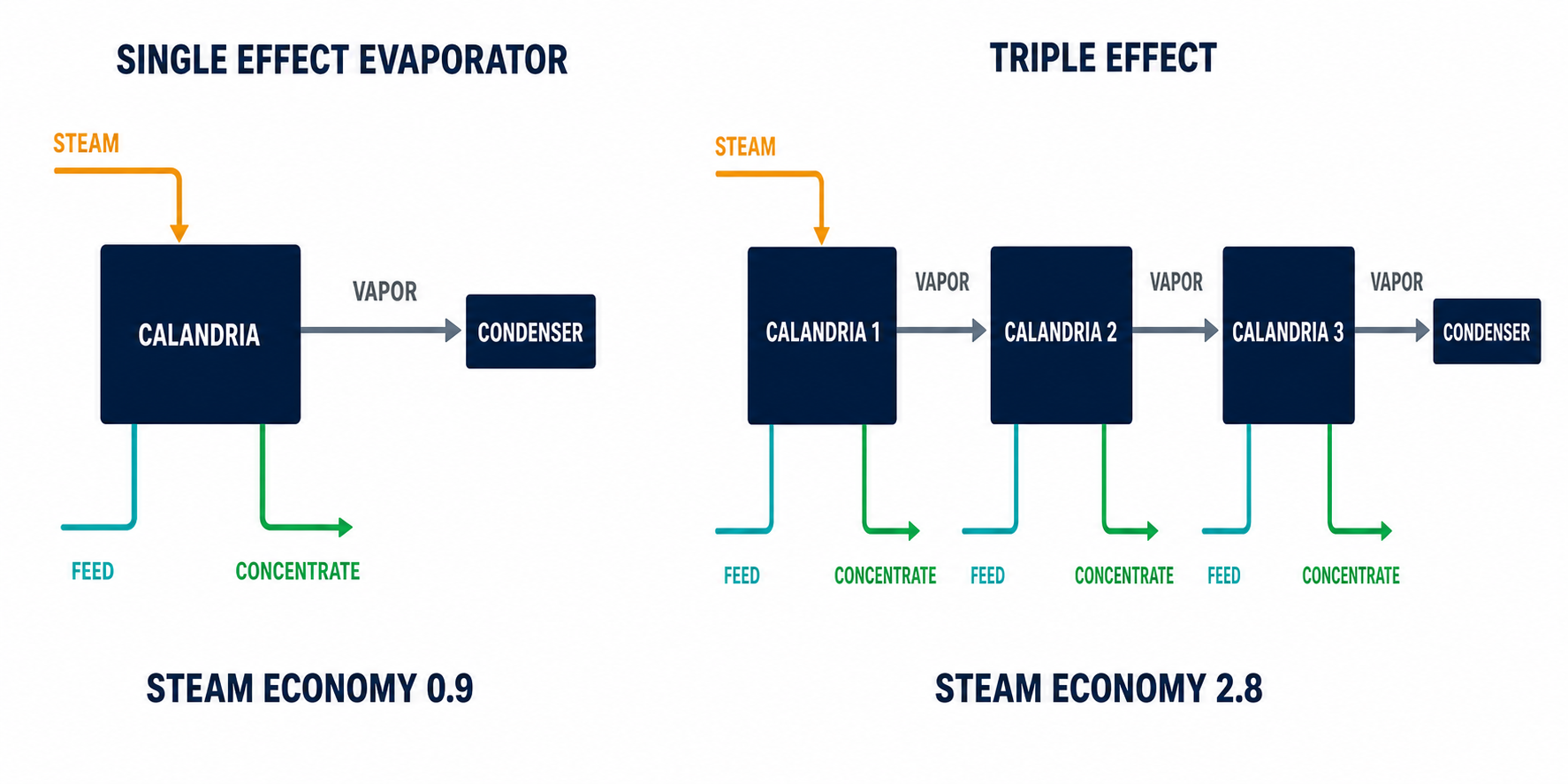
Once flows are large and continuous, the real contest is between MVR and multi-effect evaporation. The cleanest way to compare them is steam economy — kilograms of fresh steam per kilogram of water evaporated. On this common basis: single-effect is roughly 1.1; double-effect roughly 0.55–0.6; four-effect roughly 0.30–0.35. An MVR system needs fresh steam only for start-up; in stable operation it approaches zero fresh-steam consumption and instead draws 15–30 kWh of electricity per ton of water evaporated (industry-reported). For reference, a three-effect MEE consumes about 0.3–0.45 tons of steam per ton of water (industry-reported values).

MVR carries a 30–50% higher initial investment than MEE (supplier-quoted indicative), but its operating cost is lower, and typical payback lands in the 1.5–3 year range (industry-reported). MVR suits large continuous flows, particularly where electricity is favorable; MEE suits mid-scale plants, cheap steam, and batch operation.
Total Cost of Ownership Scales the Decision
Total cost of ownership = CAPEX + (energy + labor + consumables) × years of operation. The larger the throughput, the heavier the OPEX term weighs in that sum — and the more the MVR capital premium is offset by operating savings. At large flow rates, the CAPEX premium of MVR is typically absorbed by OPEX savings within 2–5 years (industry-reported), with the exact figure governed by the local electricity-to-steam price ratio.
Energy price sensitivity therefore decides the branch: expensive steam plus cheap electricity points to MVR; self-supplied steam (waste-heat boiler or cogeneration) favors MEE; expensive electricity favors MEE, optionally upgraded with a thermal vapor recompressor (TVR). For mid-scale plants that already have boilers, a TVR retrofit is cheaper than an MVR conversion because it requires no large compressor, and its energy improvement lands between plain MEE and full MVR.
Rent vs Buy: The Small-Flow Perspective
In markets where wastewater volumes are modest — the common frame in North America — the scale decision is often phrased in gallons per week rather than liters per hour. A useful bracketing: below 1,000 gallons per week, a drum evaporator or a rental unit is usually the right answer; between 1,000 and 10,000 gallons per week, purchase of a small thermal evaporator; above 10,000 gallons per week, a large system, equipped with MVR or a vacuum heat pump (VHP) to reach the lowest operating cost.
Four factors decide rent versus buy. Water volume and variability: stable long-term flow supports purchase, volatile flow supports rental. Compliance deadlines: a rental can be online immediately, while purchased equipment has a lead time. Cash flow: constrained CAPEX budgets point to monthly rental payments. Maintenance responsibility: rental agreements usually include maintenance, while ownership does not.
Hybrid arrangements resolve the common mismatch between average and peak flow. A plant running 1,000 gallons per week in normal months and 3,000 in peak season can buy a base unit and rent a supplementary unit for the peak — avoiding permanent overcapacity. At the equipment level, the analogous strategy is a standard chassis with custom modules: the body follows a well-established standard design, while the heat-transfer area, metallurgy, or crystallization section is matched to the actual wastewater chemistry.
Standard vs Custom: Judge the Project, Not the Budget
A standard evaporator is the right purchase when the project is “normal”: the waste stream falls within typical ranges for TDS, pH, and corrosivity; the throughput sits inside the standard size spectrum; the budget is tight; or the delivery window is short. Standard units ship faster, cost less, carry well-documented reliability, and use interchangeable spare parts.
Custom engineering becomes necessary for “abnormal” streams: highly corrosive, heavily fouling, high-viscosity, or heat-sensitive materials; extreme throughputs outside the standard spectrum; deep integration with existing plant systems; or regulatory requirements for certified special materials. Custom designs cost more, take longer to engineer, carry commissioning risk, and need dedicated spares.
The lifetime accounting often reverses the sticker-price comparison. A custom unit with the right metallurgy can outlast three standard units; a standard unit matched to the wrong stream fouls and corrodes into early retirement. The correct decision criterion is not budget size but whether the project is normal — and for most projects between the extremes, the standard-chassis-plus-custom-modules approach is the optimum.
Skid-Mounted vs Field-Erected
Size also decides how the system is delivered. Smaller systems ship as skid-mounted modules that are pre-assembled, pre-piped, and factory-tested before shipment, which compresses site installation to positioning, hooking up utilities, and commissioning. Factory testing before delivery is the key quality gate — problems are found on the vendor’s floor, not in your plant. Very large systems exceed transport size limits and must be field-erected, trading longer site work and more on-site welding for unlimited dimensions. Mid-size projects can split the difference with modular skids that bolt together on site.

Planning for Expansion
If throughput growth is on the horizon, decide early between modular parallel expansion and a single full-size installation. Parallel modular trains — common in MVR and skid-mounted plants — let capacity follow demand: each train runs near its efficient operating point, and a fouled or serviced train does not idle the whole system. The trade-offs are more footprint, more shared headers and interconnecting piping, and a slightly higher cost per unit of capacity. A single large system is cheaper per unit capacity and simpler to operate but runs inefficiently at part load and caps your ceiling. As a rule of thumb, size the first installation for confirmed near-term demand, reserve plot space and utility margins for a future train, and avoid paying today for a peak that may never arrive.
FAQ
At what throughput should I move from single-effect to multi-effect?
Below 300 L/h, single-effect is usually sufficient and 20–40% cheaper. Between 300 and 500 L/h, choose multi-effect when steam costs more than $0.02/kg and annual runtime exceeds 4,000 hours (industry rule of thumb). Above 500 L/h, multi-effect is the default choice.
Is MVR always better than multi-effect for large plants?
No. MVR carries 30–50% higher initial investment (supplier-quoted indicative) and suits large continuous flows where electricity is favorably priced. If the plant self-generates cheap steam from a waste-heat boiler or cogeneration, multi-effect usually wins; expensive electricity also favors MEE, optionally with a TVR upgrade.
What is the payback period for upgrading to multi-effect?
With steam priced between $0.01 and $0.03/kg, multi-effect systems typically pay back in 8 months to 2 years (industry-reported). The more expensive your steam, the faster the recovery.
Should I rent or buy a wastewater evaporator?
Buy when flow is stable and long-term and CAPEX is available; rent when flow is volatile, a compliance deadline is imminent, or maintenance responsibility should sit with the vendor. Below 1,000 gallons per week, a drum evaporator or rental is often sufficient; above 10,000 gallons per week, purchase a large system with MVR or a vacuum heat pump.
When does a custom evaporator make sense over a standard unit?
When the stream is abnormal — highly corrosive, fouling, viscous, or heat-sensitive — or the throughput is extreme, or the system must integrate deeply with existing plant. For normal projects, standard units deliver shorter lead time, lower cost, and interchangeable spares; a standard chassis with custom modules covers most in-between cases.