
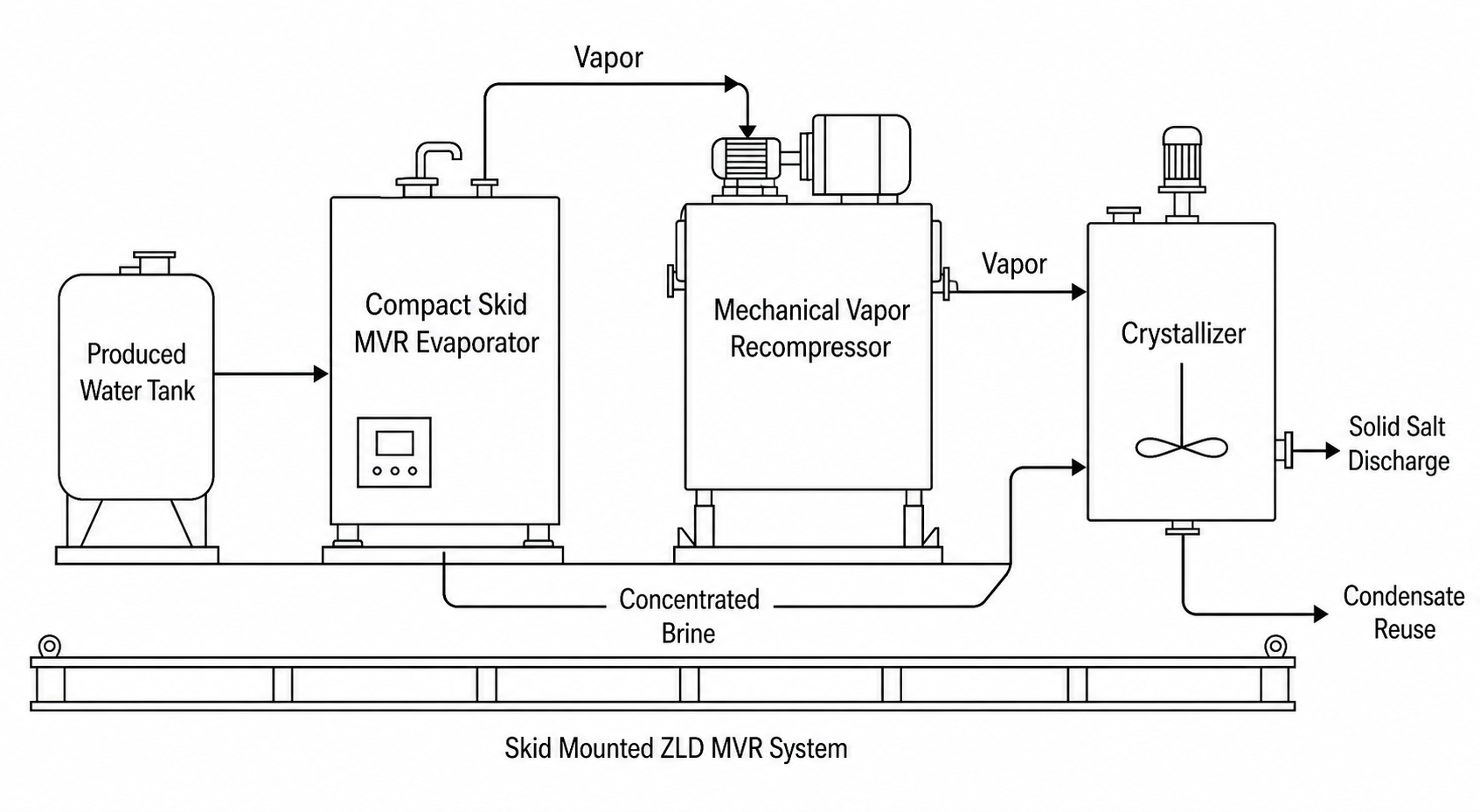
Project Parameters
| Parameter | Value |
|---|---|
| Process route | Skid-mounted MVR evaporation + crystallization (modular ZLD) |
| Industry | Oil & gas — gas field produced water (Northwest China) |
| Feed type & key components | High-salinity produced water from gas field operations; scaling-prone TDS with hydrocarbon traces |
| Capacity | 72 t/d |
| Construction format | Skid-mounted modular package, approx. one-third the footprint of conventional construction (published figure) |
Representative process configuration compiled from published industry project data. Indicative values, not a process guarantee.
Project Description
Gas fields in Northwest China produce water with the gas — formation brine and flowback that arrive at the well site already far too saline for discharge or reinjection in some formations. Hauling it away by truck is the default answer, and its cost scales with distance into terrain where distance is the defining feature. The reference configuration is a 72 t/d skid-mounted MVR evaporation plant at a gas field operated by a major national oil company: a zero-liquid-discharge package sized for well-pad economics, where the produced water is desalinated on site and the trucking problem disappears with the water volume.
The published engineering figure behind the configuration is its footprint: the skid-mounted design occupies roughly one-third the volume of a conventional field evaporation plant of the same duty — the difference between a package that ships as modules to a remote pad and a stick-built plant that cannot exist there at all. Comparable published configurations in the same region run 6 t/h MVR forced-circulation service for oilfield produced water treatment, confirming the technology’s regional standing.
Process Technology
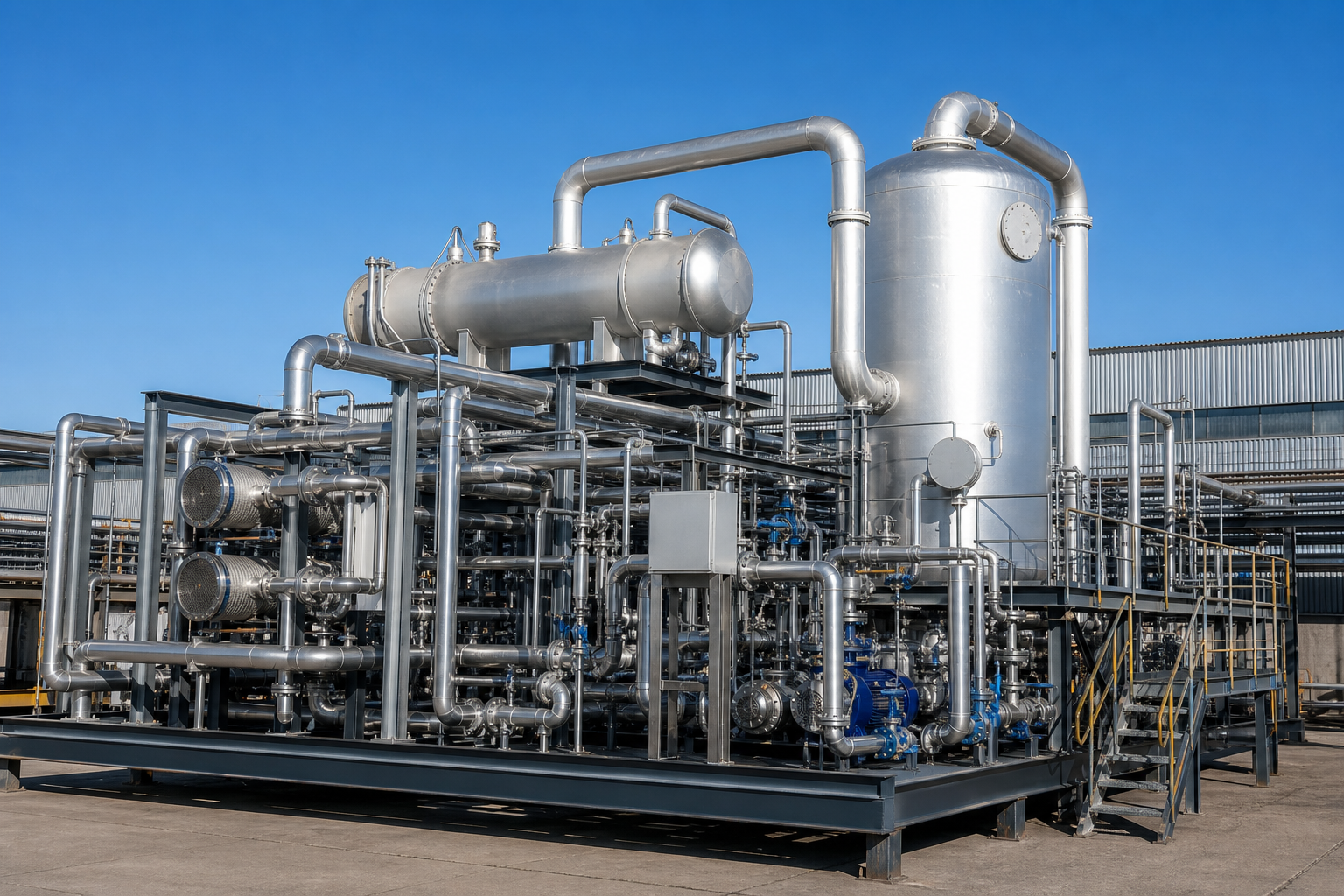
Produced water is collected from the wellsite gathering system, degassed for dissolved hydrocarbons, and conditioned: oil and grease removal protects the heat transfer surfaces, and softening manages the calcium and magnesium that would otherwise scale the evaporator — produced water is scaling chemistry by definition, and the pretreatment is what makes the thermal section maintainable at a remote site.
The conditioned brine enters the skid-mounted MVR evaporator. Mechanical vapor recompression drives the train electrically — well pads have power before they have steam, and an electrically driven evaporation package matches the site’s utility reality. The evaporator runs in forced circulation, the service for scaling-prone produced-water brines: pumped velocity holds the heat transfer surface in service between maintenance visits that are expensive to make at remote locations.
Concentration proceeds to crystallization: the salts precipitate as a mixed slurry, are centrifuged to a dry solid for compliant handling, and leave the site as a trucked solid — a volume reduction of orders of magnitude against trucking brine. Mother liquor recycles with a purge; condensate — the majority of the stream by mass — is recovered clean for reuse in field operations or controlled discharge per permit.
The modular format carries through the whole engineering: the plant ships as transportable skids, lifts onto a prepared pad, and is piped and wired into the produced water header. Maintenance philosophy matches — cartridge-style service, minimal on-site craft labor, cleaning cycles tuned to the staffing a remote pad actually has.
Equipment Configuration
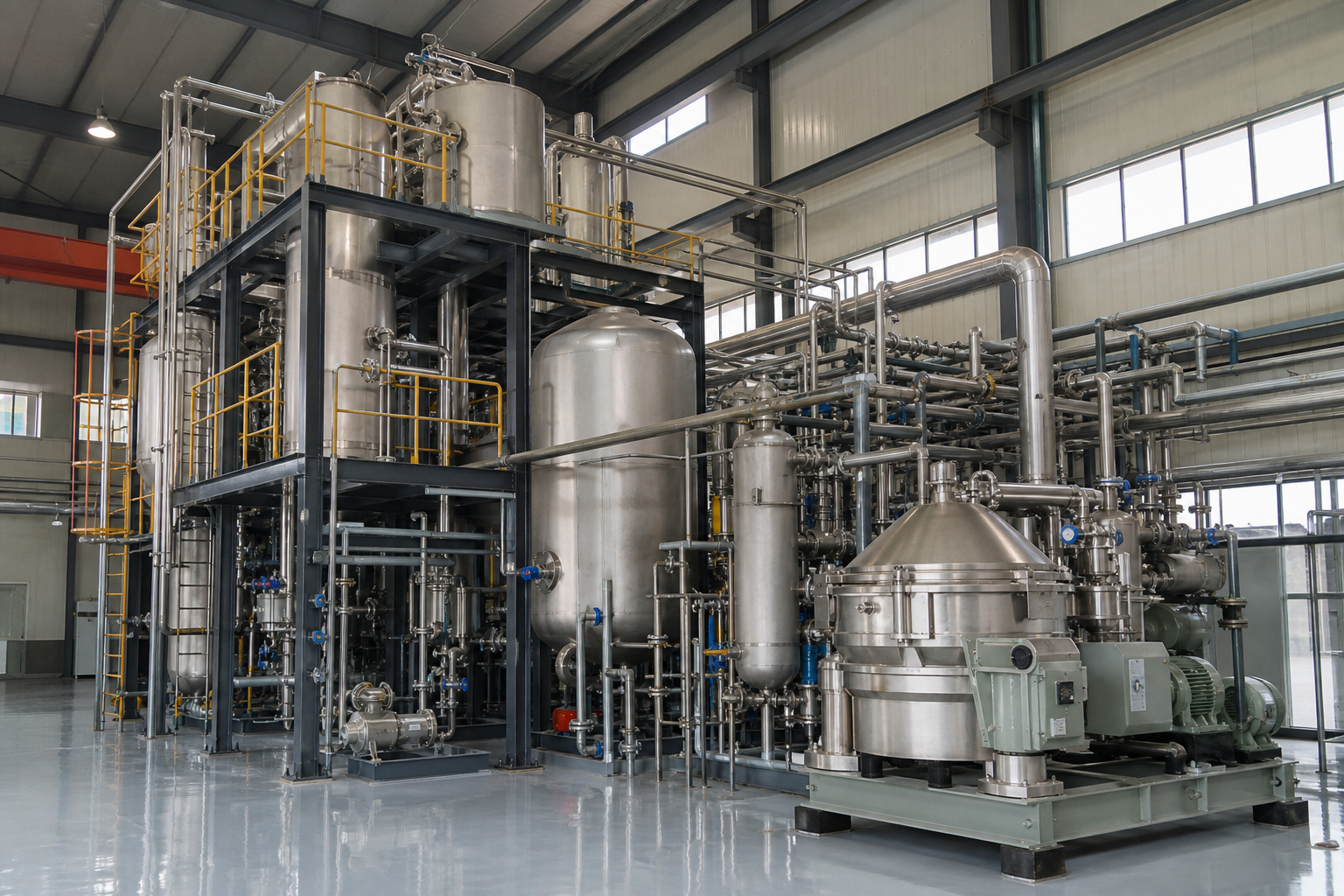
One set of the following equipment is typical for this duty:
- Produced water collection, degassing, oil removal and softening pretreatment
- Skid-mounted MVR forced-circulation evaporator with mechanical vapor recompressor
- Crystallization stage with centrifuge for dry mixed-salt handling
- Mother-liquor return and purge; condensate recovery for field reuse
- Modular transportable construction (approx. 1/3 conventional volume per published figure)
- Package PLC control with remote monitoring for unmanned well-pad operation
Performance & Outcome
Compiled from published industry project data (the published record includes the footprint figure): modular construction at approximately one-third conventional volume; 72 t/d produced water desalinated to a dry solid and recovered condensate. Specific energy and salt characterization are quoted per project water chemistry.


