Project Parameters
| Parameter | Value |
|---|---|
| Process route | MVR evaporation + staged (fractional) crystallization |
| Industry | New materials / battery chemicals (Central China, Jiangxi) |
| Feed type & key components | Lithium-sodium mixed process solution; lithium values with sodium co-salt |
| Evaporation capacity | 25 t/h |
| Construction materials | SS316L wetted parts (indicative for sulfate service) |
Representative process configuration compiled from published industry project data. Indicative values, not a process guarantee.
Project Description
Wherever lithium is processed, sodium follows — into the liquor through soda ash precipitation, through feedstock chemistry, through washing. At a new-materials plant in Jiangxi, Central China, a 25 t/h mixed lithium-sodium solution demanded a separation train: recover the lithium to the process, discharge the sodium as a clean salt, and keep the two from contaminating each other. The reference configuration is the MVR evaporation and staged crystallization package built for that duty.
The engineering core is solubility arithmetic. Lithium and sodium salts crystallize at different points on the concentration-temperature map, and a staged crystallization flowsheet walks the liquor through those points in sequence: one salt drops out where the other stays dissolved, and each pass upgrades the separation. The alternative — unselective evaporation to a mixed salt — buries lithium values in a waste product and buys a separation problem downstream instead of solving one. Comparable published configurations in the same segment run 10 t/h sodium sulfate-lithium sulfate co-crystallization service and 20 t/h nickel-cobalt mixed solution trains, confirming mixed-salt MVR crystallization as standard practice across the battery-chemicals cluster.
Process Technology
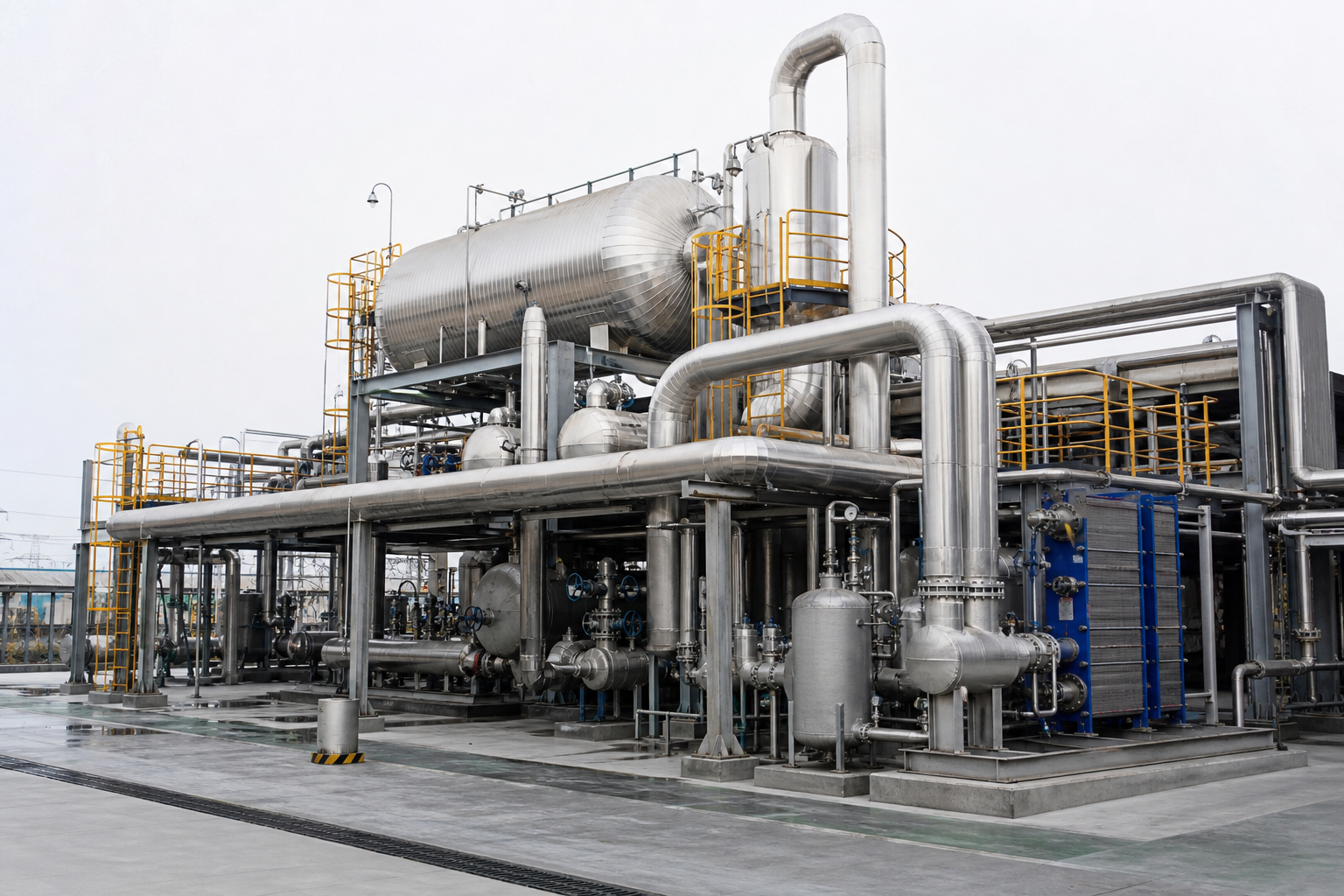
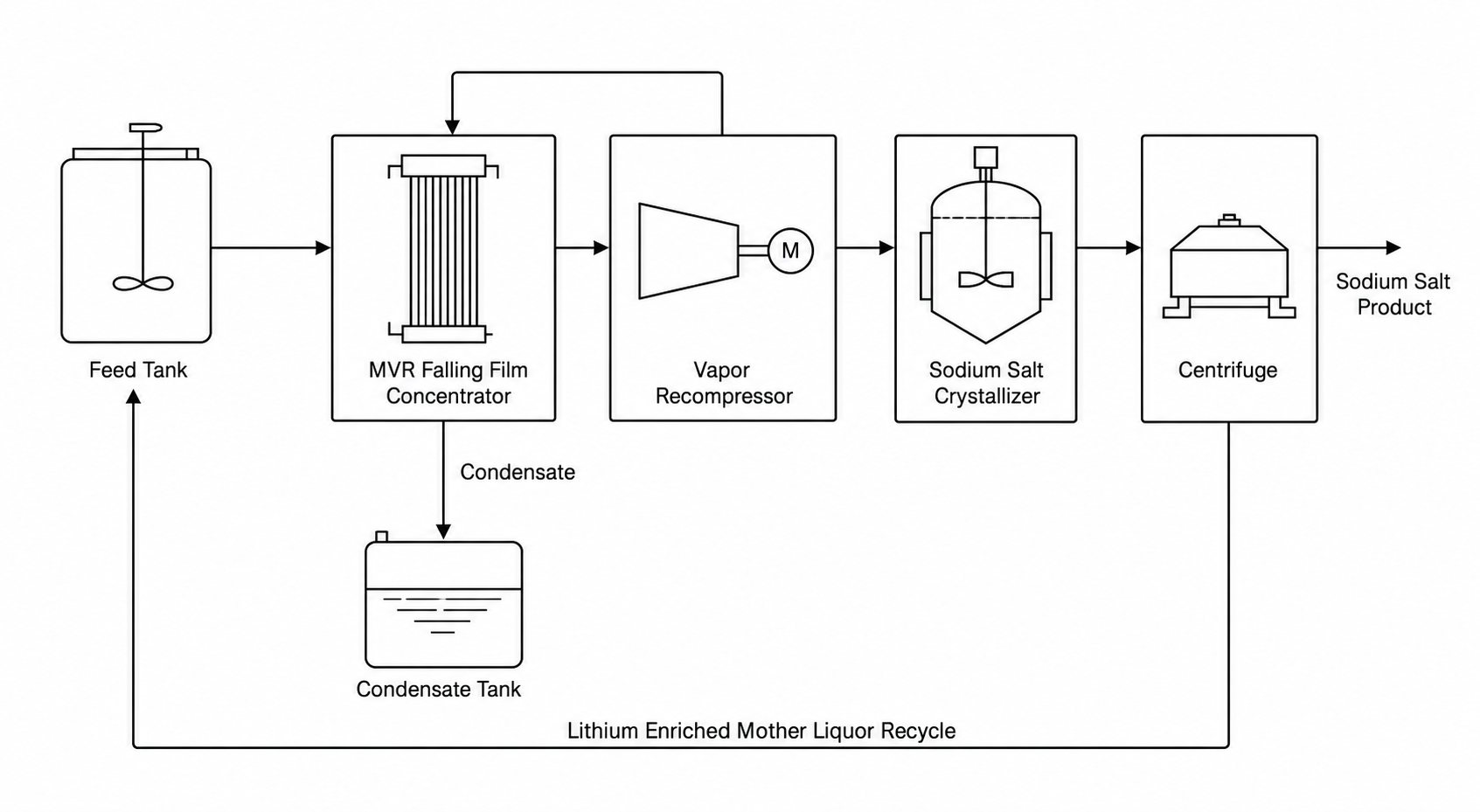
The mixed solution is equalized and filtered, then enters the MVR evaporator. Mechanical vapor recompression drives the concentration electrically: the compressor lifts secondary vapor to heating duty, and the liquor climbs toward the first crystallization point with no live steam in the process. Falling-film service carries the early concentration where the liquor is thin and heat transfer is cleanest.
As saturation approaches, the train stages its crystallization. The sodium salt — the bulk carrier — crystallizes first in its designed zone; crystals are centrifuged out as a dewatered by-product salt, and the mother liquor, now enriched in lithium relative to sodium, advances. Temperature and concentration control the cut points: each crystallizer holds its zone’s conditions so the salt that drops out is the salt the flowsheet intended.
The lithium-enriched mother liquor recycles to the front of the plant’s lithium circuit, closing the value loop; a purge on the recycle bounds the impurity inventory. Condensate from the train is recovered hot and clean for process water. The whole separation runs on electricity and solubility — no chemistry added, just the phase behavior of the salt system engineered into equipment, with density and temperature instruments at each crystallizer holding the cut points the flowsheet depends on.
Equipment Configuration
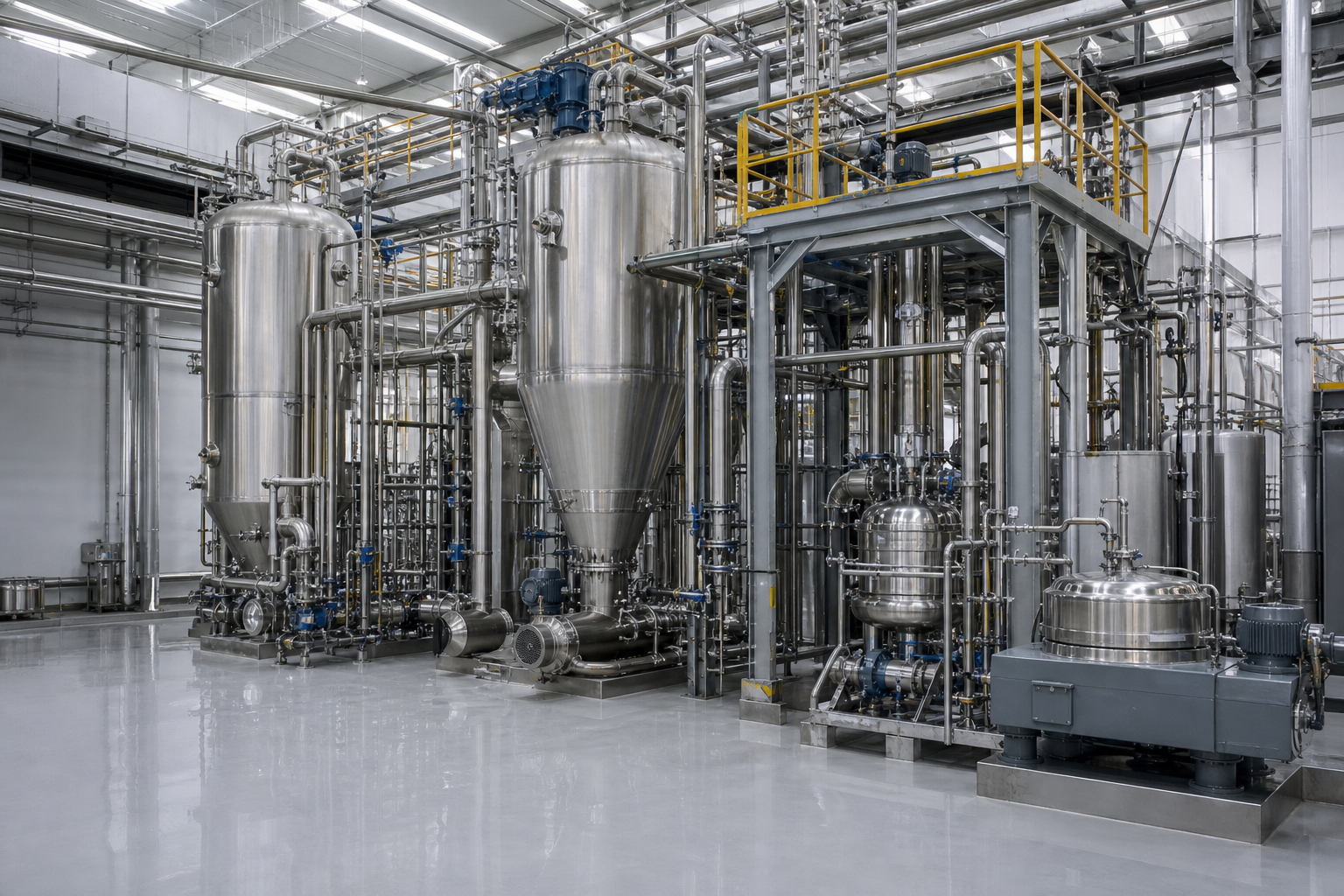
One set of the following equipment is typical for this duty:
- Feed equalization and filtration
- MVR falling-film concentrator with centrifugal vapor recompressor
- Staged crystallizers with zone-controlled temperature and concentration
- Centrifuge for by-product sodium salt dewatering
- Lithium-enriched mother liquor recycle with purge management
- PLC/DCS control of cut points, densities and crystal inventories
Performance & Outcome
Compiled from published industry project data, indicative: trains of this class separate mixed lithium-sodium solutions into by-product salt and lithium-enriched recycle on MVR energy, with condensate recovered as process water. Separation sharpness and specific energy are quoted per project solution chemistry.
A comparable process routing is covered in Lithium Recovery from Industrial Waste Liquid Evaporation Solution.