Project Parameters
| Parameter | Value |
|---|---|
| Process route | Four-effect falling-film evaporation with deammoniation duty |
| Industry | Fermentation — amino acid complex (lysine) |
| Feed type & key components | Lysine solution; dissolved ammonia / ammonium species, fermentation residuals |
| Evaporation capacity | 50 t/h |
| Plant context | Integrated fermentation-industrial complex, Xinjiang |
| Region | Xinjiang, Northwest China |
Representative process configuration compiled from published industry project data. Indicative values, not a process guarantee.
Project Description
Amino-acid complexes in China’s northwest are built on scale and integration: fermentation, extraction and evaporation utilities planned as one industrial organism. The published project behind this configuration is the evaporation piece of such an organism in Xinjiang — a 50 t/h four-effect falling-film train concentrating lysine solution with deammoniation as an explicit duty of the same step.
The ammonia matters as much as the water. Lysine broth streams carry ammonium from the fermentation pH regime; if that ammonia rides through concentration it strips into the vapor circuit, contaminates condensate, and corrodes the vacuum and condensing equipment while discoloring the product liquor. Deammoniation — removing the dissolved ammonia as the liquor concentrates — is therefore not an accessory but a design center: the published configuration combines it with four-effect falling-film concentration in one duty statement.
Process Technology
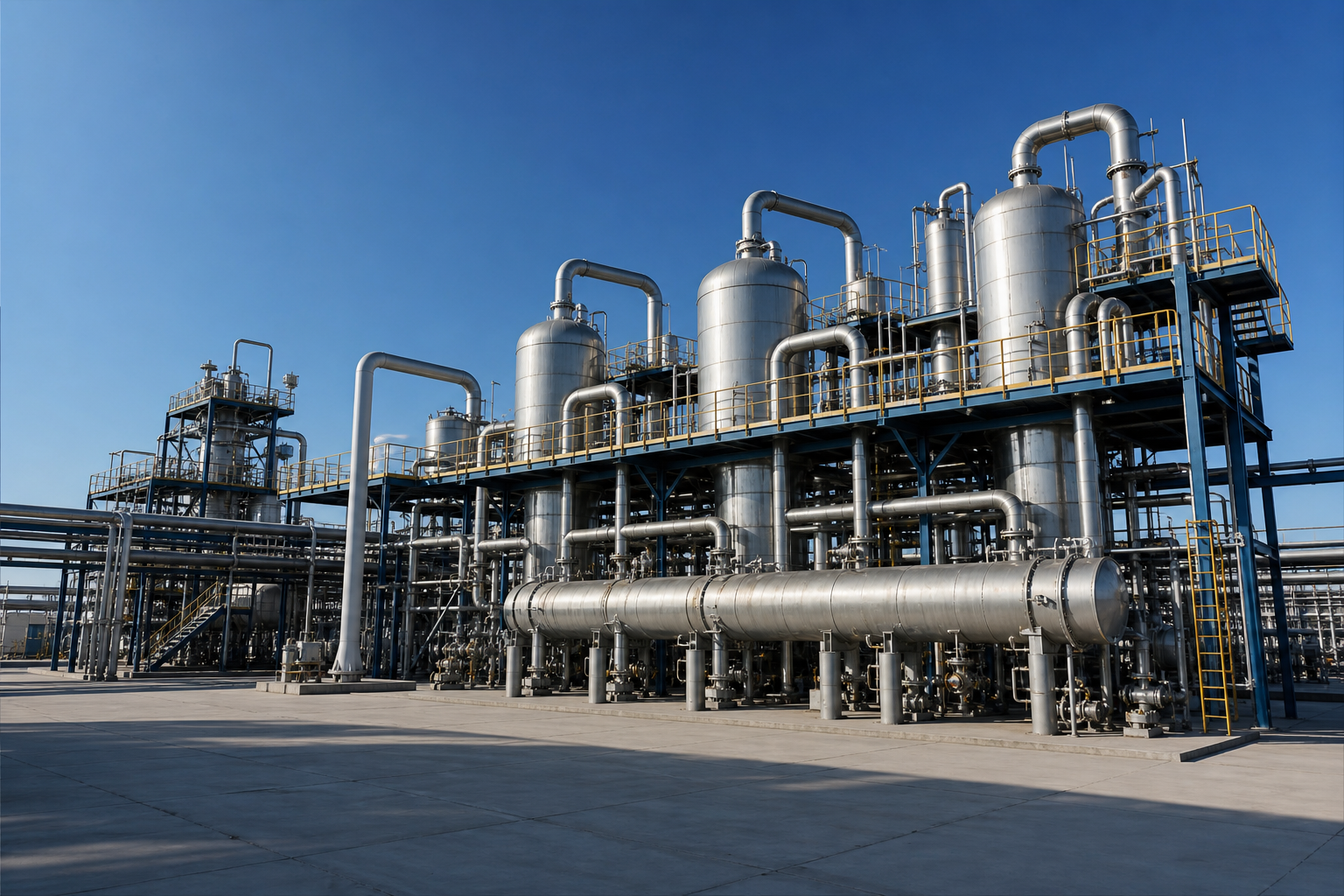
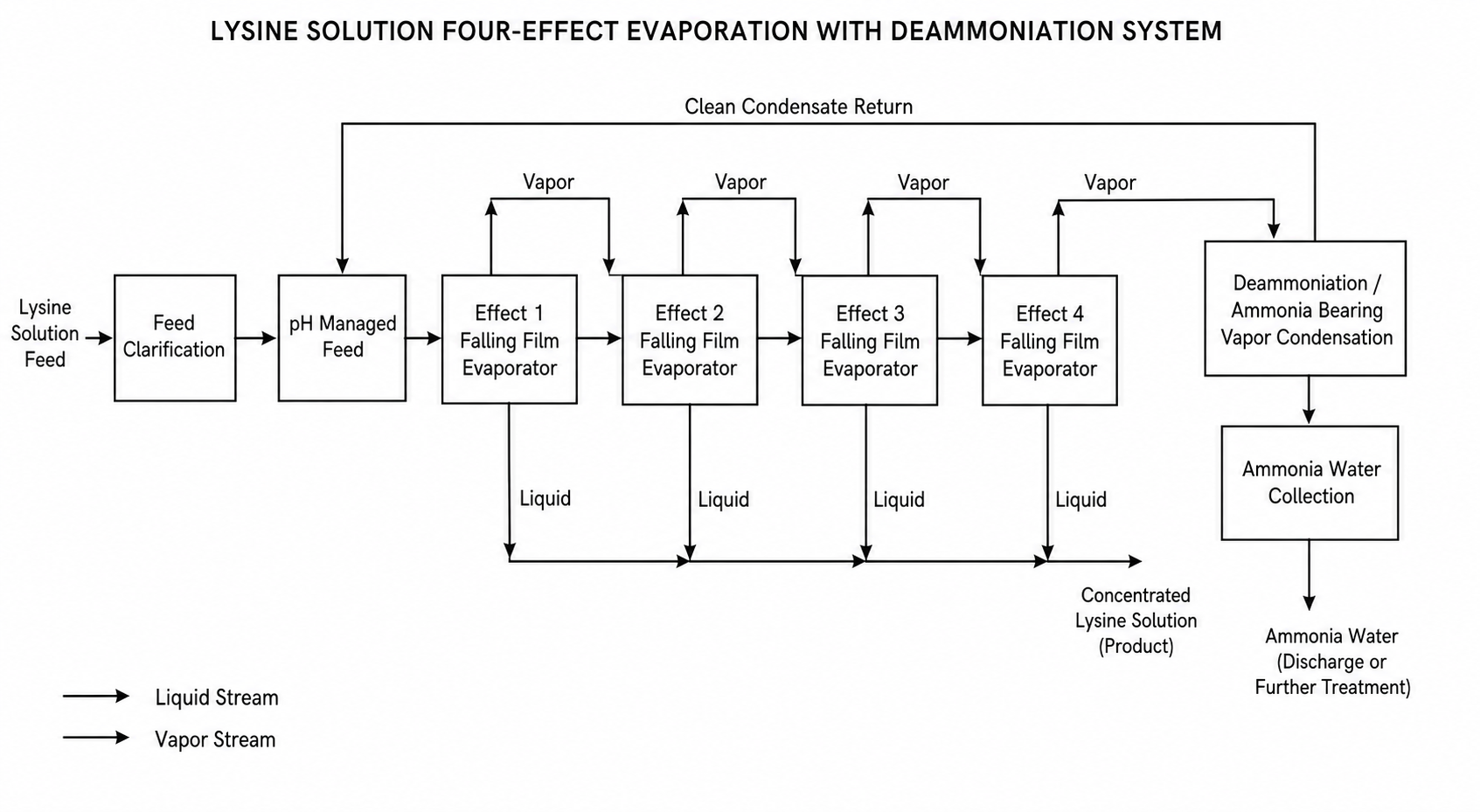
Lysine solution enters the train after clarification. In the first effect, operated under vacuum at gentle temperature, the liquor climbs in concentration while the ammonium equilibrium shifts: as water boils off and pH is managed, dissolved ammonia transfers to the vapor phase preferentially. The vapor-liquid separation and the vapor handling are engineered for this — the ammonia-bearing vapor is condensed in a controlled circuit rather than mixed into the clean condensate header, and the recovered ammonia water is collected as a segregated stream for the complex’s acid-water or fertilizer balance.
Four effects of falling-film geometry carry the bulk concentration. The film mechanism gives the lysine liquor its short hot-surface residence — amino-acid solutions brown under thermal dwell — and the four-effect chain reuses the latent heat four times between the first-effect calandria and the surface condenser. Effect staging under vacuum keeps every body inside the product’s thermal window; distributors sized for the viscosity curve hold film integrity through the train.
The deammoniation duty distributes across the effects logically: the early effects, where ammonia partial pressure is highest, do the stripping work; the later effects polish. pH management in the feed — shifting ammonium toward free ammonia — is the classic lever the process uses to make the transfer efficient, and the condensate segregation proves it: front-end condensate carries the ammonia, back-end condensate runs clean.
Concentrated, deammoniated lysine liquor discharges at the downstream density — feed for evaporation-to-product, spray drying or granulation per the complex’s product slate. Clean condensate returns to the water balance of a plant that, in Xinjiang’s water economy, counts every cubic meter.
Equipment Configuration
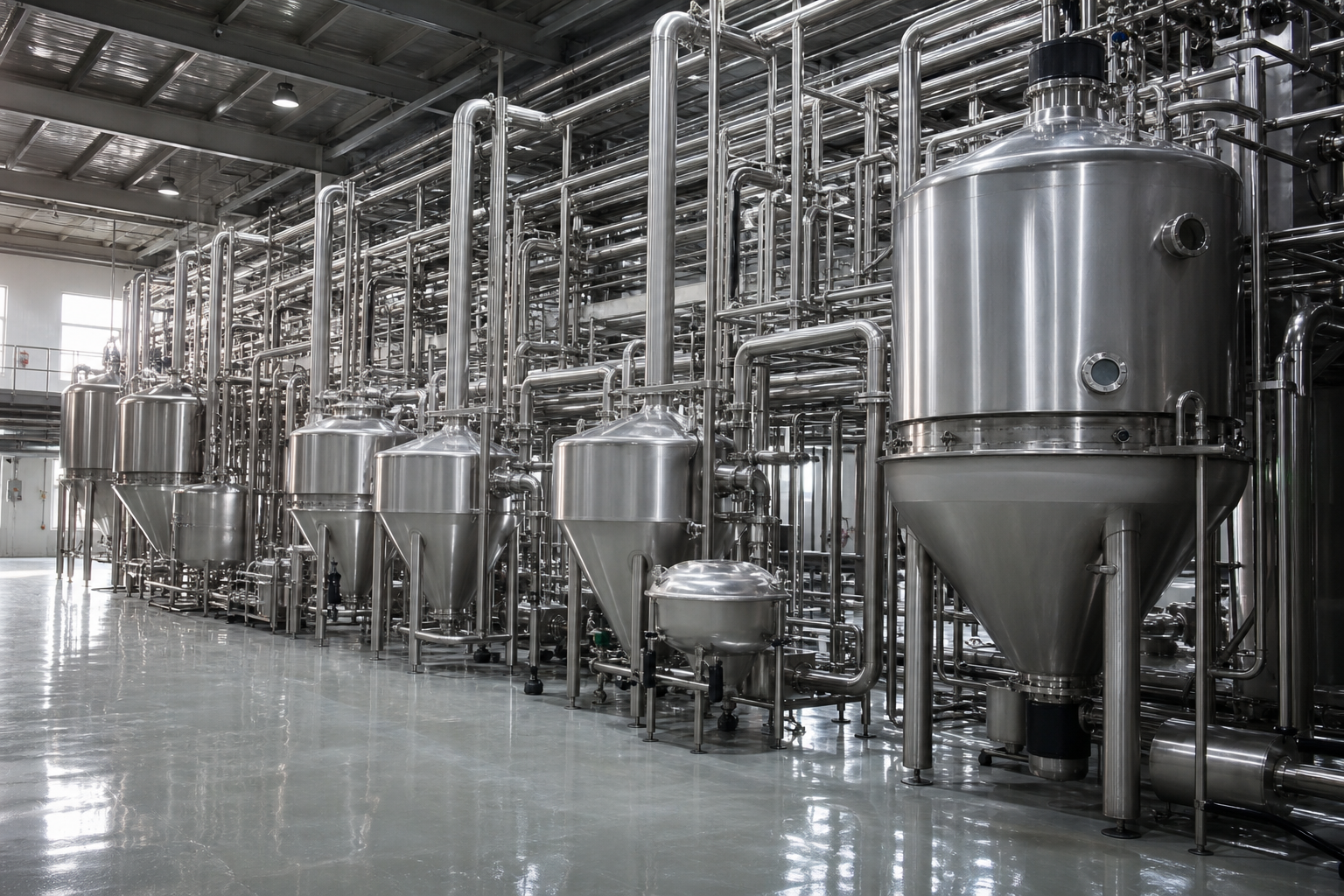
One set of the following equipment is typical for this duty:
- Lysine solution feed tank with clarification
- Four-effect falling-film evaporation train with vacuum staging
- Deammoniation circuit: pH-managed feed, ammonia-bearing vapor handling, segregated condensation
- Ammonia-water collection for plant acid-water / fertilizer balance
- Clean condensate return to the complex water loop
- Surface condenser and vacuum system rated for ammonia service
- PLC control with inline density and pH instrumentation
Performance & Outcome
Compiled from published industry project data, indicative: trains of this class concentrate 50 t/h of lysine solution at four-effect steam economy while transferring ammonia to a segregated condensate circuit, protecting both product color and the clean condensate balance. Ammonia removal efficiency and energy figures are quoted per project liquor chemistry.
Background on the evaporation train selection is available in Fermentation Finishing: Lysine, MSG & Citric Acid.