Project Parameters
| Parameter | Value |
|---|---|
| Process route | MVR forced-circulation evaporation crystallization with centrifuge separation |
| Industry | Rare earth separation / metallurgy (Baotou, Inner Mongolia) |
| Feed type & key components | High-salt RO membrane concentrate from rare earth separation effluent, chloride-dominant |
| Evaporation capacity | 60 m³/d |
| Construction materials | Titanium wetted parts for chloride brine service |
Representative process configuration compiled from published industry project data. Indicative values, not a process guarantee.
Project Description
Baotou is the center of gravity of the world’s rare earth industry, and its separation plants run on salt chemistry: extraction, precipitation and conversion circuits that trade in ammonium and sodium chlorides at industrial scale. The wastewater those circuits generate is treated — typically by membrane recovery trains that pull most of the water back — and the RO concentrate those trains reject is a dense chloride brine carrying the salt the process consumed plus traces of the values it was built to separate.
The reference configuration treats that concentrate at 60 m³/d in Baotou: a compact MVR forced-circulation crystallization train whose job is to be the terminus — the stage where the membrane plant’s reject stream finally stops being a stream.
Process Technology
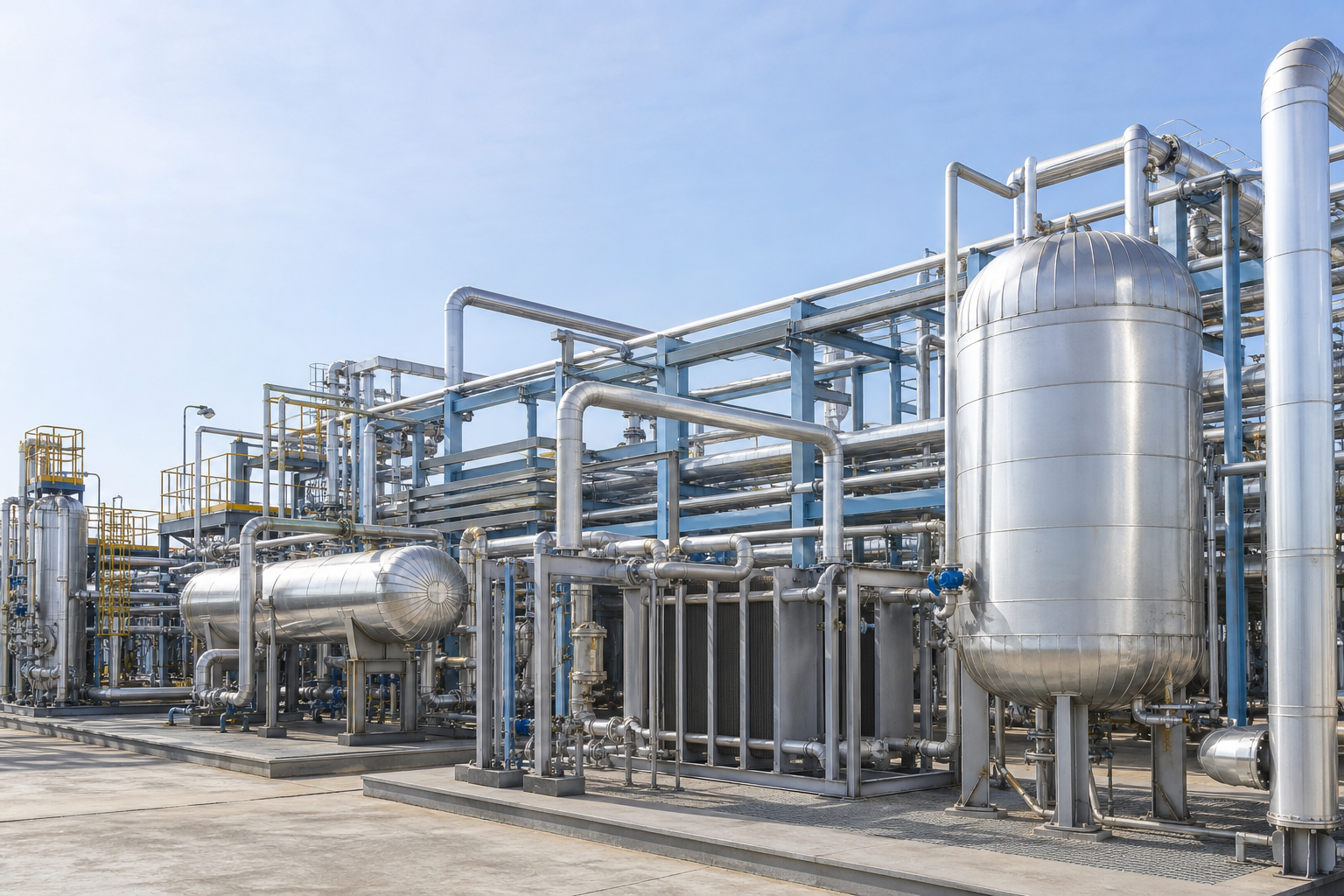
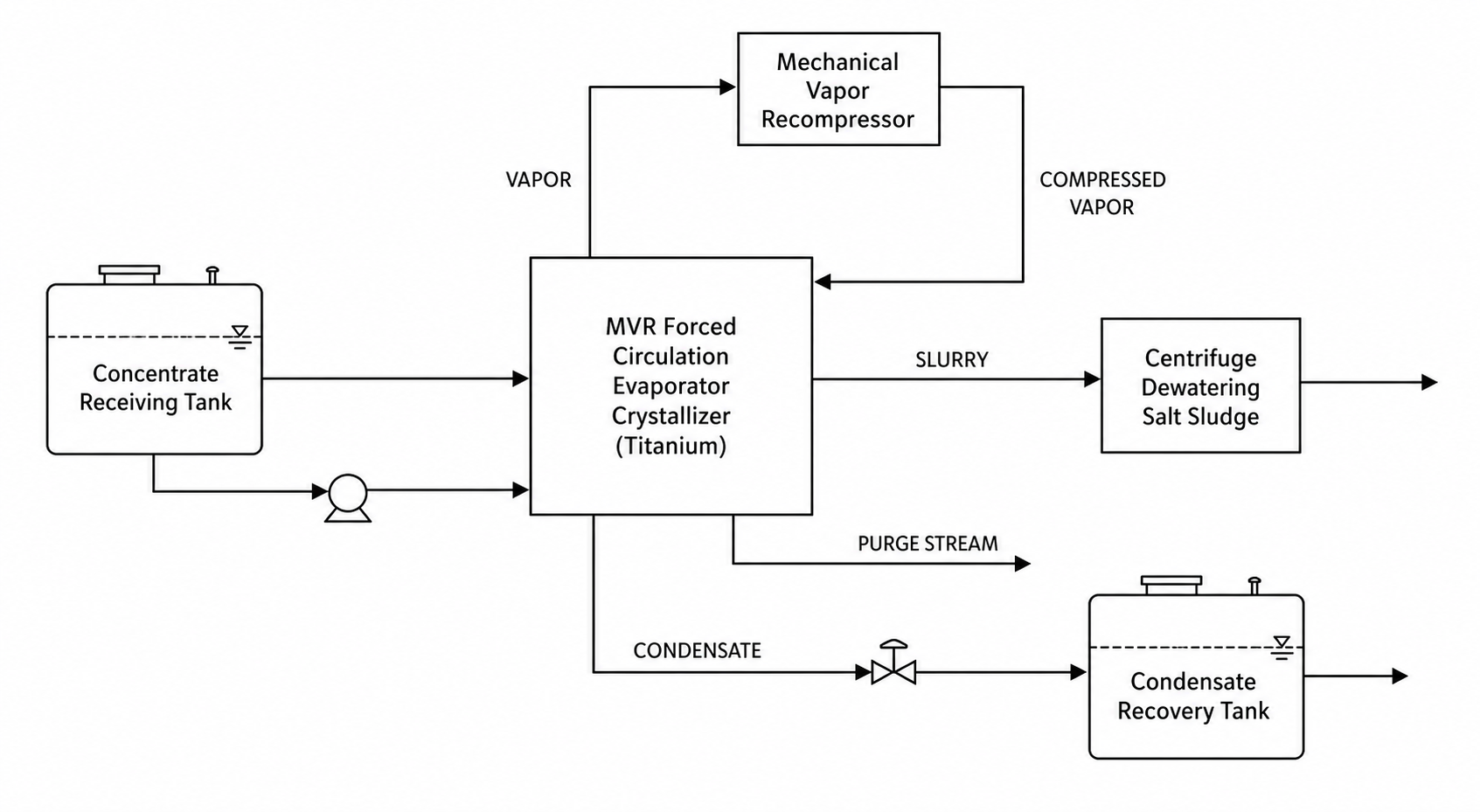
The concentrate is received and equalized, then pumped through the MVR forced-circulation loop. Forced circulation is the regime this feed earns: chloride brine at RO-reject concentration is a scaling and corrosion service simultaneously, and the pumped-velocity circuit keeps crystals in suspension and heat transfer surfaces swept while the liquor climbs toward crystallizing strength under electrically driven MVR vapor recompression.
Titanium is the material call. Rare earth separation brines are hot chloride service with trace metal values — chemistry that pits stainless steel and rewards the alloy that does not care. In the reference configuration, the titanium wetted train is the stated basis for stable long-term operation at the 60 m³/d rate.
Crystallization proceeds in the forced-circulation circuit as the salt matrix’s dominant chloride fraction reaches saturation; the slurry centrifuges to a dewatered salt sludge — held to no more than 10% moisture in the reference configuration — and mother liquor returns to the evaporator feed with a purge that carries the trace value species and process residuals out of the loop in a controlled, small-volume stream. That purge discipline is what lets the main train run continuously on a feed whose minor constituents would otherwise accumulate into an operating problem.
Condensate — the water the RO plant rejected — leaves the train clean and hot, returning to the separation site’s water balance. For an operation in Inner Mongolia, where industrial water allocation is a hard constraint, the recovered condensate is not a by-product; it is capacity.
Equipment Configuration
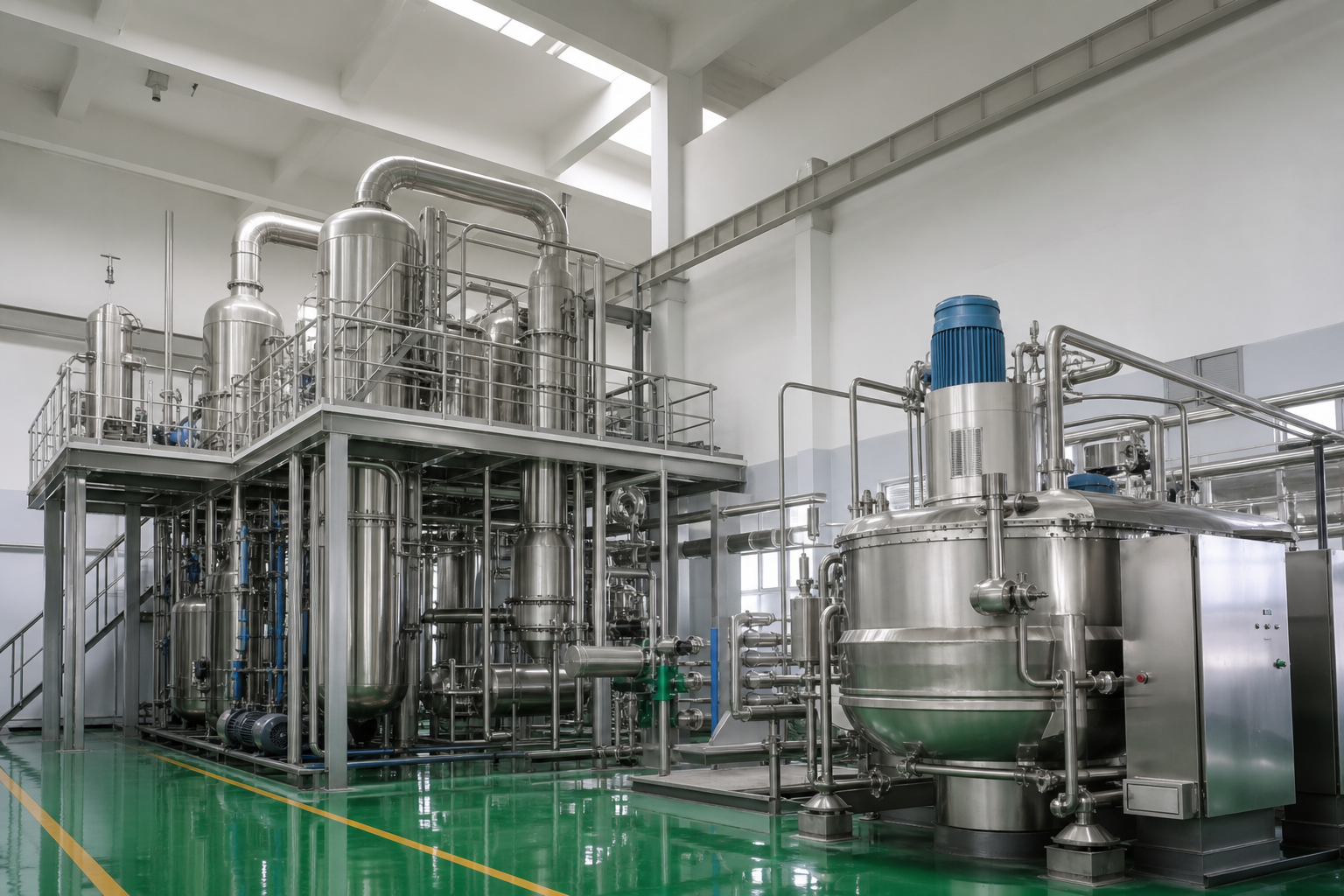
One set of the following equipment is typical for this duty:
- RO concentrate receiving and equalization
- MVR forced-circulation evaporation crystallization train, titanium wetted parts
- Mechanical vapor recompressor sized for the 60 m³/d duty
- Centrifuge dewatering salt sludge to ≤10% moisture
- Mother-liquor return with controlled purge for trace species
- Condensate recovery to site water balance; PLC control
Performance & Outcome
Compiled from published industry project data, indicative: 60 m³/d titanium MVR trains of this class terminate rare earth RO concentrate streams, producing ≤10%-moisture salt sludge and reuse condensate on electrical evaporation energy with stable long-run service. Salt disposal quality and specific energy are quoted per brine chemistry.
Simplified PFD
The simplified process flow diagram above shows concentrate equalization, the titanium forced-circulation MVR crystallizer, centrifuge dewatering, purge management and condensate recovery.