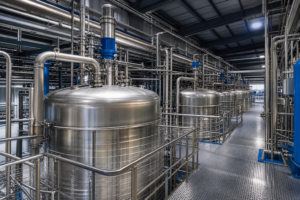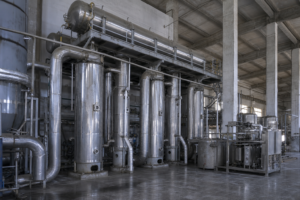
Denim mills close their water loops with a biological-plus-membrane architecture whose published benchmarks come from two sites of one group: a Shunde, China mill whose 9,000 m³/d-capacity station actually runs below 2,000 m³/d while cutting water consumption 73% against its own 2010-era baseline, and a Nha Trang, Vietnam plant (commissioned 2019, operating 2020) whose 3,000 m³/d train – screening, biological treatment, ozonation, ultrafiltration, reverse osmosis – removes about 90% of COD and discharges effluent roughly half the national COD limit while recycling indigo. Both are Advance Denim / Advance Sico operations documented on the group’s own site (an external industry reference, not an EvapCryst delivery). The design premise: denim’s water problem is rinse volume and indigo loss, and both are recoverable if biology is staged ahead of membranes and ozonation bridges them.
Why Denim Is Its Own Wastewater Class
Denim manufacture stacks three water-intensive operations. Rope or slasher dyeing runs indigo through multiple baths with chemical reduction (sodium dithionite under alkali), each bath loading the effluent with color, reducing agent residues and salt. Fabric finishing and washing consume rinse volume at scale. Garment washing – stone, enzyme, bleach, softener – adds the finishing load that made one pair of jeans famous for 3,781 liters of water (the 2013 Levi’s figure cited in the group’s published material covering a full grow-to-finish lifecycle; the mill-side share is a fraction of this but the reference frames the industry’s water accounting). The published Shunde baseline speaks mill language: roughly 600,000 m³ of water per year at the current operating level, against a station with 9,000 m³/d design headroom actually seeing under 2,000 m³/d – the gap between design capacity and real flow is itself the 73% consumption reduction stated by the group.
The recoverable fractions are specific. Indigo itself is a value stream: the group’s BlueLoop membrane separation documentation claims 98%+ indigo recovery alongside 98% water recovery in the dyeing loop. Water is the volume stream: RO permeate returning to washing. And energy increasingly rides along – the Shunde site’s solar phase one generates 6,839 kWh/day with a target of at least 40% renewable electricity by end-2025, which changes the marginal cost of any energy-hungry recovery stage.
Illustrative Feed Envelope for Screening
The envelope below consolidates the two published site references with denim effluent characteristics. It is an illustrative envelope built on published company material – not a customer dataset, and not a performance guarantee.
| Parameter | Illustrative range | Basis / note |
|---|---|---|
| Station design capacity (Shunde) | 9,000 m³/d | Published design figure |
| Actual operating flow (Shunde) | <2,000 m³/d | Consumption reduction closing the gap |
| Annual water use (Shunde) | ~600,000 m³/y | Published operating level |
| Train capacity (Nha Trang) | 3,000 m³/d RO stage | Published Vietnam reference |
| COD removal | ~90% through bio-ozone-UF-RO | Published Nha Trang performance |
| Indigo recovery (dyeing loop) | 98%+ with water recovery 98% (BlueLoop) | Published membrane-separation loop claim |
| Treatment objective | Effluent ~50% below national COD limit; water and indigo recycled | Discharge compliance + recovery economics |
Process Solution: Biology First, Ozone Bridge, Membranes Last

The published Nha Trang sequence runs five blocks, and its order is the lesson. First, screening removes grit, lint and fiber debris – denim effluent is solid-rich in a way dye-house effluent is not. Second, biological treatment (described as air plus bacteria, with the group’s MBR deployments combining microfiltration and ultrafiltration with the biology) degrades the organic load – the enzyme, starch and finishing residues that form denim’s bulk COD. Third, ozonation breaks what biology leaves: residual color and refractory organics, the fraction that would otherwise foul the downstream membranes and carry indigo tint into the permeate. Fourth, ultrafiltration polishes suspended and colloidal matter to RO-feed grade. Fifth, reverse osmosis desalinates and recovers – the published performance is approximately 90% COD removal across the whole chain and an effluent running about half the national COD limit, with recovered indigo returning to dyeing.
The Shunde variant adds the closed loops on top: the BlueLoop membrane separation on the dyeing stream itself recovering indigo and water at 98% each, and process intensification upstream – the BigBox single-box dyeing machine documented at 94-98% water savings against 8-13 box rope dyeing, and the BioBlue hydrite-free indigo process documented (with third-party verification per the group) at roughly 70% COD and 55% BOD reduction in the raw effluent because the reducing agent that caused the load is gone. These upstream choices shrink the central station’s problem before it arrives – which is why the 9,000 m³/d station sees under 2,000 m³/d.
Technical Features That Decide Whether the Loop Holds
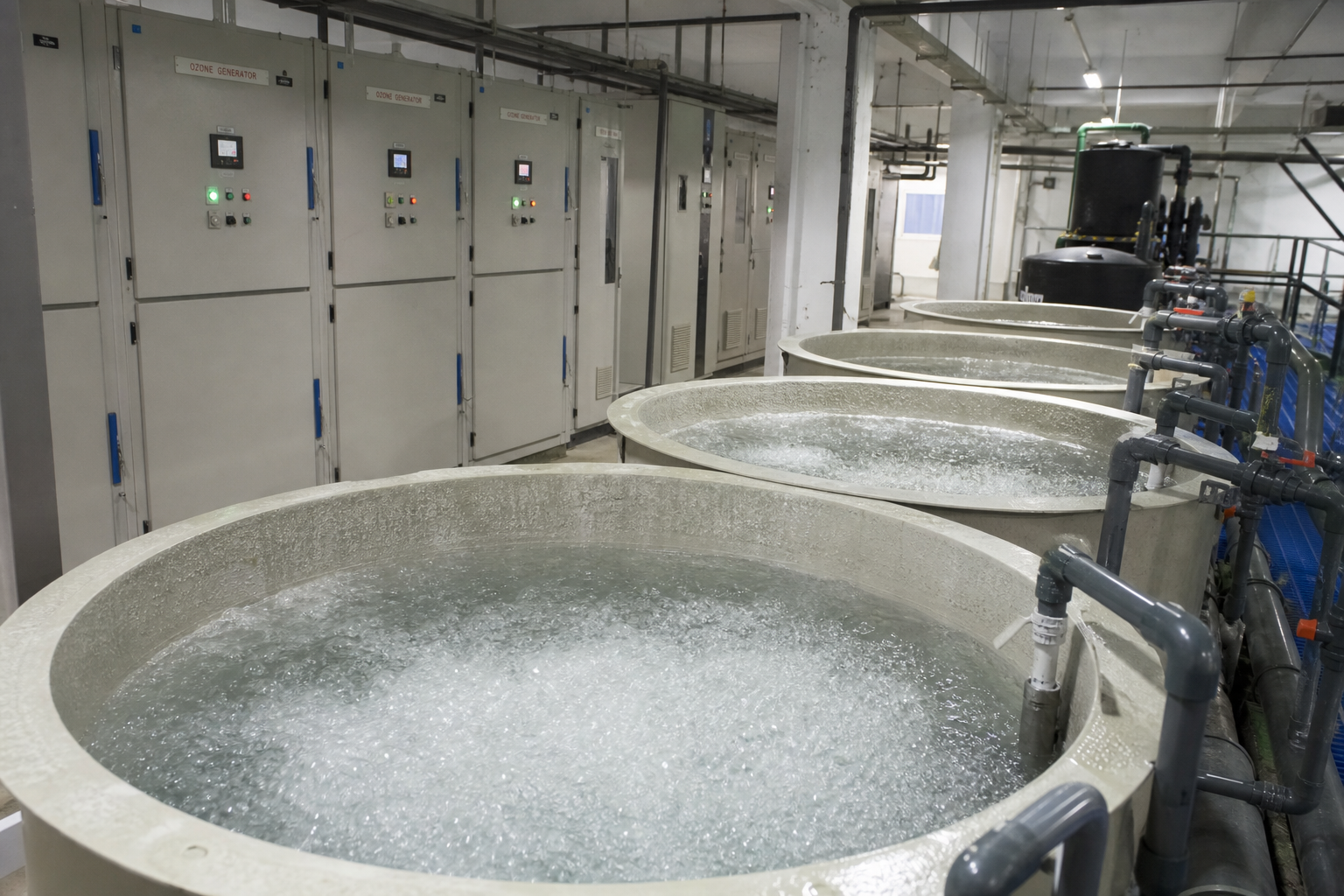
Three features carry the engineering weight. The first is the ozone bridge. Biology alone leaves denim effluent colored and membrane-hostile; RO alone chokes on it. Ozone in the middle is what makes the membrane stage durable – it oxidizes residual color bodies and refractory organics to biodegradable or inert fragments. The published train’s ~90% COD number is a property of the whole sequence, and removing the ozone block voids the membrane economics downstream.
The second is indigo recovery as a value line. Indigo is not a contaminant to destroy – it is pigment to harvest. The BlueLoop documentation’s 98% indigo recovery converts the dyeing loop’s waste stream into a feedstock stream, and the recovered-water 98% cuts rinse draw in the same separation. When denim mills evaluate reuse projects, indigo credit belongs in the model alongside water and energy.
Third is load shaping at the source. The group’s numbers make the case quantitatively: BigBox at 94-98% water savings per unit dyed, BioBlue cutting raw-effluent COD by ~70% before any treatment stage sees it. Central stations designed for old-process loads run at a fraction of capacity once the source is tamed – the Shnde station’s under-2,000 of 9,000 m³/d – and that spare capacity is either stranded capital or future production headroom.
Process Modules
| Process module | Candidate equipment types | Selection rationale | Module duty |
|---|---|---|---|
| Solids removal | Screens, grit separation | Denim lint and grit load ahead of biology | Protect bioreactor and membranes |
| Organic degradation | Biological treatment / MBR (MF+UF+biology) | Bulk COD from enzymes, sizes, finishes | Reduce organic load 80%+ typical |
| Color and refractory breaking | Ozonation | Oxidize residual indigo tint and organics | Stabilize UF/RO feed |
| Polishing filtration | Ultrafiltration | RO-grade feed quality | Protect RO elements |
| Water recovery | Reverse osmosis | Desalination and reuse of rinse water | ~90% COD removal chain-wide; permeate reuse |
| Dyeing loop separation | Membrane separation on dye baths (BlueLoop-class) | Indigo and water recovery at source | 98% indigo / 98% water recovery |
Configuration, materials and operating envelopes above are potential considerations only; actual selections depend on feed composition, temperature, fouling behavior, utilities and project capacity.
Expected Performance and Limits

The published reference performance: Nha Trang – 3,000 m³/d through screening, biology, ozone, UF and RO with ~90% COD removal and effluent roughly half the national limit, indigo recycled, operating since 2020; Shunde – 73% water-consumption reduction against baseline, ~600,000 m³/y at the current operating level against a 9,000 m³/d design station actually running under 2,000 m³/d, BlueLoop at 98%/98% indigo/water recovery, solar phase one at 6,839 kWh/day toward a ≥40% renewable target by end-2025 (Advance Denim / Advance Sico published material – an external industry reference; indicative, not a project guarantee, and not an EvapCryst delivery). The practical limits: the ozone-membrane sequence assumes a tamed biological stage – hydraulic shock or enzyme-load spikes propagate straight to the membranes; the indigo loop’s 98% figures are dyeing-loop specific, not whole-mill claims; and where ZLD rather than quality discharge is the mandate, the RO reject still requires the thermal back end covered in the selection-route article – the published references close the water loop to reuse grade, not to zero liquid discharge.
Industry References and Validation
One company’s two-site documentation anchors this route: the Advance Denim group’s published Shunde and Nha Trang material, including the 3,781 L per 501 lifecycle figure from the 2013 Levi’s study as framing, the BlueLoop indigo-water 98% loop, BigBox 94-98% dyeing water savings, BioBlue’s ~70% COD / ~55% BOD raw-effluent reduction with third-party verification, and the solar and renewable-energy program numbers (advance-sico.com published material, May 2025; an external industry reference, not an EvapCryst delivery). For your own project, validation effort should concentrate on: a water balance separating dyeing, finishing and garment-wash streams (each wants different handling); biological treatability testing on your finishing chemistry; ozone demand testing for color breaking at your indigo and auxiliary loads; and RO fouling assessment on the ozonated liquor.
Frequently Asked Questions
Why is ozone in the middle rather than at the end?
Because its job is to protect the membranes, not to polish the discharge. Ozone breaks residual color and refractory organics into fragments biology or the membranes can handle. Move it to the end and the membranes it was protecting are gone; move it to the front and biology does the work more cheaply on the degradable fraction first.
Can recovered indigo really go back into dyeing?
The published BlueLoop documentation claims 98% recovery with the recovered pigment returning to the process. Qualification on shade is the practical gate – mills qualify recovered-indigo blends on specific shades before full migration, the same discipline as any recycled-feedstock process.
What is MBR doing in this context?
Membrane bioreactor – microfiltration or ultrafiltration membranes immersed in or following the biological stage, replacing the clarifier. The group’s deployments use it where footprint is tight or sludge settleability is problematic. It delivers RO-grade solids control directly from the biology, sometimes letting a separate UF stage shrink.
Does this close ZLD?
Not by itself. The published trains close the water loop to reuse grade with a quality discharge – effluent at about half the COD limit. Zero liquid discharge additionally requires handling the RO reject thermally; that back end is a separate decision covered in the technology-selection route.
How much does process change at the source matter?
Decisively, on the published numbers: BigBox dyeing at 94-98% water savings and BioBlue cutting raw COD ~70% shrink the central station’s load before it exists – which is why the reference group’s 9,000 m³/d station runs below 2,000 m³/d. Source reduction first, then treatment, is the ordering that pays.
When This Route May Not Fit
If the mill is a pure garment-wash laundrette without dyeing – small flows, no indigo value, rented space – the biology-ozone-RO chain cannot amortize and shared municipal or cluster treatment remains rational. If discharge limits are loose and water cheap, the reuse economics that carry the capital fade to compliance-only. And if the production mix swings violently between indigo, sulfur and black shade chemistry, the ozone and membrane stages see a moving target that demands heavier buffering and instrumentation than a steadier mill would need.
What Must Be Verified Before Committing
Five items: a stream-by-stream water and pollutant balance (dyeing, finishing, garment wash separated); biological treatability testing on the real finishing chemistry including enzyme and softener loads; ozone demand curves for color breaking at your shade mix; RO pilot or fouling-proxy testing on ozonated liquor; and if ZLD is on the roadmap, a reject-characterization package for the thermal back end. These map directly onto the modules above and are the standard screening package we would run before any quote.