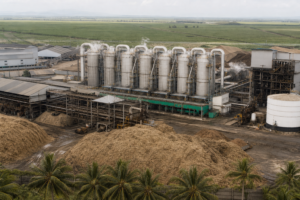
Concentrating black liquor above 65% solids is the point where conventional evaporation stops cooperating – viscosity outruns concentration and sodium salts precipitate onto heat surfaces as hard scale – and the crystallization evaporation route solves it with deliberate sulfate supersaturation: ash and/or salt cake (sodium sulfate) is mixed into the first-effect liquor at 4-8 wt% of solids, creating a supersaturated sulfate solution whose precipitating crystals grow on suspended nuclei instead of tube walls, with a dedicated crystallization concentrator lifting the product to 73-80% solids. The public reference is the Chinese patent CN101831826B (assigned to Yueyang Paper after transfer from Xiangjiang Paper, granted 2012): the documented method and its worked examples report scale-free heat surfaces through the high-solids effects and recovery boiler gains of 5-20% capacity and 10-30% steam generation depending on the solids step (published patent specification – an external industry reference documenting a patented method, not an EvapCryst delivery). The design premise: above 65% solids, scale prevention and concentration become the same problem, and the answer is crystallography, not cleaning schedules.
The Problem: Why 65% Is the Classical Wall
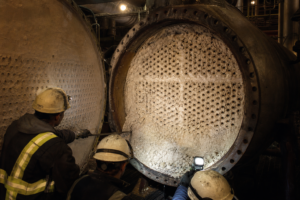
The patent’s background section states the engineering arithmetic plainly. Falling-film plate evaporators deliver liquor at about 65% solids; beyond that, viscosity growth outpaces concentration growth, and the inorganic load exceeds solubility – sodium salts precipitate, and the scale layer’s heat transfer coefficient falls below a tenth of carbon steel’s, collapsing evaporation capacity. Conventional practice answers with effect-body switching: first effects built in three chambers (A, B, C), one being washed on weak liquor or cleaning solution while two evaporate, rotating to keep surfaces workable. It works, at the cost of capacity idled in rotation and a hard ceiling on exit concentration.
The earlier literature the patent cites – including the standard Chinese reference on alkali recovery chemical recovery – documents concentrator/crystallizer stages producing 68-75%, and crystallization concentrators capable of 75-80%, but at high recirculation energy and without solving fouling above 60%. A prior patent application (CN101629393A) added ash to the second-effect liquor for the same anti-scaling purpose, but limited final concentration (second-effect exit near 50%) and depended on ash availability for nucleation – the inventors’ critique being that boiler ash supply alone cannot reliably seed sufficient nuclei.
The Method: Supersaturation by Addition, Split Flow, Dual Evaporation
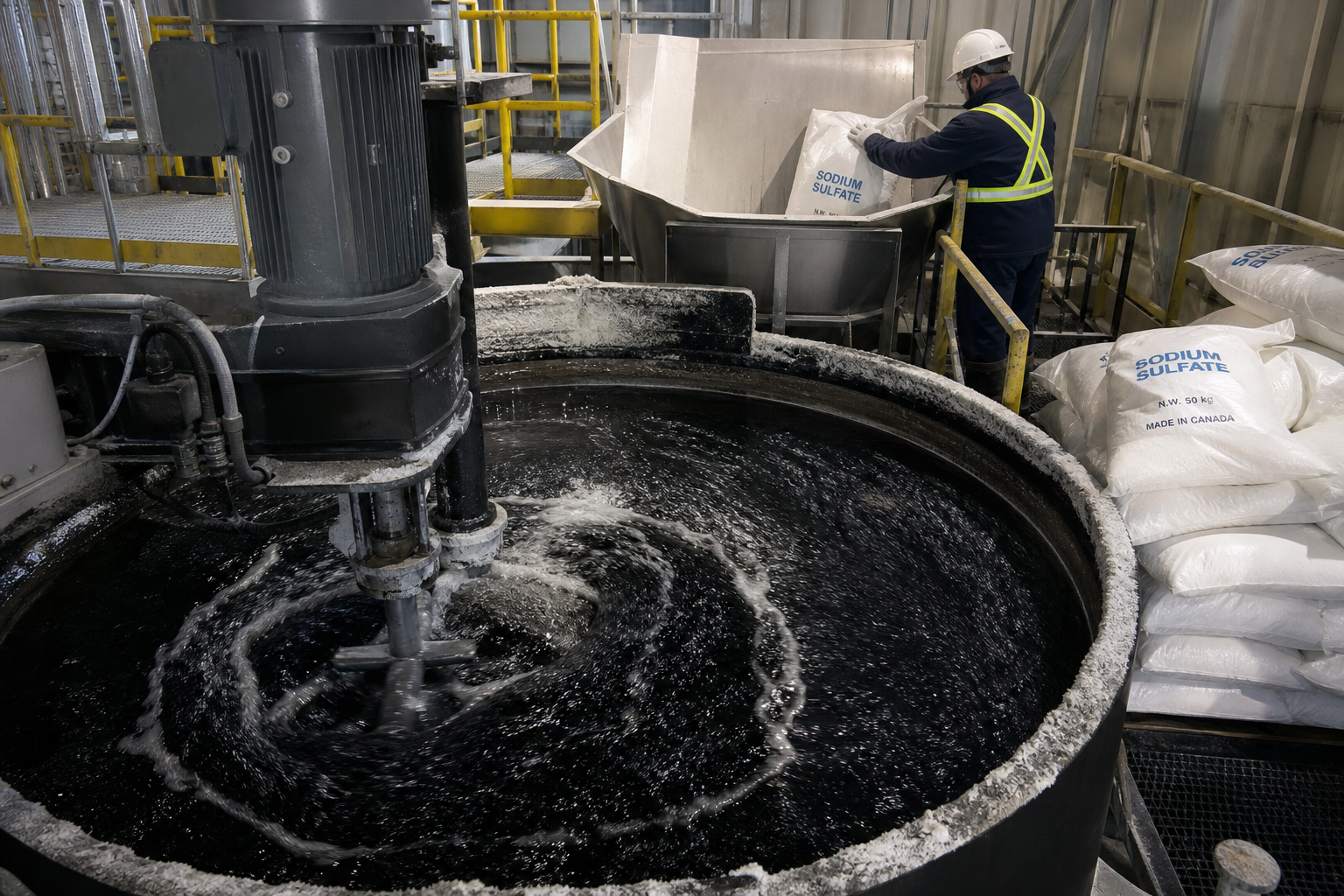
The patented method runs three steps. Step one: first-effect liquor at 58-66% solids (preferably 60-65%) passes through a flash tank into a liquor mixing tank, where ash from the recovery boiler and/or salt cake (Na2SO4) is added at 4-8 wt% of the liquor solids (preferably 5-7%). The mixture becomes sulfate-supersaturated – the essential state. Step two: the mixed liquor splits, at a volumetric ratio of 2-5:1 (preferably 3:1), between the crystallization concentrator (the larger flow) and the first-effect return (the smaller flow, blended with second-effect liquor at 41-55% solids and re-evaporated through the first effect’s three chambers in sequence). Step three: the crystallization concentrator’s product – 73-80% solids in the worked examples – flashes through an ultra-strong liquor flash tank into pressurized strong-liquor storage for the boiler; the flash vapors route back to lower effects by temperature match (third effect for the first-effect flash steam, second effect for the concentrator flash steam in the six-effect-plus-crystallization arrangement).
The mechanism is the sentence that carries the whole patent: the added sulfate creates supersaturation and crystal precipitation whose particles serve as nuclei, so further crystallization proceeds on those nuclei rather than on the heating surfaces. The chemistry insight is that insufficient sulfate lets sodium carbonate crystallize directly onto exchanger walls; excess sulfate redirects precipitation to suspended sodium sulfate/double-salt nuclei. The additive choice is flexible – ash and salt cake are interchangeable sodium sulfate sources, blended in any ratio meeting the supersaturation requirement, with the white liquor sulfidity consequence (kept within 30% for cooking suitability) as the binding constraint on total addition.
The Worked Examples, Quantified
| Example | Additive | Split ratio | Result | Boiler gain |
|---|---|---|---|---|
| 1 | 7 wt% ash | 3:1 (4 shares) | 60% → 76% DS; I-effect & concentrator scale-free | +10% capacity, +20% steam vs firing at 60% |
| 2 | 8 wt% salt cake | 5:1 (6 shares) | 65% → 80% DS; scale-free surfaces | +5% capacity, +22% steam vs firing at 65% |
| 3 | 2% ash + 2% salt cake | 2:1 (3 shares) | 58% → 65% DS; scale-free surfaces | +15% capacity, +10% steam vs firing at 58% |
| 4 | 1% ash + 4% salt cake | 3.5:1 (4.5 shares) | 62% → 73% DS; scale-free surfaces | +6% capacity, +13% steam vs firing at 62% |
| 5 (5-effect rising film) | 1.5% ash + 6.5% salt cake | 2:1 (3 shares) | 50% → 65% DS without flue-gas contact concentration | +20% capacity, +30% steam vs 50% baseline |
Figures from the CN101831826B specification’s worked examples (published patent document – an external industry reference documenting a patented method; indicative of the route’s reported behavior, not a project guarantee, and not an EvapCryst delivery).
Why the Split Flow Matters
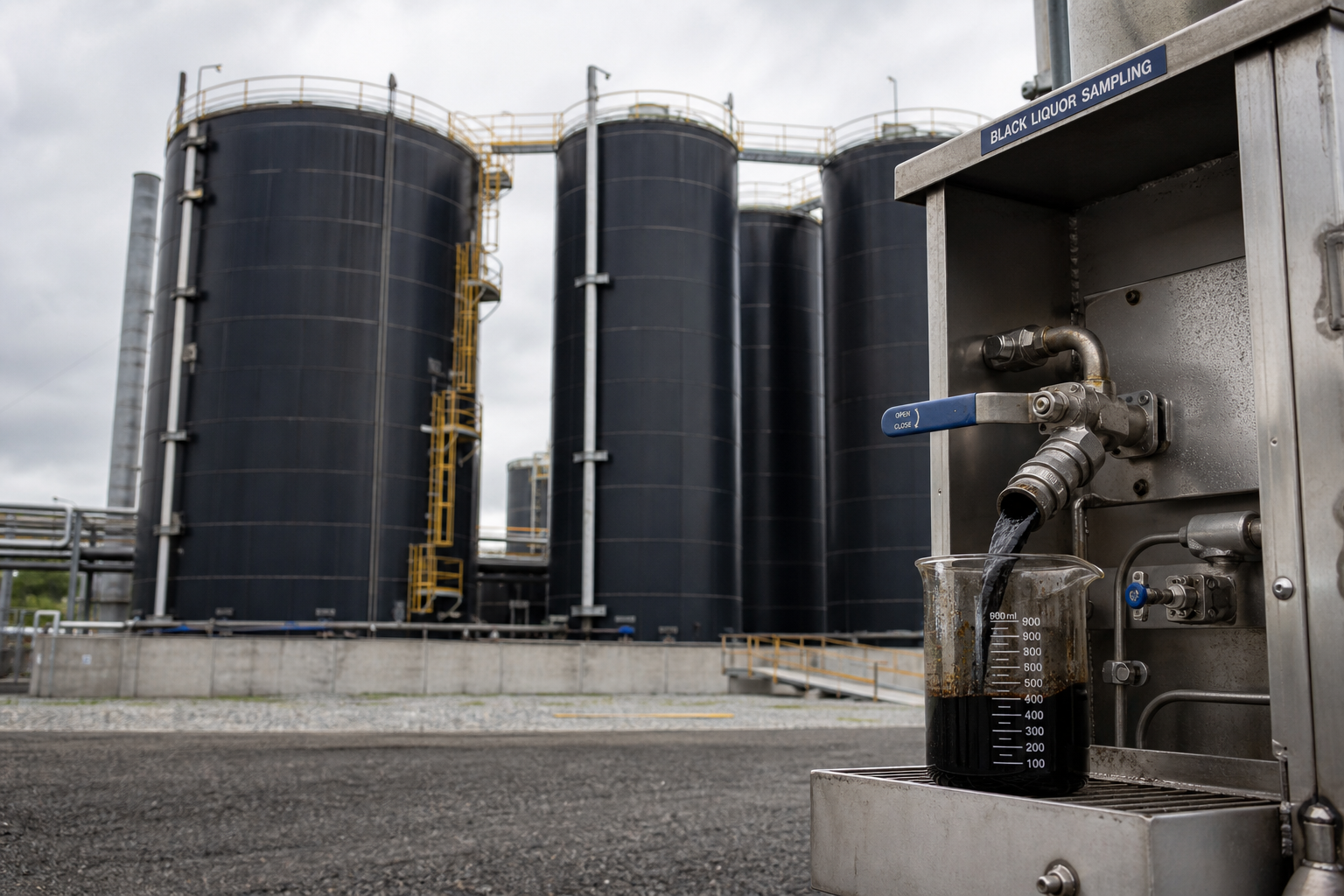
The 2-5:1 split between crystallization concentrator and first-effect return is not incidental – it is the load balance that makes the method energy-efficient. The concentrator does the high-solids lifting (where its forced-circulation-style tolerance for slurry service earns its energy cost); the smaller returned flow keeps the main effects inside their clean-film operating window while maintaining the supersaturated state at the first effect. The patent’s stated result is that this arrangement raises station exit solids 5-20 wt% over conventional, reduces cleaning downtime, raises evaporator utilization – and on the boiler side cuts plugging of tube banks and economizers, reduces soot-blowing steam, prevents dead-charcoal bed and flameout conditions in the furnace, and raises salt cake reduction rate.
Downstream Footprint
The route’s afterlife in the published record indicates its industrial relevance: the patent family is cited by a Veolia Water Technologies US patent on recovering pulping chemicals from dissolved ash with high carbonate content, by later Chinese mill patents on black liquor crystallization evaporation (Qingshan Paper, 2021) and on pulping wastewater treatment (Gold East Paper, 2014) – citation traffic from both an international technology supplier and operating mills. The method applies, per the specification’s closing scope, to four- through seven-effect falling-film and rising-film arrangements alike – the principle is chemistry-led, not architecture-bound.
Expected Performance and Limits
The published performance: exit concentration uplift of 5-20 wt% over the conventional base case with scale-free heat surfaces in the first effect and crystallization concentrator across all five worked examples; boiler capacity gains of 5-20% and steam generation gains of 10-30% depending on the solids step fired; additive consumption of 4-8 wt% of liquor solids as sulfate; steam supply to the crystallization concentrator at 0.22-0.26 MPa saturated and to the first effect at 0.15-0.20 MPa (CN101831826B specification – an external industry reference; indicative, not a project guarantee). The practical limits: sulfidity management – total sulfate addition must keep white liquor sulfidity within cooking requirements (the specification notes 30% as the bound); ash availability varies with boiler operation, making salt cake the reliable make-up; and the method presumes the liquor chemistry headroom for supersaturation – mills already running high-sulfidity liquors have a narrower addition window.
Industry References and Validation
One primary anchor with unusual completeness: the CN101831826B patent specification – method, five worked examples with full parameter sets, boiler-side outcomes, and the citation trail into both international supplier patents (Veolia US9574303B2 family) and subsequent mill patents (Qingshan Paper CN109364518B). Its technical context aligns with the standard reference literature the specification cites for 68-80% concentrator practice. For your own project, validation effort should concentrate on: a liquor chemistry baseline (current sulfidity, salt cake balance, ash production rate); a supersaturation window assessment – what addition rate your liquor tolerates within the sulfidity bound; a split-ratio and steam-integration model against your existing effects; and a pilot or first-effect-side trial with heat-transfer trending as the objective criterion.
Frequently Asked Questions
How is this different from just adding ash to the liquor?
Scale and dose discipline. The prior art added ash for wall protection but capped out at lower concentrations and depended on variable ash supply. This method engineers the supersaturation deliberately (4-8 wt%, ash/salt cake interchangeable), splits the flow so only the concentrator sees the highest solids, and returns a smaller supersaturated flow to keep the main effects protected. The worked examples document scale-free surfaces at up to 80%.
Where does the sulfate come from operationally?
Recovery boiler ash (collected from the boiler’s ash handling) and purchased or recovered salt cake (Na2SO4) – interchangeable as sodium sulfate sources in any ratio meeting the supersaturation target. Ash is free but variable; salt cake is the reliable make-up. Sulfidity is the budget you must not exceed.
What does the boiler actually gain?
The worked examples: firing 76% instead of 60% liquor bought +10% capacity and +20% steam; 80% over 65% bought +5% and +22%; the largest gain (+20%/+30%) came from replacing a flue-gas-contact concentration step in a five-effect rising-film case. Less water in the flame, more fuel per droplet – plus reduced tube-bank plugging and soot-blowing steam.
Does this fit an existing six-effect station?
Yes – that is the reference configuration: a conventional six-effect falling-film station with the crystallization concentrator added, the mixing tank and flash tanks inserted, and vapor routing adjusted. The specification claims the method extends to four-through-seven effect and rising-film arrangements.
What is the catch?
Chemistry discipline and energy on the concentrator. The addition must hold the supersaturation window without breaking white liquor sulfidity (30% bound), and the crystallization concentrator is a recirculating, higher-energy stage – the patent’s own background notes that earlier concentrator designs suffered high electricity and steam consumption per ton of water. The split-flow arrangement is the answer to that cost.
When This Route May Not Fit
If the mill’s boiler is comfortable at 65% solids and unfouled at current loads, the increment may not justify the additive handling and concentrator energy – the value scales with the boiler’s appetite for higher firing solids. If the liquor already runs at high sulfidity, the sulfate addition window narrows toward closed. And if ash production is unreliable and salt cake purchase is constrained by logistics or price, the additive supply chain becomes the binding constraint.
What Must Be Verified Before Committing
Five items: a liquor chemistry baseline (sulfidity trend, current salt cake balance, ash production and composition); a supersaturation tolerance assessment against the sulfidity bound; a split-ratio and steam-integration model for your station’s effect arrangement; a boiler-side review confirming the firing-solids gain converts to capacity and steam at your furnace; and a trial protocol with heat-transfer coefficient trending as the objective pass/fail. These map directly onto the method above and are the standard screening package we would run before any quote.