Battery-grade nickel sulfate hexahydrate (NiSO4·6H2O) is produced by a flowsheet that exploits one physical fact — the salt’s solubility rises steeply with temperature — through four stages: high-temperature evaporative concentration of purified nickel sulfate liquor, flash crystallization of the concentrated solution, thickening, and centrifugal separation, finished by vibrating fluidized-bed drying. Around that core, two configuration choices adapt the plant to your site: multi-effect (MEE) or MVR evaporation depending on energy conditions, and vacuum flash versus batch/interrupted cooling crystallization depending on the crystal quality and morphology your precursor customers demand. Wetted parts in titanium (TA2) are the established standard for this duty, because hot, acidic, chloride-traced nickel sulfate liquor destroys lesser alloys quietly. This page walks through the full system — process logic, equipment train, control parameters, and the quality levers that matter to NCM/NCA precursor production. Specification ceilings and control ranges quoted here form an illustrative envelope from published solubility and industry-practice data, not a project datasheet.
The Product: Three Hydrates, Two Grades, One Demanding Customer
Nickel sulfate is commercially available in three forms — anhydrous, hexahydrate and heptahydrate — with the hexahydrate by far the most widely used industrially. By end-use, the product splits into electroplating grade and battery grade, and battery grade is where the specification pressure lives:
- Electroplating grade feeds plating baths where nickel sulfate is the indispensable nickel source for uniform, adherent coatings; the specification tolerates more impurities than cathode service.
- Battery grade is the raw material for NCM and NCA ternary precursor coprecipitation. Different precursor formulations require different nickel contents, and the purity, consistency and crystal quality demands keep rising with nickel-rich chemistries: tighter trace-metal ceilings (Ca, Mg, Cu, Zn, Fe, Na), controlled magnetic-substance limits, and a narrow, repeatable crystal size distribution batch after batch.
- Catalyst and chemical uses round out demand at lower specification levels.
Because the crystallizer is the last unit operation before the bag, every upstream purification decision and every crystallization control parameter ends up visible in the precursor plant’s incoming inspection.
Why Solubility Behavior Dictates the Flowsheet
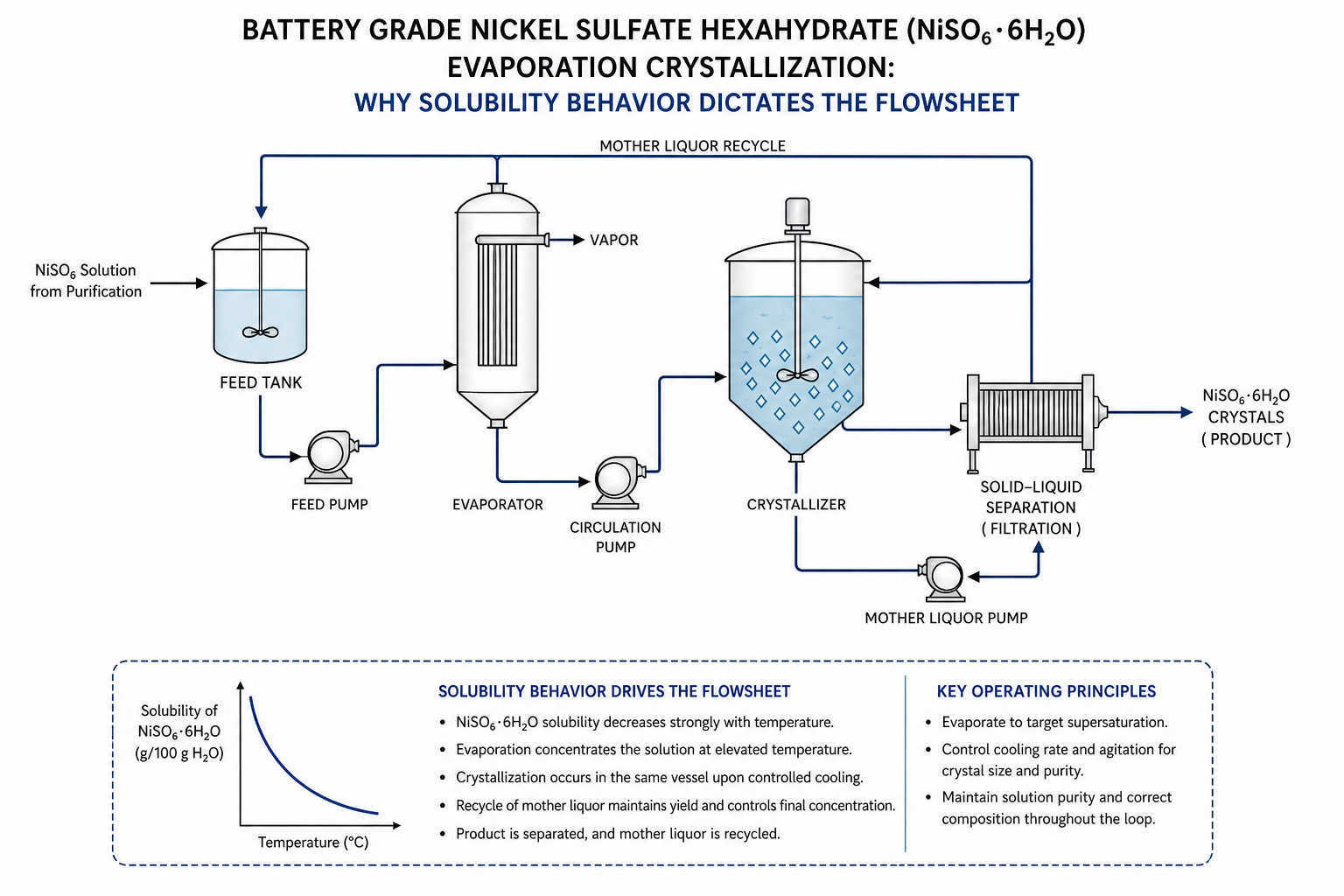
Nickel sulfate’s solubility increases significantly with rising temperature — the physical property on which the whole plant is designed. Two consequences follow:
- Concentrate hot. At elevated temperature the liquor holds far more dissolved nickel sulfate, so evaporation at temperature raises concentration without inducing premature crystallization in the heater. This is what lets the evaporator do its work with forced circulation through clean tubes.
- Crystallize cold or by flash. Drop the temperature — or flash the hot concentrated liquor into a vacuum, which self-cools it by evaporation — and supersaturation appears exactly where you want it: in the crystallizer body, where crystal surface area and residence time are waiting to absorb it. Solid NiSO4·6H2O separates from the mother liquor on your schedule instead of on the heat-transfer surface.
Plants that respect this separation between “where we concentrate” and “where we crystallize” run long campaigns between cleanings. Plants that blur it fight fouled heaters and off-spec fines.
The Process Train Stage by Stage
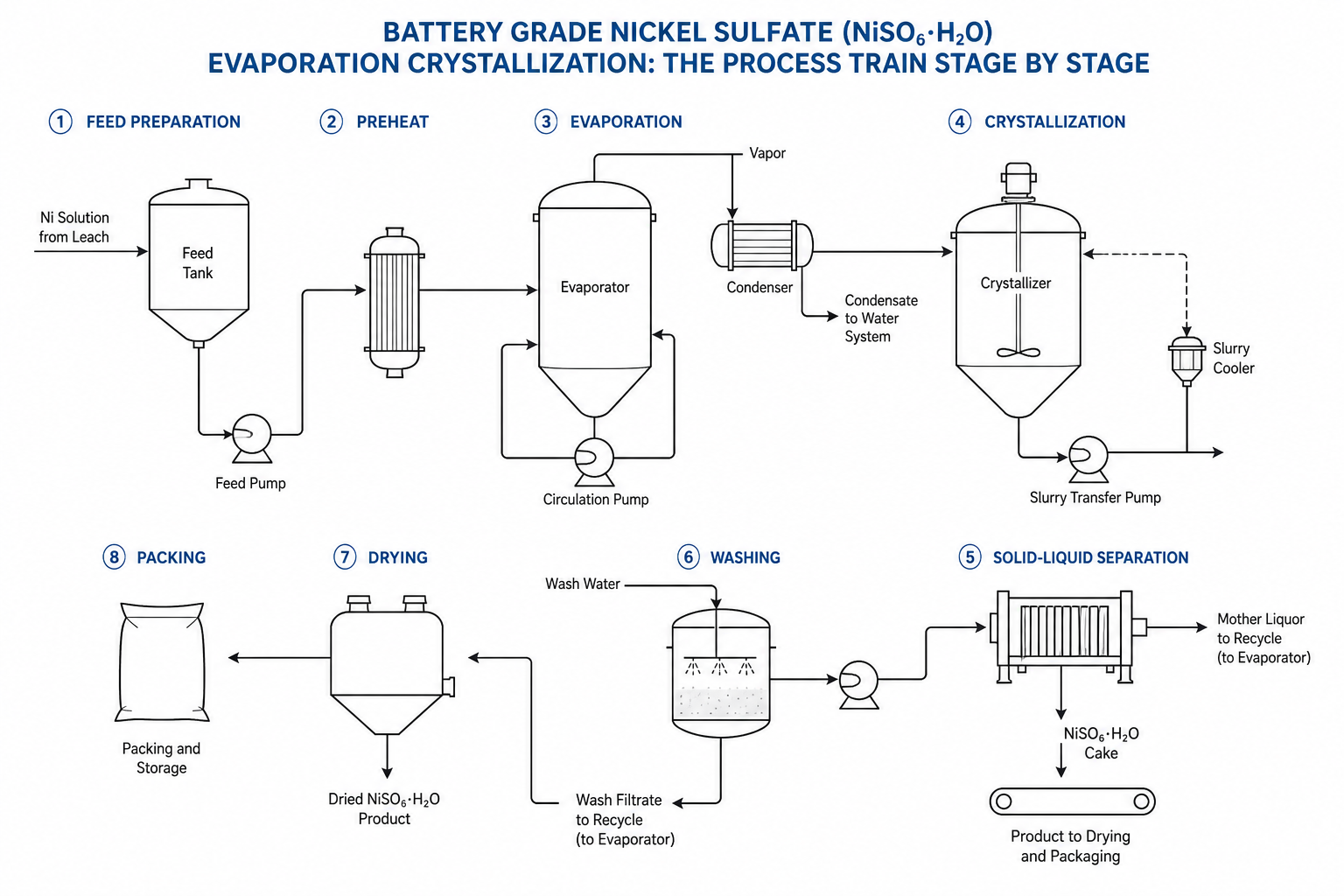
- Evaporation and concentration. Low-concentration purified feed is evaporated at elevated temperature — in a multi-effect evaporator or an MVR evaporator, chosen per site energy conditions — producing a highly concentrated nickel sulfate solution.
- Flash crystallization. The concentrated solution enters a flash crystallizer operating under vacuum; the sudden pressure drop self-evaporates water, the liquor cools along its own saturation curve, and nickel sulfate hexahydrate crystallizes under controlled supersaturation.
- Thickening. The crystallizer discharge slurry passes through a thickener that recovers additional solids and densifies the stream ahead of dewatering, maximizing overall yield.
- Centrifugation. The solids-plus-saturated-mother-liquor mixture reports to a centrifuge for efficient liquid-solid separation, yielding wet NiSO4·6H2O crystals with mother liquor recycled to the evaporation system.
- Drying. A vibrating fluidized-bed dryer brings the wet crystals to final moisture specification with gentle handling that preserves the crystal, followed by screening and packing.
- Control. An automated control system runs the plant continuously with real-time monitoring of the process parameters that matter — temperatures, densities, levels, and the crystallizer’s supersaturation proxy.
Reference system configuration
| Module | Candidate Equipment Types | Selection Rationale | Indicative Operating Envelope |
|---|---|---|---|
| Evaporation | Multi-effect evaporator (MEE) or MVR evaporator | Site energy: cheap steam favors MEE; expensive steam favors MVR electricity | Hot elevated-temperature concentration; steam or electricity input |
| Crystallization | Vacuum flash crystallization or batch/interrupted cooling crystallization | Desired crystal quality and morphology; flash for continuous throughput, cooling for size-distribution tuning | Flash: adiabatic self-cooling; cooling: programmed profile with seeding |
| Thickener | Slurry densification | Yield recovery; steady feed to the centrifuge | Densified underflow, steady centrifuge feed |
| Centrifuge | Solid-liquid separation, mother liquor return | Low cake moisture, gentle crystal handling | Wet cake; saturated mother liquor returned |
| Dryer | Vibrating fluidized bed | Final moisture with minimal crystal attrition | Gentle temperature hold to final moisture |
| Wetted materials | TA2 titanium; SS304/carbon steel non-wetted | Hot acidic sulfate service; chloride traces common | TA2 wetted parts in hot acidic service |
Configuration, materials, and ranges depend on actual feed, corrosion review, fouling behavior, utilities, and project capacity.
MEE or MVR — the Energy Decision
Both evaporator families do the same concentration job to the same specification; the choice is pure energy economics:
- Multi-effect evaporation reuses each effect’s secondary vapor to heat the next, stepping down pressure effect-to-effect. With boiler steam on site at moderate cost, MEE is proven, simple, and has the lower compressor-free maintenance profile.
- MVR evaporation compresses the secondary vapor mechanically and returns it as the heating medium, consuming electricity instead of live steam. Where steam is expensive or unavailable, MVR delivers the lower operating cost, and its small temperature lift is an anti-scaling bonus in concentrated sulfate service.
For battery-material plants specifically, MVR has become common because refineries are often sited on power-dominant energy contracts and because the gentle evaporation protects product color and crystal habit.
Flash or Cooling Crystallization — the Quality Decision
The crystallizer choice sets the character of the product:
- Vacuum flash crystallization is continuous: hot concentrated liquor flashes into a vacuum chamber, supersaturation is generated adiabatically and consumed by the suspended crystal bed, and slurry discharges steadily to the thickener. It suits high-throughput, steady-state production with consistent median size.
- Batch or interrupted cooling crystallization gives the operator direct command of the thermal history — cool slowly along a programmed profile with seeding, and each batch grows to a tight size distribution. It suits plants serving precursor grades where crystal size distribution and morphology are contractual, at the cost of cycle management.
The five control parameters of nickel sulfate crystallization
Whichever crystallizer body you choose, the same five variables decide the outcome — this is the control checklist for continuous cooling crystallization of nickel sulfate:
| Parameter | What It Controls | Failure Mode If Wrong |
|---|---|---|
| Temperature profile | Growth rate, crystal structure, purity | Wrong range = slow growth or strained, impure crystals |
| Agitation speed | Uniformity of supersaturation and suspension | Too fast breaks crystals; too slow creates local supersaturation and agglomeration |
| Solution concentration | Starting point and stability of the crystallization | Off-target feed makes every downstream control fight the material balance |
| Cooling rate | Crystal size and impurity inclusion | Too fast nucleates fines and traps impurities inside crystals; too slow wastes capacity |
| Mother liquor circulation | Solute concentration in the system, continuity | Wrong circulation rate destabilizes the steady state and the size distribution with it |
Modern plants close all five loops with sensors and automated control software, which is what makes product quality stable run-to-run rather than operator-dependent. Advanced executions add optimized seeding methods and internal crystallizer structures to narrow the particle size distribution further — the differentiator for high-performance battery production.
Crystal Quality for the Precursor Plant
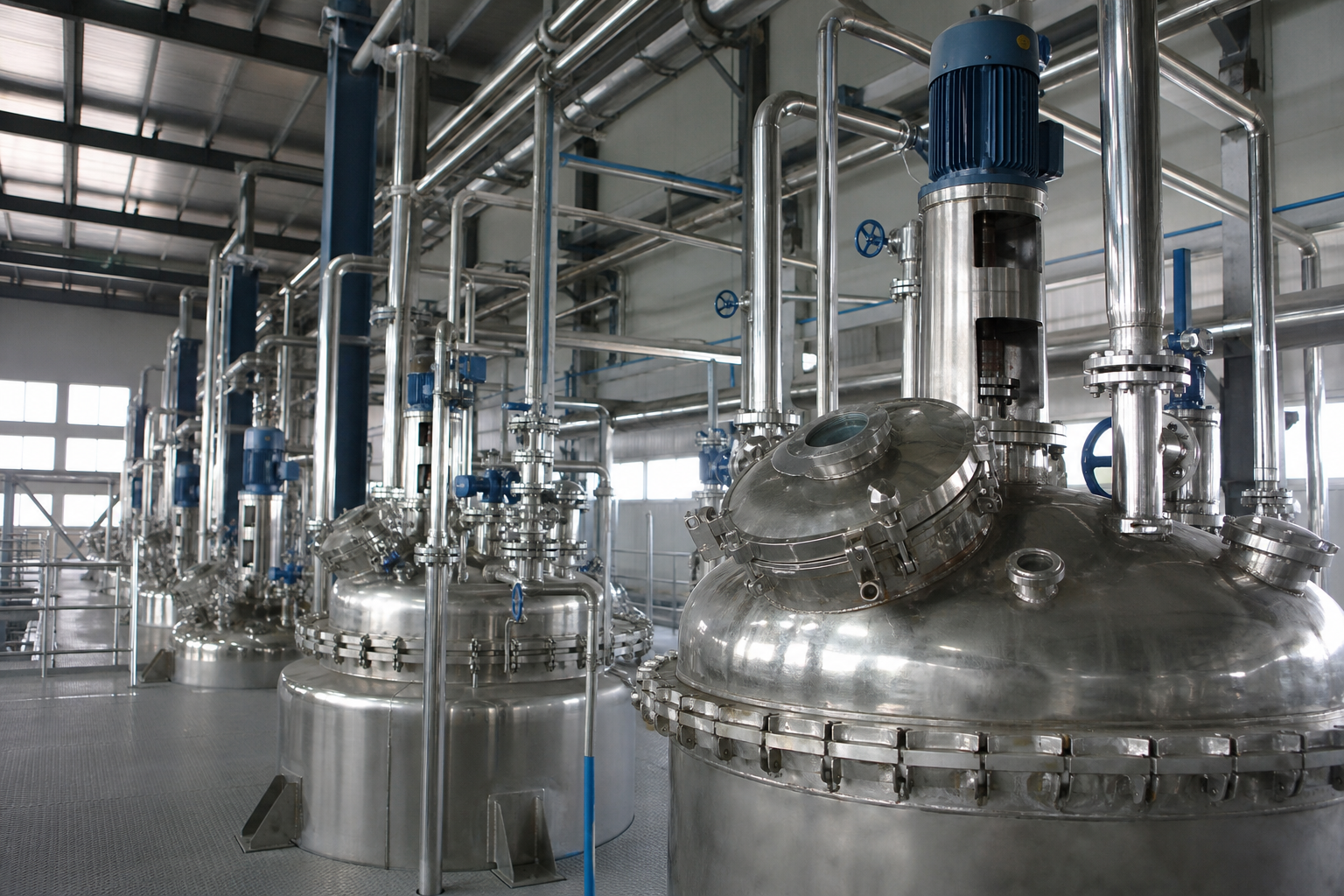
Battery-grade nickel sulfate is judged on more than assay:
- Size distribution. Precursor coprecipitation feeds prefer a narrow distribution for consistent dissolution and batching; wide distributions with a fines tail also dust and cake in handling.
- Morphology. Compact, well-formed hexahydrate crystals flow, wash and dry predictably; needle clusters and agglomerates trap mother liquor and its impurities.
- Impurity discipline. Ca/Mg/Na/Cu/Zn/Fe ceilings are met by upstream purification plus mother-liquor management — impurities that stay dissolved accumulate with each recycle and eventually co-crystallize. The purge strategy is a quality parameter, not a waste decision.
- Consistency. The precursor plant’s process control assumes a consistent input; a crystallizer that drifts quietly month-over-month costs more than one that fails loudly.
Recovery and Recycling Service
The same evaporation-crystallization technology serves both primary battery raw material production and the recovery and recycling of nickel from spent batteries — hydrometallurgical recycling of black mass produces purified nickel sulfate liquors chemically similar to primary refining streams, and the specification battery customers apply to primary product applies equally to recycled. A flexible system design covers both duties, which is why vendors quote the plant “customized based on production capacity and specific client requirements.”
Operating Watchpoints
- Heater fouling at end-of-concentration. The last increment of concentration is where sulfate service scales. Forced-circulation velocity, small terminal temperature difference, and CIP access keep the campaign long.
- Crystal attrition in transfer. Pumps, elbows and undersized valves mill the crystal distribution finer. Short slurry paths, moderate velocities and a gentler centrifuge protect the size you grew.
- Dryer thermal abuse. Overheating the hexahydrate surface drives off water of crystallization, changes assay and can cake the bed. The vibrating fluidized bed exists to hold temperature precisely while it dries.
- Mother-liquor impurity accumulation. Trend the recycle assay; when it climbs, purge or treat before the certificate of analysis notices.
- Vacuum integrity in flash service. Air in-leakage destabilizes the flash, the supersaturation, and therefore the size distribution. Leak testing is commissioning scope, not optional.
Validation focus. Statements here reflect published solubility data and industry practice, not EvapCryst deliveries — indicative, not a project guarantee. Before committing this route, fix the actual precursor-customer specification set, analyze the purified liquor for trace metals, and run crystallization trials that demonstrate the target size distribution and morphology. The checklist below consolidates these gates.
When This Route May Not Fit
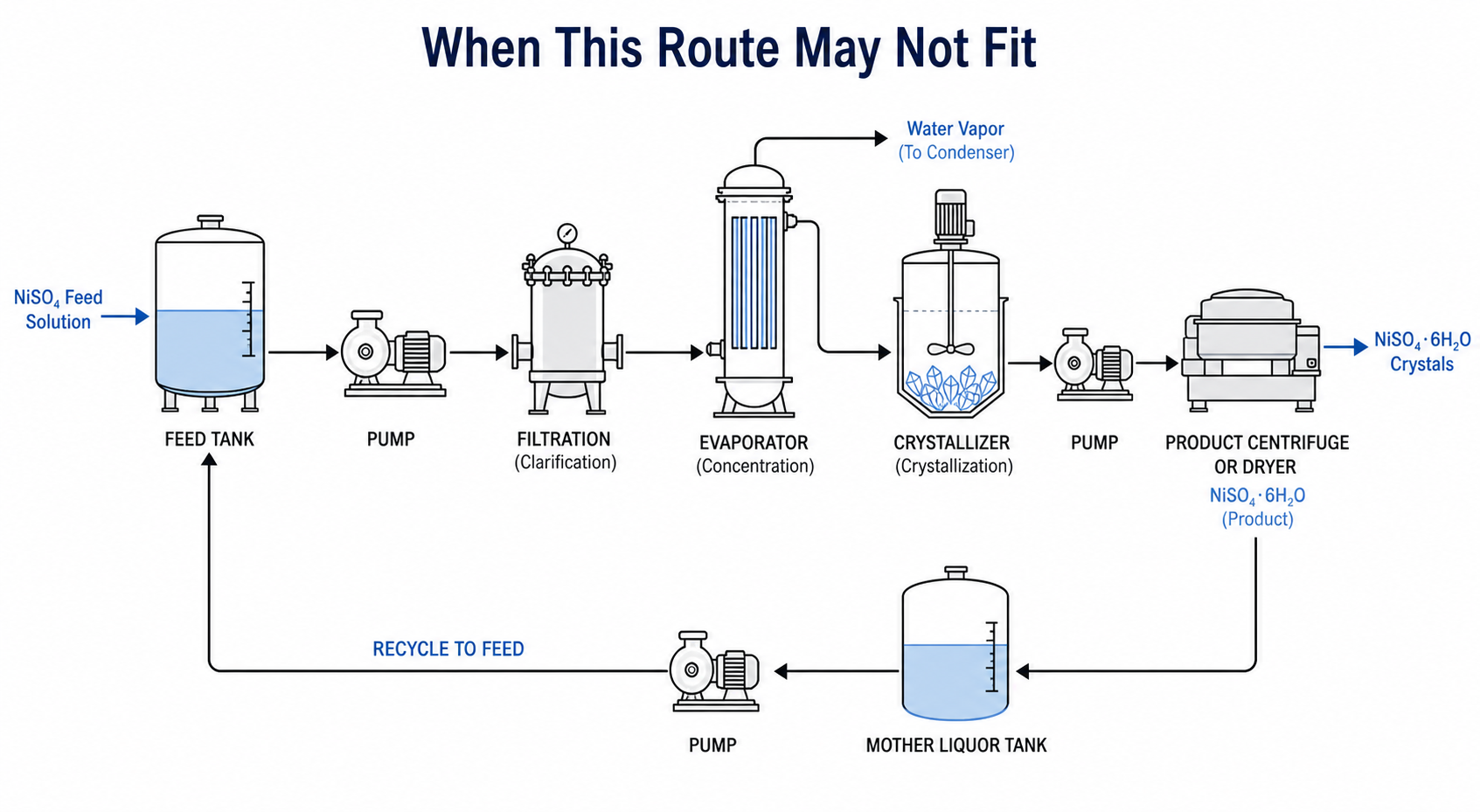
This route assumes battery-grade or plating-grade nickel sulfate is genuinely the product. A plant whose liquor is a dilute waste stream with no nickel recovery credit, or whose nickel tenor makes refining uneconomic, should solve the waste problem with a different flowsheet rather than crystallize product at a loss. The route also misfits sites that cannot support the purification burden: battery-grade ceilings for Ca, Mg, Cu, Zn, Fe, and Na are set by upstream refining, and no crystallizer, however well controlled, purifies a feed it never receives. Flash crystallization specifically misfits small campaigns serving specialty morphology grades, where batch cooling gives the tighter thermal command. And projects without a confirmed precursor-customer specification set are optimizing against a target that will move before commissioning.
What Must Be Verified
Before a battery-grade plant is committed, the following must be verified against project data rather than the illustrative envelope above. A full purified-liquor analysis — Ni tenor, sulfate balance, and trace metals Ca, Mg, Cu, Zn, Fe, Na — because impurity ceilings decide whether upstream refining is adequate before any crystallizer is selected. The actual customer specification set, including magnetic-substance limits and crystal size distribution windows, fixed contractually before layout. Measured solubility and viscosity at end-of-concentration conditions, checked against heater temperature difference and compressor lift where MVR is planned. Seeding and cooling-profile trials that demonstrate the target morphology. And a recycle-loop impurity model with a defined purge strategy, because impurities that stay dissolved accumulate with every mother-liquor return.
FAQ
What is the standard process for battery-grade nickel sulfate hexahydrate?
Evaporation of purified nickel sulfate liquor at elevated temperature (in an MEE or MVR evaporator), followed by flash crystallization under vacuum where NiSO4·6H2O crystallizes from the concentrated solution, thickening of the slurry, centrifugal separation of crystals from saturated mother liquor, and vibrating fluidized-bed drying to final moisture — all under automated control.
Why does nickel sulfate plant design start from the solubility curve?
Because NiSO4 solubility increases significantly with temperature. That single fact lets the plant concentrate hot (salt stays dissolved in the heater) and crystallize cold or by flash (supersaturation appears in the crystallizer, not on the heat-transfer surface). The whole layout — where we evaporate versus where we crystallize — falls out of that curve.
Should crystallization be continuous flash or batch cooling?
Continuous vacuum flash suits high-throughput steady production and consistent median size. Batch or interrupted cooling crystallization gives direct control of the thermal profile — programmed cooling with seeding — which is how plants tune a narrow size distribution and specific morphology for demanding precursor grades. Many plants select based on the crystal specification their customers enforce.
Which control parameters matter most in nickel sulfate crystallization?
Five: the temperature profile (growth rate, structure, purity), agitation speed (uniform supersaturation without breaking crystals), solution concentration (the starting point), cooling rate (fast cooling traps impurities in crystals and makes fines), and mother-liquor circulation (system stability). Automated control of these five is what makes quality repeatable.
Can the same plant serve nickel recovery from spent batteries?
Yes. Hydrometallurgical recycling of black mass produces purified nickel sulfate liquors comparable to primary refining streams, and the same evaporation-crystallization technology, in titanium construction, produces battery-grade hexahydrate from either feed. Systems are routinely quoted for both primary production and recycling duty in one customizable design.
Next step: send your purified-liquor analysis, capacity, and target specification set, and receive a first-pass screening of the process direction and boundary conditions — inputs exchanged for engineering direction.