Project Parameters
| Parameter | Value |
|---|---|
| Process route | Three-effect evaporation desalting (stage of hydrolysis + evaporation + biological sequence) |
| Industry | Pesticide manufacturing — triazine herbicide (atrazine) production |
| Feed type & key components | Atrazine production wastewater; NaCl salt load 20,000–30,000 mg/L (published), ammonia nitrogen from organic amines, elevated COD |
| Evaporation capacity | 5 t/h |
| Construction materials | SS316L wetted parts (indicative for chloride pesticide service) |
Representative process configuration compiled from published industry project data. Indicative values, not a process guarantee.
Project Description
Atrazine is the workhorse triazine herbicide of corn, sorghum and sugarcane agriculture, and its production washes a difficult wastewater: the synthesis generates sodium chloride directly, the water wash of the product carries active ingredient traces, and the salt load — published at 20,000–30,000 mg/L as mixed wastewater — sits far above what biological treatment tolerates. Active atrazine is environmentally persistent, and its endocrine activity is documented; the wastewater is treated, not diluted. The reference configuration is the 5 t/h three-effect evaporation train that takes the salt out so the biology can work.
The process sequence this train belongs to is the published combination for this effluent class: thermal hydrolysis breaking refractory organics, three-effect evaporation removing the salt, and an anoxic-aerobic biological stage polishing the desalted stream. The evaporator’s role is narrow and decisive — the wastewater’s B/C ratio (published above 0.3) says the organics are biodegradable, but only after the salt comes out; desalting is the gate the whole sequence passes through.
Process Technology
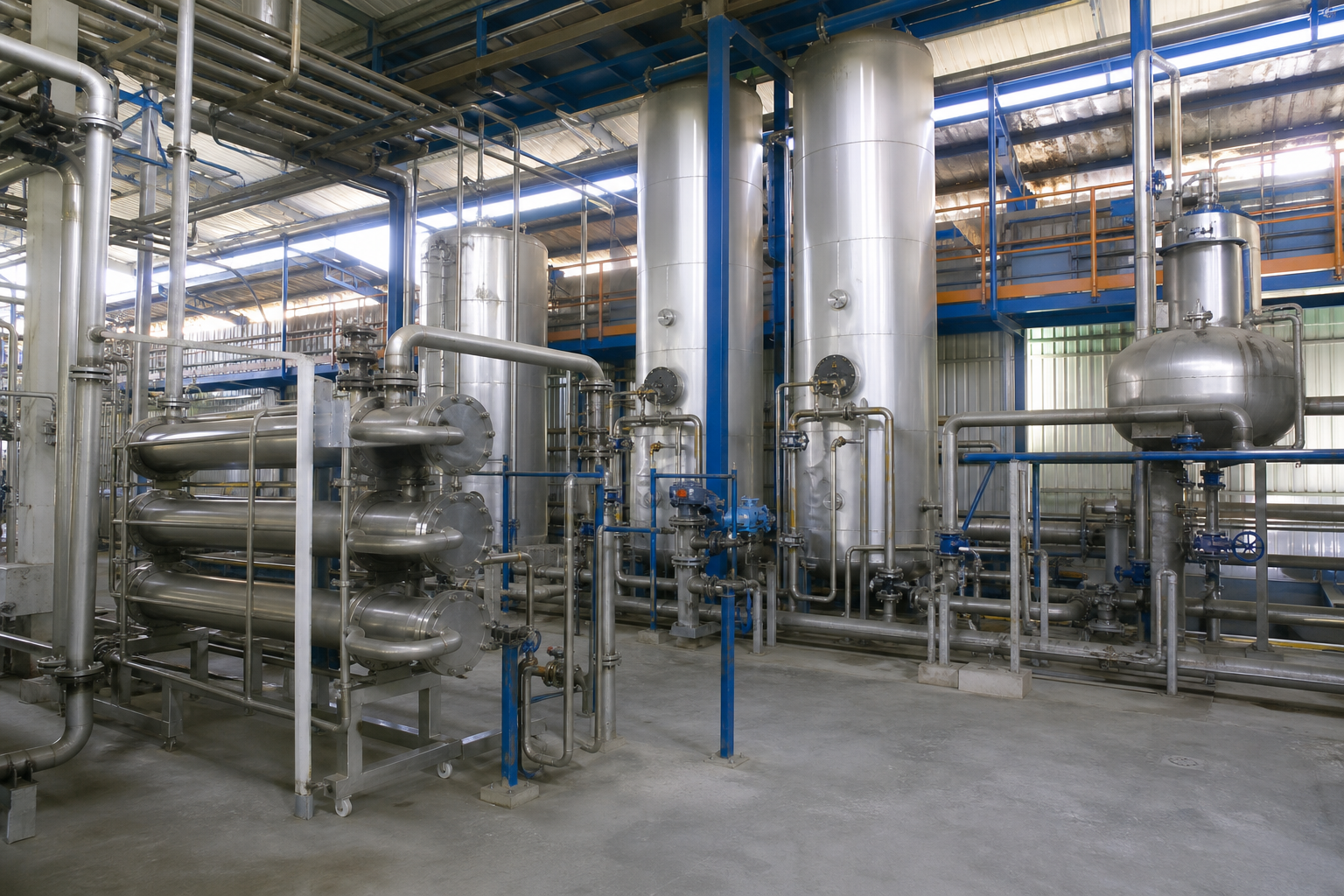
The wastewater is collected from the synthesis and washing sections, equalized, and pre-treated for suspended atrazine particles and free oil. Thermal hydrolysis upstream attacks the refractory fraction, converting it toward biodegradable forms.
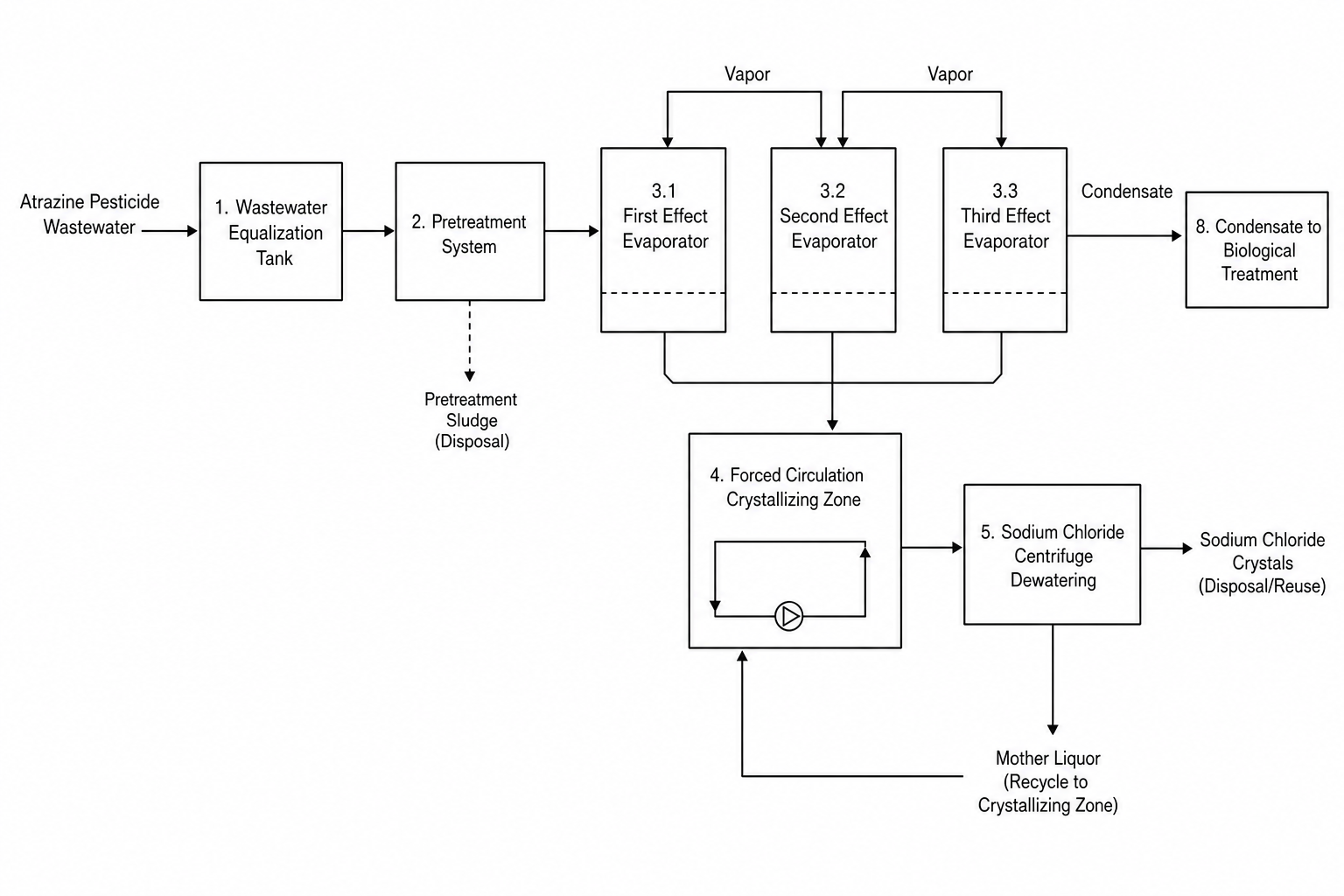
The desalting runs on three-effect evaporation: live steam drives the first effect, vapor cascades through the second and third under vacuum, and the water leaves the train as clean condensate while the salt concentrates. Sodium chloride crystallizes from the concentrated brine in the train’s crystallizing zone — forced circulation defends the heat transfer surfaces — and the salt leaves as a dewatered chloride cake for managed disposal. The ammonia nitrogen, arriving from the organic amines of synthesis, splits between condensate and brine as the chemistry dictates; the condensate stream is monitored and returned to the sequence’s front end.
The desalted condensate advances to the anoxic-aerobic biological stage, where the B/C-friendly organics finally leave the water and the ammonia nitrogen from the synthesis amines finds its nitrogen biology. The train’s three-effect steam economy keeps the desalting step affordable at pesticide-plant steam prices; condensate heat preheats incoming wastewater; and the sequence discharges a biologically polished stream.
Equipment Configuration
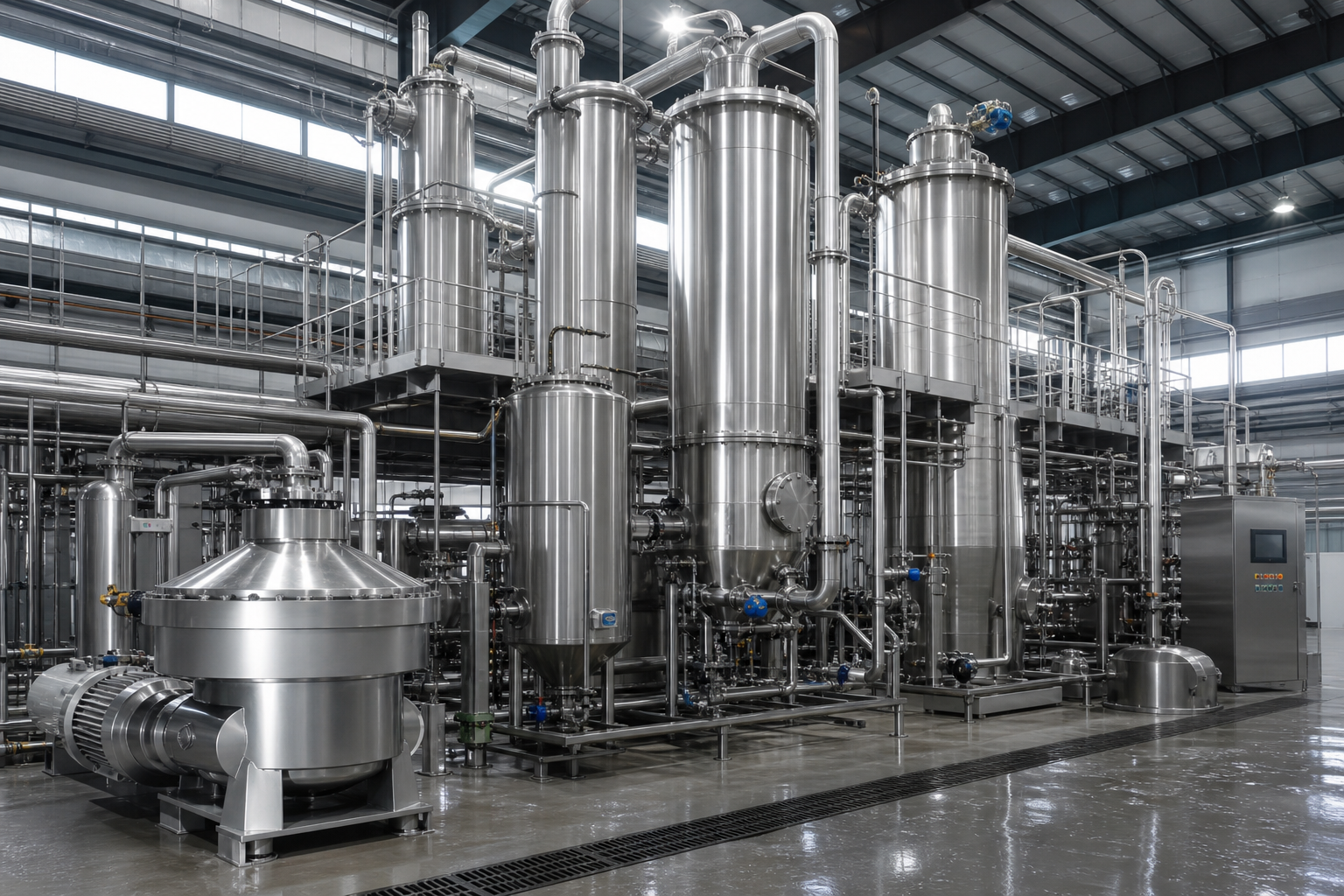
One set of the following equipment is typical for this duty:
- Wastewater equalization with solids and oil pretreatment
- Thermal hydrolysis interface for refractory organics (sequence partner)
- Three-effect evaporation train with forced-circulation crystallizing zone
- Chloride salt dewatering (centrifuge) for managed disposal
- Condensate monitoring and routing to biological treatment
- PLC control of effect profile, density and salt inventory
Performance & Outcome
Compiled from published industry project data, indicative: trains of this class cut the wastewater salt load from the 20,000–30,000 mg/L range to biologically tolerable condensate, enabling downstream biological polishing of a biodegradable organic load. Desalting depth and steam economy are quoted per project wastewater chemistry.
Simplified PFD
The simplified process flow diagram above shows wastewater pretreatment, the three-effect desalting train with salt dewatering, and condensate routing to biological treatment.