Evaporation is the concentration engine of every brine-based lithium line. Whether the front end is solar ponds or direct lithium extraction (DLE), lithium arrives in water at low concentration alongside sodium, magnesium, boron and sulfate — and mechanical vapor recompression (MVR) evaporation lifts it to the strengths conversion chemistry requires, before crystallizers finish battery-grade lithium carbonate or lithium hydroxide. The hardest sites anchor the published record: an external industry reference — a supplier-published salt-lake case from China’s high-altitude western plateaus — describes two MVR falling-film systems, one concentrating lithium chloride and one borax, reporting energy consumption reduced by over 60% versus conventional evaporation with stable high-altitude operation (supplier-published indicative figure, not a project guarantee). Downstream, published references from international water-treatment specialists report lithium carbonate at purity above 99.9%. The evaporation island is where brine chemistry, energy cost and product specification meet — and where project economics are largely decided.
The Lithium Brine Value Chain
A brine lithium production line is a chain of concentration and purification steps, each raising lithium tenor and rejecting impurities until the liquor is ready for conversion into a solid battery-precursor product.
| Stage | What happens | Role of evaporation / crystallization |
|---|---|---|
| Resource extraction | Salt-lake brine pumped from aquifers, or oilfield brine, or geothermal brine | Solar pond pre-concentration where climate permits |
| Concentration | Lithium tenor lifted from site-specific low levels to process specification | MVR falling-film evaporation — the energy-efficient core duty |
| Impurity removal | Magnesium, calcium, boron, sulfate rejected by precipitation, adsorption or ion exchange | Evaporation recycles wash waters and brines through removal steps |
| Conversion / finishing | Sodium carbonate precipitation of lithium carbonate, or caustic conversion to lithium hydroxide | Crystallizers classify and wash the battery-grade crystal |
| Mother liquor & water management | Recovery of lithium-bearing liquors and process water | Mother-liquor concentration returns lithium to the front; condensate recycles as wash and process water |
Every arrow in that chain that carries water needs an evaporator; every arrow that ends in a solid needs a crystallizer. That is the scope of a brine-lithium evaporation system supplier’s work.
Where Evaporation Fits: Solar Ponds, DLE and Mechanical Evaporation
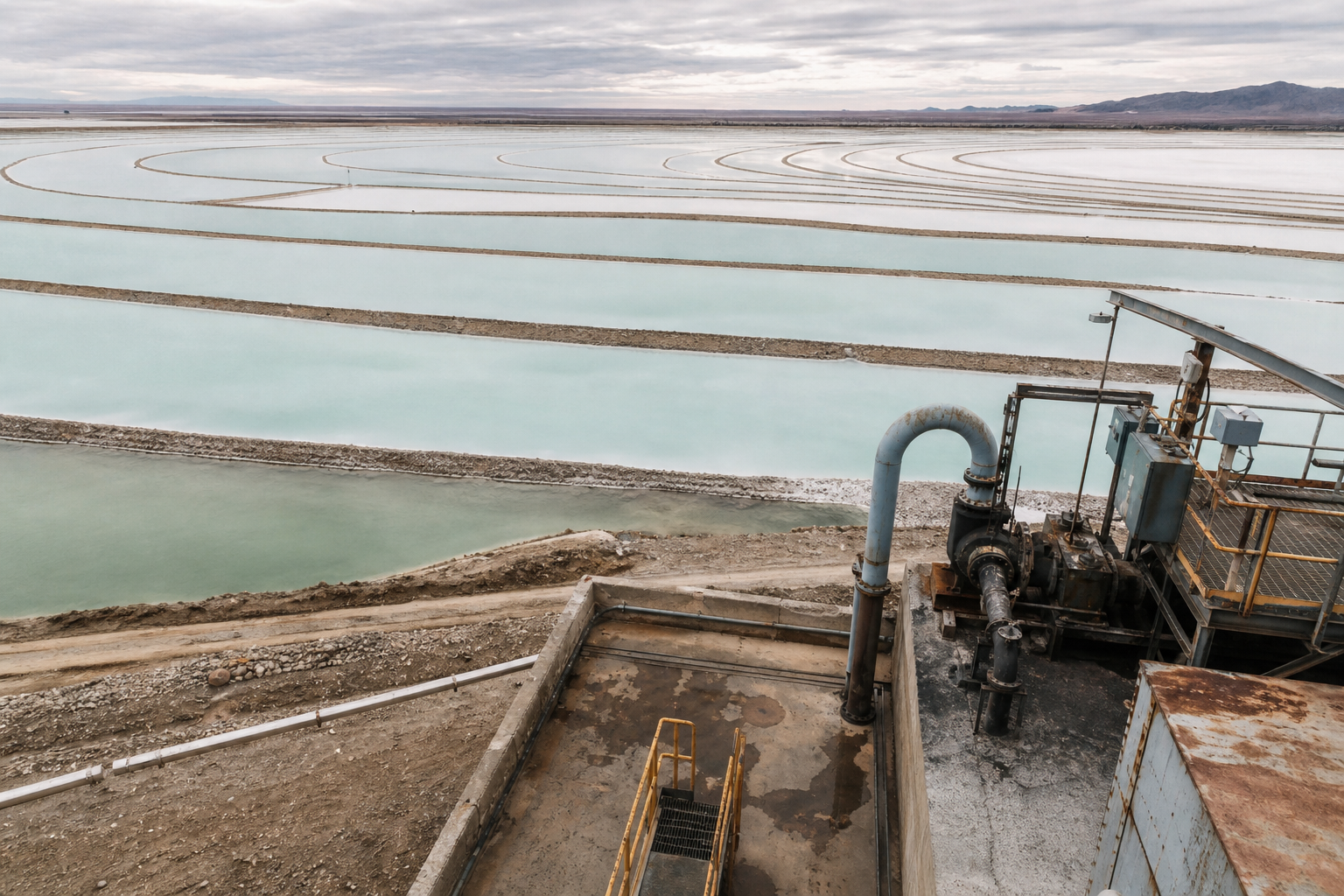
Classical salt-lake production leans on solar ponds for bulk concentration free of energy cost — but ponds are slow, land-hungry, weather-dependent and inefficient on brines with unfavorable magnesium-to-lithium ratios. DLE inverts the picture: adsorbents or solvents pull lithium from raw brine and return a clean but dilute lithium chloride eluate, moving the concentration burden to the process plant, where mechanical evaporation takes over; international suppliers report most of their lithium systems operate downstream of another firm’s DLE process. Even in pond-based flowsheets, mechanical evaporation covers what ponds cannot: winter operation, controlled final concentration ahead of precipitation, and end-of-chain mother liquors whose lithium value justifies recovery.
Core Duties of the Evaporation System
Lithium chloride concentration
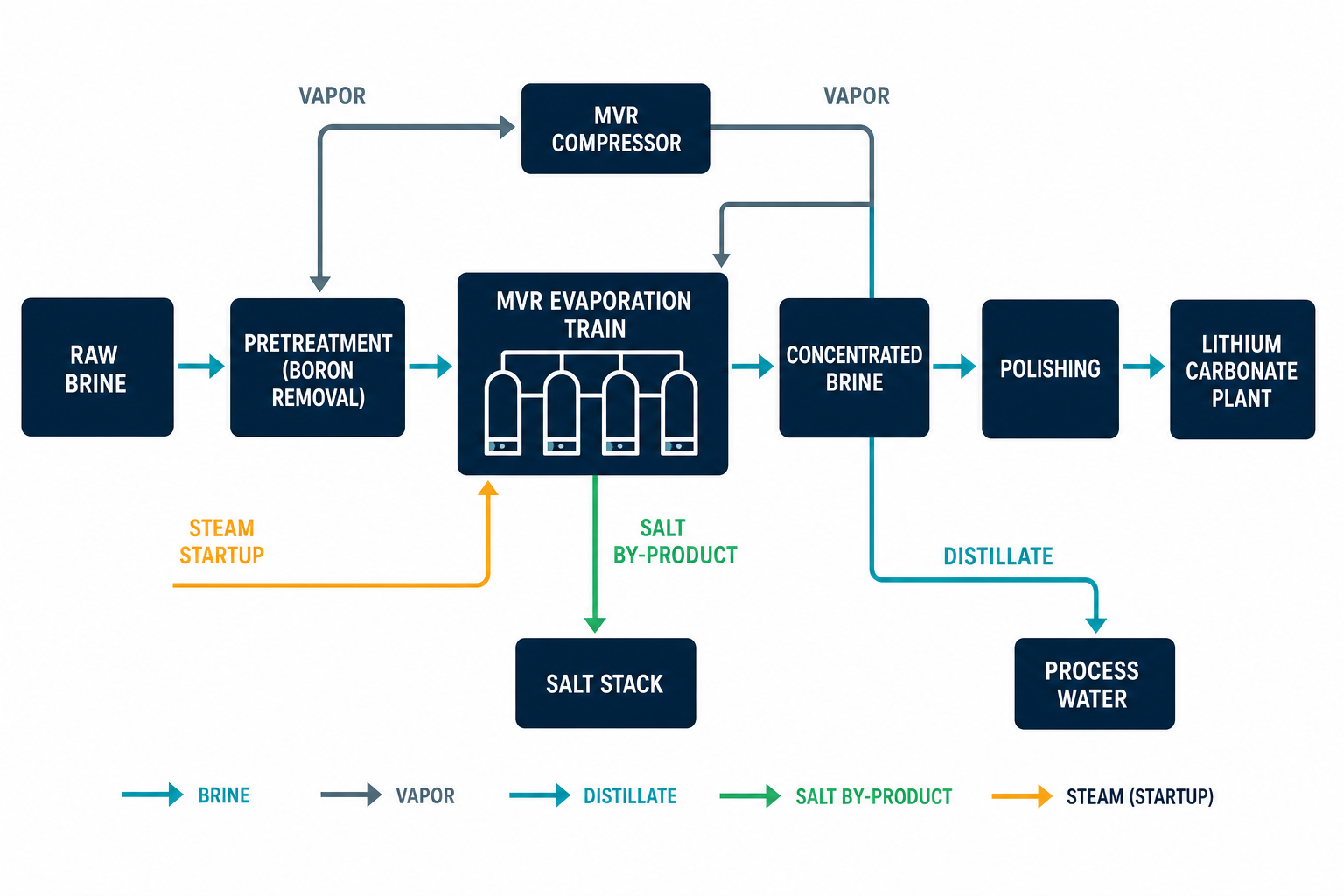
The signature duty. In the published supplier case referenced above, the feed brine carried low lithium concentration with a small amount of sodium and a pH that varied within a range; the target was to raise lithium concentration to meet product specification at a high hourly evaporation capacity. The configuration was falling-film evaporation combined with MVR — recovering the heat of the evaporated steam for low-energy concentration — with the reported result of stable lithium concentration and smooth system operation. Falling-film bodies suit this duty because lithium chloride brine at moderate concentration is clean enough to reward high heat-transfer coefficients, and the short residence time limits corrosion exposure per pass.
Boron and co-product concentration
Many salt lakes carry a second paycheck. In the same published case, a borax concentration system treated brine of moderate-to-high boron concentration with significant sodium at alkaline pH, targeting a much higher boron level at high evaporation capacity. The engineering challenge is specific — borax crystallizes readily and fouls surfaces — so the falling-film MVR system was designed around borax crystallization and fouling behavior; the reported outcome, boron concentrated to target with borax recovered, shows how co-product recovery rides on the same utility island as lithium.
Crystallization of battery-grade products
The final conversion is precipitation and crystallization: sodium carbonate reacts with concentrated lithium chloride to precipitate lithium carbonate, which is classified, washed and dried; the lithium hydroxide route converts through intermediate steps to lithium hydroxide monohydrate crystallized by cooling or evaporation. Product quality is defined here — published international project references report lithium carbonate exceeding 99.9% purity and battery-grade lithium hydroxide produced for Fortune 500 entrants to the industry. Crystallizer selection and washing design control the impurity story: sodium in the mother liquor, sulfate carryover and boron contamination are all managed through classification, reslurry washing and controlled supersaturation rather than through heroic upstream cleanup.
Mother liquor and water loop
Lithium carbonate precipitation leaves a sodium chloride-bearing mother liquor with residual lithium value; concentrating and recycling it returns that lithium to the front of the process instead of a tailings pond, lifting overall yield. The train’s condensate, hot and effectively salt-free, becomes wash water, DLE elution water and general process water where fresh water is the scarcest reagent of all.
| Process module | Equipment candidates | Selection basis | Indicative envelope |
|---|---|---|---|
| Brine pre-concentration | Solar ponds; DLE eluate feed | Climate, Mg/Li ratio | Site-specific feed tenor |
| Lithium chloride concentration | Falling-film MVR bodies | Clean brine, energy cost | To conversion specification |
| Boron / co-product concentration | Fouling-tolerant MVR train | Borax fouling behavior | To saleable borax level |
| Conversion crystallization | Carbonate precipitators; cooling crystallizers | Battery-grade purity | >99.9% Li₂CO₃ reported |
| Mother-liquor recovery | MVR concentrator | Lithium yield | Liquor recycled to front |
Configuration, materials and envelopes depend on the actual brine analysis, impurity profile, site energy and product specification.
Project Example: Salt Lake Lithium and Boron by MVR
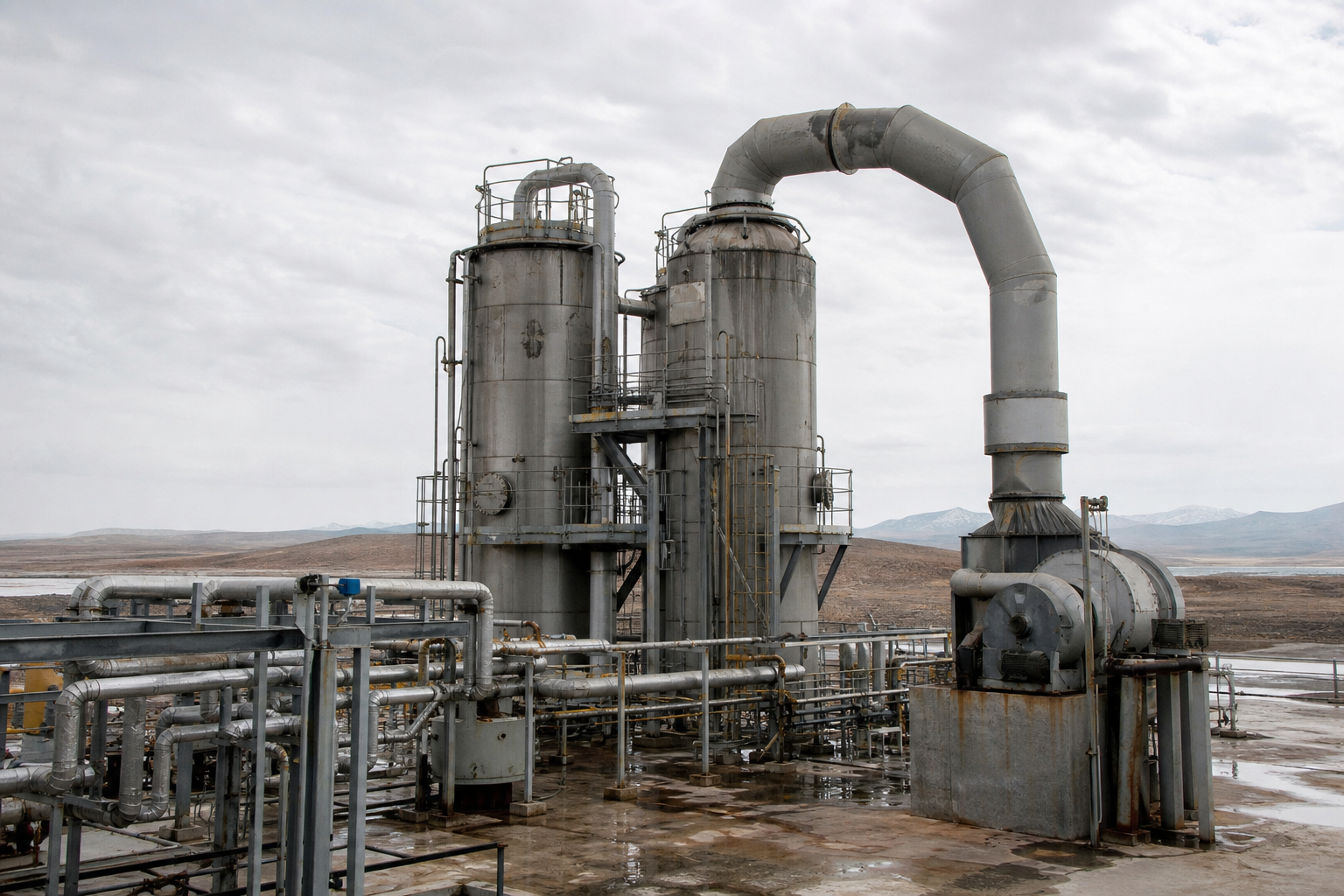
This section is an external industry reference — a supplier-published project case, not an EvapCryst delivery — worth a close read because it bundles the sector’s constraints. A large salt lake held lithium and boron to be extracted and concentrated to required levels; the owner selected an MVR evaporation supplier and received the lithium chloride and borax concentration systems described above. The reported outcomes: both systems reached designed evaporation capacity and concentration ratio with high recovery; energy savings exceeded 60% versus conventional evaporators (supplier-published figure); and the equipment operated stably at altitude with easy maintenance. Three lessons generalize: dual-product recovery changes project economics materially; MVR’s energy advantage compounds at remote sites where steam must be hauled or generated locally; and altitude — thin air, cold winters, distant service — punishes anything but robust, simple-to-maintain rotating equipment.
Why MVR Dominates Modern Brine Projects
- Energy economics: MVR recycles the evaporated vapor as heating steam via a compressor, consuming electricity instead of live steam; supplier-reported reductions exceed 60% in comparable service — a supplier-published indicative range, not a project guarantee. At remote brine sites, steam is the expensive option and grid or locally generated power the cheap one.
- Water as a product: the condensate is the plant’s best water source in arid salt-lake regions, feeding DLE elution, washing and dust control.
- Footprint and climate immunity: mechanical evaporation does in hours what ponds do in months, on a compact plot, in any season — decisive at altitude where winter ends pond chemistry.
- Turndown: brine grades swing with the aquifer; MVR trains follow load without the all-or-nothing character of solar pond chains.
- Proven finishing: supplier-published cases place MVR-driven crystallizers in commercial service producing battery-grade lithium and nickel products for the EV battery industry.
Impurity Management: The Real Difficulty of Brine Lithium
Lithium is common in brines; clean lithium is not. Magnesium is the historic enemy — high magnesium-to-lithium ratios defeat pond routes and burden chemical removal — and its rejection happens largely upstream of the evaporators. But boron, sodium and sulfate shape the evaporation and crystallization design itself: borax fouling drives heat-surface selection, as the published case shows; sodium chloride loading defines crystallizer duty; sulfate chemistry decides where mixed salts drop out, which is where salt separation earns its place in the flowsheet. Pilot testing and demonstration plants are the industry’s standard de-risking instruments before full-scale commitment — international suppliers structure entire test centers around that need, and we hold the same view: brine chemistry is individual, and the qualification run is part of the engineering. That is also the validation focus below.
How evapcryst Delivers Brine Lithium Evaporation Systems
evapcryst engineers MVR evaporation and crystallization systems for the battery-materials value chain, from brine concentration through battery-grade finishing. Our scope on a brine lithium production line covers falling-film concentration bodies, forced-circulation finishers, crystallizers for carbonate and hydroxide duties, mother-liquor recovery, and the condensate management that remote sites depend on — integrated with the impurity-removal steps that define final purity. The same systems serve adjacent duties described on our battery materials industry page and in resource-recovery projects such as high-salinity wastewater resource recovery. Required inputs: the brine analysis, the target product and specification, and the site’s energy picture — in exchange, an initial process direction covering the concentration train, crystallizer selections and an indicative energy budget.
When This Route May Not Fit
This route assumes the brine is worth concentrating — lithium tenor, impurity profile and site conditions that reward mechanical evaporation. It may not fit where the magnesium-to-lithium ratio is high and no upstream removal route exists: evaporation concentrates magnesium with lithium and cannot separate them, so the separation problem must be solved before this train makes sense. It may not fit on very large volumes of extremely dilute brine in pond-friendly climates with cheap land, where solar pre-concentration followed by targeted mechanical stages beats a fully mechanical train. It may not fit where the site has no reliable electricity and fuel-hauled steam is the only energy, undermining the MVR case. And it may not fit where a co-product like boron is too lean to amortize a second system, leaving the dual-product economics unrealized.
What Must Be Verified
Before the route is fixed, the validation focus is: a full brine analysis across seasons — lithium, sodium, magnesium, boron, sulfate, chloride, pH — because aquifer composition swings and the train must be designed for the worst season, not the average. Then the magnesium rejection route and its residual level into the evaporators. Then boron behavior: fouling-rate tests on the actual brine, since borax deposition sets the cleaning cycle and surface selection. Then a conversion crystallization bench test confirming the target product grade is reachable from this liquor. Then site energy economics — electricity price and reliability at altitude or in remote locations — and the water balance for elution and wash demand. Pilot or demonstration runs on the real brine, not synthetic liquor, are the evidence base.
FAQ
Why use mechanical evaporation when salt lakes have free sunlight?
Solar ponds do bulk concentration cheaply but slowly, over large land areas, only in favorable climates, and poorly on brines with high magnesium-to-lithium ratios. Mechanical MVR evaporation concentrates in hours on a compact plot, in any season, at controllable endpoint — and for DLE-based plants that produce a dilute lithium chloride eluate, it is the only concentration option at all. Most modern evaporation scopes combine the two: ponds where they work, MVR where control matters.
What energy savings does MVR deliver on lithium brine concentration?
In a published supplier case on salt-lake lithium and boron, MVR systems reported energy consumption reduced by over 60% compared with conventional evaporators — a supplier-published indicative figure, not a project guarantee. The saving comes from recompressing and reusing the evaporated vapor as heating steam, replacing purchased or hauled steam with electricity.
Can evaporation systems produce battery-grade lithium directly?
The evaporation and crystallization island is where battery grade is reached: concentrated lithium chloride is precipitated as lithium carbonate and the crystal is classified, washed and dried — or converted to lithium hydroxide and crystallized. Published external references report commercial plants at lithium carbonate above 99.9% purity, better than battery-grade specification. The impurity work upstream of crystallization determines how hard the crystallizer must work for it.
How is boron handled in a lithium brine plant?
Boron is both an impurity and a product. As a contaminant it is rejected upstream by adsorption, extraction or precipitation, because boron carryover degrades battery-grade specifications. Where concentrations justify it, a dedicated borax concentration system — falling-film evaporation designed around borax’s crystallization and fouling behavior — recovers borax as a saleable co-product on the same utility island, as reported in the published supplier case cited above.
What information is needed to scope a brine lithium evaporation system?
The essentials: full brine analysis (lithium, sodium, magnesium, boron, sulfate, chloride, pH), daily or hourly brine flow, target product and its specification, the site’s electricity and steam situation, and any altitude or climate constraints. From these a supplier can propose the concentration train configuration, estimate energy consumption per ton of water removed and per ton of product, and flag the impurity issues that will shape the crystallizer design.