Project Parameters
| Parameter | Value |
|---|---|
| Process route | Multi-effect evaporation of black liquor + chemi-mechanical pulping wastewater |
| Industry | Pulp & paper (Chongqing, Southwest China) |
| Feed type & key components | Kraft black liquor mixed with chemi-mechanical (CMP) pulping wastewater; organics, sodium salts, fiber fines |
| Evaporation capacity | 580 t/h |
| Construction materials | SS316L / duplex wetted parts (indicative for alkaline liquor service) |
Representative process configuration compiled from published industry project data. Indicative values, not a process guarantee.
Project Description
A large paper mill in Chongqing operates both chemical and chemi-mechanical pulping lines. The kraft lines produce black liquor — the organic-laden alkaline spent cooking liquor whose evaporation and combustion closes the mill’s chemical and energy loop. The chemi-mechanical lines, which refine wood with chemical pretreatment rather than full cooking, produce a different wastewater: still organic and hot, but with higher fiber fines and a different salt profile. The published project for this site treats both streams in one 580 t/h evaporation plant — a combined-duty scale-up of the black liquor evaporation architecture, second only in the region’s published fleet to the 750 t/h class installed in Hubei.
The pairing matters because the two liquors stress an evaporator differently. Black liquor is a fouling, viscosity-rising fluid whose behavior through concentration is textbook-chartered; CMP wastewater brings fiber fines and extractives that demand pretreatment discipline upstream of the heat transfer surfaces. Managing both in one plant concentrates the design effort where they overlap: robust liquor cleaning, fouling-tolerant body selection, and washing strategy across effects.
Process Technology
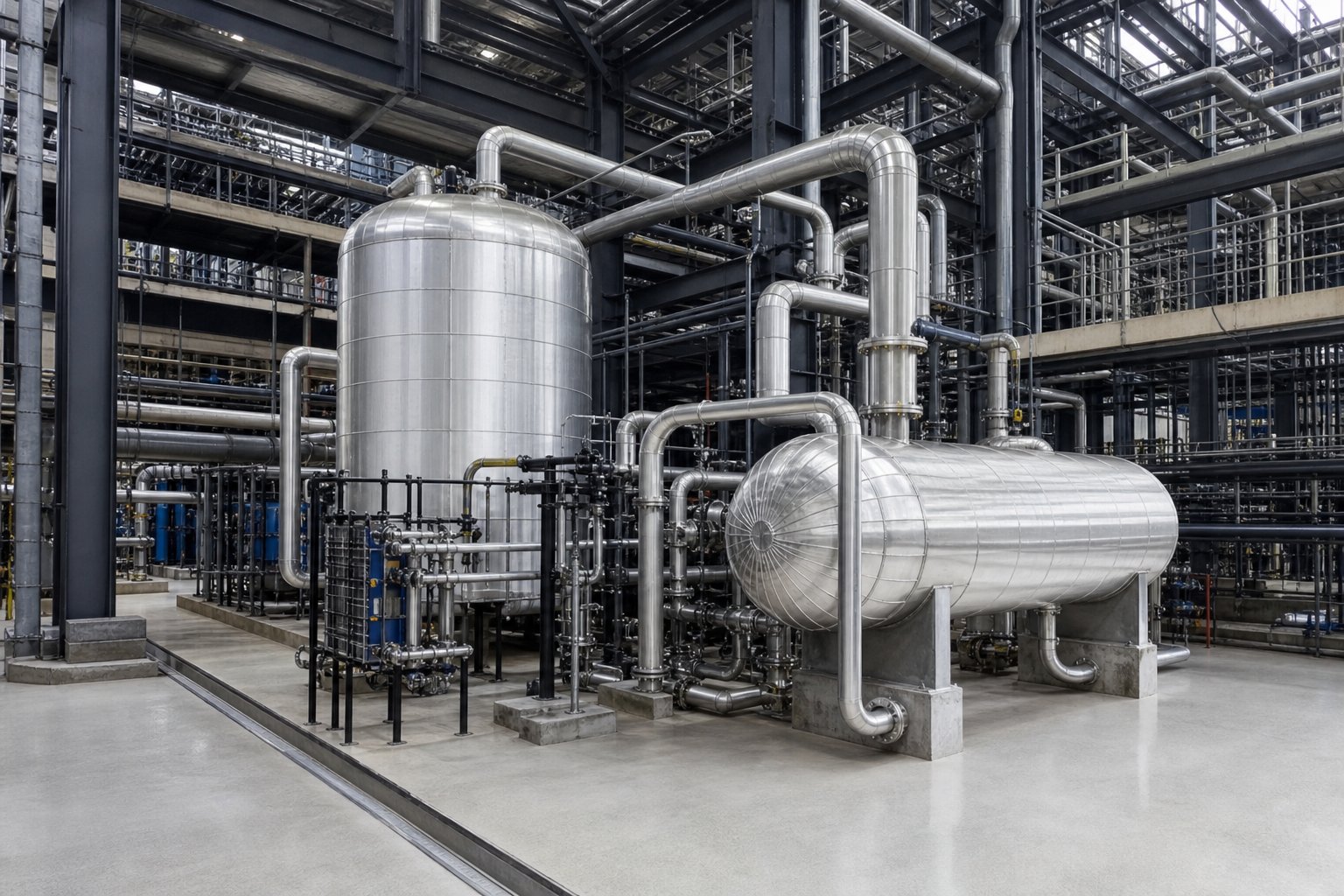
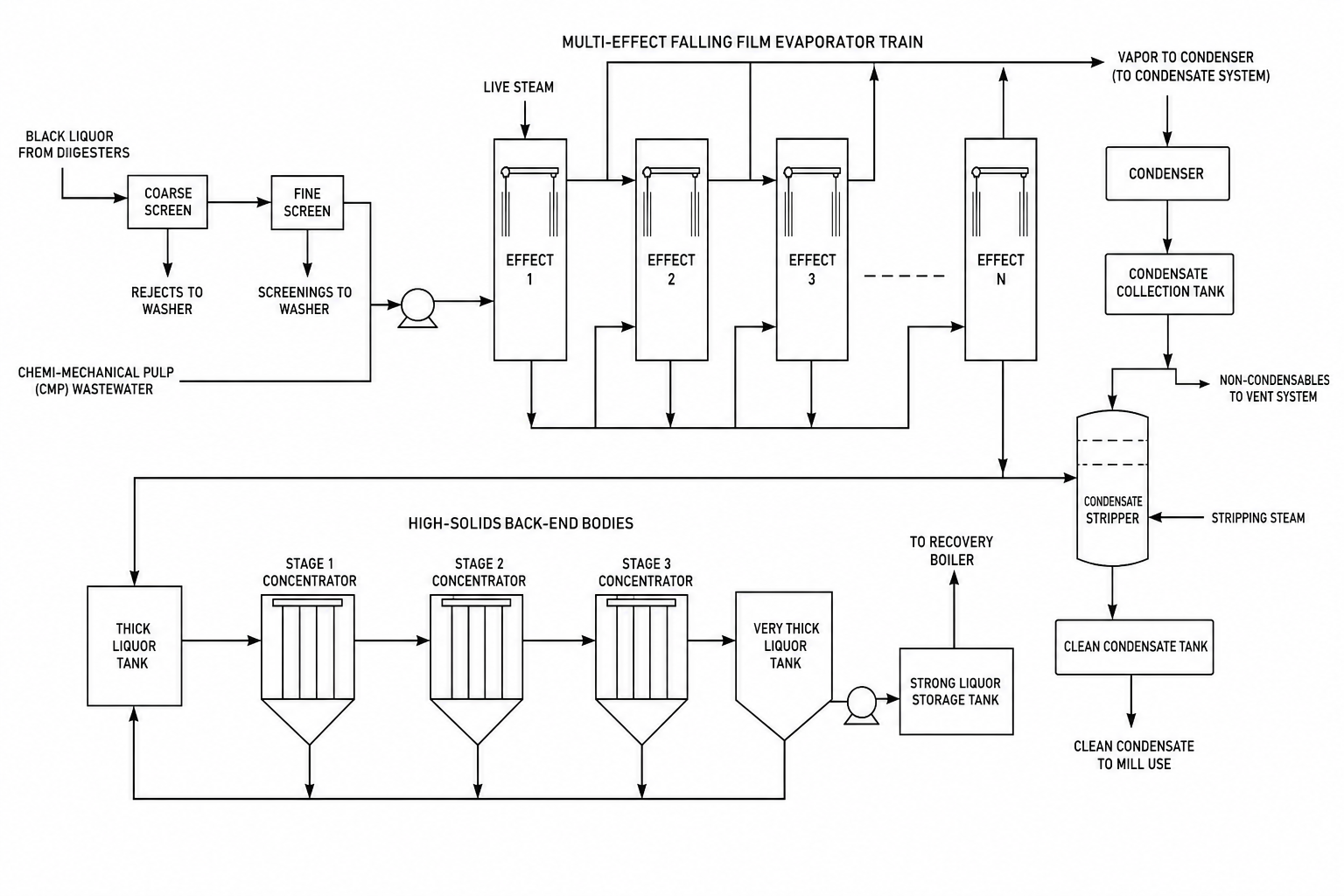
Black liquor from the kraft lines is screened and stripped of fiber carryover, mixed or interleaved with pretreated CMP wastewater per the site’s liquor balance, and fed forward to the multi-effect train. The effects are arranged in series with descending temperature and pressure: live steam motivates the first effect, and each subsequent effect boils on the vapor of the one before, so each tonne of steam evaporates several tonnes of water across the train — the steam economy that keeps a mill-scale evaporation plant affordable to run.
Falling-film bodies carry the primary concentration duty. Black liquor in the early and mid concentration window wets the calandria as a thin film, evaporating at low temperature difference with short residence time — the regime that keeps viscosity-driven fouling manageable as solids climb toward the firing range. Where the liquor works toward high solids, bodies designed for the viscous, scaling back end of the duty take over. For the CMP fraction, pretreatment — fiber removal and equalization — protects the film distribution systems from fines that would blind them.
Concentrated strong liquor is stored and fired in the recovery boiler, generating steam and recovering the pulping chemicals; this is the circularity that makes black liquor evaporation an energy asset rather than a treatment cost. Condensate from the effects is segregated by cleanliness: clean condensate returns to the mill’s process water system, fouled condensate stripped of methanol and reduced sulfur compounds per standard recovery-area practice.
Equipment Configuration
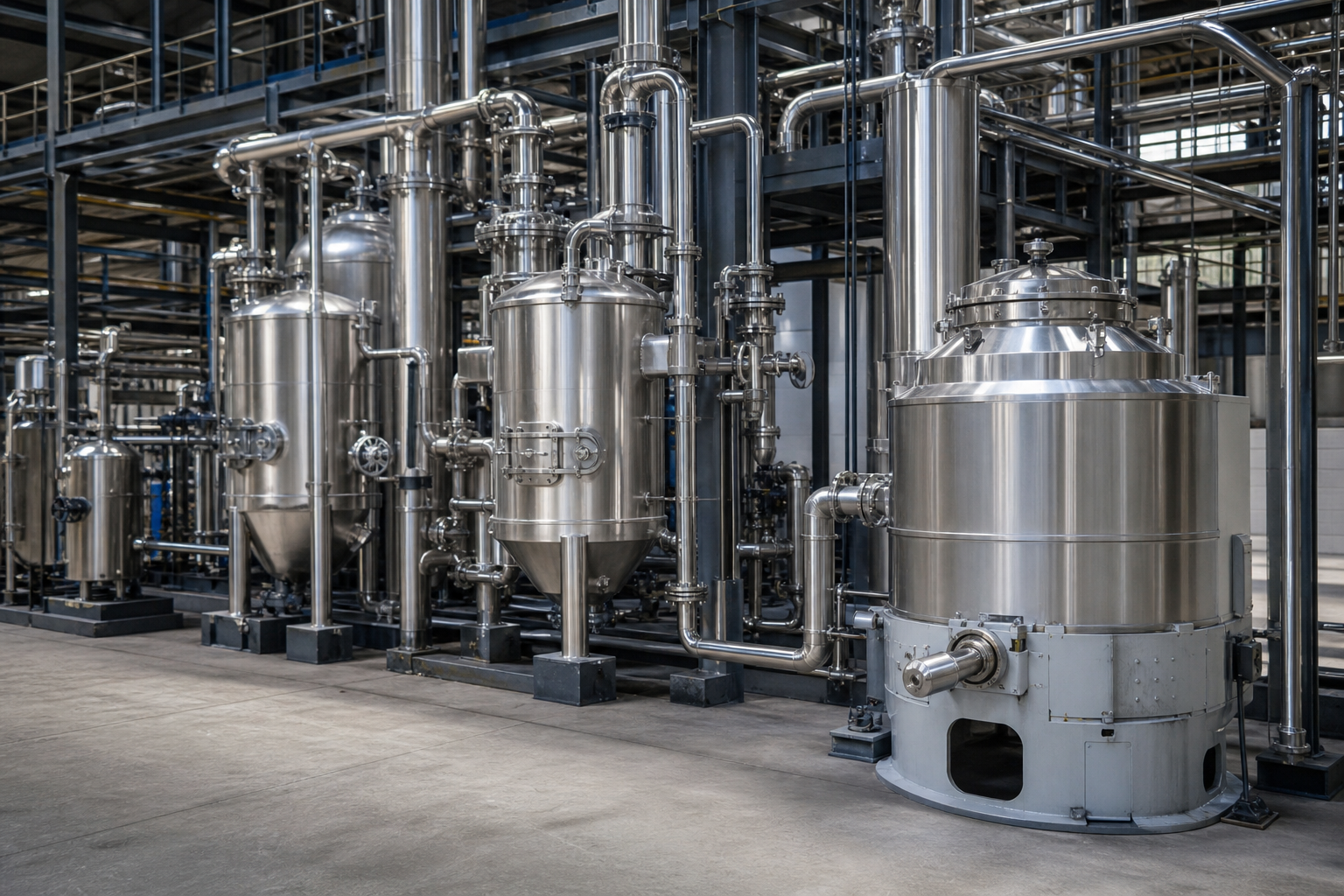
One set of the following equipment is typical for this duty:
- Black liquor screening / fiber removal; CMP wastewater pretreatment and equalization
- Multi-effect falling-film evaporation train with steam distribution across effects
- Back-end bodies rated for high-solids viscous liquor service
- Strong liquor storage and forwarding to the recovery boiler
- Segregated condensate system with stripping of methanol/TRS contaminants
- DCS control of effect temperatures, liquor solids and washing sequences
SS316L is the indicative reference with duplex upgrades assessed for the hottest alkaline zones per project.
Performance & Outcome
Compiled from published industry project data, indicative: plants of this class evaporate black liquor and CMP wastewater together at the 580 t/h scale, delivering strong liquor to the recovery boiler and returning segregated condensate to mill water systems. Steam economy and final liquor solids are quoted per project.
For context on where this equipment class fits, see Multiple-Effect Evaporation (MED).