Project Parameters
| Parameter | Value |
|---|---|
| Process route | Complete juice line: fruit/vegetable preparation + triple-effect forced-circulation evaporation |
| Industry | Fruit & vegetable juice processing (Xinjiang, Northwest China) |
| Feed type & key components | Blended raw materials: tomato, carrot, apple, cherry plum |
| Line capacity | 1,000 t/d raw fruit & vegetable processing |
| Construction materials | SS316L wetted parts (food-grade finish) |
Representative process configuration compiled from published industry project data. Indicative values, not a process guarantee.
Project Description
Xinjiang&rsqu;s growing season delivers long sunlight hours and a harvest calendar that brings tomatoes, carrots, apples and cherry plums through the same plants in overlapping waves. A blend-juice line is built for exactly that pattern: rather than a single-fruit evaporator tuned for one product, the line processes whatever the harvest brings — singly or as blends — into concentrate and finished juice products. The published project for this duty is a 1,000 tonne-per-day line at a Xinjiang juice base, supplied as a complete production line from raw fruit receiving through evaporation.
Blend processing changes the evaporation problem in two ways. First, the feed chemistry swings with the crop: tomato liquor carries pulp and pectin, carrot carries carotenoids and fibers, apple brings sugar and clarity, cherry plum brings acidity and intense color. Second, the viscous, pulp-bearing liquors that result — tomato and carrot in particular — are not thin juices: they concentrate into pastes and heavy concentrates that a falling-film body cannot finish. The published configuration answers with triple-effect forced-circulation evaporation, the body type built for viscous, fouling-prone, solid-bearing juice service — the same architecture that carries the region&rsqu;s 6,750 t/d tomato paste lines.
Process Technology

Raw fruit and vegetables are received, washed, sorted and prepared per product — crushing and enzyming for apples and cherry plum, breaking and pulping for tomatoes, crushing and pressing for carrots — then clarified or pulped forward to the evaporation stage per the product recipe. For clear juice streams, fines removal ahead of the evaporator protects the heat transfer surfaces; for pulp products, the pulp is the product and carries through.
The heart of the line is the triple-effect forced-circulation evaporator. Liquor is pumped through the calandria at high velocity, boiling under controlled suppression in the separator: the pumped circulation is what lets viscous vegetable liquor and pulp-laden tomato juice concentrate without baking onto the heat transfer surface. Three effects step the duty down in temperature and pressure, each boiling on the previous effect&rsqu;s vapor — the steam economy a seasonal, high-throughput plant needs, where fuel per tonne of concentrate is a headline operating cost.
Concentration targets follow the product: tomato and carrot liquors work toward paste-class solids, apple toward AJC-class concentrate, blends toward the formulation&rsqu;s target Brix. Finished concentrate is flash-cooled and sent to aseptic filling or cold storage. Condensate from the effects is recovered as hot clean water and reused in washing and CIP — in a water-scarce region, this recovery is part of the plant&rsqu;s operating permit logic, as it is across Xinjiang&rsqu;s fruit-processing fleet.
Equipment Configuration
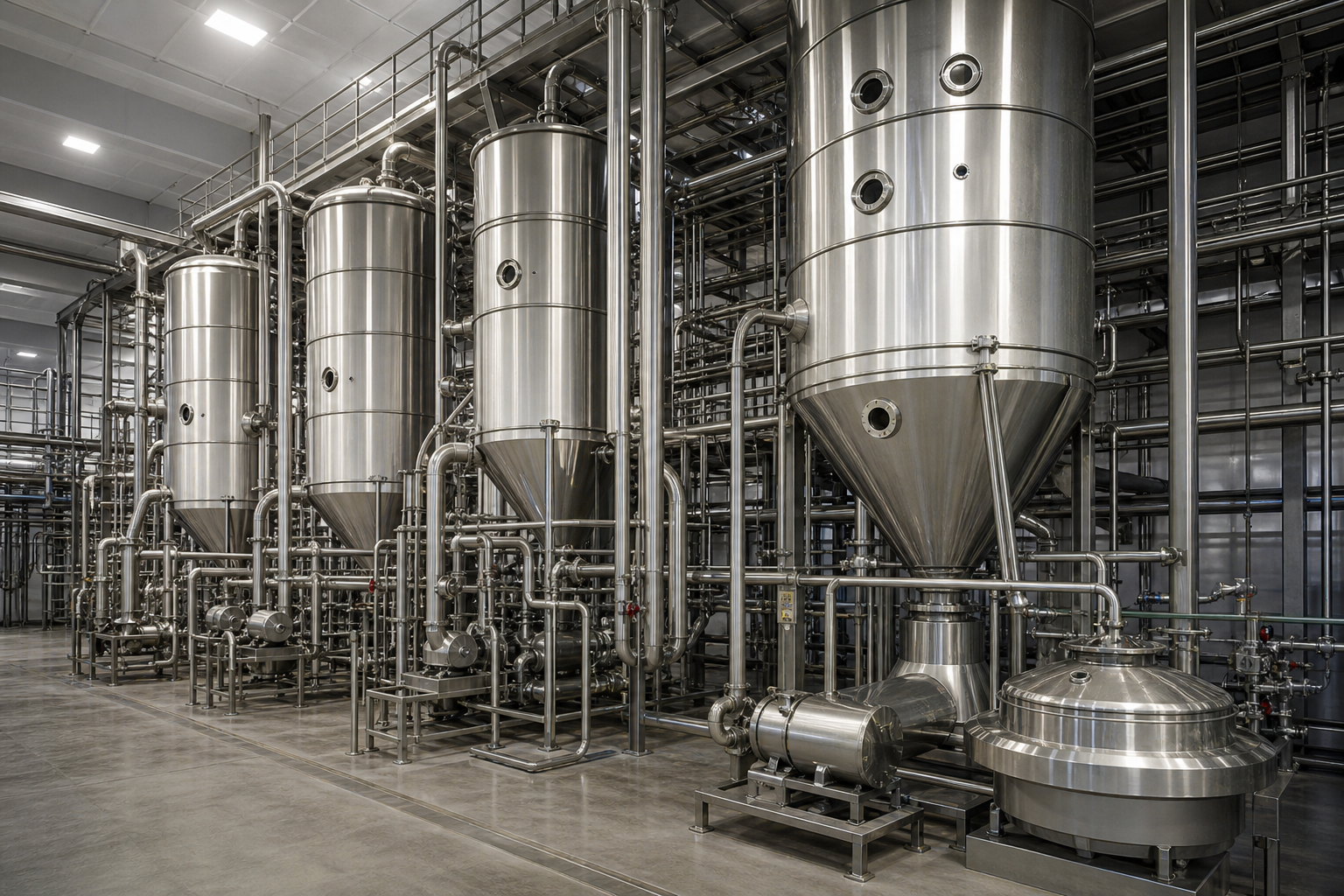
One set of the following equipment is typical for this duty:
- Fruit & vegetable receiving, washing, sorting and preparation (crush/break/press per product)
- Clarification and fines management for clear-juice streams
- Triple-effect forced-circulation evaporator with vacuum system
- Concentrate flash cooling, aseptic filling and cold storage interface
- Condensate recovery for washing/CIP reuse; food-grade CIP system
- Line-wide PLC/SCADA control coordinating preparation with evaporation
SS316L with food-grade finish is the reference construction throughout product contact.
Performance & Outcome
Compiled from published industry project data, indicative: complete lines of this class process 1,000 t/d of blended fruits and vegetables with triple-effect forced-circulation evaporation, flexing across tomato, carrot, apple and cherry plum products. Steam per tonne and concentrate Brix by product are quoted per project.