
Project Parameters
| Parameter | Value |
|---|---|
| Process route | Triple-effect forced falling-film evaporation |
| Industry | Inorganic chemicals — chromium salts |
| Feed type & key components | Chromium salt production wastewater (Cr-bearing salt liquors) |
| Evaporation capacity | 4 t/h water removal |
| Construction materials | SS316L / higher alloys on chromium service (indicative) |
Representative process configuration compiled from published industry project data. Indicative values, not a process guarantee.
Project Description
A chromium chemicals plant in Chongqing, Southwest China, produces chromium salts on lines that also co-produce fine chemicals from the chromium circuit. The plant’s wastewater is unlike generic saline effluent: it carries chromium species in a salt matrix, and every cubic meter that leaves the process battery is a hazardous-liquid management problem rather than a discharge question. The site’s objective is source-side volume reduction — concentrate the chromium-bearing liquor at the point of generation so that the chromium reports to a small, controlled stream for recovery or hazardous-waste handling, while the recovered water returns to the process.
The reference configuration is a compact 4 t/h triple-effect forced falling-film evaporation train. At this scale a three-effect cascade matches the plant’s steam services without over-engineering, and the forced falling-film body type answers the specific behavior of chromium salt liquors: they concentrate to high density, scale at the wall as salts approach saturation, and reward the extra circulation control that a forced falling-film architecture provides.
Process Technology
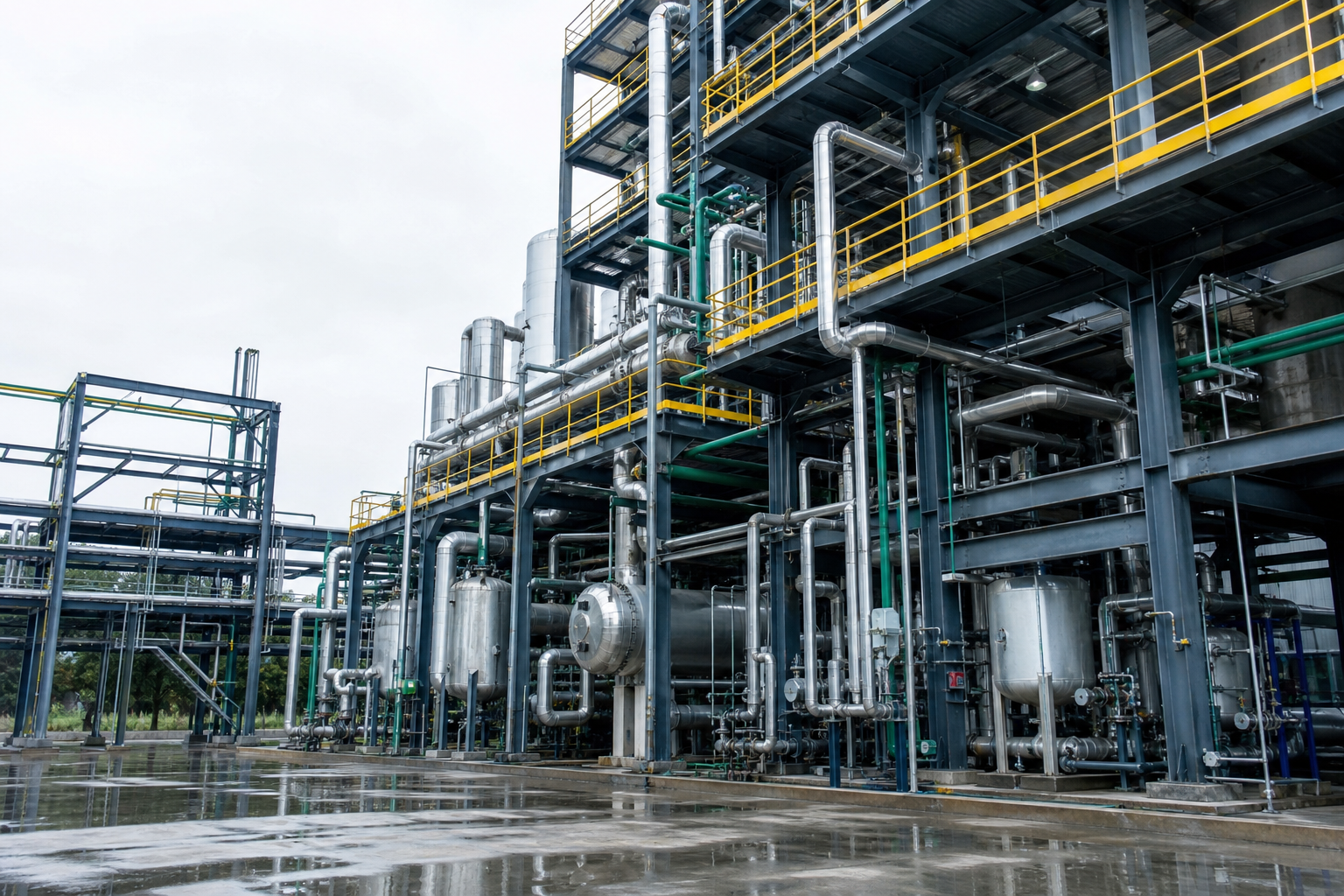
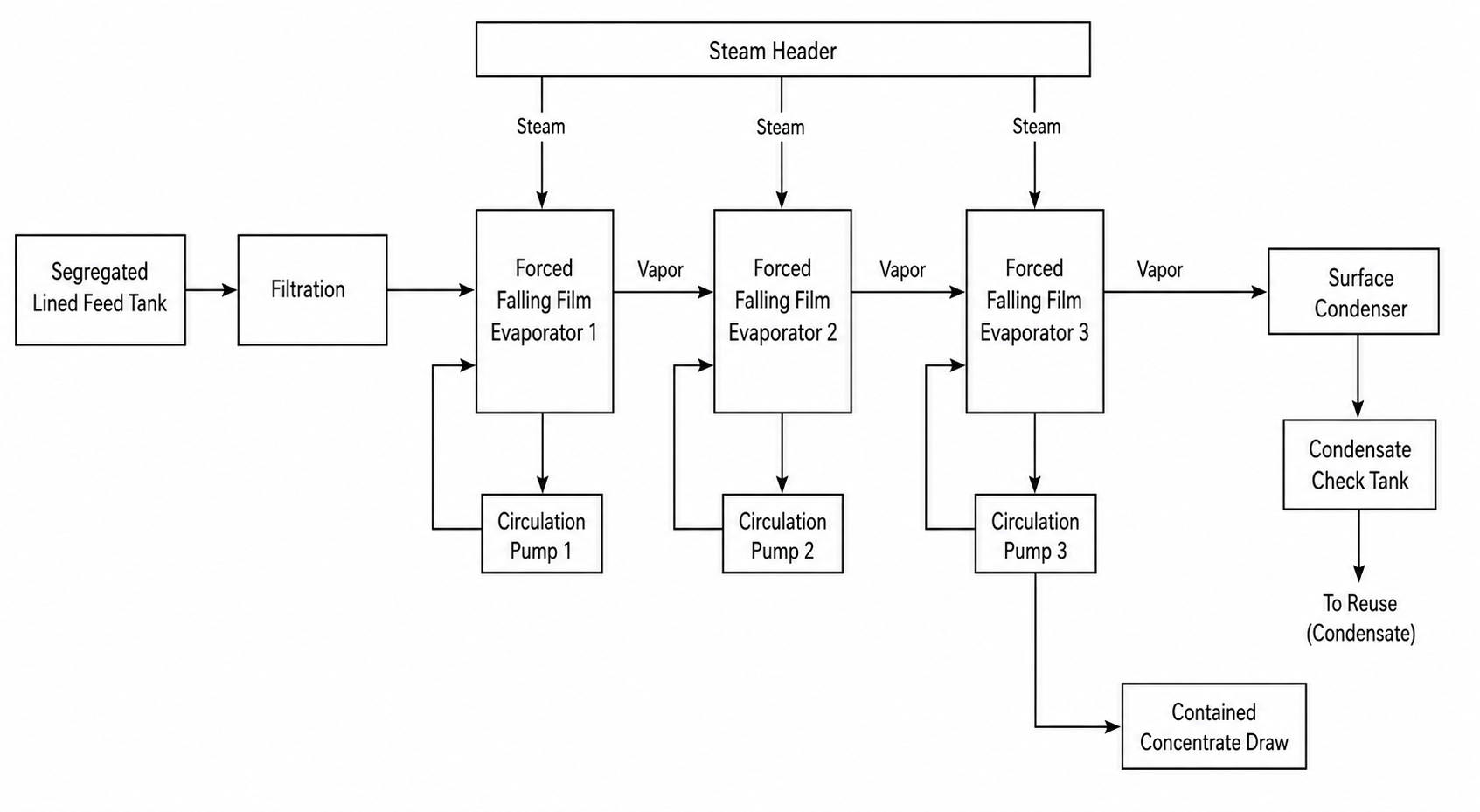
Wastewater from the chromium lines is collected in a dedicated, lined equalization tank — segregation from other plant sewers is absolute at chromium sites, and the evaporation train receives only the chromium-bearing stream. The liquor is filtered to intercept chromium hydroxide fines and process solids, then preheated against condensate.
The train runs as three effects in descending temperature. In each body the liquor is pumped over a distributor and filmed down the tube wall, with a forced circulation loop adding wall shear and velocity beyond what gravity filming alone gives: the forced falling-film pattern keeps the chromium salt liquor moving fast over the heat transfer surface, suppressing the local over-concentration at the wall that would otherwise deposit chromium salts and degrade transfer. Vapor from each effect heats the next; the third effect operates under vacuum, and the whole train is driven by steam to the first effect alone.
Concentrate is drawn from the third effect at the density set by the downstream route: back to the chromium process where the values are recoverable, or to solidification and controlled hazardous-waste handling where they are not. Either way the water fraction — the bulk of the incoming stream — leaves as condensate from the surface condenser, is checked against chromium limits, and returns to the plant’s washing circuit. The volume reduction converts a continuous hazardous-liquid stream into a small, high-density chromium stream under full containment.
Equipment Configuration
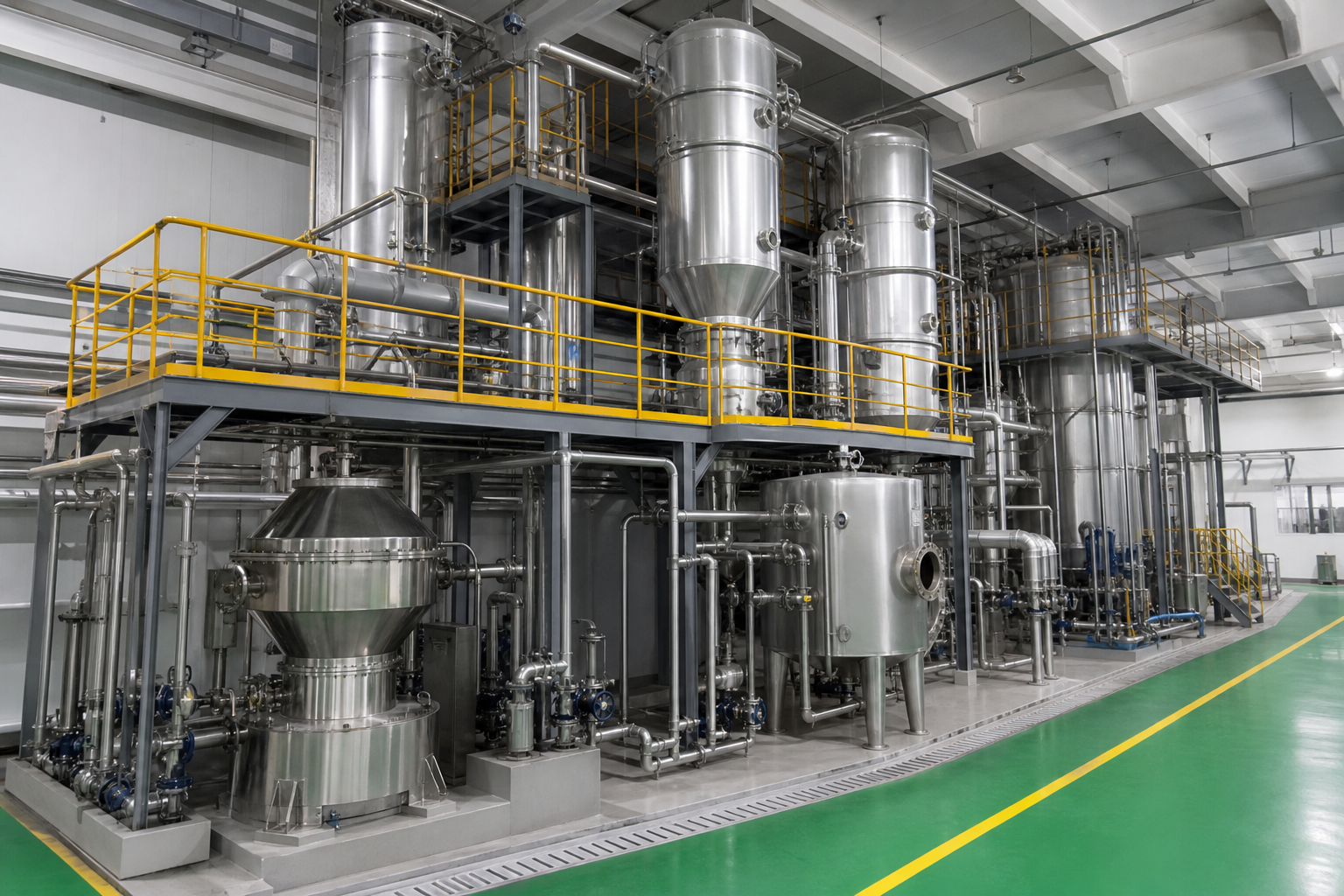
One train of this class comprises:
- Dedicated lined equalization and filtration for the segregated chromium stream
- Triple-effect forced falling-film bodies with circulation pumps and demisters
- Steam header to effect one; surface condenser and vacuum system on effect three
- Concentrate draw at controlled density to recovery or hazardous-solidification routes
- Condensate tank with chromium limit check before washing-water reuse
- Density, temperature and vacuum control with confined CIP circuits
SS316L is the indicative baseline; wetted parts are upgraded where chromium and co-salt chemistry at the hot end demand higher alloys.
Performance & Outcome
Compiled from published industry project data, indicative: trains of this class reduce chromium salt wastewater volumes by the large majority at small duties, transferring the chromium inventory to a controlled high-density concentrate and returning condensate to process washing under containment. Reduction ratio, concentrate density and materials guarantees depend on chromium speciation and co-salts and are validated per project.


