Battery-grade cobalt sulfate (CoSO4·7H2O) is produced by concentrating a purified cobalt sulfate solution to supersaturation and crystallizing it under controlled conditions — and the evaporator architecture you choose determines whether the plant runs weeks or months between cleanings. For cobalt streams from spent-battery recycling and primary refining, the two established routes are multi-effect forced-circulation evaporation (when live steam is cheap) and MVR evaporation (when electricity is the cheaper utility). Both concentrate feed liquors in the 10–20% salt range to a supersaturated slurry, discharge crystals through a centrifuge, and return mother liquor to the evaporator in a closed loop. This guide walks through the process chemistry, equipment selection, materials of construction, and the operating parameters that separate a stable cobalt sulfate crystallization plant from a scaling headache.
Why Cobalt Sulfate Crystallization Is Demanding
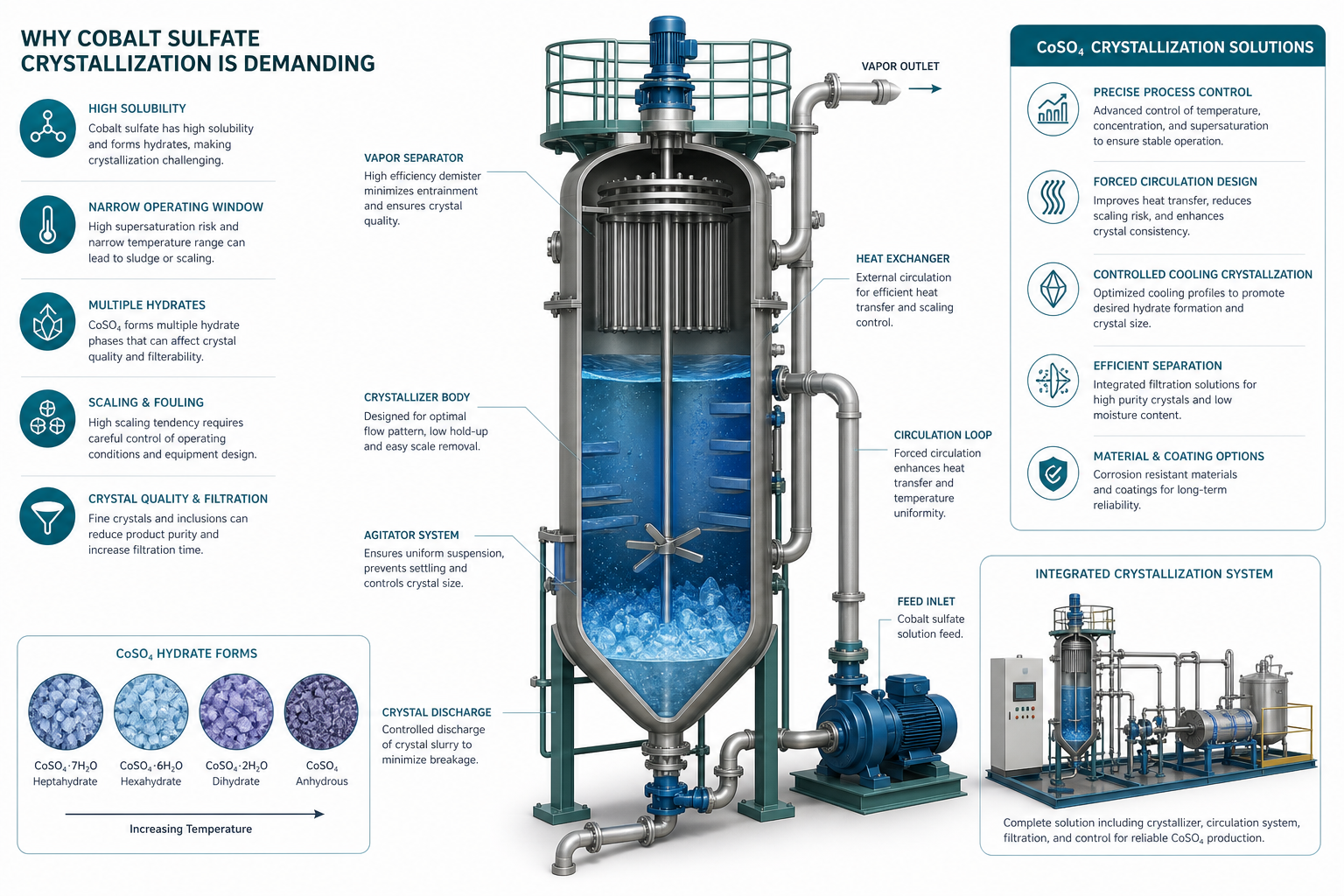
Cobalt sulfate is not a difficult salt in isolation — the difficulty comes from what travels with it. In real feed streams, cobalt shares the liquor with nickel, manganese, copper, zinc and magnesium sulfates, plus sodium sulfate carried in from neutralization steps. Because these sibling metals have similar sulfate chemistry, the crystallizer does double duty: it is simultaneously a production unit (growing saleable CoSO4·7H2O crystals) and an impurity-accumulation point (everything cobalt does not carry into the crystal builds up in the mother liquor).
Three consequences follow:
- Solubility window is workable but sensitive. CoSO4·7H2O solubility rises from roughly 250 g/L around 0 °C to about 550 g/L near 100 °C (published solubility data), so both evaporative and cooling routes are viable — but a feed that has not been purified upstream will co-crystallize nothing useful and everything problematic.
- Corrosion is chloride-driven. Even trace chlorides in a hot, acidic sulfate brine push 316L past its limits; vendor-published plant references for cobalt (and nickel) sulfate specify titanium (TA2) wetted parts, with SS316L or carbon steel reserved for non-wetted sections.
- Crystal quality is contractual. Cathode precursor makers specify Co content typically ≥ 20%, with ceilings on Ni, Cu, Zn, Ca, Na and magnetic foreign matter — which makes upstream purification (extraction, resin, precipitation) and crystallizer hygiene inseparable from the evaporator design itself.
Process Routes: Multi-Effect vs MVR for CoSO4
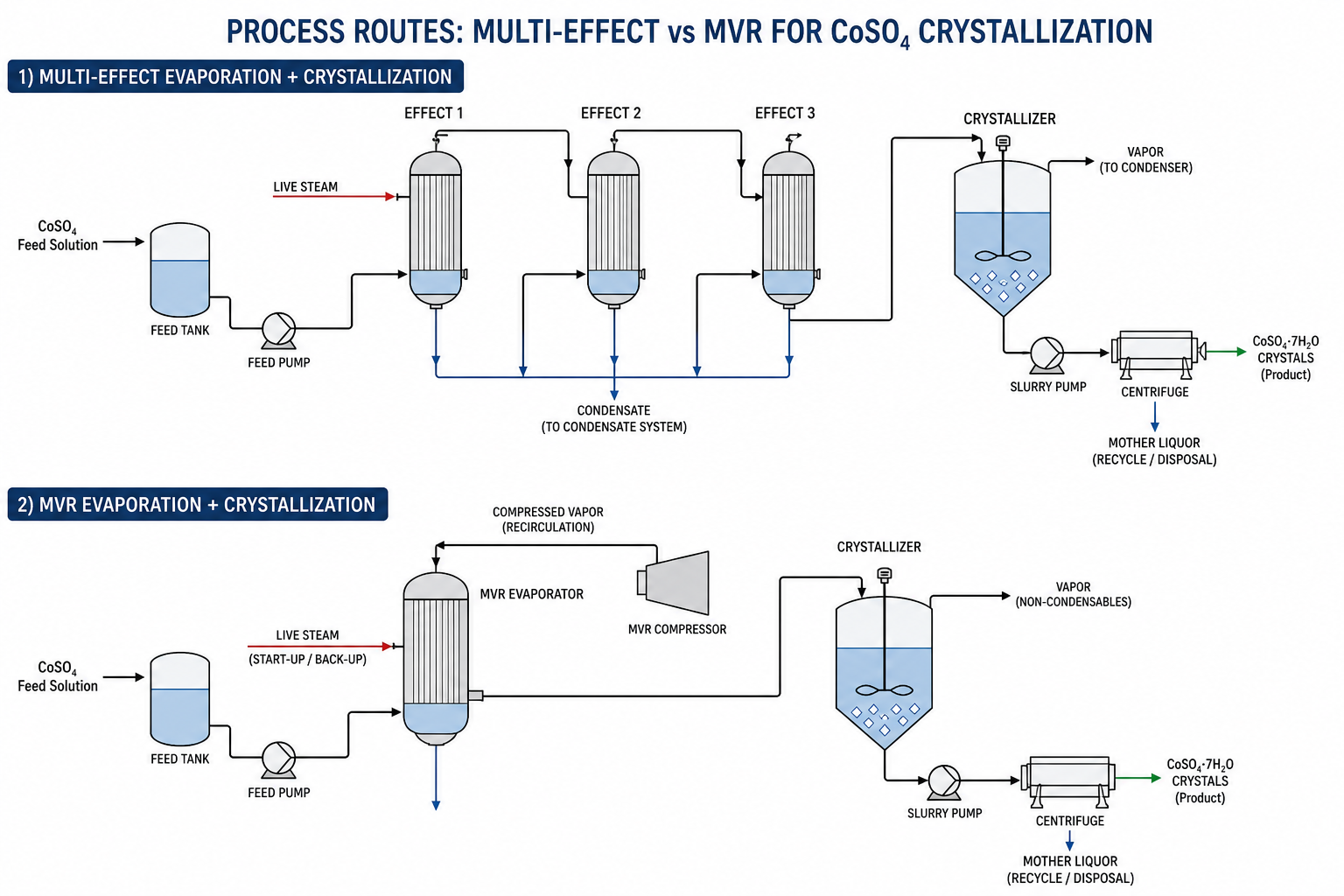
The process objective is identical for both routes: concentrate a purified cobalt sulfate liquor to supersaturation, crystallize, dewater, and recycle mother liquor. One externally published vendor case for battery-recycling service — an external industry reference, not an EvapCryst delivery — used a triple-effect forced-circulation evaporator to concentrate a cobalt-bearing desulfurization liquor to supersaturation, then recovered cobaltous sulfate crystals by centrifugation, with mother liquor returned to the evaporator as a continuous circulation loop. TA2 was specified for all wetted parts, with SS316L or carbon steel for non-wetted sections.
Multi-effect forced circulation (FC) makes sense when boiler steam is available at low cost. Triple-effect operation reuses secondary vapor from each effect to heat the next, cutting fresh steam consumption dramatically versus single-effect — industry-reported triple-effect designs in comparable sulfate service show energy reductions above 70% relative to single effect, and the same thermodynamic logic applies to cobalt sulfate. Forced circulation also minimizes scaling and prevents blockage of the heat transfer tubes while processing concentrated salt solutions, extending continuous operating periods between cleanings.
MVR makes sense when steam is expensive or unavailable and electricity is reasonably priced. A mechanical compressor lifts the secondary vapor by roughly 15–25 °C and returns it as the heating medium, so the evaporator needs almost no live steam after startup. MVR forced-circulation evaporators are standard in battery-material service (lithium, cobalt and nickel sulfate concentration) precisely because they combine low operating cost with small temperature differences that limit scaling on the heat transfer surface and treat the product gently.
Typical configuration — cobalt sulfate crystallization system
| Process Module | Candidate Equipment Types | Selection Basis | Module Function |
|---|---|---|---|
| Preheat | Condensate preheater + exhaust vapor preheater | Available sensible-heat sources | Recovers heat, cuts fresh steam demand |
| Evaporation | Triple-effect FC evaporator or single-train MVR FC evaporator (potential material consideration: TA2-class wetted parts) | Steam-versus-electricity economics | Concentrates purified liquor to supersaturation |
| Crystallization | Flash/evaporative crystallizer or cooling crystallizer | Hydrate target, crystal size duty | Generates supersaturation where crystals grow, not on tube walls |
| Separation | Centrifuge + mother liquor return system | Cake moisture, crystal habit | Discharges wet crystals; recycles liquor to evaporator |
| Utilities | Condenser, vacuum unit, condensate heat recovery | Site utility portfolio | Maintains vacuum; recovers heat in clean condensate |
| Control | PLC with density/temperature/level loops | Unattended operation, spec tightness | Holds slurry density and temperature difference inside the design window |
Configuration, materials and operating envelopes above are potential considerations and indicative envelopes; actual selections depend on feed composition, temperature, pressure, corrosion review, fouling behavior, utilities and project capacity.
Where Cobalt Sulfate Streams Come From
Three feed origins dominate, and each shapes the flowsheet:
- Spent lithium-ion battery recycling. Black mass is leached in sulfuric acid; after impurity removal and solvent extraction, a purified CoSO4 liquor is the front end of cobalt sulfate heptahydrate production. The evaporator sees a hot, acidic, metal-laden sulfate brine — titanium construction and forced circulation are the baseline, not the upgrade.
- Primary cobalt intermediates. Cobalt hydroxide or carbonate purchased from miners is redissolved, purified and re-crystallized. Feed is cleaner, but sodium and magnesium control still decides the mother-liquor purge strategy.
- Hydrometallurgical byproduct recovery. Nickel-copper matte and alloy refining streams carry cobalt in sulfate liquor; cobalt sulfate crystallization here competes with solvent extraction and is usually chosen when the crystal product can be sold directly.
Key Design and Operating Parameters
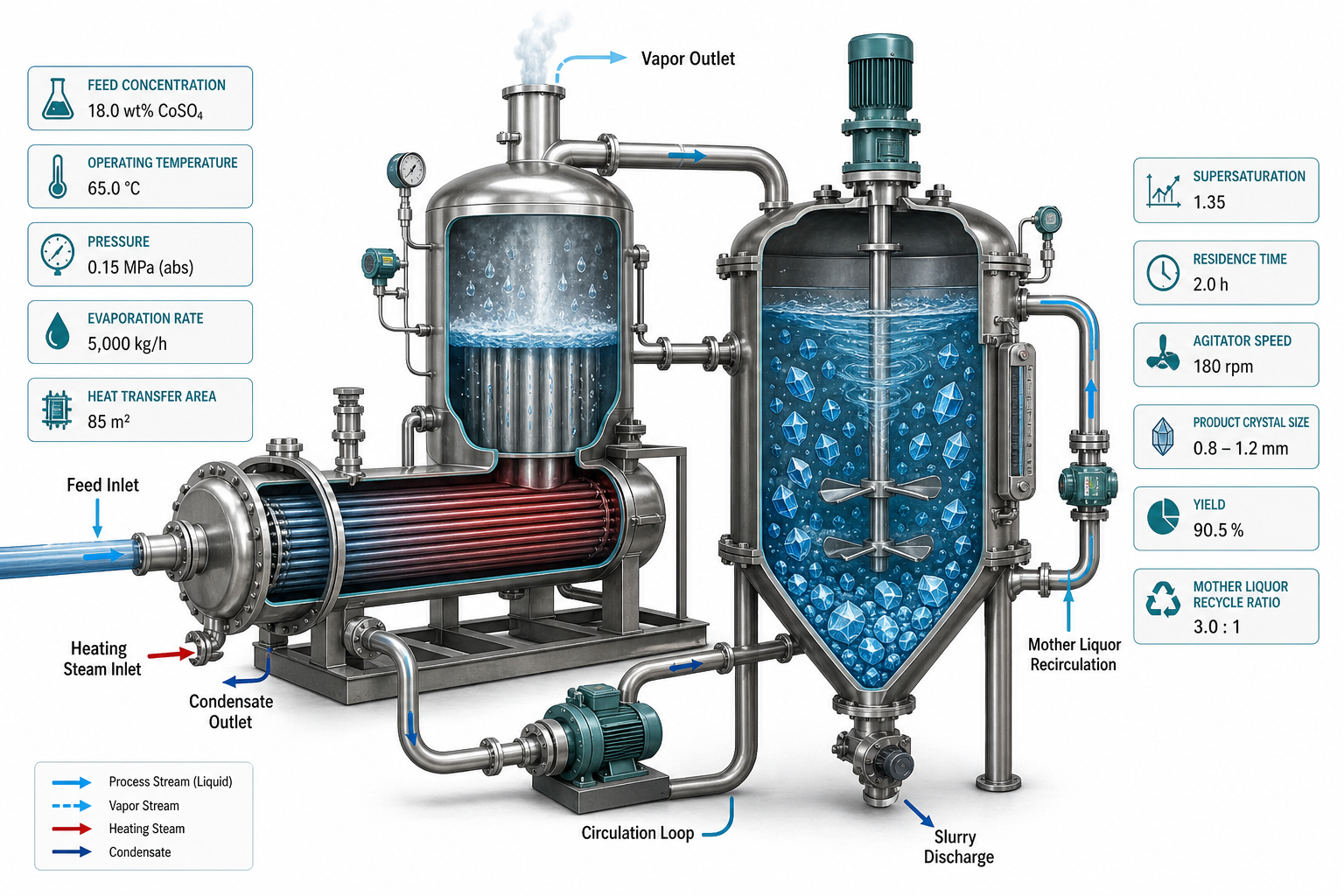
The ranges below form an illustrative operating envelope for planning — constructed from published cobalt sulfate practice and the vendor case cited on this page, not from customer or project data. Exact values must come from feed characterization and pilot verification.
| Parameter | Illustrative Range | Why It Matters |
|---|---|---|
| Feed concentration | 10–20% CoSO4 | Below ~10%, evaporation load dominates capex; above ~25%, pumping and fouling worsen |
| Operating temperature (MVR) | 60–80 °C under vacuum | Stays under boiling point elevation escalation, protects crystal habit and limits corrosion rates |
| Compressor lift (MVR) | 15–25 °C | Small temperature difference means more heat-transfer area but gentle evaporation and less scaling |
| Slurry density at crystallizer discharge | 15–25 wt% solids | High enough for centrifuge capacity, low enough to keep tubes scoured |
| Wetted-part material | TA2 standard; 316L only for verified chloride-free streams | Hot acidic sulfate plus chloride traces means rapid 316L attack |
| Cleaning interval target | Weeks to months, set by temperature difference and impurities | Circulation velocity and small terminal temperature difference are the levers against tube fouling |
Failure Modes to Design Against
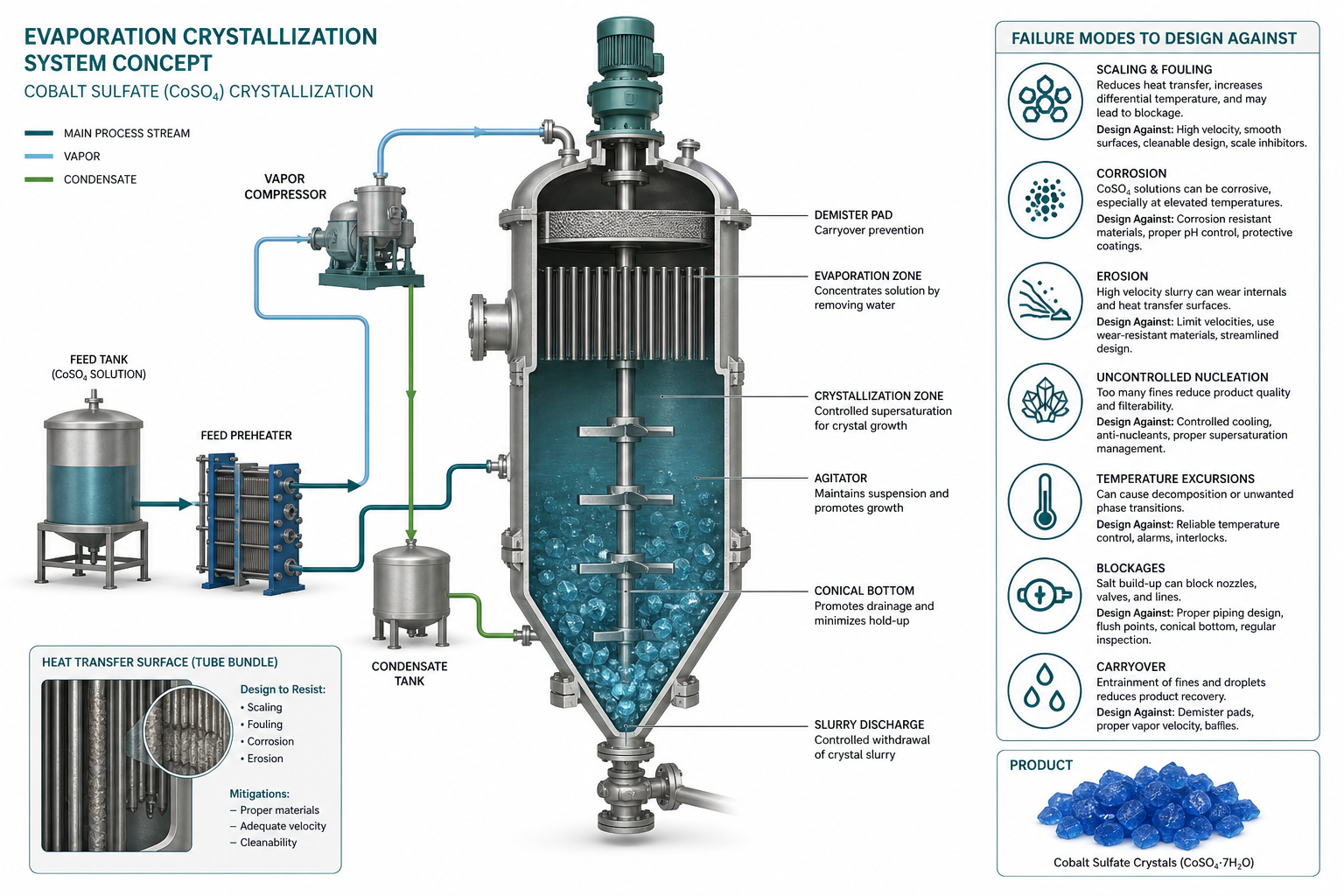
- Tube fouling. Salt that crystallizes on the heat transfer surface instead of in the crystallizer throttles capacity within weeks. Countermeasures: forced-circulation velocity (industry-practice range of 1.5–2.5 m/s in the tubes), limited terminal temperature difference, and generating the final supersaturation in a flash chamber rather than on a tube wall.
- Impurity accumulation in mother liquor. Sodium, magnesium and manganese sulfates concentrate with every recycle pass. Without a planned purge (or an impurity-removal step on the recycle), crystal purity drifts downward until the product fails spec — a slow failure that shows up in certificates of analysis, not in alarms.
- Corrosion at unexpected points. Condensate loaded with acidic carryover attacks carbon steel condensate systems; splash zones above the liquid level often corrode faster than fully wetted titanium. Specify materials for the worst local condition, not for the average liquor.
- Crystal breakage in the transfer path. Heptahydrate crystals degrade in high-speed pumps and undersized valves. Keep slurry lines short, velocities moderate, and select a centrifuge suited to the crystal habit.
- Vacuum instability. Air ingress or a fouled condenser surface swings boiling temperature, which swings supersaturation, which swings crystal size distribution — the cascade that ends in off-spec product.
From Crystals to Product: Drying and Quality Control
Wet crystals from the centrifuge typically carry a few percent free moisture and go directly to drying. For battery-grade cobalt sulfate, fluidized-bed or vibrated-fluidized-bed dryers with controlled inlet temperature keep the heptahydrate from surface caking while avoiding dehydration toward lower hydrates at the crystal surface. Downstream, product is screened and packed in moisture-barrier packaging (cobalt sulfate is hygroscopic enough to lump in humid storage), then released against a certificate of analysis covering Co content and trace-metal ceilings.
Because the crystallizer is the last purification step, the quality loop must run upstream: extraction efficiency, wash ratios on filter cakes, and purge rates all show up in the crystal analysis. A plant that treats the crystallizer as a black-box producer rather than the final stage of purification will chase impurities forever.
When This Route May Not Fit
Evaporative crystallization assumes a liquor that is already purified to near product chemistry. It may not fit when: the upstream extraction or precipitation train cannot hold Ni, Cu, Zn, Mn and Mg below the ceilings the cathode customer demands — no crystallizer fixes that after the fact; cobalt tenor in the feed is very low, so thickening, resin or solvent-extraction enrichment should precede any evaporation capacity; the required product is the monohydrate or anhydrous form, which is a different dehydration plant rather than this heptahydrate flowsheet; output is small and campaign-based, where tolling the duty to an existing producer beats a dedicated line; or the project cannot carry titanium-class metallurgy, without which hot acidic sulfate service is not honestly buildable. Where cobalt value cannot support the plant, disposal-focused ZLD is the alternative scope.
What Must Be Verified
Before this route is fixed for your project, verify against your own case: a complete feed analysis — Co plus Ni, Mn, Cu, Zn, Mg, Na, Ca and chloride, with swing, because these set the mother-liquor purge strategy and the achievable certificate; chloride level specifically, since it confirms or denies the titanium assignment; pilot crystallization on the actual purified liquor confirming growth rate, crystal size distribution and impurity occlusion; a dryer temperature-residence profile that preserves the heptahydrate at your moisture target; magnetic-foreign-matter capability against the battery-grade specification; and a mass balance on the purge so impurities never reach co-crystallization. The vendor-published case cited on this page is an external industry reference — indicative, not a project guarantee.
FAQ
Which is better for cobalt sulfate crystallization: MVR or multi-effect evaporation?
It is an energy-economics decision, not a technical one. If you have cheap boiler steam, a triple-effect forced-circulation system has the lowest capex and is well proven in cobalt sulfate recovery from battery recycling streams. If steam is expensive and electricity is reasonable, MVR usually wins on operating cost and adds smaller temperature differences, which reduces scaling. Both routes produce equivalent crystal quality when supersaturation control is done properly.
Why is titanium specified so often for cobalt sulfate plants?
Hot, acidic sulfate liquors that contain even trace chlorides corrode 316L stainless steel at rates that compromise vessel life. Titanium (TA2) handles this combination comfortably, so it is the standard choice in vendor-published references for wetted parts — separators, heaters, crystallizer bodies — with 316L or carbon steel used for non-wetted sections such as shells and supports.
What cobalt sulfate feed concentration is ideal for an evaporator?
Most plants are designed for feeds in the 10–20% CoSO4 range. Much below that, you are paying to evaporate water that an upstream thickening step could have removed more cheaply; much above that, feed pumping, fouling tendency and boiling point elevation start to work against you. The exact optimum depends on your purification train and the crystal production rate required.
How is nickel kept out of battery-grade cobalt sulfate crystals?
Nickel follows cobalt through most sulfate chemistry, so separation happens upstream — solvent extraction or selective precipitation produces the purified CoSO4 liquor. The job of the crystallizer is to not undo that work: control growth rate and mother-liquor inventory so nickel sulfate stays dissolved, and purge enough mother liquor that accumulated impurities never reach co-crystallization levels.
Can cobalt sulfate be recovered profitably from battery recycling wastewater?
Yes — cobalt value is high enough that recovery systems routinely justify themselves. An externally published vendor case (external industry reference, not an EvapCryst delivery) concentrated cobalt-bearing desulfurization liquor from waste-battery recycling in a triple-effect forced-circulation evaporator to supersaturation, recovered cobaltous sulfate crystals by centrifuge, and recycled mother liquor continuously, cutting wastewater discharge while producing a saleable cobalt product.
To move from this screening to a grounded design basis, share your liquor analysis (Co tenor and key metals), throughput target and product specification — EvapCryst returns a first-pass process-direction screening for your case.