Black liquor is a fuel whose quality is set by an evaporator: every percentage point of dry solids removed from weak liquor is firing capacity, steam and power at the recovery boiler, and the mill-scale proof is public – a 500,000 t/y kraft mill running 2,500 t/d of black liquor solids through a 6-7 effect station to 65-70% firing solids recovers about 800 t/d of alkali while raising 1,200 t/h of steam and 100 MW of generation, meeting roughly 80% of mill steam demand and all its electricity, with the operator crediting steam and power worth on the order of 300 million RMB per year (published Chinese environmental engineering case material – an external industry reference, not an EvapCryst delivery). The chemistry-side proof: a patented crystallization evaporation route documents boiler steam output rising 10-30% with firing solids lifted from the 58-65% class to 73-80% (CN101831826B specification – an external industry reference). The design premise: in a kraft mill’s energy balance, the evaporator station and the power plant are one machine, and the connecting variable is solids content.
The Energy Chain: From Cooking Liquor to Grid Power
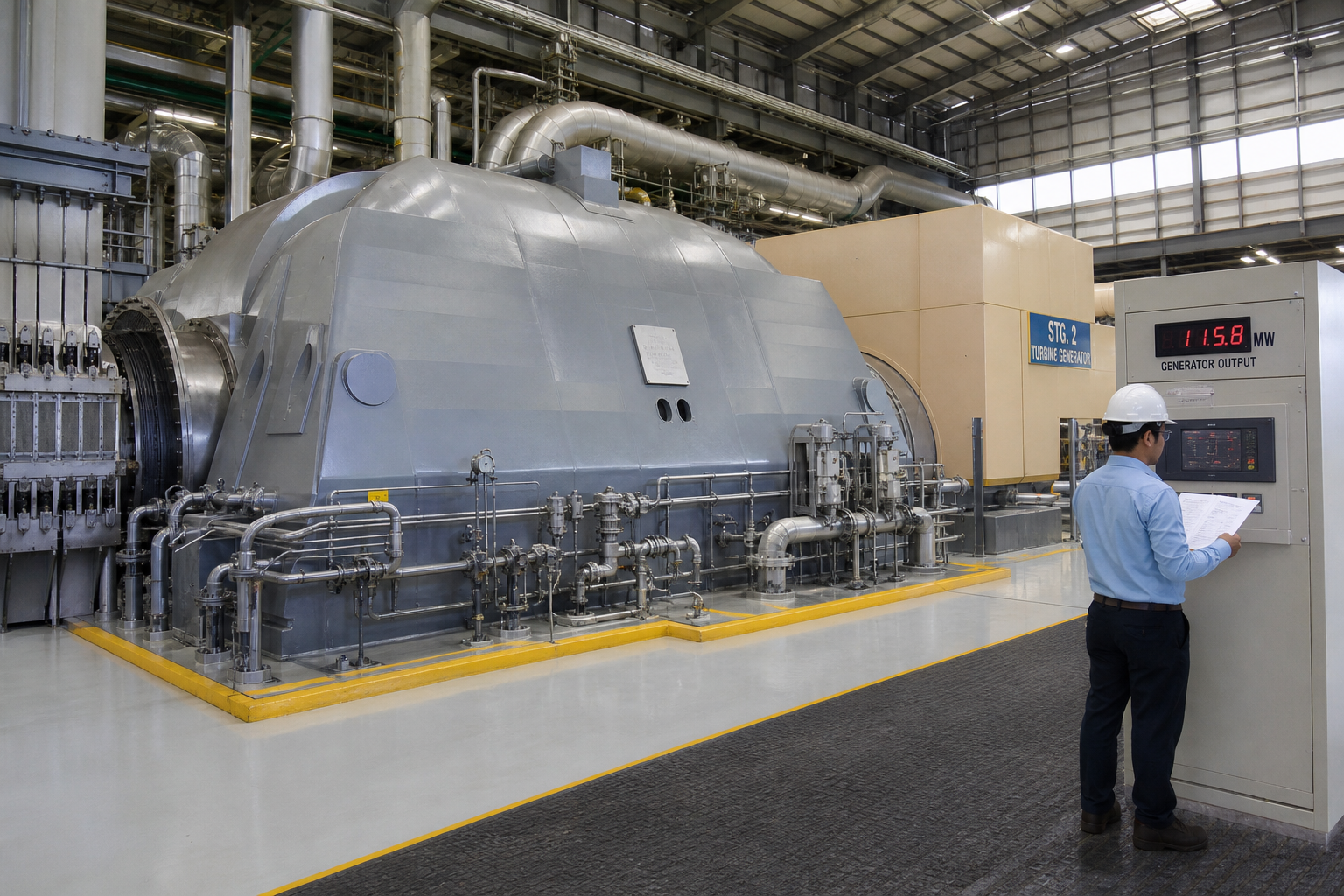
Black liquor’s organic fraction – roughly two-thirds of its solids – is solar energy captured in wood and released in lignin, hemicellulose degradation products and organic acids. The inorganic third is the cooking chemistry awaiting recovery. The recovery cycle converts both: the evaporator station concentrates the organics into a furnace-ready fuel; the recovery boiler burns it at 800-1,050°C, raising high-pressure steam (6-9.8 MPa, 450-510°C class depending on the installation) while smelting the inorganics to green liquor for causticizing; the steam drives turbines and heats the process. The reference case’s numbers size the prize: 2,500 t/d of solids supports 1,200 t/h steam and 100 MW; the published energy-value accounting – around 300 million RMB annually for steam and power against 250 million for recovered alkali – makes energy the larger of the recovery island’s two revenue lines.
The peer-reviewed energy analysis completes the chain’s modern extension: mechanical vapor recompression on the evaporator itself converts part of the station’s duty from steam to electricity, with a published case showing a second MVR unit saving 263 t/d of fresh steam for 14.4 MWh/d of compressor power – and, critically, that the value of that trade depends entirely on what the marginal steam was worth, because black liquor steam is not a tradable fuel: it must burn on site regardless (Engineering Proceedings, MDPI, 2023 – an external academic reference). Energy flexibility inside the recovery island is therefore about routing – which steam goes to turbines, which to process, which to vent – not about fuel choice.
Solids Content to Boiler Output: The Quantified Relationship
| Firing solids step | Boiler capacity gain | Steam generation gain | Source |
|---|---|---|---|
| 60% → 76% | +10% | +20% | Patent worked example 1 (CN101831826B) |
| 65% → 80% | +5% | +22% | Patent worked example 2 |
| 58% → 65% | +15% | +10% | Patent worked example 3 |
| 62% → 73% | +6% | +13% | Patent worked example 4 |
| 50% → 65% (replacing flue-gas contact concentration) | +20% | +30% | Patent worked example 5 (5-effect rising film) |
Figures from the CN101831826B specification’s worked examples (published patent document – an external industry reference; indicative of the documented relationship, not a project guarantee, and not an EvapCryst delivery). The pattern: steam gains of 10-30% track the water removed from the flame, with additional benefits the specification lists – reduced tube-bank and economizer plugging, less soot-blowing steam, no dead-bed or flameout conditions, and improved salt cake reduction.
Why Water in the Flame Is So Expensive
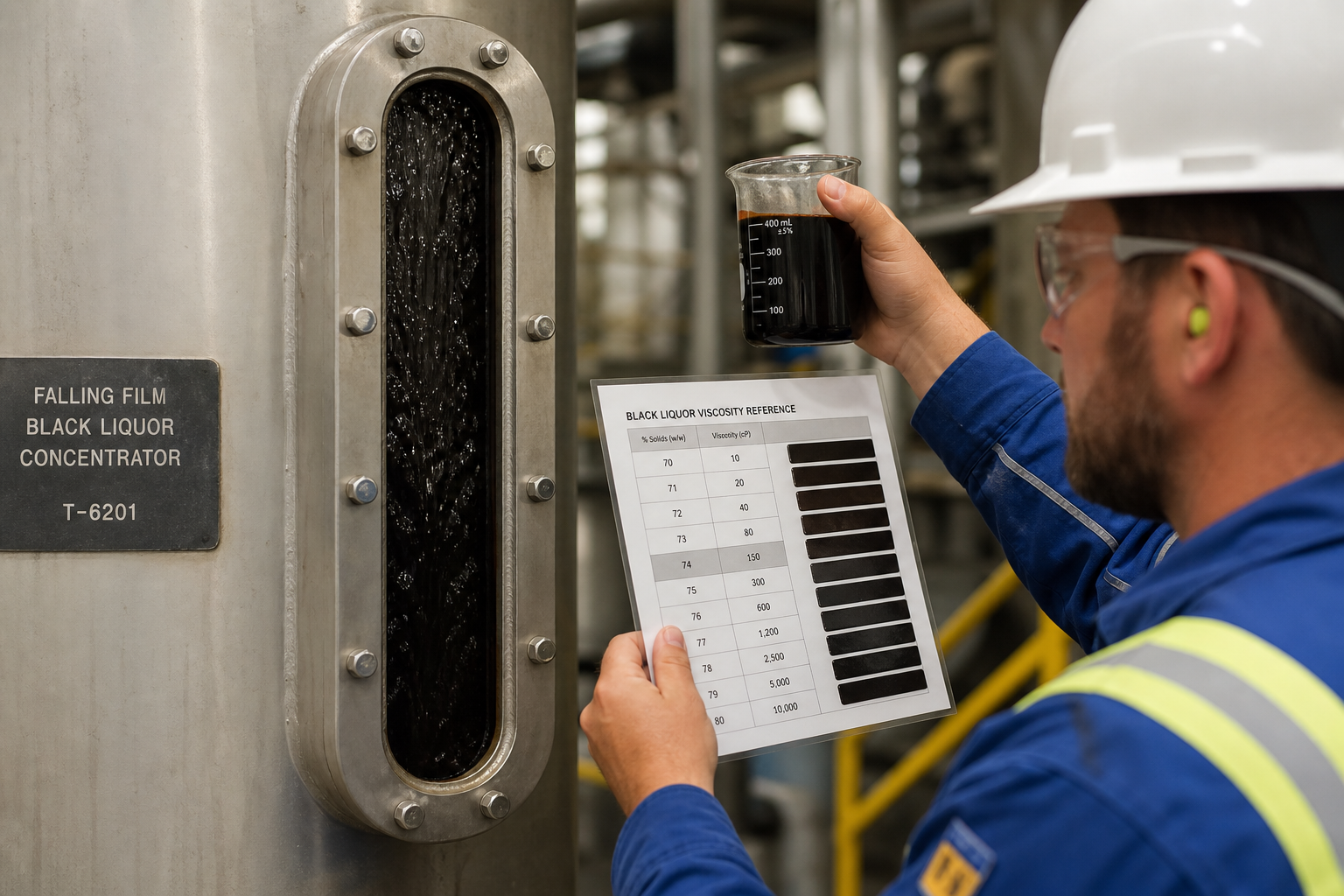
The boiler-side arithmetic penalizes weak firing in three compounding ways. First, latent heat: every kilogram of water entering the furnace with the liquor absorbs its evaporation enthalpy in the flame before any useful heat releases – water that the evaporator removes with multi-effect steam economy (0.25-0.35 kg steam per kg water at the reference station) costs a fraction of what it costs as furnace latent load. Second, flue gas volume and losses: more water vapor means more stack flow carrying sensible heat, larger fans, more plugging-prone surfaces. Third, bed stability: the specification’s furnace observations – dead charcoal bed, flameout risk at weak firing – are combustion chemistry consequences, and they cap throughput below what the steam side could otherwise carry. This is why the industry’s whole high-solids push – from 65% conventional through the 73-80% crystallization routes to the 80% TS capability the major suppliers publish – is an energy program, not a concentration vanity metric.
The energy accounting flows both ways at the evaporator. Multi-effect steam economy reuses vapor effect-to-effect; MVR converts duty to electricity where the site’s power economics favor it; and the crystallization route buys its higher solids with sulfate addition and concentrator energy – each option trading evaporator-side cost against boiler-side output. The reference case and the MVR study bracket the trade: 0.25-0.35 kg/kg multi-effect steam on one side, 263 t/d steam displaced by 14.4 MWh/d of power on the other.
The System View: Where the Energy Goes
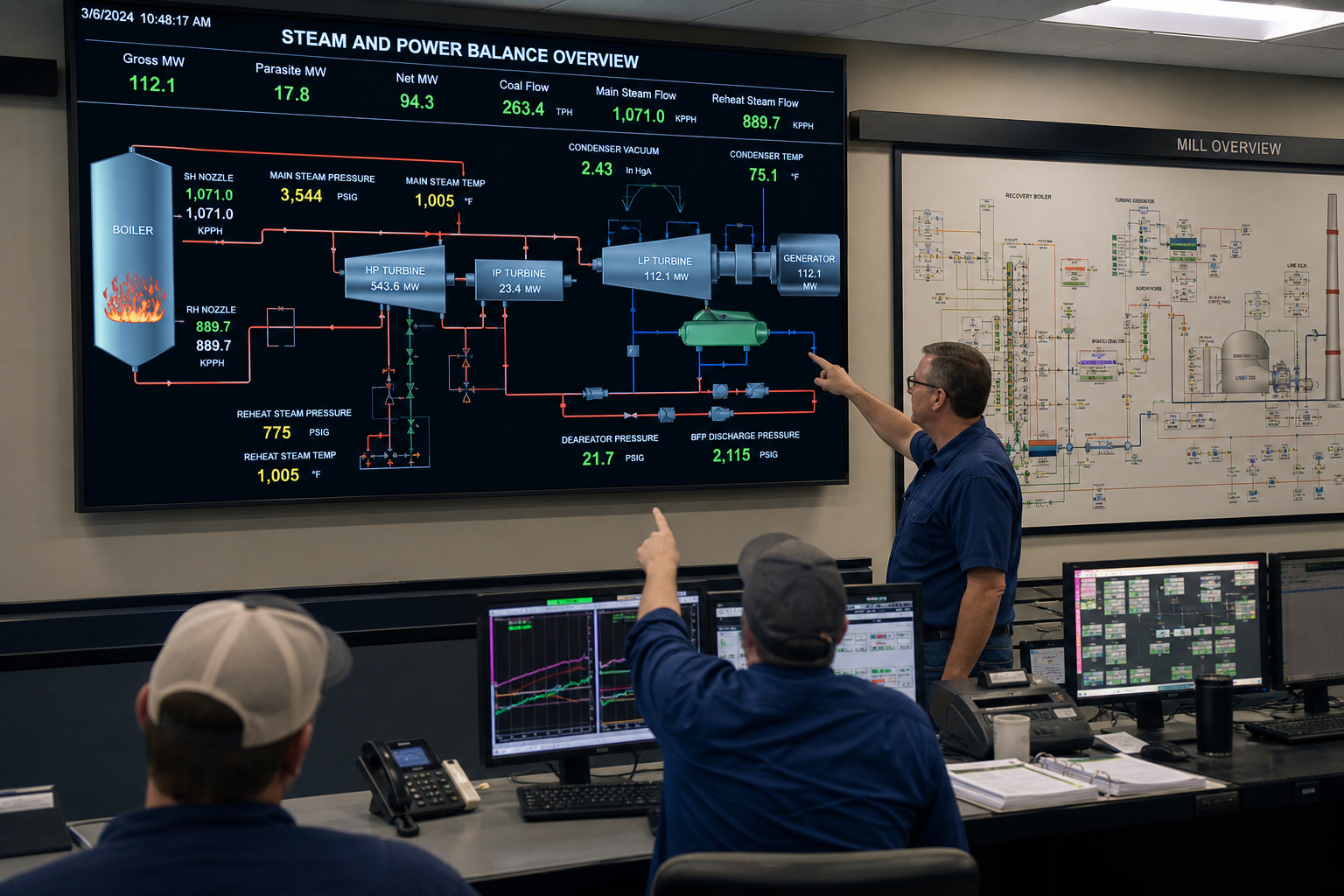
The reference case closes the loop at mill scale: 100 MW generation and 1,200 t/h steam from 2,500 t/d solids meets the mill’s full electricity and most of its steam; the recovered 800 t/d of alkali (worth ~250 million RMB/y) rides the same combustion; and the published net benefit – above 300 million RMB annually after operating costs – is the energy line dominating the chemical line. The same material notes the industry direction: systems scaling past 5,000 t/d solids with above 98% alkali recovery and full-plus energy self-sufficiency, meaning modern large mills are net energy exporters on the strength of their liquor. The peer-reviewed MVR analysis adds the planning caution for mills investing on the electrical margin: verify where freed steam actually goes – into condensing turbine capacity or out the vent – before crediting any electrification saving.
Expected Performance and Limits
The published reference performance: 65-70% firing solids from a 6-7 effect station at 0.25-0.35 kg steam/kg water; boiler steam and power output meeting ~80% of steam and all electricity at the 500 kt/y reference; steam-generation gains of 10-30% documented for solids steps from the 58-65% class to 73-80%; and the mill-scale economics of ~300 million RMB/y energy value in the reference accounting (published case material and patent specification – external industry references; indicative, not project guarantees, and not EvapCryst deliveries). The practical limits: the solids-energy relationship flattens as viscosity and scaling costs rise toward 80% – the crystallization route’s additives and concentrator energy are the price of the last points; boiler-side constraints (NPE accumulation, fouling, smelt chemistry) bound how hard the furnace can be pushed regardless of liquor quality; and the energy accounting is market-denominated – power prices and steam valuations differ widely between regions, so each mill’s arithmetic must be run on its own tariffs.
Industry References and Validation
Three public anchors triangulate this route. The mill-scale energy case: 2,500 t/d solids, 1,200 t/h steam, 100 MW, ~300 million RMB/y energy value, ~250 million RMB/y alkali value (published Chinese environmental engineering case material; an external industry reference, not an EvapCryst delivery). The solids-to-boiler-output relationship: the five worked examples of CN101831826B with their capacity and steam gains (published patent specification; an external industry reference). And the electrical-margin analysis: the MVR retrofit study with its verified energy model, DPES methodology and steam-price sensitivity (Engineering Proceedings, MDPI 37(1):50, 2023; an external academic reference). For your own project, validation effort should concentrate on: your boiler’s firing-solids response curve (the furnace’s own arithmetic, not a borrowed one); the evaporator-side cost of each solids increment (steam economy, scaling risk, chemistry); the mill steam-power balance including turbine condensing headroom; and the tariff set that denominates the result.
Frequently Asked Questions
How much more energy do we get per point of solids?
The documented pattern runs 10-30% steam generation gain across solids steps of 7-15 points, with the biggest single gain (30%) from eliminating a flue-gas contact concentration step. The relationship is not linear – furnace chemistry and flue-gas losses shape it – so your boiler’s own response curve is the number that matters.
Why not just fire at 65% and avoid the scaling risk?
You can – 65-70% is the mainstream firing class, as the reference mill shows. The question is what the incremental points buy at your boiler: if the mill is power- or steam-limited, the documented 10-30% steam gains justify the crystallization route’s chemistry and energy costs; if energy is long already, they do not.
Is black liquor carbon-neutral energy?
Treat that as an accounting question, not a technical one. The organics are biomass-origin; the peer-reviewed MVR discussion shows the practical nuance – if the marginal fuel displaced is fossil, electrification and efficiency measures cut fossil primary energy; if the margin is already biomass, the benefits shift to fuel logistics and capacity. Energy value, yes; emissions claims, mill-specific.
What limits how high solids can go?
Viscosity and scale chemistry at the evaporator, and furnace-side behavior at the boiler. The industry’s practical ceiling sits at 80% TS with chemistry assistance (crystallization routes); beyond that, firing technology and liquor chemistry (soap, calcium, silica) decide case by case.
Where does MVR fit the energy picture?
It trades evaporator steam for electricity. The published case: 263 t/d of steam displaced by 14.4 MWh/d of power, paying back in 2.5 years at European energy prices – but only where freed steam has somewhere to go. It is an optimization within the energy chain, not a change to it.
When This Route May Not Fit
If the mill’s energy balance is already long – surplus steam vented, turbines maxed – incremental firing solids add nothing bankable, and the evaporator’s target should stay at the conventional class. If the boiler is NPE-limited (chloride or potassium accumulation), pushing solids accelerates the fouling problem before it delivers the energy. And for nonwood furnishes with high silica, the high-solids ceiling retreats and the energy case must be made at lower firing concentrations.
What Must Be Verified Before Committing
Five items: the boiler’s firing-solids response (capacity and steam across the solids range you contemplate); the evaporator-side marginal cost of each solids point (steam economy at your effect count, scaling risk, chemistry-assistance needs); the mill steam-power balance with turbine headroom and vent reality; the NPE profile of the boiler loop; and the tariff structure that denominates steam and power value at your site. These map directly onto the energy chain above and are the standard screening package we would run before any quote.