Project Parameters
| Parameter | Value |
|---|---|
| Process route | Seven-effect plate falling-film evaporation for NMMO concentration |
| Industry | Lyocell / solvent-spun cellulose fiber, 60,000 tpa plant (Hebei, North China) |
| Feed type & key components | Dilute NMMO spin bath and wash water from solvent-spinning of cellulose |
| Evaporation capacity | 104 t/h |
| Construction materials | SS316L wetted parts (indicative for NMMO aqueous service) |
Representative process configuration compiled from published industry project data. Indicative values, not a process guarantee.
Project Description
Lyocell is cellulose fiber spun directly from a solution of pulp in hot N-methylmorpholine N-oxide (NMMO) and water. The process closes its economics on the solvent loop: water is evaporated out of the spin bath and wash streams to re-concentrate the NMMO, and the solvent cycles back to dissolution. A 60,000 tonne-per-year lyocell plant — the scale of the technical-upgrade project this configuration represents, in Hebei province — moves roughly a hundred tonnes of water per hour through that loop, which makes the evaporation train one of the largest and most energy-defining units on the site.
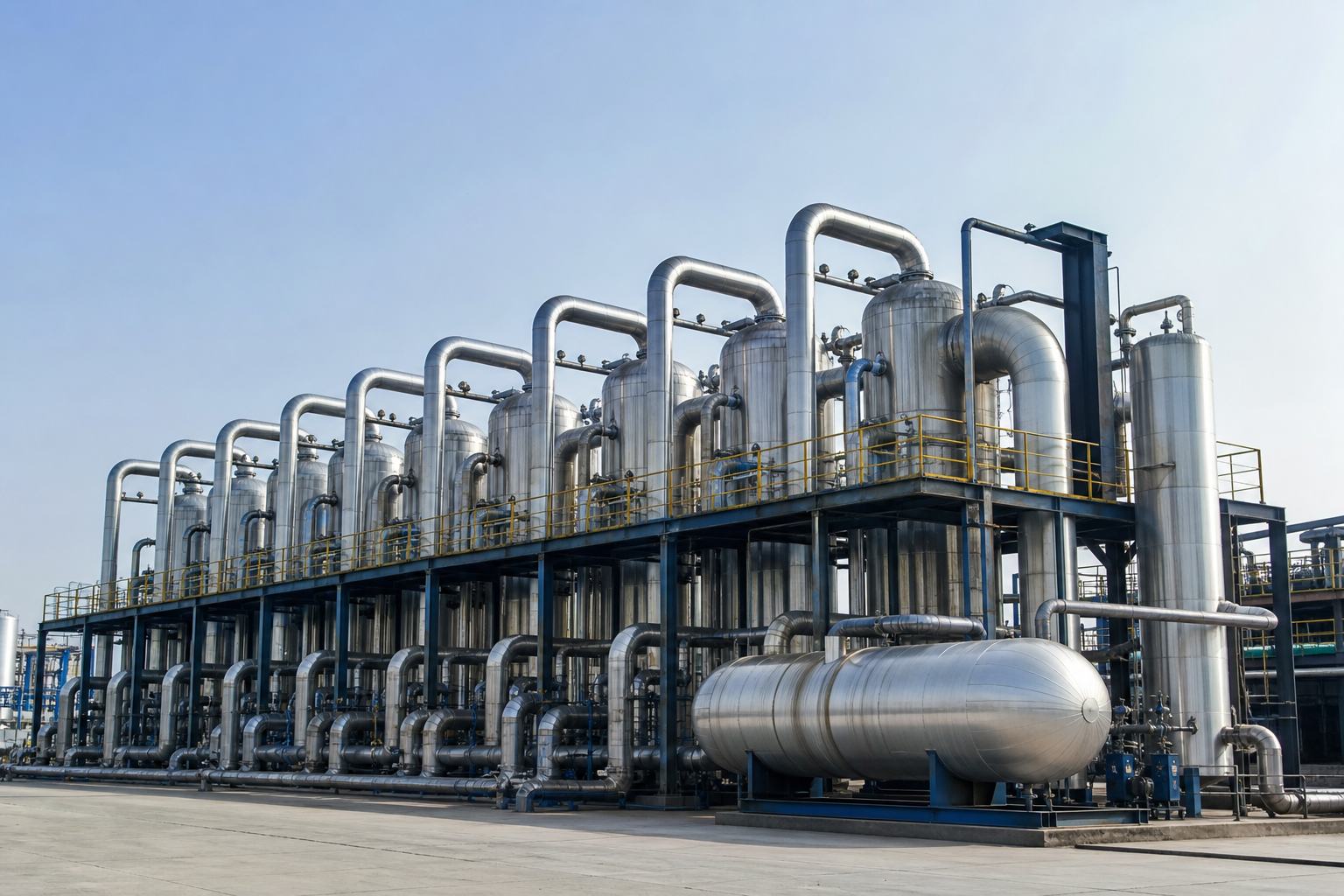
The reference configuration is a 104 t/h seven-effect plate falling-film train. The seven-effect count is the energy statement: each effect reuses the previous effect’s vapor, so the train evaporates seven-odd tonnes of water per tonne of live steam. Plate heat-transfer bodies deliver that duty in a compact footprint with high heat-transfer coefficients — the geometry of choice for NMMO service, as published both for this domestic project and for the 165 t/h five-effect plate trains operating at Southeast Asian lyocell sites.
Process Technology
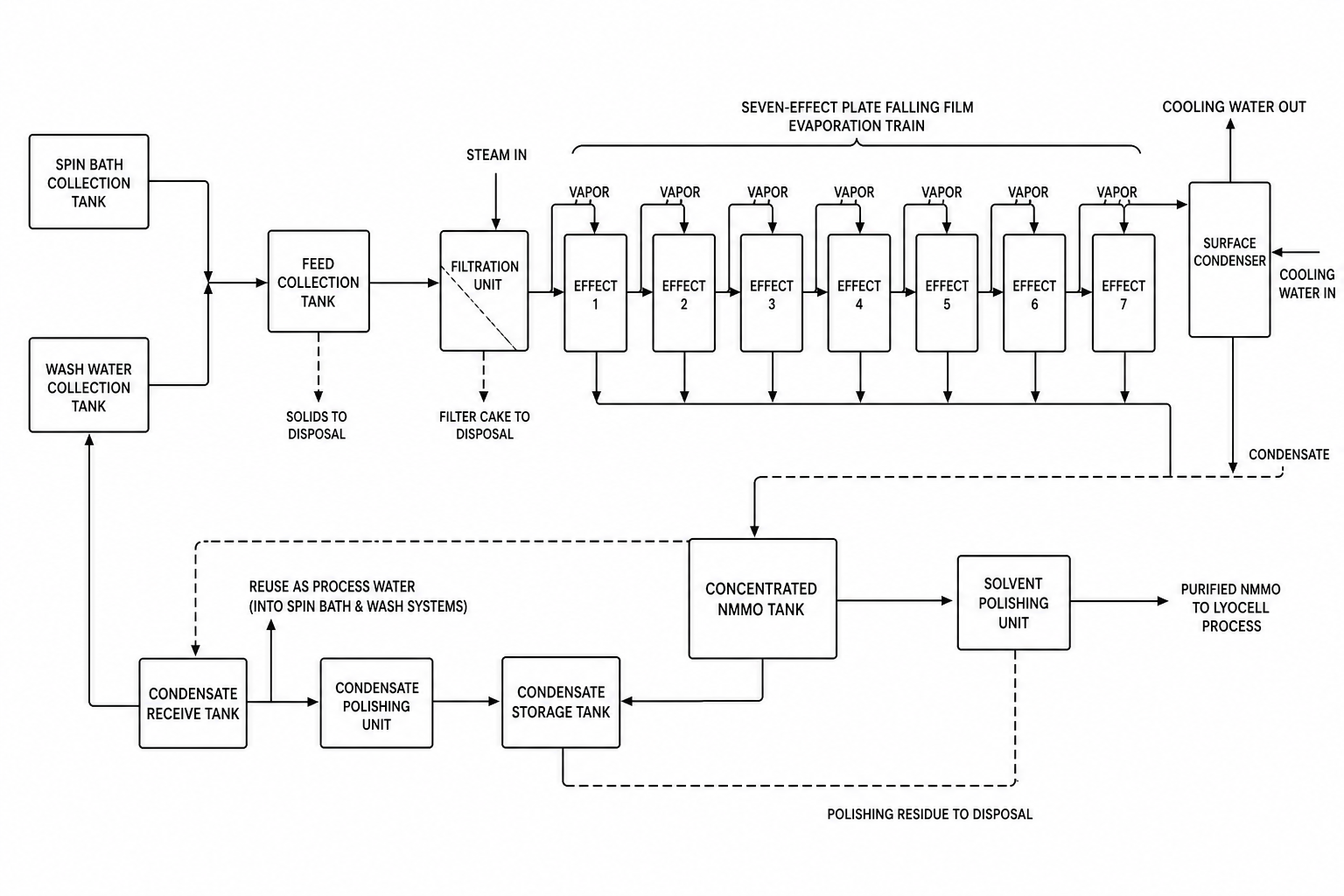
Dilute NMMO from the spin bath and fiber washing is collected, filtered to remove fiber fines, and fed to the first of seven effects. The liquor concentration path in NMMO recovery is constrained by chemistry: too hot or too concentrated and NMMO begins to decompose — exothermically — so every effect runs at low temperature difference with falling-film wetting, short residence time, and temperature ceilings enforced by the effect arrangement itself. The seven effects step down in temperature and pressure across the train, each boiling on the previous effect’s vapor.
Plate falling-film bodies suit this duty on three counts: their high heat-transfer coefficient allows the low-temperature-difference operation the chemistry demands; their low holdup keeps NMMO residence time at temperature short; and their compactness keeps a seven-effect train inside a process-building footprint. Film distribution over plate packs is the precision element — uneven wetting means dry spots, and dry spots in hot NMMO service are where degradation chemistry starts.
Concentrated NMMO at spinning-solution strength returns to the dissolution stage. Overhead vapor condenses through the train; the condensate is hot, clean water reused for fiber washing and make-up. A small purge controls the accumulation of degradation products and stabilizer inventory in the loop, and ion-exchange polishing of a slipstream maintains solvent color and purity — standard practice for spin-quality NMMO recovery.
Equipment Configuration
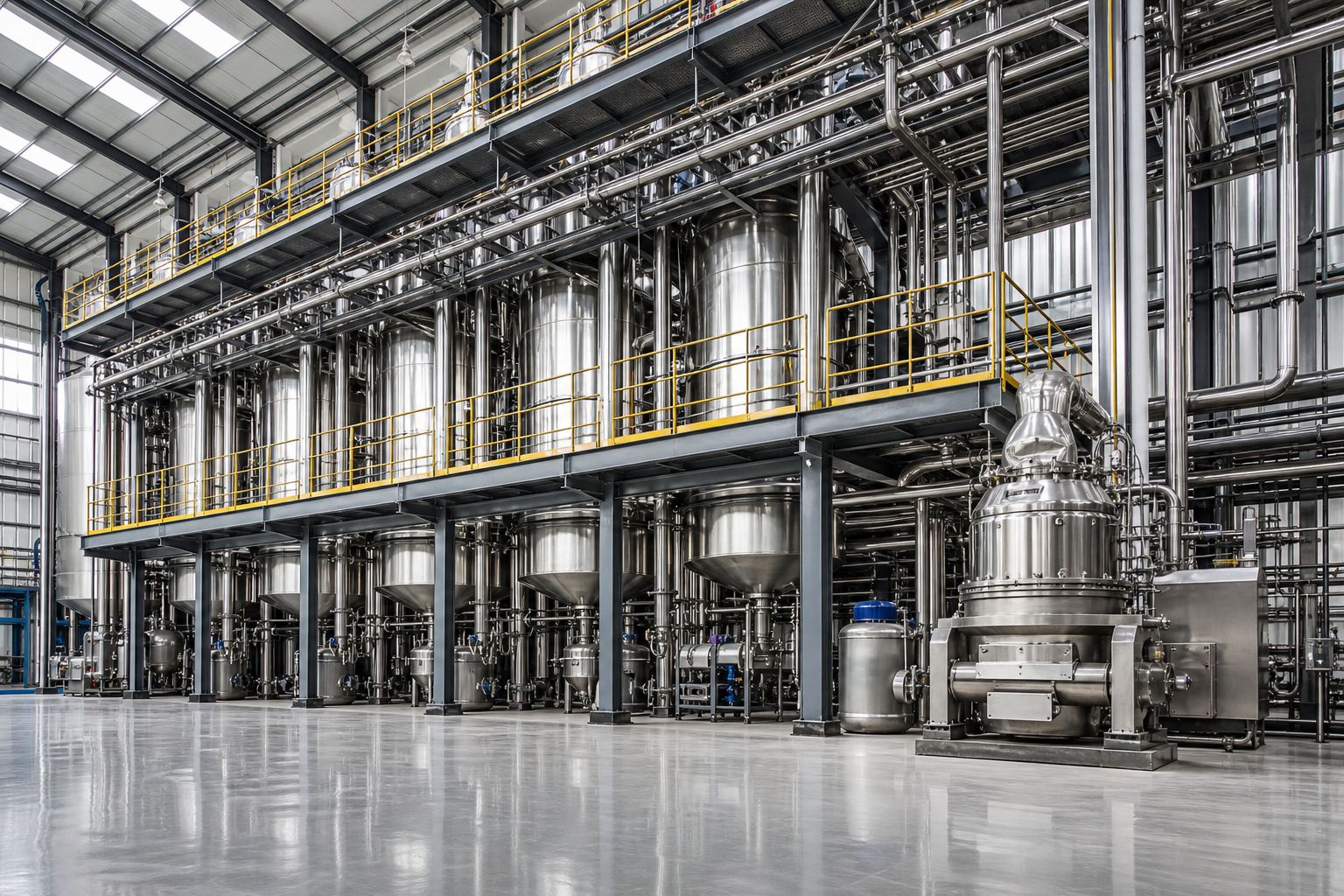
One set of the following equipment is typical for this duty:
- Spin bath and wash-water collection with filtration of fiber fines
- Seven-effect plate falling-film evaporation train with steam distribution
- Surface condenser and condensate recovery for wash-water reuse
- Concentrated NMMO storage with temperature and stabilizer control
- Solvent slipstream polishing (ion exchange) and loop purge management
- DCS control of effect temperatures, concentration and safety interlocks
SS316L is the indicative reference for aqueous NMMO service; hot concentrated zones are assessed per project.
Performance & Outcome
Compiled from published industry project data, indicative: trains of this class recover NMMO solvent at 104 t/h on seven-effect steam economy in plate construction, returning spin-quality solvent and reusable condensate to a 60,000 tpa fiber plant. Steam economy and solvent recovery rates are quoted per project.