
Project Parameters
| Parameter | Value |
|---|---|
| Process route | Low-temperature negative-pressure plate MVR forced-circulation evaporation (integrated unit) |
| Industry | Municipal solid waste — landfill leachate concentrate treatment |
| Feed type & key components | Leachate DTRO membrane concentrate: high salt, high organic load, scaling-prone |
| Evaporation capacity | 3 t/h |
| Scale-removal performance | Online cleaning plus manual cleaning; 100% restoration of design values after maintenance (published) |
| Construction materials | SS316L / duplex wetted parts (indicative for chloride service) |
Representative process configuration compiled from published industry project data. Indicative values, not a process guarantee.
Project Description
Landfill leachate treatment across China typically runs membrane trains — and every membrane train leaves a concentrate. At Chaohu in Anhui province, East China, a leachate treatment project operated for a major environmental group treats the DTRO (disc-tube reverse osmosis) concentrate of the leachate plant with a 3 t/h integrated MVR unit, published as a benchmark project for this duty class. The concentrate is the leachate’s problem fraction concentrated several-fold: the salts, the humic organics and the scaling chemistry that the membranes rejected.
The engineering problem at 3 t/h is not evaporation — it is fouling. Leachate concentrate scales: calcium carbonate, calcium sulfate and silica all precipitate as concentration proceeds, and organics smear across heat transfer surfaces between the mineral events. The published configuration confronts this directly, naming anti-scaling performance as the design’s defining property: strong anti-fouling capability in service, online cleaning when scale forms, manual (open-up) cleaning when it accumulates — and, in the published phrase, 100% restoration of design values after maintenance.
Process Technology
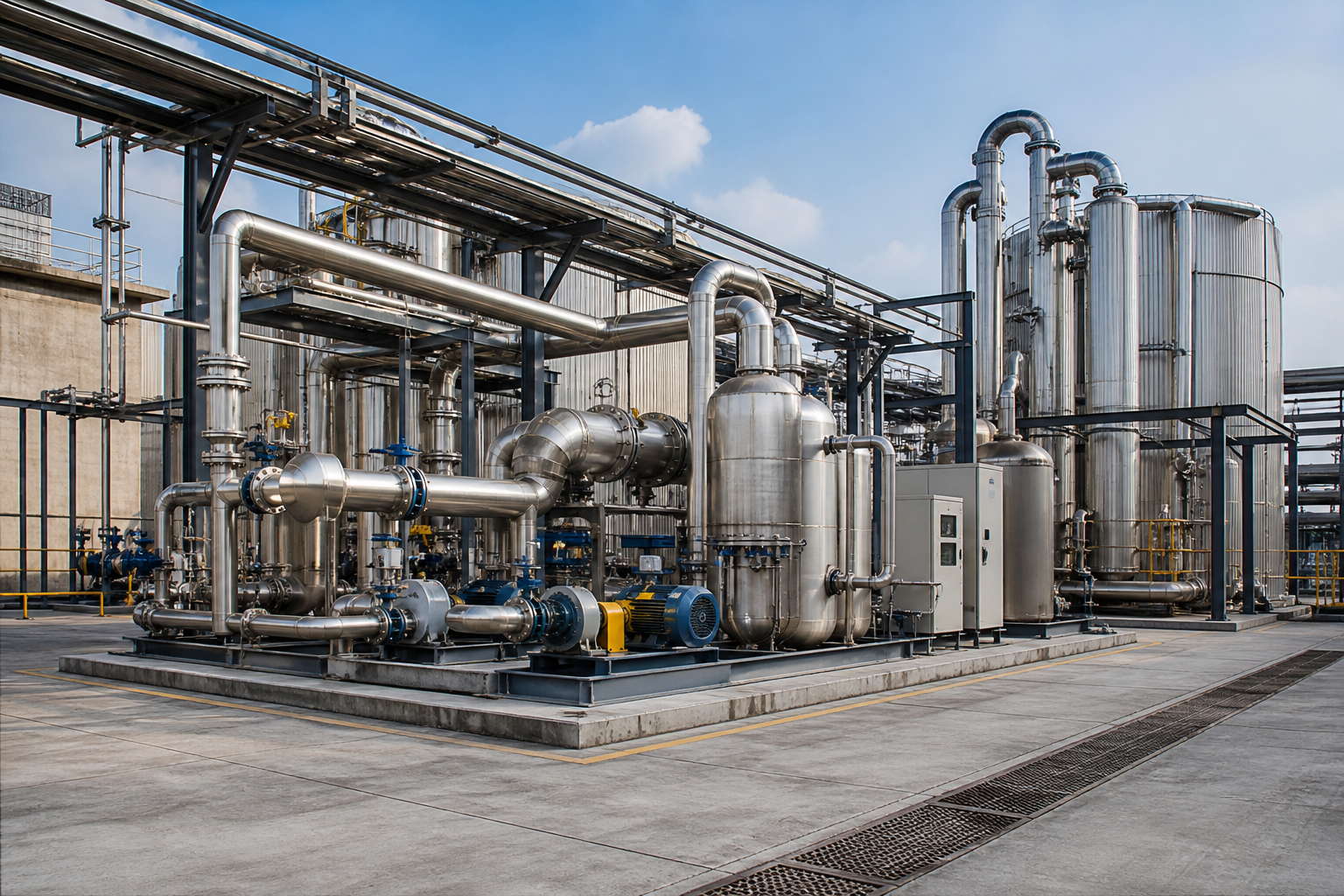
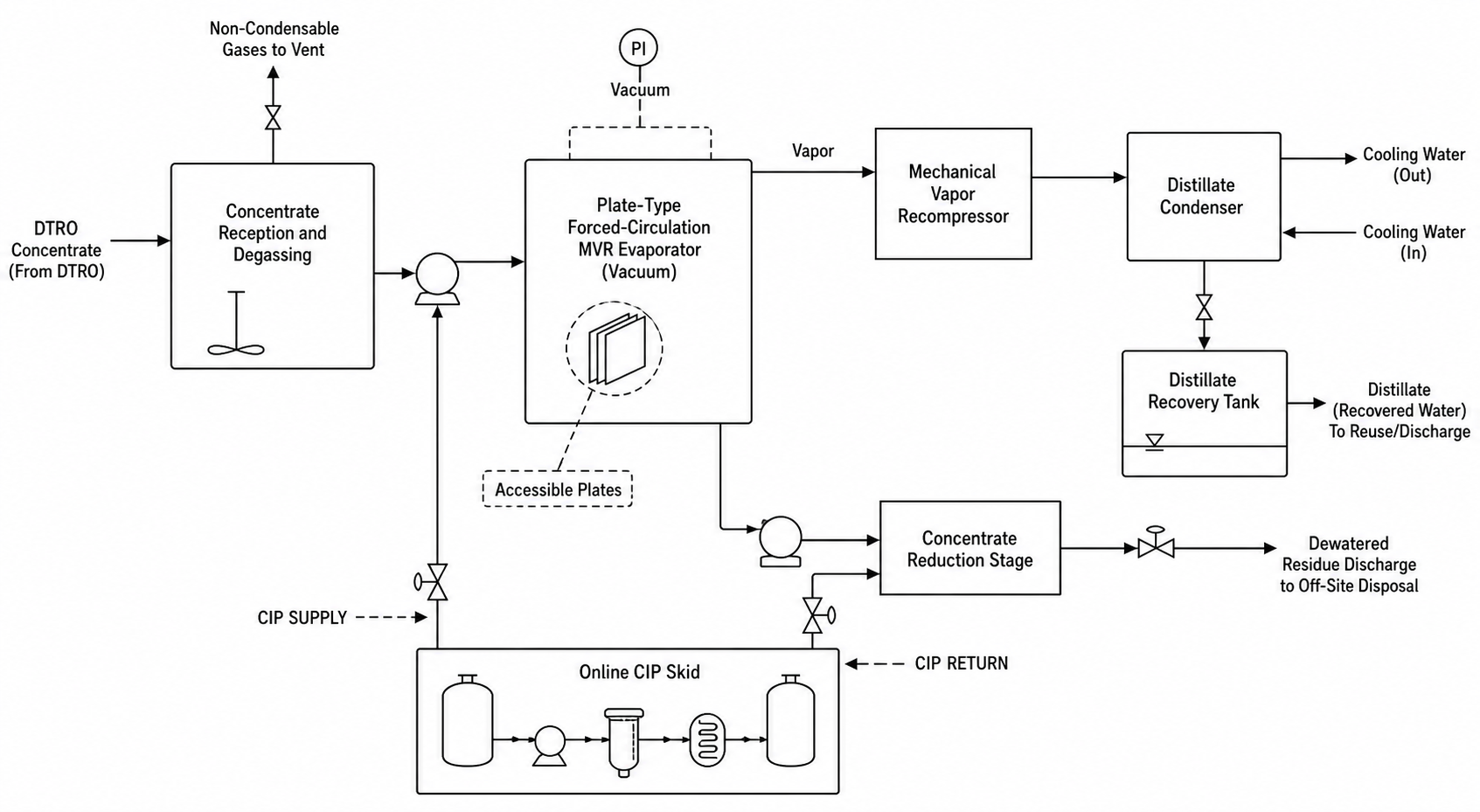
The concentrate feeds the integrated unit’s reception and degassing stages, then enters plate-type forced-circulation evaporation under MVR drive. The plate heat exchanger is the anti-fouling choice twice over: corrugated plate geometry sustains turbulence at low temperature difference, and the plates are mechanically cleanable in a way welded tube bundles are not — when scale demands the manual cleaning the design provides, the surfaces come back to as-new condition rather than carrying a permanent fouling penalty forward.
Forced circulation carries the liquor: pumped velocity through the plate pack keeps the scaling-prone concentrate moving past the heat transfer surface, suppressing wall supersaturation where crystal nucleation begins. Low-temperature negative-pressure operation holds the boiling point down — the vacuum side of the design — which slows the scaling kinetics that accelerate with temperature and keeps the volatile organics of leachate inside the condensate-treatment envelope rather than flashing them loose.
The MVR compressor closes the energy loop: secondary vapor recompressed to heating duty, electricity the marginal input, no steam supply at a landfill site that has none. Distillate condenses as the unit’s water product — the volume that once left by tanker as concentrate now leaves as clean water — and the concentrate reduces step by step toward a dewatered residue for disposal, the zero-concentrate-discharge pattern now standard for leachate projects.
The operating regime the published project describes — online cleaning in service, manual cleaning between campaigns, full design-value restoration — is what makes small leachate MVR units economically survivable: the machine’s availability between cleans, and its youthfulness after them, decide the treatment cost per tonne.
Equipment Configuration
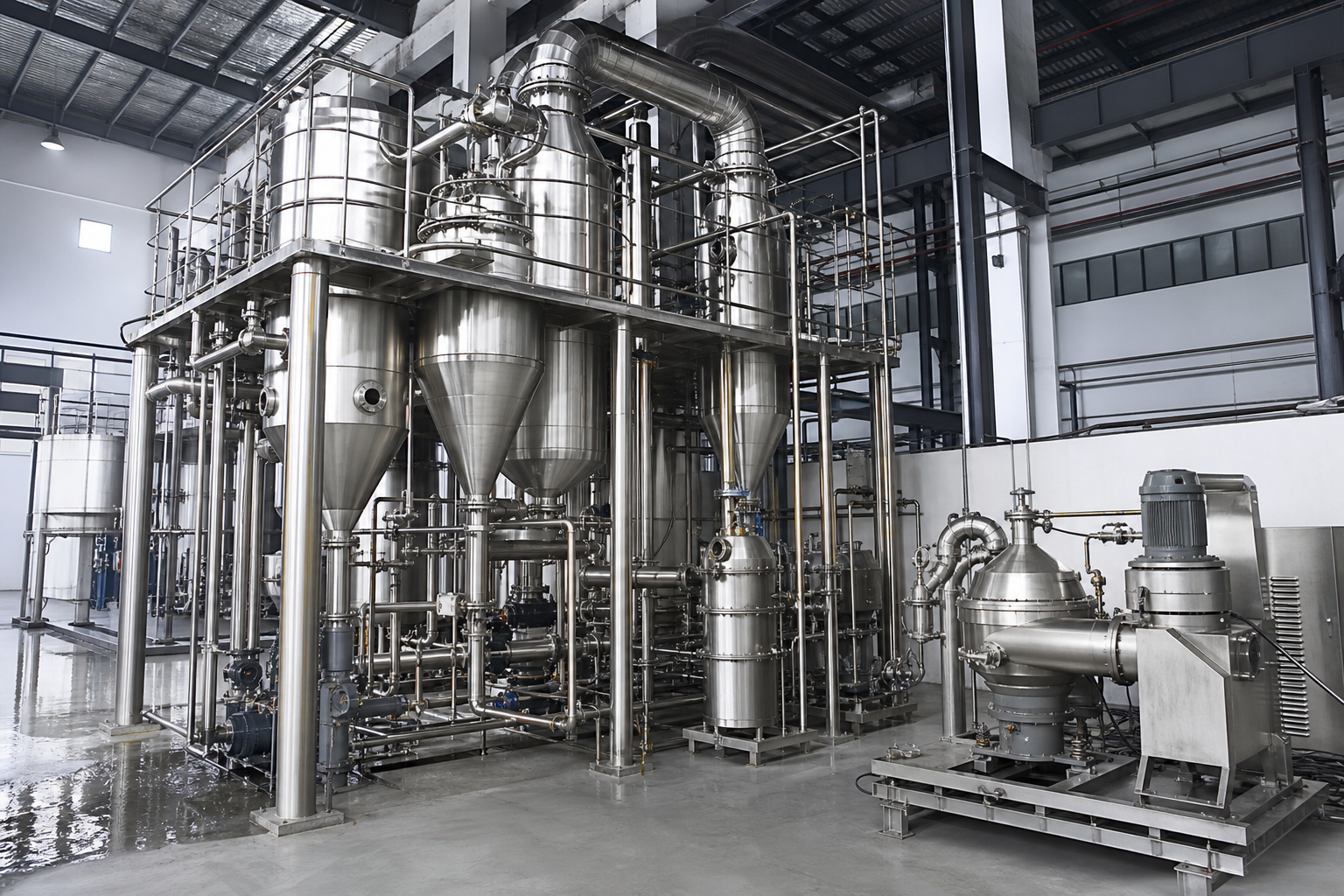
One set of the following equipment is typical for this duty:
- DTRO concentrate reception and degassing
- Plate-type forced-circulation MVR evaporator under low-temperature vacuum
- Mechanical vapor recompressor and condensate/distillate recovery
- Online CIP system plus accessible plates for manual cleaning
- Concentrate reduction and dewatered residue disposal
- Integrated PLC control; SS316L / duplex wetted parts for chloride service
Performance & Outcome
Compiled from published industry project data: 3 t/h evaporation of leachate DTRO concentrate on low-temperature plate MVR forced circulation, with strong anti-scaling service, online and manual cleaning, and published 100% restoration of design values after maintenance. Distillate quality and cleaning frequency are quoted per project concentrate.


