
Project Parameters
| Parameter | Value |
|---|---|
| Process route | Three-effect forced-circulation evaporation + crystallization (OSLO/DTB class) |
| Industry | Inorganic chemicals — potassium salt production from process brine |
| Feed type & key components | Potassium chloride-bearing brine; crystallizing salt with hardness-driven scaling tendency |
| Evaporation capacity | 5 t/h |
| Steam economy (published class) | 0.3–0.5 t steam per tonne of water vs approx. 1.2 t single-effect |
| Construction materials | SS316L or titanium per chloride service (indicative) |
Representative process configuration compiled from published industry project data. Indicative values, not a process guarantee.
Project Description
Potassium chloride is a commodity with a crystallization problem attached: it crystallizes readily from brine — which is why it is produced by evaporation at every scale from brine field to chlor-alkali complex — and it crystallizes on heat transfer surfaces just as readily if the flowsheet lets it. The reference configuration is a 5 t/h three-effect forced-circulation train for KCl recovery from chemical-process brine: the steam-economical, scale-defending configuration that has become the default answer for crystallizing chloride salts where site steam is available.
The selection logic is a three-way trade. Single-effect evaporation is simple and steam-hungry (published: about 1.2 t steam per tonne of water for this service); MVR trades steam for electricity and earns its capital where power is cheap; three-effect forced circulation earns its complexity where steam is already on site — published steam economies of 0.3–0.5 t per tonne, a 60–75% cut against single effect. The customer’s utility map, not fashion, picks the configuration.
Process Technology
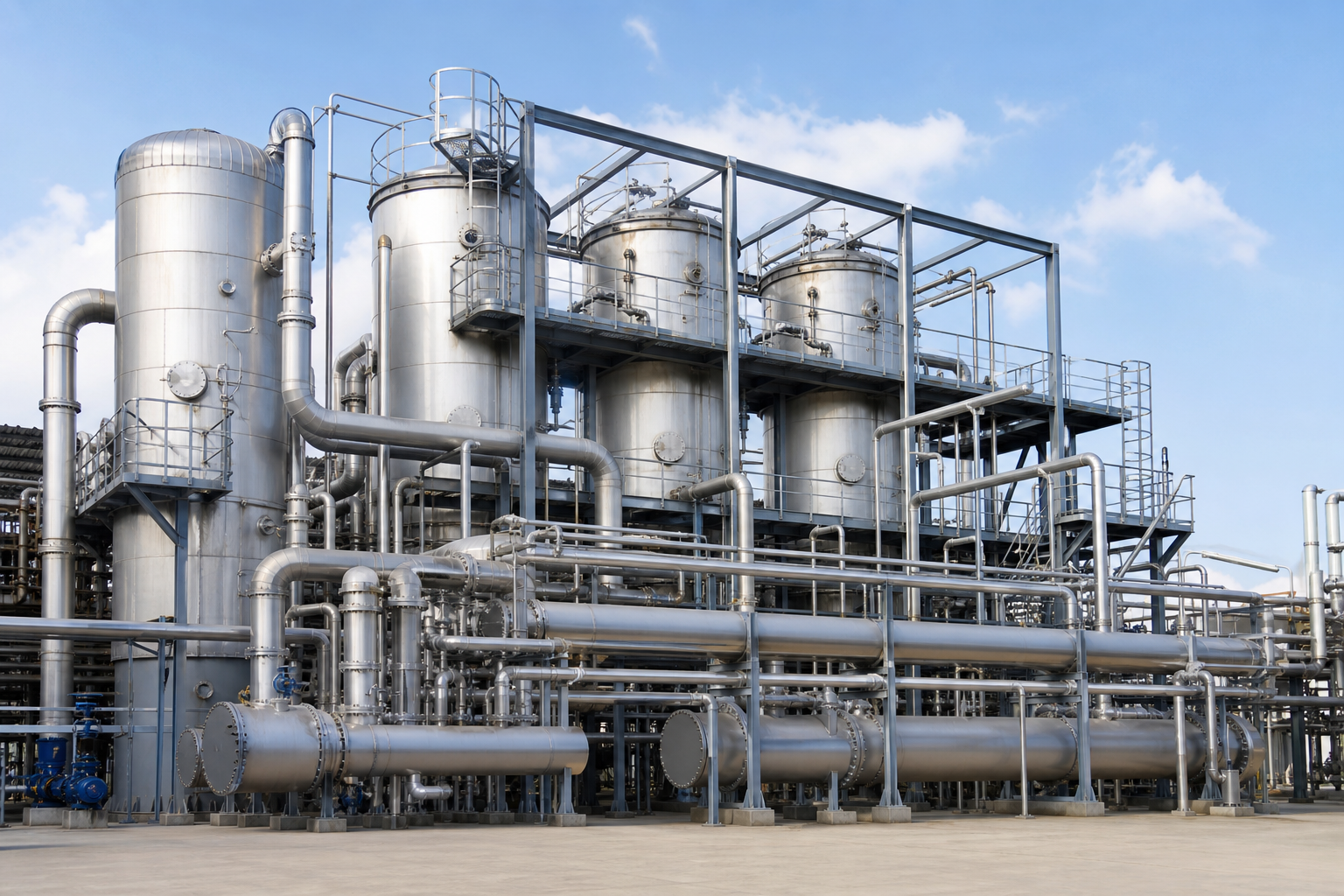
The brine is equalized, filtered and — where hardness is present — softened, because calcium and magnesium are the scaling species a chloride train fights; the pretreatment budget is always smaller than the cleaning budget it prevents. Feed preheating on condensate and vapor heat recovers energy into the incoming liquor.
Evaporation runs across three effects in series: live steam drives the first effect, its vapor drives the second, the second’s vapor drives the third, and the temperature profile steps down through the train under vacuum. Forced circulation carries each effect’s liquor through its heater at published velocities of 2 m/s and above — the pumped scour that keeps crystallizing KCl off the tube wall — and an online cleaning (CIP) provision washes the surfaces on schedule between campaigns.
The crystallization stage sets the product. Concentrated liquor advances to OSLO- or DTB-class crystallizers, whose classified-growth zones grow the uniform KCl crystal that centrifuges cleanly and dries to product specification; fines recycle to the growth zone instead of escaping with the mother liquor. Salt slurry centrifuges and dries into product for sale or reuse; mother liquor returns to the effects with a purge, and condensate from the train is collected clean and hot for the plant’s water systems.
Equipment Configuration

One set of the following equipment is typical for this duty:
- Brine equalization, filtration and hardness control
- Three-effect forced-circulation evaporator train with feed preheating
- OSLO/DTB-class crystallizer with fines recycle and classification
- Centrifuge and dryer for product KCl
- CIP provision for online surface cleaning
- PLC/DCS control of effect profile, circulation velocity and crystal inventory
Performance & Outcome
Compiled from published industry project data, indicative: three-effect trains of this class evaporate at 0.3–0.5 t steam per tonne (published), recover KCl as product-grade crystal with mother-liquor recycle, and deliver clean condensate for reuse. Steam economy and crystal size distribution are quoted per project brine and steam conditions.
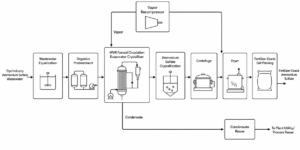
Simplified PFD
The simplified process flow diagram above shows brine pretreatment, the three-effect forced-circulation train, classified crystallization and product finishing.